
Truly Preserved is reader-supported. If you buy through a link on this page we may earn a commission at no extra cost to you. Nobody pays for placement or scores.
THE SHORT ANSWER
For low-acid food, yes — in every way that matters. “Tested” means a process with a measured time and temperature behind it, developed so the coldest spot in the jar gets hot enough, long enough, to kill botulism spores. An untested recipe has no such measurement behind it, so nobody — not the person who wrote it, not the grandmother who swore by it — actually knows what happened inside those jars. The food isn’t automatically poison. It is automatically a gamble, and botulism is the stake.
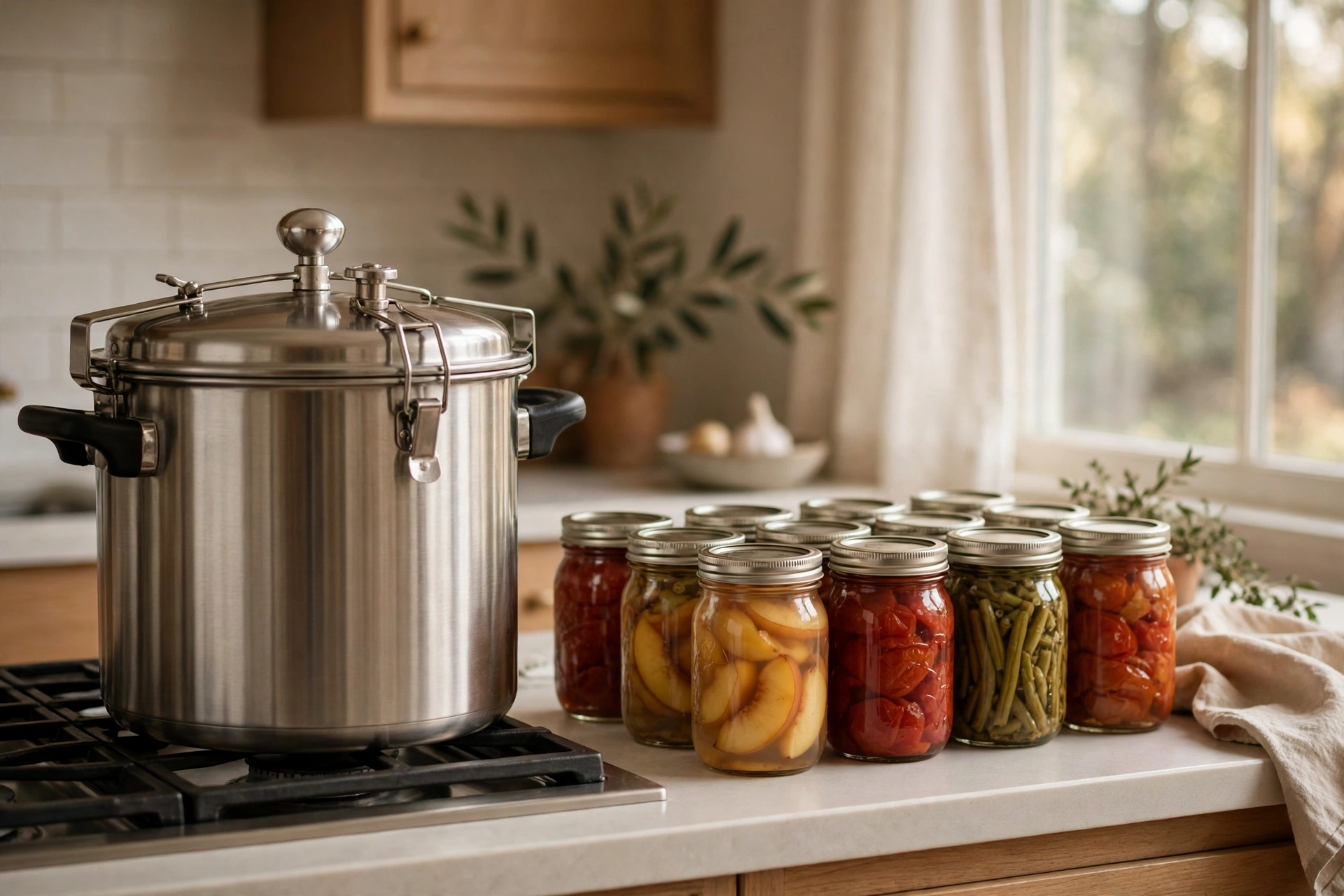
The question shows up in the canning groups in a few forms. A family recipe with no processing time. A video that water-baths green beans “the old way.” A sealed jar from a method nobody can find in any guide. Underneath all of them is the same confusion: the jar sealed, it looks fine, it smells fine — so how unsafe can it be?
The honest answer starts with what “tested” actually means, because the word does real work. A tested process isn’t a recipe someone got away with. It’s a procedure where researchers put temperature sensors in the cold spot of the jar, in the cold spot of the canner, and measured exactly how long it takes lethal heat to reach the last surviving spore. That measurement — not tradition, not a sealed lid — is the entire product.
The One Number That Draws the Line: pH 4.6
Every canning rule hangs on a single measurement. Foods at pH 4.6 or below — fruits, pickles, jams, properly acidified tomatoes — are acidic enough that botulism spores cannot grow in them, so boiling water at 212°F is a sufficient process. Foods above pH 4.6 — every vegetable, meat, soup, and bean — are low-acid, and in that environment the spores can grow and produce toxin. Boiling water cannot kill the spores themselves: they survive 212°F for hours. Destroying them takes 240–250°F, which water only reaches under pressure. That’s not a preference in the guides; it’s the physics of the spore, and it’s why our water bath vs pressure canner answer treats the two pots as different tools for different foods, not rivals.
So “untested” splits in two. An untested tweak to an acid food — a different spice blend in a tested pickle recipe — stays inside the safety system, because the acid is doing the protecting. An untested process for a low-acid food steps outside the system entirely: nothing in the jar is holding the line except a time and temperature nobody measured.

Presto 23-Quart Pressure Canner
The only home equipment that reaches the 240–250°F low-acid food requires — dial gauge, holds 7 quarts / 20 pints, and doubles as a boiling-water canner for acid foods.
Check Availability
Ball Regular Mouth Lids (96-count)
A tested process assumes a new flat lid on every jar — the gasket compound flows to seal once. A 96-count box keeps "just reuse last year's" from ever becoming the plan.
$36.99 from Amazon“But It Sealed” Is Not a Safety Test
A popping lid tells you a vacuum formed as the food cooled. It says nothing about what temperature the center of the jar reached, or for how long. Botulism toxin adds no help either: it produces no smell, no taste, no bulge anyone can rely on, in food that looks and spoons up completely normal. The USDA’s position is not ambiguous, and the National Center for Home Food Preservation repeats it in every publication: use only tested recipes from reliable sources, processed for the full tested time, adjusted for altitude. The canning section’s did I ruin it? answer works the same sources for the jars already on your shelf — which seal failures and siphoning are survivable, and which jars get discarded without a taste.
What To Do With Jars You’re Not Sure About
If a jar on your shelf came from a process you can’t trace to a tested source, the guidance is plain: don’t taste it to check. For low-acid food processed by an untested method, the jar is discarded — the toxin risk is not one you can inspect your way out of. If the food is still within 24 hours of an under-processed run, tested guidance allows reprocessing with a new lid and the full correct process; past that window, the answer is the discard, and the lesson goes on the shelf label of everything you can from now on: recipe source, date, process, time.

Thrive Life: Freeze-Dried Blueberries - Pantry Can Size
Freeze-dried food by the can, no machine: the same long-life ingredients the kits are built from, bought a can at a time.
$60.00 from Amazon
ThermoPro TP49 Hygrometer
The ten-year verdict depends on the temperature the food actually lived at — a min/max hygrometer in the storage room replaces guessing with the number.
$8.54 from Amazon
Follow-Up Questions
My grandmother canned it this way for 50 years. Was she just lucky?
Partly luck, partly arithmetic she never saw. Botulism is rare — most jars of anything are fine — so a risky method can produce decades of fine jars and still be a risky method. The tested process exists so the outcome doesn’t depend on which jar happened to carry spores.
Is a recipe from a canning group “tested” if hundreds of people use it?
No. Popularity is not a temperature measurement. A tested recipe names its source — the USDA Complete Guide, NCHFP, a university extension service, or a lid maker’s current lab-tested booklet — and its times trace back to cold-spot heat-penetration work.
What about recipes from other countries, or very old cookbooks?
Treat them the same way: a recipe is only as good as the testing behind it. Older guidance predates modern spore research and today’s lower-acid tomato varieties, which is why the current guides supersede it rather than grandfather it in.
Viewers also searched for these items.

Morton Canning and Pickling Salt, 4 lb
The pure salt three of the ten categories are written around.
$2.68 from Amazon
Mrs. Wages Pickling and Canning Salt
The resealable-pouch version of the same additive-free rule.
$19.32 from Amazon
Millennium Energy Bars (SOS Food Lab)
Nine real flavors and the only bar here people call genuinely good. Single 400-calorie bars made for go-bags and school kits.
$19.99 from AmazonFrequently Asked Questions
Can I make an untested jar safe by boiling the food before serving?
Boiling home-canned low-acid food for 10 minutes before serving is a long-standing extra precaution against toxin — it is not a substitute for a tested process, and it is not a rescue the current guides offer for food canned by an unknown method. The process is the safety step.
Does freezing untested canned food make it safe?
No. Freezing pauses bacteria; it doesn’t destroy botulism toxin or spores. The jar’s problem was made in the canner, and only the canner could have fixed it.
Where do I check whether a recipe is tested?
The two sources behind every answer on this page: the USDA Complete Guide to Home Canning (PDF) and the National Center for Home Food Preservation. If a recipe’s method and time appear there, it’s tested. If they appear nowhere, it isn’t.
All method and safety calls per the USDA Complete Guide to Home Canning and the National Center for Home Food Preservation.
This question came from our harvest of what readers ask in the forums. See the rest of the list: What People Are Asking About Canning.
Prices shown on this page were last checked November 26, 2026 — prices change; check before you buy.
Talk it over with other readers
The Truly Preserved Community on Facebook is where readers compare notes on food storage, water, and backup power — and where your questions help decide what we research next.