
Affiliate Disclosure: Truly Preserved is reader-supported. When you buy through links on this page, we may earn a commission at no extra cost to you. As an Amazon Associate, Truly Preserved earns from qualifying purchases. Read our full affiliate disclosure.
Last updated: October 30, 2026
THE SHORT ANSWER
Most “did I ruin it?” jars are not ruined. Liquid lost during processing (siphoning) is, in the National Center for Home Food Preservation’s own words, “not a sign of spoilage” — a sealed jar that lost liquid is kept, never opened to top it up. A jar that failed to seal is a clock, not a loss: reprocess it within 24 hours with a new lid and the full processing time, or refrigerate it and eat it within several days. The hard discards are different, and they are not judgment calls: bulging or spurting lids, mold, off odors, or any low-acid food that was processed the wrong way — those get thrown out, without tasting, every time.
This is the question behind the biggest canning threads on the internet: seven quarts of chili with two lids blown off mid-run (144 comments), a jar that lost half its water and sealed anyway (the poster asking “is it still safe or should I get rid of it?”), jars sitting lower than they were filled, sticky jars, too much headspace. Everyone is asking the same thing in different words: did I ruin it, and is it still safe? Below is the decision path, built symptom by symptom from the USDA Complete Guide to Home Canning (Guide 1, Principles of Home Canning) and NCHFP’s published problem tables. Where the guidance gives a keep, we say keep. Where it gives a discard, there is no debate section.
First: test the seal before you judge anything
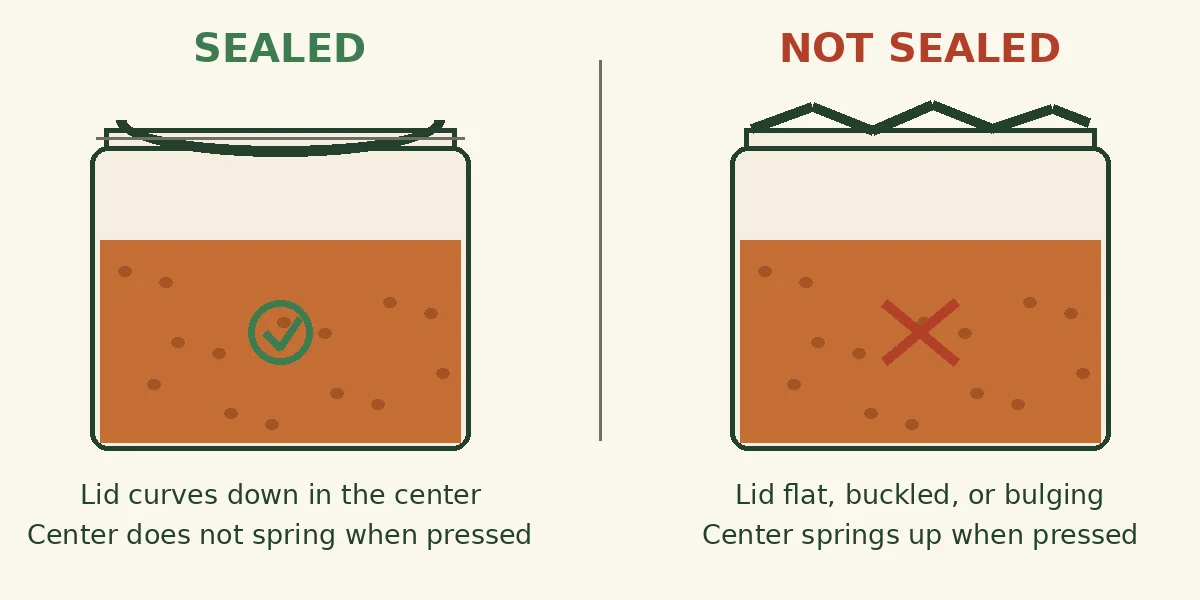
Half of these panics get judged too early, on jars that have not finished cooling. The USDA Guide’s sequence is: let jars cool undisturbed at room temperature for 12 to 24 hours, do not retighten lids (retightening hot lids may cut through the gasket and cause the very failure you are worried about), then remove the screw bands and test each seal one of three ways — press the center of the lid (it should not spring up), tap it with a spoon (a sealed jar rings high-pitched; a dull sound means unsealed, or food touching the lid), or look across the lid at eye level (sealed is concave, curved down slightly in the center; flat or bulging is not sealed). Every call below starts from that test.
The decision table
| What you see | Likely cause | The call |
|---|---|---|
| Liquid level dropped; jar sealed | Siphoning during processing | Keep — do not open |
| Jar did not seal (checked at 12–24 hrs) | Food on rim, nicked jar, bad band, wrong tightness | Reprocess within 24 hrs, or refrigerate |
| Headspace looks too big after cooling | Air exhausted, food shrank — normal in raw packs | Keep if sealed |
| Food dark at the top of the jar | Air left in jar; food above the liquid | Keep — quality loss only |
| Lid bulging, jar leaking, liquid spurting | Spoilage gas | Discard — do not taste |
| Mold, off odor, rising bubbles, strange color | Spoilage | Discard — do not taste |
| Low-acid food water-bathed or unprocessed | Wrong method — no tested process was followed | Discard — sealed or not |
The reasoning for each row, in the USDA and NCHFP’s own terms, is below the table — because the table tells you what to do, and the prose tells you why, and with canning you deserve both before you feed anybody.
Siphoning: the jar lost liquid, and it sealed anyway
Siphoning is liquid being pushed out of the jar during processing. NCHFP’s table — “Causes and Possible Solutions for Problems with Canned Food,” adapted from So Easy to Preserve — lists eight causes for loss of liquid: pressure in the canner lowered suddenly after processing; pressure fluctuating during processing; air bubbles not worked out of the jars before processing; an imperfect seal; ring bands not tight enough; jars not covered with water in a boiling-water canner (they need 1 to 2 inches over the tops, the whole process); starchy foods absorbing liquid (dried beans must be fully rehydrated first; use hot pack for other starchy foods); and food packed too tightly, which boils over — the fix for that one is leaving the appropriate headspace.
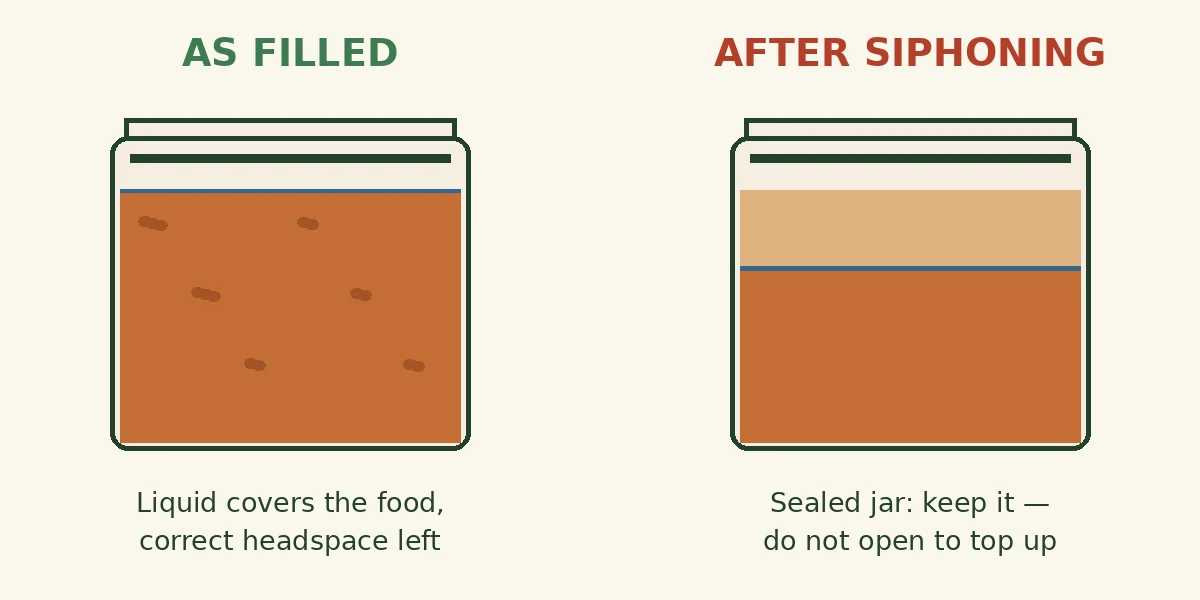
The call, in the table’s own heading: “Loss of liquid from glass jars during processing. Do not open to replace liquid. (Not a sign of spoilage.)” The USDA Guide’s cooling section says the same thing from the other side: if a jar loses excessive liquid during processing, do not open it to add more liquid. A sealed, properly processed jar that siphoned is a good jar with less liquid in it. The real cost is quality, not safety — food left above the liquid line can darken in storage, which NCHFP lists as “not necessarily a sign of spoilage,” caused by air left in the jar and food not fully covered.
One more normal sight that scares first-timers: raw-packed jars sit noticeably lower after cooling even without siphoning. The Guide expects it — air is exhausted during processing and food shrinks. Low fill after cooling is not, by itself, a failure.
The jar did not seal: the 24-hour window
NCHFP’s imperfect-seal row lists the usual suspects: chips or cracks in the jar’s sealing surface (find them by rubbing a fingertip around the mouth of the jar), lids not prepared per the manufacturer’s directions, particles left on the rim, bad ring bands, bands applied too loose or too tight, fat on the rim — and inverting jars after processing or lifting them by their tops while hot, both of which break seals that were forming.
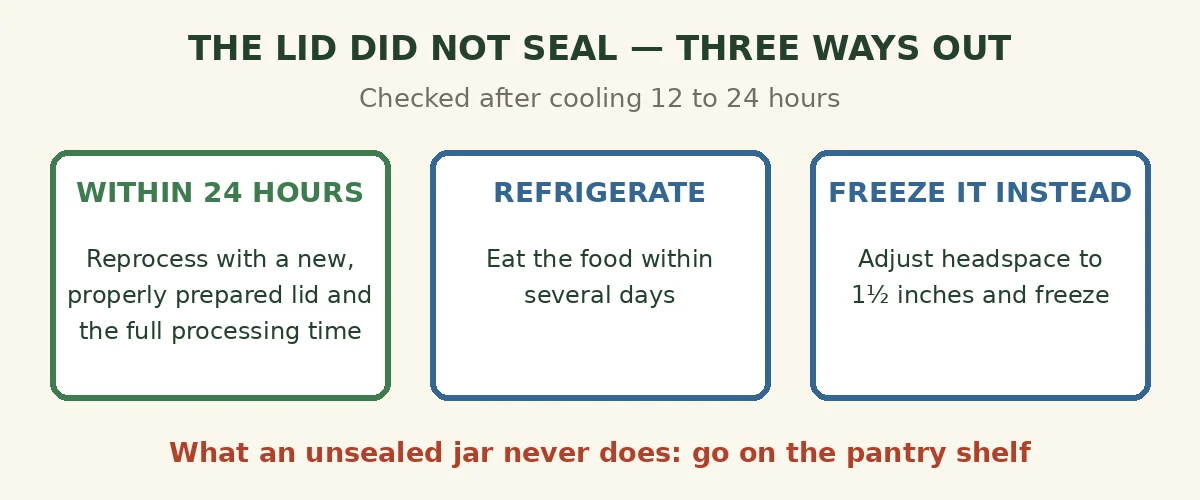
The USDA Guide’s answer is a window, not a shrug: “If a lid fails to seal on a jar, remove the lid and check the jar-sealing surface for tiny nicks. If necessary, change the jar, add a new, properly prepared lid, and reprocess within 24 hours using the same processing time.” Same food, same full process time, new lid, inside 24 hours of the original run. Two honest qualifications from NCHFP’s own FAQ on reprocessing: reprocessing is not recommended, because of the loss of quality — the food gets cooked twice — and the 24-hour reprocess only produces a safe product if your first attempt followed an up-to-date, research-tested recipe. If it did not, that FAQ is blunt: all the jars, sealed or unsealed, may be unsafe and should be discarded.
Past the window, or instead of reprocessing: the Guide says foods in single unsealed jars can be stored in the refrigerator and consumed within several days. Freezing is the third option — the Guide notes headspace in unsealed jars may be adjusted to 1½ inches and the jars frozen instead of reprocessed. What an unsealed jar never does is go on the pantry shelf and get judged later.
Headspace: the error that causes the other two
Headspace — the unfilled space between the food and the lid — is where siphoning and seal failure are usually born. The USDA Guide’s specified headspaces are short enough to memorize: ¼ inch for jams and jellies, ½ inch for fruits and tomatoes processed in boiling water, and 1 to 1¼ inches for low-acid foods processed in a pressure canner. The space exists for two jobs: food expands as jars are processed, and a vacuum has to form as they cool.
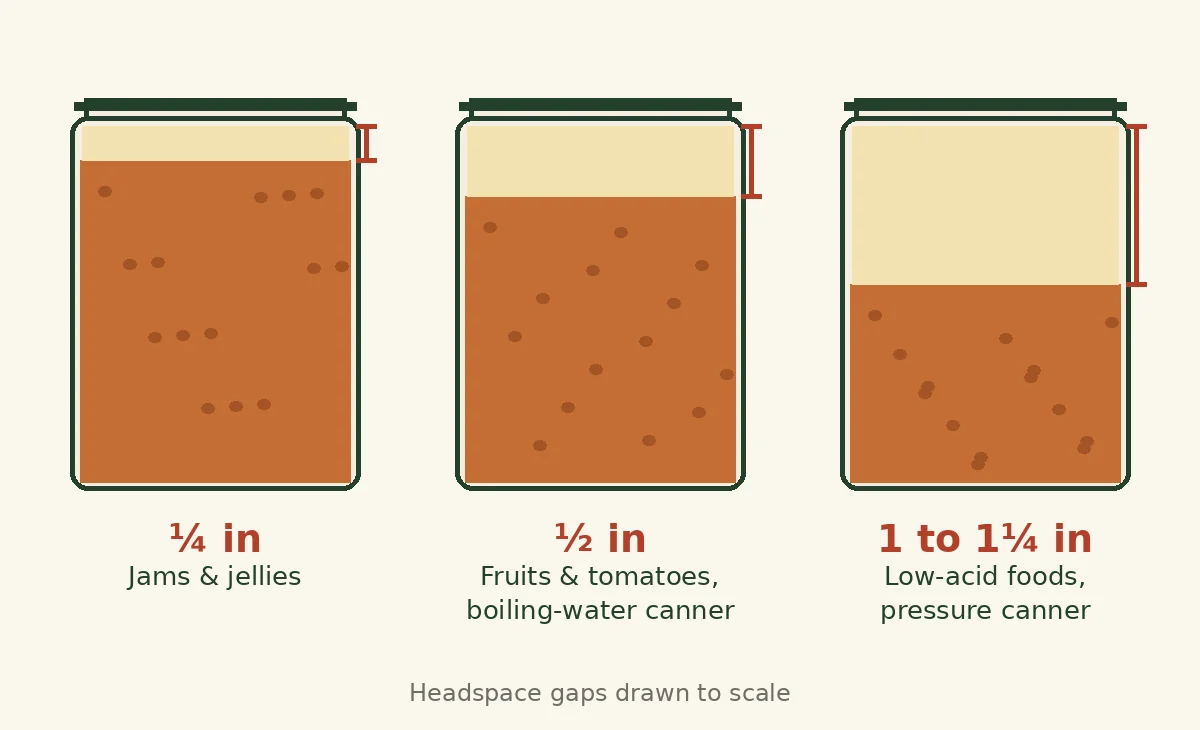
Too little headspace and the expanding food has nowhere to go but out — under the lid, across the sealing surface, taking liquid with it. That is siphoning with a food film on the rim, which is how a jar that “almost sealed” fails in storage. Too much headspace and the jar keeps too much air: the vacuum forms weaker, the food at the top oxidizes and darkens, and quality drains away over the storage year. Neither error is fixed after the fact. Both are prevented in the ten seconds with the headspace tool before the lid goes on — and if a sealed jar comes out of storage with more headspace than you left, that gap grew because liquid left or gas formed, which puts it back in the table above, not in this paragraph.
The hard discards: no decision to make
From Guide 1, “Identifying and handling spoiled canned food”: do not taste food from a jar with an unsealed lid or food that shows signs of spoilage. The signs, as the Guide lists them: a lid that has lost its tight vacuum (spoilage bacteria and yeast produce gas, which pressurizes the food, swells lids, and breaks seals), streaks of dried food running down the outside of the jar from the top, rising air bubbles and unnatural color in the contents, and on opening — spurting liquid, unnatural odors, and cotton-like mold growth on the food surface or the underside of the lid.
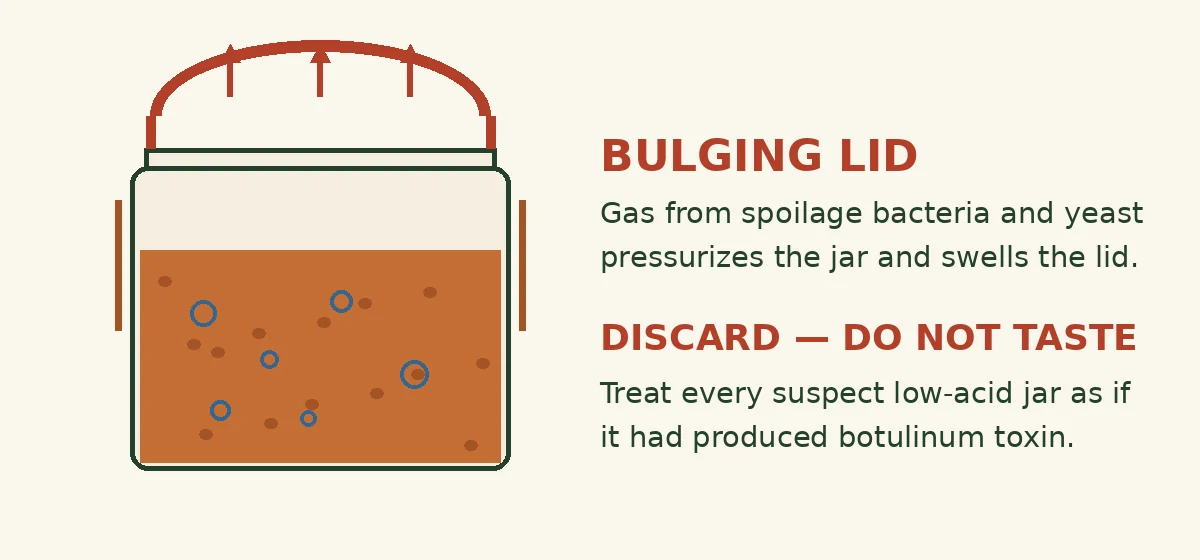
The rule that outranks every other row on this page: spoiled low-acid foods, including tomatoes, may show different spoilage evidence — or very little evidence. So every suspect container of low-acid food is treated as having produced botulinum toxin. Still sealed? It goes in a heavy garbage bag, into the trash or a landfill, unopened. Unsealed, open, or leaking? It gets detoxified before disposal: gloves on, containers and lids on their sides in a large pot, covered with water by at least an inch, boiled 30 minutes, then cooled and discarded. Our general stored-food page covers the same discard discipline for the rest of the pantry: how to tell if stored food has gone bad.
And the case this page cannot soften: low-acid food — green beans, corn, meat, chili, vegetable soup — that was processed in a boiling-water canner, or flipped upside down to seal, or simply filled hot and left, was never processed by a tested method at all. A popping lid is not a process. The Guide’s improperly-canned rule applies to the whole batch, sealed jars included: discard. The why is on the hub page, and it is not negotiable: what people are asking about canning.
Where this comes from
USDA Complete Guide to Home Canning (2015 revision), Guide 1 — Principles of Home Canning: “Cooling jars,” “Testing jar seals,” “Reprocessing unsealed jars,” “Controlling headspace,” and “Identifying and handling spoiled canned food.” NCHFP: Causes and Possible Solutions for Problems with Canned Food (loss of liquid, imperfect seal, cloudy liquid, dark product tables), Identifying and Handling Spoiled Canned Food, and the NCHFP newsflash “May canned food be reprocessed if the lid does not seal?” Every keep and discard call above traces to one of those pages. If your situation is not on this page, the answer is not to improvise — it is to check the NCHFP table for your symptom.
Questions people also ask
My jar sealed but lost a lot of liquid. Should I get rid of it?
No — not for the liquid loss alone. NCHFP’s table calls loss of liquid “not a sign of spoilage” and says do not open the jar to replace it. If the jar was processed by a tested recipe for the full time and the seal holds, keep it. Expect the food above the liquid line to darken over storage; that is a quality change, not spoilage.
The lids popped when I flipped the hot jars upside down. Am I done?
No. A lid popping from hot food and cooling is a vacuum forming — it is not processing, and it destroys nothing. NCHFP lists inverting jars as a cause of imperfect seals, and the USDA’s tested methods are a boiling-water canner for acid foods and a pressure canner for low-acid foods, full stop. Hot-filled, flipped jars of anything need to be reprocessed properly right away if the food and recipe allow it — and low-acid food done this way should be discarded, because no tested process ever touched it.
I left the jars sitting in the canner overnight. Are they ruined?
The guidance gives you no rescue for this one, and we will not invent one. The USDA sequence is remove the jars after processing, cool them undisturbed 12 to 24 hours, then test seals — jars left sitting warm for hours sat in the temperature range where spoilage organisms grow, in food whose process ended when the heat did. Treat unsealed or suspect jars by the discard rules above; for low-acid food, treat the batch as suspect. When in doubt, the Guide’s spoiled-food rule is the tiebreaker: do not taste it to decide.
Can I just put a new lid on an unsealed jar and run it again tomorrow?
Only inside the window: reprocessing must happen within 24 hours, with a new, properly prepared lid, a checked (or changed) jar, and the same full processing time — and only if the first run followed a tested recipe. After 24 hours the options are the refrigerator (eat within several days) or the freezer, not the canner.
Related questions
- Why do old canning jars still look cloudy after washing?
- How many jars and lids do I need for 50 pounds of produce?
- How do I tell if stored food has gone bad?
This question sits in What People Are Asking About Canning — the full list of canning questions from real groups and forums, each answered from USDA and NCHFP guidance.
Talk it over with other readers
The Truly Preserved Community on Facebook is where readers compare notes on food storage, water, and backup power — and where your questions help decide what we research next.