
Affiliate Disclosure: Truly Preserved is reader-supported. When you buy through links on this page, we may earn a commission at no extra cost to you. As an Amazon Associate, Truly Preserved earns from qualifying purchases. Read our full affiliate disclosure.
Last updated: November 1, 2026
THE SHORT ANSWER
It depends on the food, and the USDA publishes the numbers: about 1 pound of cranberries fills a quart jar, green beans take 2 pounds per quart, peaches 2½ pounds, and sliced apples and crushed tomatoes about 2¾ pounds. So 50 pounds of produce becomes roughly 50 quarts of cranberries, 25 quarts of green beans, 20 quarts of peaches, or about 18 quarts of apples or tomatoes — and every one of those quarts needs its own jar and its own brand-new flat lid. Count lids by the jar, never by the box you hope is in the drawer.
The thread behind this page: “What to do with 50 pounds of cranberry pulp” — 84 comments of people doing yield math from memory and landing in five different places. Yield math is not a memory game. The USDA Complete Guide to Home Canning prints a quantity line at the top of every tested recipe — pounds per canner load, pounds per quart — and the standard approximate-yields table that Extension services republish carries the rest. This page does the arithmetic for the five foods our readers asked about most, at the 50-pound glut size, and says plainly where each number came from. If a food is not in the USDA tables, it is not in this chart; we do not estimate yields.
Pounds of produce that fill one quart jar
The produce weights in the USDA Complete Guide lines quoted in the short answer above — the input to every jar count on this page.
The yield table: pounds in, jars out
| Food | Pounds per quart | Quarts from 50 lb | Pints from 50 lb |
|---|---|---|---|
| Cranberries | 1 | ~50 | ~100 |
| Green beans (snap) | 2 | 25 | 50 |
| Peaches, halved or sliced | 2½ | 20 | ~41 |
| Apples, sliced | 2¾ | ~18 | ~37 |
| Tomatoes, crushed | 2¾ | ~18 | ~32 |
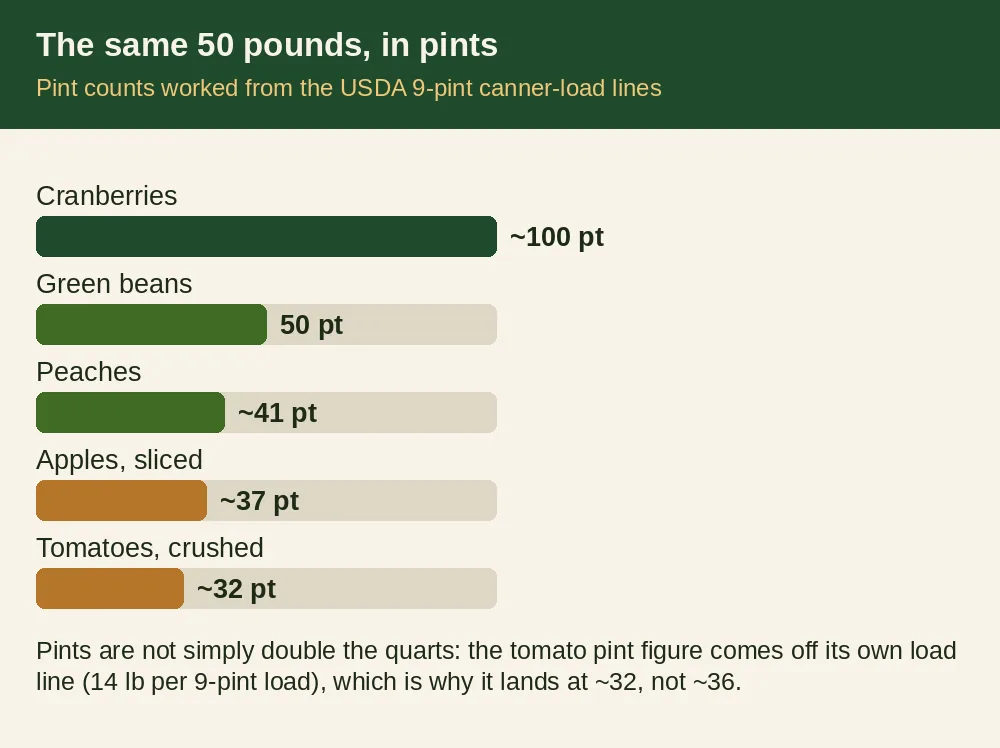
Where each row comes from, because a yield table you cannot trace is just another comment thread. Green beans, peaches, apples, and tomatoes are the USDA Guide’s own quantity lines: snap beans average 2 pounds per quart (a 30-pound bushel yields 12 to 20 quarts, Guide 4); peaches average 2½ pounds per quart (a 48-pound bushel yields 16 to 24 quarts, Guide 2); sliced apples average 2¾ pounds per quart (a 48-pound bushel yields 16 to 19 quarts, Guide 2); crushed tomatoes average 2¾ pounds per quart (a 53-pound bushel yields 17 to 20 quarts, Guide 3). The pint figures for those four are worked from the same quantity lines — the Guide gives pounds per 9-pint canner load (beans 9 lb, peaches 11 lb, apples 12¼ lb, crushed tomatoes 14 lb) — divided into 50 pounds and rounded down to whole jars. Cranberries are not in the Guide’s per-recipe quantity lines, so their row comes from the approximate-yields table for canned fruits that Extension services republish from the USDA figures (Clemson Extension’s HGIC 3000 carries it): a 100-pound bushel of cranberries fills 100 quart jars — 1 pound per quart — and the pint figure is that quart count by volume. The “~” marks are honest: yields move with ripeness, trim, and how a jar is packed, which is why the Guide itself prints ranges for bushel yields.
Quarts of finished jars from 50 pounds of produce
Worked from the USDA quantity lines and the Extension approximate-yields table, October 2026. More jars is not better — it is just how far the food stretches.
The cranberry bar is the story of the original thread. Fifty pounds of a one-pound-per-quart fruit is not a weekend project — it is fifty quart jars, fifty new lids, and, at seven quarts to a standard canner load, eight canner loads. The poster’s actual question was what to do with pulp left from making juice, and the yield table answers that too, backwards: juice first is how you shrink the pile. NCHFP’s own juice-extraction figure (from its mixed-fruit jelly directions) is about 2 cups of cranberry juice per pound of berries, simmered with an equal measure of water and strained — so 50 pounds of cranberries is roughly 25 quarts of juice in the pot, before sweetening, and a much smaller pile of pulp to deal with after. One caution that is not optional, from Penn State Extension’s cranberry-juice guidance: the social-media method of packing raw berries and dry sugar into jars and topping with water is not a tested process — the berry-to-water ratio decides the acidity, and too few berries can leave the juice not acid enough to keep botulism from growing. Extract the juice first, the tested way, then can the juice.
Lids and loads: the two counts people run out of
Lids. The USDA Guide’s system is one new flat lid per jar, every run — jars and screw bands get reused, flat lids do not. So the lid count is the jar count from the table, plus a margin for the jar that always chips, the lid that always drops gasket-down on the floor, and the batch you reprocess. Fifty quarts of cranberries means fifty-plus lids on hand before the first jar is filled, not forty-eight and optimism. If you are stocking up, Ball regular-mouth lids in the 96-count case are how the math usually gets bought — but count what your table row says, in the mouth size your jars actually are.
Canner loads. Most canners hold seven quart jars at a time (Guide 1, “Recommended canners”), so loads are quarts divided by seven, rounded up: cranberries 8 loads, green beans 4, peaches 3, apples 3, tomatoes 3. That is the number that decides whether this is a Saturday or a weekend, and whether a 50-pound deal at the farm stand is a deal. Pints run nine to a load, which is why a glut you plan to give away often makes more sense in pints.
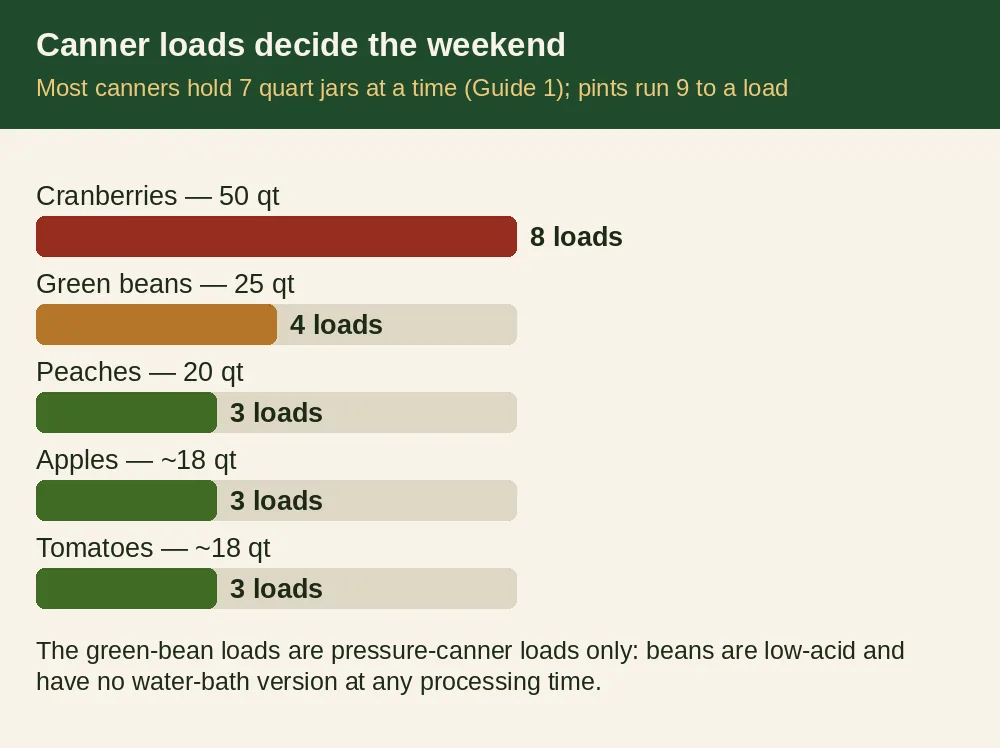
The green-bean row carries a rule, not just a number. Those 25 quarts are pressure-canned quarts. Green beans are a low-acid food; the Guide processes them only in a pressure canner, and there is no water-bath version of this row at any processing time. If all you have is a water-bath canner, the yield table for beans is a freezing table — blanch and freeze them, per NCHFP’s freezing guidance — and the jars stay in the cupboard. The canner-choice page walks through why, with the temperatures.
Before you buy the 50 pounds
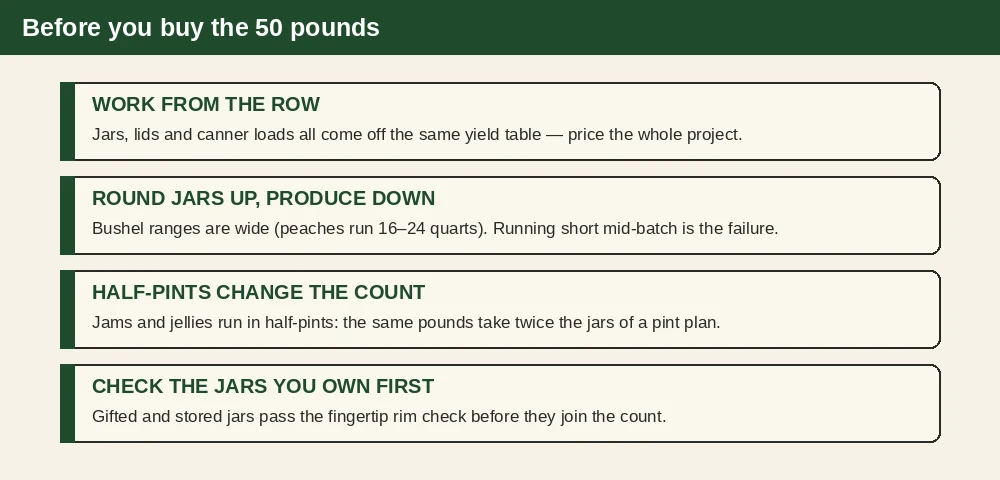
- Work from the row, not the deal. Jars, lids, and canner loads all come off the same table. Price the whole project — 50 lb of cranberries is also 8 loads of stove time.
- Round jars up and produce down. The Guide’s bushel ranges (peaches 16 to 24 quarts from one bushel) are wide because fruit varies. Have more jars and lids than the average says; running short mid-batch is how food sits hot in a pot losing quality.
- Half-pints change the count, not the pounds. Jams, jellies, and chutneys run in half-pints — the Guide’s process times treat half-pints and pints the same — so a jam plan doubles the jar count of a pint plan for the same weight of fruit.
- Check the jars you already own first. Gifted and stored jars need the fingertip rim check before they join the count — our cloudy-jar page has the inspection and the vinegar soak for the mineral film that makes old jars look dirtier than they are.
Where this comes from
USDA Complete Guide to Home Canning (2015 revision): Guide 2 (Fruits and Fruit Products) quantity lines for peaches and sliced apples; Guide 3 (Tomatoes) for crushed tomatoes; Guide 4 (Vegetables) for snap beans; Guide 1, “Recommended canners,” for the seven-quart canner load. Cranberry yield: the Approximate Yields for Canned or Frozen Fruits & Vegetables table (USDA figures as republished by Clemson University Extension, factsheet HGIC 3000). Cranberry juice extraction: NCHFP, Mixed Fruit Jelly directions. Cranberry-juice safety caution: Penn State Extension, “Proper Canning of Cranberry Juice” (updated October 2026). Yields are planning numbers, not safety guidance — the safety guidance is the tested recipe for the food you are canning, and it comes from the same Guides.
Questions people also ask
How many pounds of tomatoes do I need for 7 quarts of sauce?
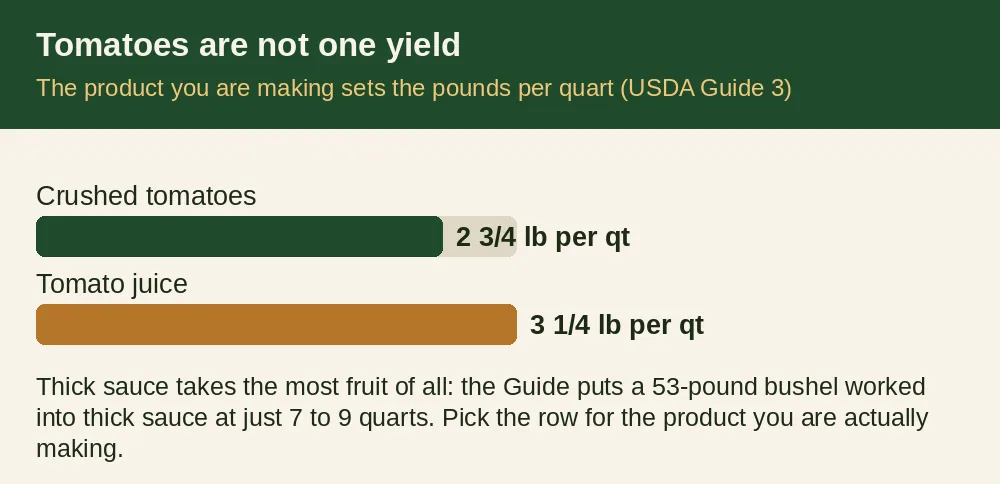
It depends on the product, and the Guide’s quantity lines show why “tomatoes” is not one yield: crushed tomatoes average 2¾ pounds per quart, and the Guide’s own canner-load figure is 22 pounds for a 7-quart load (the Guide prints both figures as-is; its per-load figure is not the per-quart average multiplied by seven); tomato juice averages 3¼ pounds per quart (a 53-pound bushel yields 15 to 18 quarts). Thick sauce takes more — the Guide’s figure for a bushel of tomatoes worked into thick sauce is 7 to 9 quarts from 53 pounds. Pick the row for the product you are actually making.
Why did my 50 pounds come out to fewer jars than the chart?
Because the chart is the Guide’s average, and your fruit is your fruit. The Guide prints bushel yields as ranges — peaches run 16 to 24 quarts a bushel — because ripeness, variety, trim loss, and pack all move the result. Peeling and pitting peaches, coring apples, and stemming beans all subtract weight the chart counted. If you landed inside the Guide’s range, nothing went wrong.
Can I just use pints for everything and skip the quart math?
You can, and the Guide’s pint-load figures are in the table above. Two things to know: process times are set by jar size, and the tested recipe’s table is the one you follow — pints and quarts often carry different times — and half-gallon jars are only for very acid juices, per the Guide. When a recipe offers only one jar size, that size is the recipe.
What do I do with the leftover cranberry pulp after juicing?
The tested routes are the ones NCHFP publishes recipes for — cranberry-orange chutney and spicy cranberry salsa are both in Guide 2 of the USDA Complete Guide, with tested processes. Beyond those, pulp freezes well for baking and sauces. What pulp does not have is a tested plain-purée canning process, so “can the pulp plain” is not on the list — the same density problem that keeps pumpkin purée out of the canner applies to thick purées generally: no tested process, no shelf-stable jar.
Related questions
- Water bath or pressure canner — which should a beginner buy?
- Why do old canning jars still look cloudy after washing?
- Did I ruin it — is my canning still safe?
This question sits in What People Are Asking About Canning — the full list of canning questions from real groups and forums, each answered from USDA and NCHFP guidance.
Talk it over with other readers
The Truly Preserved Community on Facebook is where readers compare notes on food storage, water, and backup power — and where your questions help decide what we research next.