
Affiliate Disclosure: Truly Preserved is reader-supported. When you buy through links on this page, we may earn a commission at no extra cost to you. As an Amazon Associate, Truly Preserved earns from qualifying purchases. Learn more.
THE SHORT ANSWER
Yes — freeze first, then seal. A deep freezer at 0°F for three to four days kills pantry insects at every life stage, eggs included; that’s Utah State Extension’s published cold treatment, and the University of California’s IPM program puts the floor at four days. Then let the bag sit, still sealed, at room temperature for a full day before it goes into mylar, so the cold food doesn’t sweat condensation into your long-term storage.
Here’s the part that surprises people: the bugs are usually already in the bag when you bring it home. A female rice weevil lays her eggs inside individual grain kernels, sealed in where no amount of looking will find them. Sealing that rice in mylar with an oxygen absorber keeps new insects out, but it does nothing certain about the eggs already inside — and a hatch inside a sealed five-gallon bucket is a miserable discovery two years later. Freezing is the kill step that sealing can’t be.
The Method, Step by Step
1. Freeze it as it comes home. The store bag goes straight into the freezer — no need to repackage first. What matters is the temperature: a true 0°F, verified with a freezer thermometer if yours has never been checked. Most chest freezers hold 0°F easily; a fridge freezer compartment that drifts warmer is where half-hearted freezes happen.
2. Give it the full time. Utah State Extension’s cold treatment is three to four days at 0°F for insects, larvae, and eggs. A 24-hour freeze — the version most often repeated in forums — kills adults and leaves the hardiest eggs alive, which is worse than useless because it looks like you handled it. Big bags get extra time: a 25- or 50-pound sack takes most of a day just to reach 0°F in the middle, so give bulk bags a full week.
3. Rest it before you seal it. Cold food pulled into a warm kitchen sweats. Seal that moisture into mylar and you’ve packed the one thing long-term storage can’t tolerate. Leave the frozen bag closed at room temperature for about 24 hours, until it’s fully back to room temperature and dry to the touch, then pack it.
4. Seal it the usual way. Mylar bag, oxygen absorber sized to the bag, hot seal, check the draw-down the next day. Our mylar bags guide covers absorber sizing and the seal check in detail.
How Long, by Food
| Food | Time at 0°F | Note |
|---|---|---|
| Rice and whole grains | 4 days (7 for 25 lb+ bags) | Eggs hide inside kernels |
| Flour, white or whole wheat | 4 days | Spread thin bags flat to chill through |
| Dry beans and pasta | 4 days | Same treatment, same reason |
| Bird seed and dry pet food | 4 days | The overlooked infestation source |
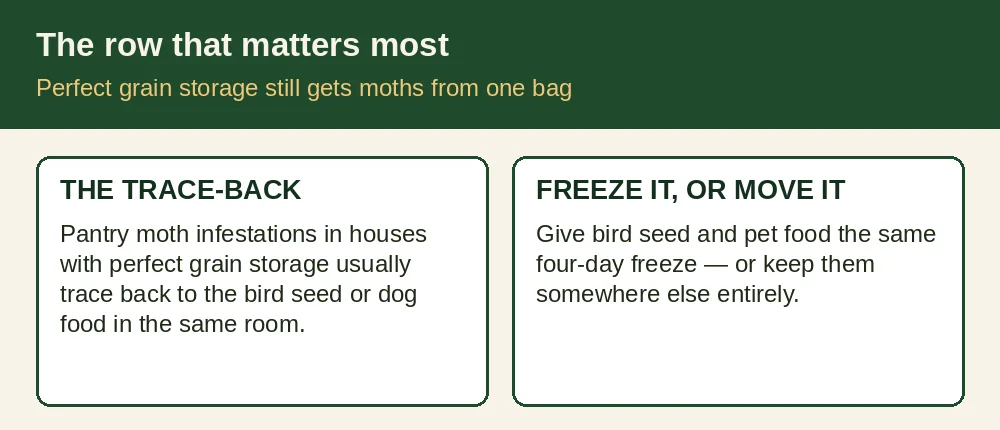
That last row matters more than it looks. Pantry moth infestations in houses with perfect grain storage usually trace back to the bag of bird seed or dog food in the same room — freeze those too, or store them somewhere else entirely.
What Freezing Doesn’t Do
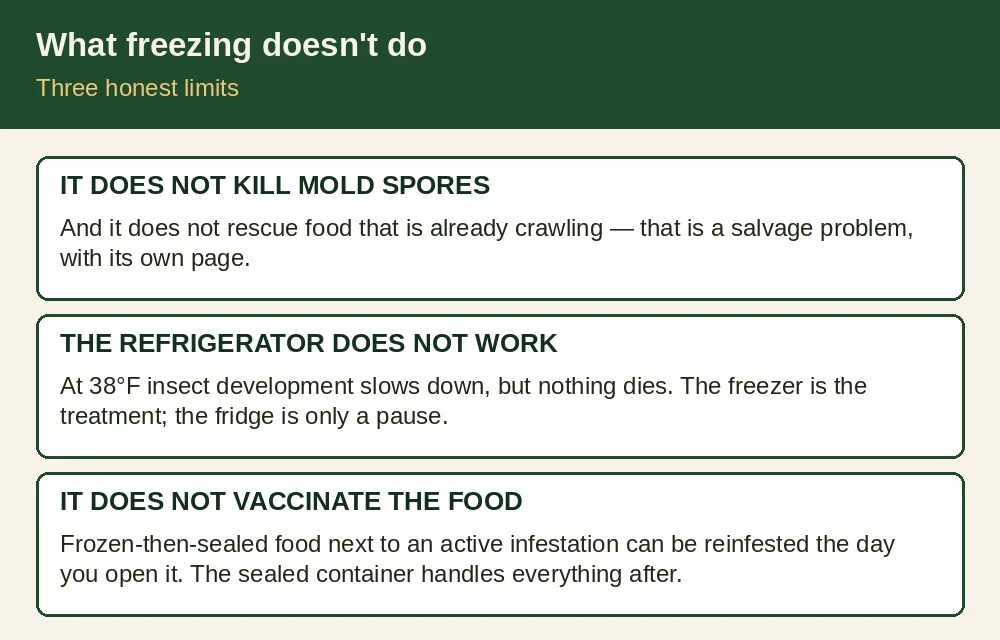
It doesn’t kill mold spores, and it doesn’t rescue food that’s already crawling — that’s a different problem, with its own page: I Found Weevils in My Stored Rice — Now What? It doesn’t work in the refrigerator, either; 38°F slows insect development down but kills nothing. And it doesn’t vaccinate the food. Frozen-then-sealed rice stored next to an active pantry infestation can be reinfested the day you open it — the freezer handles what’s inside the bag, the sealed container handles everything after.
Follow-Up Questions
Do oxygen absorbers kill bugs on their own?
A properly sealed mylar bag with absorbers drops oxygen below what insects need, and it’s a real barrier — but the kill is slow, and eggs sealed inside grain kernels are the hard case. Absorbers are the wall; freezing is the certainty. The two together are the standard because each covers the other’s gap.
Can I freeze rice that’s already packed in mylar?
Yes — the whole bag goes in the freezer, and the same rest rule applies in reverse: let it come fully back to room temperature before you handle it much, since cold mylar is stiff. Freezing before packing is simpler, but a packed bag is not a reason to skip the step.
What if I don’t have freezer space for a 50-pound bag?
Freeze in rotation — a week’s worth of smaller bags while the rest waits in a sealed tote. The alternative for small batches is heat: food-safety authorities list 140°F held for 30–60 minutes as a kill step for grain insects, useful for a few pounds of flour, impractical for a sack of rice.
Frequently Asked Questions
Will freezing change the rice or flour?
No meaningful change for dry goods — rice cooks the same, flour bakes the same. The texture complaints about freezing belong to produce and meat, not to dry staples coming back to room temperature before use.
Do bay leaves in the bag do the same job?
No. Bay leaves are a deterrent tradition with no kill evidence behind them — at best they discourage, they do not treat. If a bag arrives with eggs in the kernels, a bay leaf is a garnish. Freeze.
Once, or every time I buy?
Every time, for anything headed into long-term storage. It costs four days of freezer space and nothing else, and it’s the difference between “sealed for 25 years” and “sealed with whatever was in it.”
Last updated: October 27, 2026. Cold-treatment figures per Utah State University Extension and UC IPM guidance on stored-product pests.
This question came from our harvest of what readers ask in the forums. See the rest of the list: What People Are Asking About Food Storage.
Talk it over with other readers
The Truly Preserved Community on Facebook is where readers compare notes on food storage, water, and backup power — and where your questions help decide what we research next.