
Affiliate Disclosure: Truly Preserved is reader-supported. When you buy through links on this page, we may earn a commission at no extra cost to you. As an Amazon Associate, Truly Preserved earns from qualifying purchases. Learn more.
How we researched this comparison. We scored 3 products head to head for this page. The work behind the scores: manufacturer specifications and certification records where they apply, prices checked when this review was written, and patterns across verified owner feedback — a praise or complaint point only counts here when it shows up again and again, not once. The products were chosen to cover the main designs and price points a buyer in this category actually cross-shops. We are a research desk: we do not buy or hands-on test the products, and commissions never change a score. How we research and score →
A dehydrator is the cheapest way to turn a garden glut or a case of marked-down fruit into food that sits on a shelf for months — no freezer space, no canning jars, no power needed to keep it stored. The best food dehydrator for long-term food storage is the one whose trays you will actually fill, week after week, without babysitting it. This comparison is built from published specs, current prices, and aggregated owner feedback from retailer listings and owner forums. We don’t own these machines; we did the homework so you can see the full picture before spending. The three names that come up in every pantry conversation are here: the Nesco Snackmaster Pro FD-75A, the COSORI Premium CP267-FD, and the Excalibur 3926TB 9-tray. They all draw 600 watts. Almost everything else about them is different — and the differences that matter are tray space, timers, and noise, not wattage. New to drying? Start with our Preserve the Harvest hub for the storage side of the job.
The Short Version
COSORI Premium CP267-FD
See it on AmazonWe may earn a commission at no extra cost to you.
Excalibur 3926TB 9-Tray
See it on AmazonWe may earn a commission at no extra cost to you.
Nesco Snackmaster Pro FD-75A
See it on AmazonWe may earn a commission at no extra cost to you.
How we chose: We compared the manufacturers’ published specs side by side, checked current street prices on October 20, 2026, and read owner feedback across retailer listings and forums — including roughly 38,800 Amazon ratings across the three listings — counting the praises and complaints that kept coming up. Scores weigh how well it dries, what it costs to buy and run, build and warranty, and what owners say after months of use. Read our full methodology.
Head-to-Head Specs
| COSORI Premium CP267-FD Read the review ↓ |
Excalibur 3926TB Read the review ↓ |
Nesco Snackmaster Pro FD-75A Read the review ↓ |
|
|---|---|---|---|
| Price | $143.96 | No live Amazon price on Oct 20, 2026 | $80.51 |
| Best for | Most households — quiet, set-and-forget drying | Big garden harvests and jerky by the batch | Starting out, and growing tray by tray |
| Trays | 6, stainless steel | 9, plastic with mesh inserts | 5, plastic (BPA-free); grows to 12 |
| Drying space | 6.5 sq ft | 15 sq ft | 5 round trays, about 5 sq ft |
| Cost per sq ft of drying space | ~$22 | — (no live price to divide) | ~$16 (our math from the $80.51 price) |
| Temperature range | 95–165°F, digital, 1° steps | 105–165°F, dial | 95–160°F, dial |
| Timer | Up to 48 hours, auto shut-off | 26 hours, auto shut-off | None |
| Power | 600W | 600W | 600W |
| Airflow | Rear fan, across every tray | Rear fan, across every tray | Top fan, down the wall and across each tray |
| Noise | Under 48 dB (maker’s figure) | No published figure; owners call it the loud one | No published figure; owners call it moderate |
| Size | 13.4 × 17.8 × 12.4 in | 17 × 19 × 12.5 in | About 13 in round, stacks down for storage |
| Warranty | 2 years | 10 years | 1 year |
Prices and specs from manufacturer and retailer listings, October 2026. The Excalibur’s Amazon listing showed no live offer when we checked on October 20, 2026 — the link above still takes you to its page, and stock on this model comes and goes.
COSORI Premium CP267-FD: The One Most Kitchens Should Buy
Our score: 9/10 — the most complete home dehydrator of the three: metal trays, a real timer, degree-by-degree control, and a fan quiet enough to run while the house sleeps.
The CP267-FD is a stainless box with six stainless trays giving 6.5 square feet of drying space, a rear fan that pushes air across every tray at once, and a digital panel that sets temperature from 95°F to 165°F in one-degree steps and time up to 48 hours. Set a batch of apple slices at 135°F before bed and it shuts itself off when the timer ends — neither rival here can be left alone that completely, and the Nesco cannot be left alone at all. COSORI rates the brushless fan under 48 dB, and owners back that up: across ~21,615 ratings on its Amazon listing it holds 4.7 stars, and quiet is the word that comes up again and again in owner feedback for this model. The trays go in the dishwasher, and the box includes a mesh screen for herbs and small pieces, a fruit roll sheet, and a 50-recipe book.
What owners love: the quiet run, even drying without rotating trays, and controls that do what the display says. What owners complain about: food sticks to the mesh screen, the rear fan screen is fiddly to clean, and a few owners say the box runs a little short of the set temperature at the top of the range — worth knowing if you plan to dry jerky at 165°F and nothing else. It is also a heavy, full-size box (about 18 pounds) that earns a permanent counter spot rather than living in a cupboard.
- Pros: stainless trays; 48-hour timer with auto shut-off; 95°F low end suits herbs and yogurt; quietest here; dishwasher-safe trays; 2-year warranty
- Cons: 6.5 sq ft is a third of the Excalibur’s room; mesh screen sticks; rear fan is hard to clean well; bulky to store
Buy it if you dry food most weeks and want to load it, set it, and walk away. Skip it if your harvest arrives by the bushel — you will run this box three times to match one Excalibur load.
The COSORI Premium CP267-FD is $143.96 on Amazon as of October 20, 2026 — about $22 per square foot of drying space — sold by Amazon and in stock when we checked. Check the current price on Amazon →
Excalibur 3926TB: The Harvest-Day Workhorse
Our score: 8/10 — the biggest home drying box of the three and the longest warranty, held back by plastic trays at a premium price, real fan noise, and an Amazon listing that had no live offer the day we checked.
Nine trays, 15 square feet — that is the whole pitch, and for a garden household it is a strong one. A rear 7-inch fan blows across all nine 15 × 15-inch trays, shelves pull out so a tray of tall items or a bowl of rising dough fits, and the 26-hour timer shuts the unit off at the end. The thermostat runs 105°F to 165°F. Excalibur has built this basic box in the USA for decades, backs it with a 10-year limited warranty, and sells spare parts — owners report first machines still running after many years, and across ~3,406 ratings on its Amazon listing it holds 4.6 stars. When tomato season lands all at once, this is the machine that swallows it in one load instead of three.
What owners love: the sheer capacity, even drying with no tray rotation, and parts and support that still exist years later. What owners complain about: the fan is loud enough that several owners move the machine out of the kitchen; the trays are plastic, and the solid sheets you need for fruit leather cost extra; and a run of critical reviews describes units arriving with trays that fit poorly or thermostats that ran hotter than the dial said. None of that stopped it earning its reputation — but at this price, check your trays and your temperatures in the first week, while returns are easy.
- Pros: 15 sq ft in one batch; 10-year warranty; trays removable for tall foods; made in the USA; spare parts available
- Cons: plastic trays, leather sheets sold separately; the loudest here; big footprint (17 × 19 in); no live Amazon offer on Oct 20, 2026
Buy it if you garden seriously or make jerky in quantity and the machine will live in a pantry or garage. Skip it if you dry a tray or two at a time — you are paying for space you will not fill.
We could not verify a current Amazon price for the 3926TB on October 20, 2026 — its listing showed out of stock at Amazon, and the last tracker-recorded third-party price was already a month old — so we print no price rather than guess one. Check the current price on Amazon →
Nesco Snackmaster Pro FD-75A: The Budget Starter That Grows
Our score: 8/10 — the cheapest way into drying that does not feel like a toy, with one real flaw you should accept before buying: there is no timer.
The FD-75A is a round stacking machine with the fan and heater in the lid. Heated air runs down the outside wall and across each tray to the middle — Nesco calls it Converga-Flow — and owners say it works as advertised: across ~13,755 ratings on Amazon it holds 4.6 stars, the largest owner base of these three by far, and even drying without turning trays is the praise that repeats. It ships with five trays, two fruit roll sheets, two mesh Clean-A-Screens, and jerky seasoning samples, and it grows: Add-A-Trays take it to 12 trays, so the machine you buy for apple chips in October can be the machine that handles next summer’s zucchini flood. The dial runs 95°F to 160°F. It is made in Wisconsin and costs $80.51 at Amazon as of October 20, 2026 — less than half the COSORI’s money for a first machine.
What owners love: the price, the even drying, how small it stacks down for storage, and jerky results. What owners complain about: no timer and no auto shut-off, so a batch that finishes at 3 a.m. keeps cooking until you wake up; plastic trays that want hand-washing or a gentle top-rack cycle; and a 160°F top end that leaves no headroom for jerky work (read the safety section below before making jerky in any of these).
- Pros: $80.51; expands from 5 to 12 trays; proven even airflow; huge, happy owner base (~13,755 ratings, 4.6 stars); stores small
- Cons: no timer or auto shut-off; 1-year warranty is the shortest here; 160°F ceiling; plastic trays
Buy it if you are finding out whether drying is your thing, or your batches are modest. Skip it if you need to run batches unattended overnight — buy the COSORI’s timer instead.
The Nesco Snackmaster Pro FD-75A is $80.51 on Amazon as of October 20, 2026, sold by Amazon and in stock when we checked. Check the current price on Amazon →
Head-to-Head by Criterion
Which dehydrator dries the biggest batch?
The Excalibur 3926TB dries the biggest batch, and it is not close: 15 square feet across nine trays, against the COSORI Premium’s 6.5 square feet and the Nesco FD-75A’s five round trays (about 5 square feet). In garden terms, one Excalibur load is roughly two and a half COSORI loads. The Nesco answers differently — stack on Add-A-Trays up to 12 and its total tray count passes the COSORI’s, though each round tray holds less than a 15-inch square one. If your problem is a harvest that all ripens the same week, capacity is the criterion and the Excalibur wins it outright.
Do you have to rotate the trays while drying?
No — none of these three asks you to rotate trays, which was not true of the cheap stacking machines of twenty years ago. The COSORI Premium and the Excalibur 3926TB both blow air from a rear fan across every tray at the same time. The Nesco FD-75A pushes air down its outside wall and across each tray to the center, and its owners’ most repeated praise, across ~13,755 ratings, is that food dries evenly without turning anything. What still matters more than the machine: slice food the same thickness, and do not pack pieces tight against each other.
Which dehydrator is quiet enough to run overnight?
The COSORI Premium CP267-FD is the overnight pick. COSORI rates its brushless fan under 48 dB — quieter than a normal conversation — and it pairs that with the longest timer here, 48 hours with auto shut-off, so a batch can start at dinner and finish before breakfast without anyone tending it. The Nesco FD-75A has no published noise figure and a bigger problem than noise: no timer, so an overnight run keeps going until you stop it. The Excalibur 3926TB is the one owners describe moving to another room because of fan noise; it has a 26-hour timer, so it will stop itself, but you may hear it until it does.
Is 165°F hot enough to make jerky safely?
A 165°F dial is not, by itself, what makes jerky safe — in any of these machines. The USDA’s Meat and Poultry Hotline recommendation is to heat meat to 160°F (poultry to 165°F) before the drying starts, because wet heat is what kills Salmonella and E. coli, and a dehydrator may never get the meat itself that hot while moisture is evaporating off it. The COSORI Premium and Excalibur 3926TB top out at 165°F and the Nesco FD-75A at 160°F, but treat those numbers as drying temperatures, not as the safety step: simmer strips in marinade or use the oven for the heat step first, then dry at a steady 130–140°F. Any dehydrator page that tells you the dial alone makes jerky safe is skipping the step that matters.
Stainless steel or plastic trays — which are easier to live with?
The COSORI Premium’s stainless steel trays are easier to live with: they go in the dishwasher, do not stain with tomato or turmeric, and will not warp in a hot wash. The Excalibur 3926TB and Nesco FD-75A both use plastic trays (the Nesco’s are BPA-free). Plastic is lighter and cheaper to replace, and Excalibur’s mesh inserts handle small pieces well, but owners of both machines report hand-washing as the safer routine, and sticky jerky marinade on nine big plastic trays is a real chunk of sink time after every batch. If you dry weekly, tray cleanup is the chore you will feel most — weight it more than the spec sheet does.
How long will each machine last?
The Excalibur 3926TB carries the longest promise: a 10-year limited warranty, US manufacture, and spare parts sold by the maker — the combination that keeps a machine out of the landfill. The COSORI Premium gives 2 years, the Nesco FD-75A just 1 year, the shortest here despite its long-lived reputation among owners. Warranty length is not the same as lifespan — plenty of Nescos outlive their paperwork — but if a fan dies in year three, only the Excalibur owner is still covered.
What does it cost to run a dehydrator?
All three machines draw 600 watts, so a 10-hour batch uses at most 6 kilowatt-hours — about 96 cents at 16 cents per kWh, and less in practice because the heater cycles off once the box is at temperature. The real cost difference is how much food that dollar dries. On one 10-hour run, the Excalibur 3926TB dries 15 square feet (about 6 cents of power per square foot), the COSORI Premium 6.5 square feet (about 15 cents), and the Nesco FD-75A about 5 square feet (about 19 cents). Buying cost per square foot tells the same story from the other side: the Nesco works out to about $16 per square foot of tray space at its verified $80.51 and the COSORI to about $22 at $143.96, while the Excalibur cannot be scored on that measure today because it had no verifiable live price when we checked. Electricity will not decide this purchase — filling the trays will. A half-empty big machine wastes more food value in one spoiled harvest than a year of power costs.
Dried food only pays if it keeps. Once a batch is conditioned — a week in a jar, shaken daily, watching for any sign of moisture — pack it for the shelf with the Oxygen Absorber Calculator to size the absorbers, and check realistic keeping times in the Food Shelf-Life Lookup before you count those jars as storage. And if you are comparing drying against the other big preservation machine, our home freeze dryer comparison covers what freeze-drying does that a dehydrator cannot — at roughly ten times the price.
Tray area dried in one 10-hour run
All three draw 600 watts, so a run uses the same power — what differs is how much tray that run dries.
Honest caveats before you buy
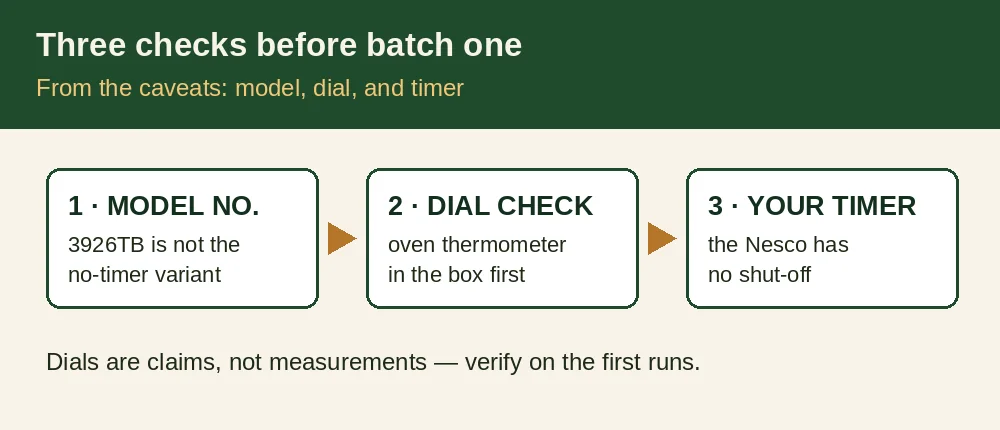
The Excalibur’s price is a moving target right now. Its Amazon listing showed no live offer on October 20, 2026. The model also sits in a confusing lineup — 3926TB, 3900B, 2900ECB and newer “Select” and digital versions share the same 9-tray box with different timers and controls, so check the exact model number on any listing before paying; a no-timer variant is a different machine at a similar price. The Nesco’s missing timer is a food-quality issue, not just a convenience one: fruit left running hours past done turns leathery-hard, and there is no shut-off to save it. Temperature dials are claims, not measurements: owners of all three brands include some who checked with a thermometer and found the box running hot or cool against the setting — a cheap oven thermometer inside the box for your first few batches is money well spent, especially before jerky. None of these machines runs without power — a dehydrator is a harvest-season tool for building storage while the grid is up, not an outage tool.
Frequently asked questions
How long does it take to dehydrate food?
Plan on hours, not minutes: apple slices at 135°F take about 6–10 hours, most vegetables 6–12 hours, and jerky 4–10 hours depending on thickness. Humidity and slice thickness move those numbers more than the machine does — all three models here run at 600 watts, so drying times between them are close. Food is done when it bends without any wet spots (fruit) or cracks without snapping (jerky, after it cools).
What temperature should I set for jerky?
Heat the meat first — 160°F for beef, 165°F for poultry, per the USDA — then dry at a steady 130–140°F. The COSORI Premium and Excalibur 3926TB dial to 165°F and the Nesco FD-75A to 160°F, but the dial is the drying temperature, not a guarantee the meat reached it inside. The pre-heating step is the safety step; do not skip it because the machine’s number looks high enough.
How much drying space do I actually need?
Match the box to your biggest normal batch, not your biggest imaginable one. The Nesco’s five trays (about 5 sq ft, growing to 12 trays) handle a few pounds of fruit at a time; the COSORI’s 6.5 sq ft covers a family batch of jerky or a market haul of peppers; the Excalibur’s 15 sq ft is for garden harvests measured in buckets. On cost per square foot, the Nesco’s space runs about $16 per square foot at its $80.51 price and the COSORI’s about $22 at $143.96; the Excalibur could not be scored on October 20, 2026 because it had no verifiable live price that day — bigger boxes are usually cheaper space, but only if you fill them.
Can I add more trays to any dehydrator later?
Only the Nesco FD-75A grows — it takes Add-A-Trays up to 12 total. The COSORI Premium is fixed at six trays and the Excalibur 3926TB at nine, though the Excalibur lets you leave trays out to make room for tall items. If you think your batches will grow, that expandability is the Nesco’s best argument after its price.
How long does dehydrated food keep?
Dried fruit kept cool, dark, and sealed with an oxygen absorber holds good quality for about a year; vegetables about the same; jerky is the short-lived one at 1–2 months in the pantry, longer frozen. Conditioning matters: jar the batch for a week after drying, shake it daily, and send anything that shows moisture back for more drying time. Moisture left in the food — not the machine that dried it — is what decides shelf life.
Is a dehydrator worth it next to a freeze dryer?
For most pantry building, yes: the Nesco in this comparison costs $80.51, even the big-box class runs to a few hundred rather than thousands, every machine here sips power at 600 watts, and a dehydrator handles fruit, vegetables, herbs, and jerky well. A freeze dryer keeps more flavor and nutrients and stores food for far longer, but the machines start around ten times the dehydrator’s price and run for a day or more per batch. Many households end up with the dehydrator for garden volume and skip the freeze dryer entirely.
Sources & freshness: manufacturer spec pages and manuals (COSORI, Excalibur, Nesco), Amazon listing data via Keepa and camelcamelcamel, USDA jerky guidance via university extension publications, and owner feedback aggregated from retailer reviews and dehydrator forums. Prices last checked: October 20, 2026. Last updated: October 30, 2026.
Talk it over with other readers. The Truly Preserved Community on Facebook is where readers compare notes on food storage, water, and backup power — and where your questions help decide what we research next. Join the group →