
Affiliate Disclosure: Truly Preserved is reader-supported. When you buy through links on this page, we may earn a commission at no extra cost to you. As an Amazon Associate, Truly Preserved earns from qualifying purchases. Learn more.
How we researched this comparison. We scored 3 products head to head for this page. The work behind the scores: manufacturer specifications and certification records where they apply, prices checked when this review was written, and patterns across verified owner feedback — a praise or complaint point only counts here when it shows up again and again, not once. The products were chosen to cover the main designs and price points a buyer in this category actually cross-shops. We are a research desk: we do not buy or hands-on test the products, and commissions never change a score. How we research and score →
Every water storage decision is really three decisions wearing one coat: do you want your water in one big vessel, in pieces you can carry, or not stored at all until a warning arrives? This water storage containers compared guide prices those three answers as finished systems for the same job — 56 gallons, the two-week supply for a family of four — using an Augason Farms 55-gallon drum kit, Saratoga Farms stackable 5-gallon containers, and a waterBOB bathtub bladder. It is built from published specs, current prices checked October 22, 2026, and aggregated owner feedback across roughly 7,250 Amazon ratings. We don’t own these containers; we did the homework so you can see what each format costs, what it weighs full, and where it fails before you spend. If you have not run your household’s number yet, start with how much water a family of four needs for two weeks — then come back and pick the shape it lives in. The Preserve the Water hub holds the filters and planners that complete the picture.

The Short Version
Augason Farms 55-Gallon Kit
See it on AmazonWe may earn a commission at no extra cost to you.
Saratoga Farms 5-Gallon Stackables
See it on AmazonWe may earn a commission at no extra cost to you.
waterBOB Bathtub Bladder
See it on AmazonWe may earn a commission at no extra cost to you.
How we chose: We compared the manufacturers’ published specs side by side, verified current prices on October 22, 2026 through price-tracker listings, and read owner feedback across about 7,250 Amazon ratings for the three listings, counting the praises and complaints that kept coming up. Scores weigh cost per gallon as a finished system, how the water comes out, rotation workload, and what owners report after real storms and real storage time. Read our full methodology.
Head-to-Head Specs
| Augason Farms 55-Gallon Kit Read the review ↓ |
Saratoga Farms 5-Gallon Stackables Read the review ↓ |
waterBOB Bathtub Bladder Read the review ↓ |
|
|---|---|---|---|
| Price | $235.12 | $318.79 (12-pack) | $36.99 |
| Best for | A garage or basement corner that never moves | Apartments, closets, and rotation one jug at a time | Hurricane and storm warnings, as a second layer |
| Capacity | 55 gal in one drum | 5 gal × 12 jugs = 60 gal | Up to 100 gal (about 65–80 in a standard tub) |
| Cost per gallon of capacity | $4.27 | $5.31 | $0.37 by the box rating; about $0.53 at a real tub’s 70 gallons — per fill |
| Full weight | About 480 lb in one place | About 42 lb per jug | Carried by the tub itself |
| How water comes out | Hand pump / siphon (included in kit) — no spigot | Pour or spigot, jug by jug | Siphon hand pump (included) |
| Stacks when full? | No — round drum | Yes — flat tops and bottoms nestle | No — it is the tub |
| Stored-water life | Rotate every 6 months untreated; kit treatment included | Listing copy says rotate every 6 months to a year | Up to 16 weeks filled, per the maker |
| Needs warning time? | No — filled and waiting | No — filled and waiting | Yes — 20 to 30 minutes of working tap water |
| Reusable? | Yes, for years | Yes, for years | No — maker says dispose after one use |
Prices verified October 22, 2026. The Augason price is the full kit (drum, pump, treatment, opener), not a bare drum. The Saratoga price is the 12-pack at 60 gallons total. Always confirm before buying.
Augason Farms 55-Gallon Kit: The Cheapest Stored Gallon, Bolted to the Floor
Our score: 8/10 — the lowest cost per gallon of any finished rigid system here, with the pump and treatment in the box — held back by pump-only dispensing and a full weight that ends every conversation about moving it.
The Augason kit (model 6-07910) is a new, food-grade, BPA-free 55-gallon drum, about 23 inches across and 35 inches tall, sold with the parts a bare drum leaves you to hunt down: two 2-inch bung plugs, a 6-foot siphon hose with hand pump, Aquamira treatment bottles, and a barrel opener. That bundling is the product. A drum alone is a sealed blue statue until the pump and wrench arrive; the kit is a system the day it lands. At $235.12 it works out to $4.27 per gallon of capacity, the cheapest rigid gallon in this comparison.
What owners love, across ~800 ratings (4.7 stars): the drum arrives new and clean rather than reconditioned from an unknown past life, it seals tight, and one purchase covers a family of four for 13.75 days at the 1-gallon baseline — a gallon short of two weeks, so add one jug beside it. What owners complain about: there is no spigot, so every cup of water is a pumping session; the drum carries a new-plastic smell on first opening that needs a wash and a bleach-sanitizing rinse before the first fill (1 teaspoon of unscented bleach in a quart of water, per the CDC); and the included pump draws durability questions often enough to budget for a better one someday.
Buy it if: you have a slab corner in a garage or basement and want the most stored water per dollar. Skip it if: you rent, you might move it, or anyone in the house needs water drawn ten times a day without a workout.
Check the current price on Amazon →
Saratoga Farms 5-Gallon Stackables: The Supply You Can Carry One Piece at a Time
Our score: 8/10 — the only format here that stacks filled, spreads across a home, and rotates in an afternoon — at $5.31 a gallon, you pay for every bit of that convenience.
Each Saratoga Farms container holds 5 gallons in BPA-free, food-grade HDPE with flat tops and bottoms that nestle, a low-profile handle, and a twist breathing port so pouring does not glug and stall. The 12-pack at $318.79 holds 60 gallons total — 15 days for a family of four at the baseline, with a small cushion the drum does not give you. Twelve jugs also means twelve separate chances: one jug leaks or turns, you lose 5 gallons, not 55.
What owners love, across ~990 ratings (4.5 stars): they genuinely stack full and stay put along a closet or garage wall, and rotation day is one 42-pound jug to the sink instead of a drum-draining project. Owners who lived through the Texas freeze tell the same story in review after review — carried the jugs in one at a time, lids sealed tight, water tasted fresh months later. What owners complain about: the jug shape never quite empties, and a stacked jug cannot be drained where it sits — unstack, pour, restack, and plan the bottom row as the last one you use. Caps and spigots on a twelve-jug kit take real assembly time and a firm hand with the wrench.
Buy it if: you live in an apartment, store in closets, or know rotation discipline is your weak point. Skip it if: cost per gallon is your first concern and you have the slab corner for a drum.
Check the current price on Amazon →
waterBOB Bathtub Bladder: 100 Gallons for $36.99, With Two Strings Attached
Our score: 7/10 — the best dollars-to-gallons ratio in emergency water, full stop — scored as a layer, not a supply, because it stores nothing until a warning arrives and the maker says throw it away after one use.
The waterBOB is a heavy-duty, food-grade, BPA-free bladder (10-mil LLDPE) that unrolls in a bathtub, fills through a sock on the tub faucet in about 20 to 30 minutes, and dispenses through an included siphon pump. Folded, it is about the size of a loaf of bread and lives in a drawer. Filled, the maker rates it at up to 100 gallons and says the water stays fresh up to 16 weeks sealed and out of sunlight. The honest capacity note every good review adds: a standard tub holds roughly 65 to 80 gallons, so 100 needs a big tub. At a realistic 70 gallons, $36.99 is still about $0.53 a gallon.
What owners love, across ~5,460 ratings (4.7 stars): it has a real hurricane record — owners in Florida rode out Matthew and Irma outages on it for a week — and nothing else buys this much protected water this cheaply with zero storage space. What owners complain about: the siphon gets fiddly as the level drops, hose sections can pop apart inside the bladder, the receiving jug has to sit below the pump, and the last water in the bladder never quite comes out. The structural complaints matter more: it is useless if the water is already off or already suspect when you hear the news, it takes your only tub out of bathing service while deployed, and it sells out the moment a storm is forecast. Buy it on a calm Tuesday or do not count on it.
Buy it if: you get forecast warnings — hurricanes, named storms, planned shutoffs — and already store some drinking water. Skip it if: it would be your only plan, or your emergencies arrive without warning.
Check the current price on Amazon →
Which Is Cheaper Per Gallon Once You Buy the Pump, Wrench and Treatment?
The Augason kit is cheaper per gallon as a finished system: $4.27 a gallon with its pump and treatment already in the $235.12 box, against $5.31 a gallon for the Saratoga 12-pack. That ordering surprises people who price a bare drum first — a drum alone looks cheaper until the pump, bung wrench and preserver join the cart, and then the kit has already won. The waterBOB at $36.99 is cheapest of all per gallon, but its gallon is rented, not owned: the $0.37 to $0.53 is spent again at every event, while the drum’s $4.27 is spent once for years of fills.
Which Full Container Can One Person Actually Carry — and What Happens on Rotation Day?
Only the Saratoga jug can be carried, at about 42 pounds full — a real two-handed lift, not a casual one. The Augason drum full is about 480 pounds and does not move; rotation means pumping 55 gallons out where it sits, sanitizing, and refilling in place, which is a project you schedule, not a chore you squeeze in. The waterBOB is never carried at all — the tub carries its 540 to 830 pounds. If rotation is the job you know you will put off, buy the format that makes rotation small: twelve jugs, one a month, and the whole supply quietly turns over every year.
What If the Water Goes Off With No Warning?
If the water goes off with no warning, only stored water exists — the drum and the jugs are the whole answer and the waterBOB is a flat piece of plastic in a drawer. A bladder fills from a working tap before pressure drops or a do-not-use notice lands. After that notice, filling it is exactly what the notice forbids. This is the first decision in water storage, ahead of price: households whose emergencies are earthquakes, main breaks and sudden contamination notices need gallons already sealed. Households whose emergencies arrive on the weather forecast can let a $36.99 bladder carry the second half of the plan.
How Long Will Each One Keep Water Safe?
The drum and the jugs keep water on the CDC clock: replace home-filled water every 6 months, with treatment products claiming longer — the Augason kit ships treatment in the box, and Saratoga’s own listing copy says rotate every 6 months to a year. The waterBOB keeps filled water fresh up to 16 weeks per its maker, because it is an event device, not storage. Treat the 5-year figures printed by treatment makers as what they are — manufacturer claims sitting next to, not instead of, the CDC’s 6-month guidance — and pick the workload you will actually do. All three want the same storage conditions when filled and waiting: cool, dark, and away from gasoline and chemicals. When the stored supply runs short, a filter is the layer behind it — our water filter comparison covers what the home systems remove.
Which One Fits an Apartment?
The Saratoga stackables fit an apartment best, split across closets and under beds, with the waterBOB in a drawer as the warning-day layer. Twelve jugs spread 500 pounds across a whole home instead of concentrating 480 pounds in one corner of a floor you do not own, and they leave through the door with you when the lease ends. The drum is the wrong answer in most rentals: floor load, a landlord’s fair question, and a move-out problem in the same blue package. The bladder alone is not enough for an apartment either — it needs warning time and a tub you can spare.
What Breaks or Leaks First?
On the drum, the pump breaks first — it is the only moving part, the kit’s most-questioned piece, and the difference between stored water and a sealed decoration. On the stackables, seals leak first: a cap seated carelessly or a gasket twisted in its groove weeps slowly onto the jug below it, which is why owners who check seating at fill time report tight lids and owners who hurry report drips. On the bladder, the siphon breaks first — air in the line, hose sections parting inside the bladder — and the whole product is single-use by design, because a bladder that cannot be fully dried can grow mildew in storage. None of these is a reason to avoid its format. All three are reasons to buy the format whose failure you are set up to notice.
Cost of Ownership: The 56-Gallon Bill, Three Ways
To hold the two-week baseline for a family of four, the drum kit costs $235.12 once and about $0.30 a gallon per refill in treatment and wear after that — call it the cheapest water you will ever own, paid for in rotation effort. The stackables cost $318.79 once, $83.67 more for 5 extra gallons and a supply that rotates in pieces and can be handed, jug by jug, to a neighbor who stored nothing — a use no drum can match. The bladder costs $36.99 per event: two hurricanes in a year is $73.98, five quiet years is $36.99 sitting in a drawer, and either way it never replaces a stored gallon for the no-warning day. Most households land on a mix for a reason: a stored base you control, in the format your space allows, plus a bladder if your emergencies send a forecast first. The Household Emergency Checklist puts that mix in order with the rest of the first 72 hours.
Gallons stored, as configured
Total capacity for each setup as priced in this section — storage volume, not price.
Honest Caveats
The 100-gallon waterBOB figure is a box number. Standard tubs hold about 65 to 80 gallons. The bladder is still the cheapest water in this comparison at the honest number — it did not need the big one.
Single-use is a real cost and a real waste stream. The maker instructs disposal after one use because residual moisture risks mold on re-storage. Some owners reuse a bladder for flushing and washing water only. Drinking from a reused bladder is a gamble the manufacturer has already declined to take for you.
No warranty terms were published for any of the three in the listings and maker pages we checked — no term is printed in this comparison because none was stated. Rigid containers from these makers are multi-year products in owner reports, but “owners report” is not a warranty, and we score them as different things.
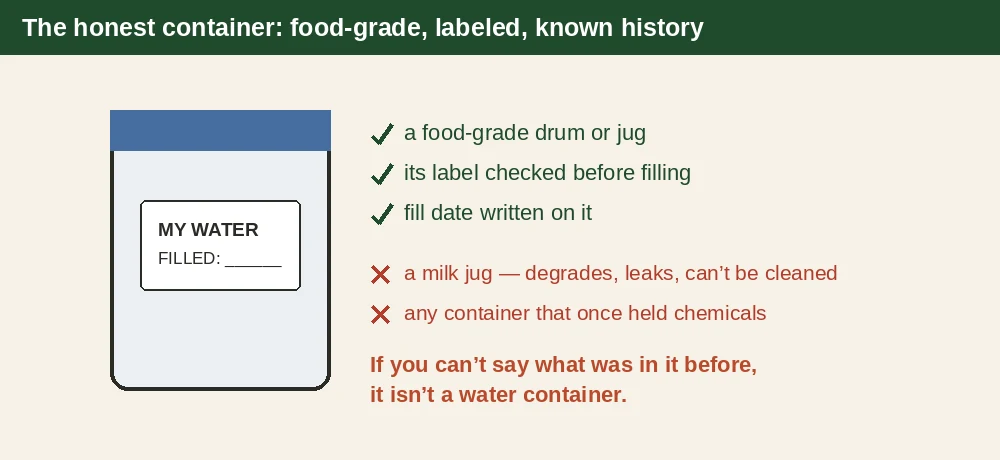
Never store drinking water in a container that held chemicals, and never in a milk jug. The CDC’s line is food-grade containers made for water, washed, sanitized with the bleach solution above, labeled with the fill date. A used drum of unknown history is the false economy this whole category is priced against.
Frequently Asked Questions
How much water should I store per person per day?
One gallon per person per day is the Ready.gov and CDC baseline, covering drinking and basic hygiene. A family of four needs 56 gallons for two weeks at that rate. Heat, illness, pregnancy, nursing and pets all add on top — our full breakdown is in the family-of-four guide linked at the top of this page.
Is a 55-gallon drum better than 5-gallon stackable containers?
The drum is better on price — $4.27 a finished gallon against $5.31 — and simpler, if it never has to move and you have a slab corner for 480 pounds. The stackables are better for apartments, for rotation, for carrying, and for not losing the whole supply to one failure. Better depends on which of those sentences sounds like your house.
How long can water be stored before it goes bad?
Water does not spoil, but containers and taste degrade. The CDC says replace home-filled water every 6 months; treatment makers claim up to 5 years for treated water; a filled waterBOB is rated fresh up to 16 weeks. Rotate on the CDC clock and the question mostly answers itself.
Can you drink water stored in a bathtub?
Not from a bare tub — soap film, dust and whatever the tub has held make it a flushing supply. Yes from a food-grade bladder like the waterBOB, filled from the tap before the supply is compromised. That distinction is the entire product.
Can I use a waterBOB more than once?
The manufacturer says no: dispose of it after one use, because it cannot be fully dried and stored moisture risks mold. Owners who reuse one generally downgrade it to washing and flushing water. For drinking, budget it as one bladder per event.
Do I need to treat tap water before storing it?
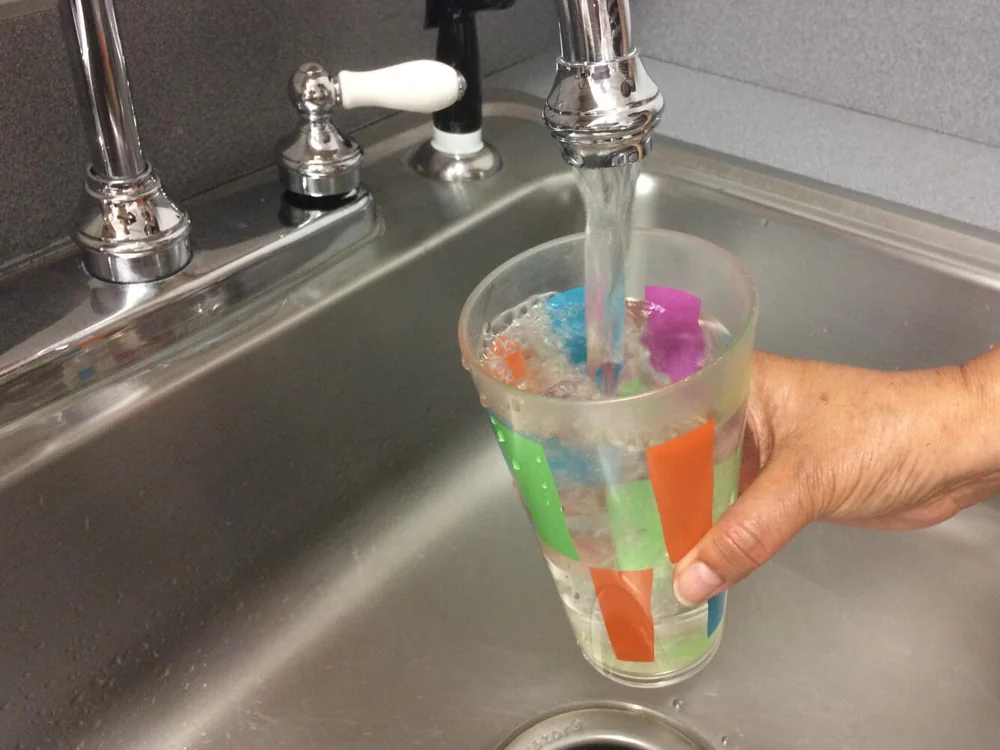
City tap water is already chlorinated and usually goes in as it comes, in a washed and sanitized food-grade container, labeled with the date. Sanitize the container with 1 teaspoon of unscented bleach in 1 quart of water per the CDC method. Treatment products exist to stretch the rotation interval, not to make untreated storage safe by magic.
Sources: manufacturer and retailer listings for the Augason Farms 6-07910 kit, Saratoga Farms stackable containers and waterBOB (specs and kit contents as published), CDC emergency water supply guidance, Ready.gov water guidance, aggregated Amazon owner reviews via price-tracker listings (about 7,250 ratings across the three products). Prices last checked: October 22, 2026. Last updated: October 30, 2026.
Talk it over with other readers. The Truly Preserved Community on Facebook is where readers compare notes on food storage, water, and backup power — and where your questions help decide what we research next. Join the group →