
Affiliate Disclosure: Truly Preserved is reader-supported. When you buy through links on this page, we may earn a commission at no extra cost to you. As an Amazon Associate, Truly Preserved earns from qualifying purchases. Learn more.
How we researched this comparison. We scored 3 products head to head for this page. The work behind the scores: manufacturer specifications and certification records where they apply, prices checked when this review was written, and patterns across verified owner feedback — a praise or complaint point only counts here when it shows up again and again, not once. The products were chosen to cover the main designs and price points a buyer in this category actually cross-shops. We are a research desk: we do not buy or hands-on test the products, and commissions never change a score. How we research and score →
The best mylar bags for long term food storage are not the ones with the biggest number on the listing. They are the ones whose thickness is quoted the honest way, whose oxygen absorbers arrive still alive, and whose seal you can tug on without it peeling apart. This guide is built from manufacturer specs, prices verified on October 24, 2026, Utah State University Extension and Church of Jesus Christ (LDS) packing guidance, and aggregated owner feedback — including the failures. We don’t own these bags; we did the homework, and the homework starts with a trick the listings play on purpose. The Preserve the Harvest hub collects the preserving methods this packing step finishes.

The Short Version
Wallaby 1-Gallon Mylar Bags, 30-Pack with 400cc Absorbers
See it on AmazonWe may earn a commission at no extra cost to you.
Sukerle 5-Gallon Mylar Bags, 15-Pack with 2000cc Absorbers
See it on AmazonWe may earn a commission at no extra cost to you.
METRONIC 8-Inch Impulse Sealer
See it on AmazonWe may earn a commission at no extra cost to you.
How we chose: Bags are judged on thickness quoted per side, absorber packaging (factory packs and an oxygen indicator over loose bulk), and cost per bag with its absorber counted in. The sealer is judged on seal consistency and bar width against the bags it has to close. Read our full methodology.
Head-to-Head: What a Sealed Bag Actually Costs
| Product | Price | Per bag | Best for |
|---|---|---|---|
| Wallaby 1-Gallon, 30-pack Read the review ↓ |
$21.99 | $0.73 | Portioning rice and beans |
| Sukerle 5-Gallon, 15-pack Read the review ↓ |
$37.99 | $2.53 | Lining 5-gallon buckets |
| METRONIC 8-Inch Sealer Read the review ↓ |
$39.99 | — | Quart and gallon bags |
Read the per-bag column the right way round. The Sukerle liner costs more per bag and stores five gallons at once — about 51 cents per gallon stored. The Wallaby gallon bag costs $0.73 per gallon stored, and the premium over a liner buys you the thing that actually saves food: portions. Crack a 5-gallon liner and the whole 30 pounds starts aging. Crack one gallon bag and the other four gallons in the bucket never notice. Most households want both — liners for the deep stock, gallon bags for the working stock — and our Oxygen Absorber Calculator sizes the absorbers for either.
Wallaby 1-Gallon Mylar Bags, 30-Pack — Our Score: 9/10
The Wallaby 30-pack is the bag we’d hand a neighbor packing rice and beans for the first time, and the reason is printed right in its title: “10 Mil” total thickness, which Wallaby itself explains means 5 mil per side. In a category where the number is usually inflated to mislead, the maker doing the division for you is the whole review in miniature.
Each 10-by-14-inch bag is a PET, aluminium foil, and polyethylene laminate — the foil layer is the oxygen and light barrier, the plastic layers are puncture resistance and the heat-seal surface. Five mil per side is the floor serious packing sources set for 10-to-20-year storage, and Wallaby’s absorbers match the bag honestly: 400cc each, inside the 300-to-500cc-per-gallon rule, factory-sealed in packs of 10 rather than repacked loose, with labels in the box. At $21.99 verified October 24 — Keepa and camelcamelcamel agree — the kit is $0.73 per finished gallon portion.
Pros
- Thickness quoted both ways — 10 mil total, 5 mil per side — so you can compare it against anyone.
- Absorbers arrive in factory 10-packs: open ten, seal ten, and the other twenty are still at full strength.
- Gallon portions mean opening food never exposes the whole stock.
Cons
- Heat-seal only on this pack — there is no zip to lean on, which is correct for long-term storage but surprises buyers who expected one.
- Per gallon stored, portion bags still cost more than a bucket liner — $0.73 against about $0.51.
- Five mil is the floor, not armor: sharp pasta edges still deserve the heavier bag or a liner-first pack.
Buy it if you are packing your first buckets of rice, beans, wheat, or oats and want the sizing decisions already made. Skip it if your whole plan is bucket liners and you portion nothing — the Sukerle pack below is your bag.
Check the current price on Amazon →
Sukerle 5-Gallon Mylar Bags, 15-Pack — Our Score: 8/10
The Sukerle 15-pack solves the 5-gallon bag’s worst problem, and it isn’t thickness — it’s the absorbers. Each of the 15 bags (10.5 mil total, stated plainly, so 5.25 mil per side) ships with a 2000cc oxygen absorber sealed individually. Line a bucket on Saturday, and the other fourteen absorbers are still factory-fresh next month. Bulk absorber packs opened all at once start dying in the open air within minutes; this pack design refuses that failure.
A 2000cc absorber sits at the low end of the 2,000-to-2,500cc a 5-gallon bag wants — right for dense rice, wheat, and flour, light for airy pasta or freeze-dried food, where you’d add a second packet. At $37.99 verified October 24 — both trackers agree — each finished bucket liner costs $2.53, the cheapest per-gallon packing in this guide.
Pros
- Individually sealed absorbers — the single most useful design choice in any 5-gallon kit we’ve compared.
- Thickness stated as a total, 10.5 mil, which converts cleanly to 5.25 mil per side — above the 5-mil floor.
- Lowest cost per gallon stored: about 35 cents.
Cons
- 2000cc is the minimum for five gallons; airy foods need a second absorber the kit doesn’t include.
- One failed seal puts the whole bucket’s food in question — liners concentrate risk exactly as much as they concentrate savings.
- A 20-to-30-inch bag mouth laughs at an 8-inch sealer. Budget for overlapping passes or a wider bar.
Buy it if you store in buckets and pack a bucket at a time, a few times a year. Skip it if you pack small amounts weekly — the individually sealed absorbers help you, but gallon bags will serve you better.
Check the current price on Amazon →
METRONIC 8-Inch Impulse Sealer — Our Score: 7/10
The METRONIC is the cheapest way to get a real impulse seal — a heated bar that fires only when you press it, 0.2 to 1.5 seconds across 8 heat settings, rated to seal film up to 10 mil — instead of dragging a clothes iron over a board and hoping. It ships with spare heating elements and a repair kit, which tells you the maker expects the element to be the wear part and prices the fix into the box. At $39.99 verified on October 24, with Keepa and camelcamelcamel agreeing, it costs more than a hair straightener and less than a second wasted packing day.
Now the limit, stated before you buy rather than after: the bar is 8 inches long. A gallon mylar bag’s mouth is 10 inches wide. You will seal gallon bags in two overlapping passes — workable, and common — and a 5-gallon liner in several, checking each overlap twice. Readers packing mostly gallon and 5-gallon bags should step up to a 12- or 16-inch sealer in this same class. For quart bags, pouches, and resealing, 8 inches is genuinely enough.
Pros
- Consistent, timed seals beat every iron and straightener workaround on thick bags.
- Adjustable heat: thin bags and 7-mil bags want different settings, and this dials both.
- Spare elements in the box — the wear part is replaceable, not a new sealer.
Cons
- Eight-inch bar versus 10-inch gallon mouths and 20-inch-plus liner mouths: overlapping passes are a workaround, not a feature.
- Two-millimeter seal width is narrow. Double-seal every bag — two lines, a quarter inch apart.
- No vacuum function, and it cannot vacuum smooth mylar anyway — no standard sealer can.
Buy it if your packing is quart and gallon bags and you want consistent seals without spending sealer money twice. Skip it if 5-gallon liners are your main bag — buy the wider bar first and save the frustration.
Check the current price on Amazon →
How thick should mylar bags be — and why do the mil numbers lie?
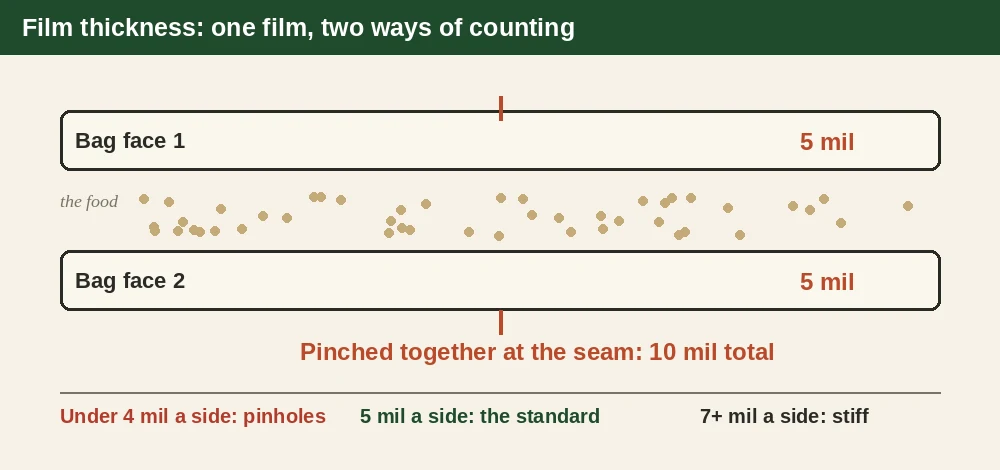
Mylar bags should be at least 5 mil per side for long-term storage, and the mil numbers lie because sellers count two different things. One mil is a thousandth of an inch. Honest US makers quote thickness per side: a Wallaby or PackFreshUSA “5 mil” bag is 5 mil of film on each face, 10 mil if you pinch both faces together. Many Amazon listings quote that pinched total — or pad it — so a “15 mil” no-name bag can be 7.5 mil per side and a “10 mil” bag can be the exact same film as a maker’s “5 mil.” Never compare two listings until both numbers are in per-side terms. Below 4 mil per side, bags fail two ways: oxygen creeps through the film over months, and folds and sharp food corners open pinholes. At 7 mil per side and up, bags shrug off pasta edges and rough handling but get stiff and need more heat and a longer press to seal. Five per side, inside a bucket, is the working standard for rice, beans, wheat, and oats; go heavier for sharp freeze-dried food — the kind our freeze dryer comparison produces — or for bags that will live outside a bucket.
How many oxygen absorbers do I need for a 1-gallon or 5-gallon bag?
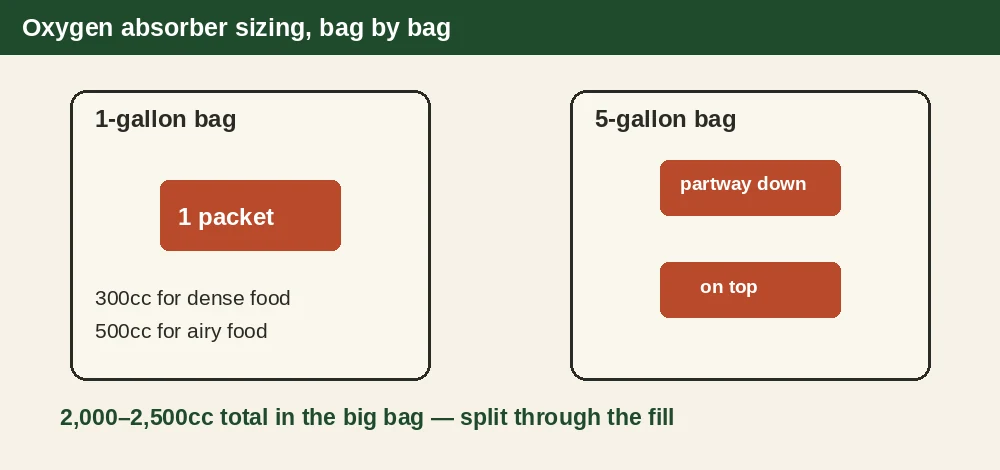
You need 300 to 500cc of absorber per gallon of bag: 300cc for dense food like rice in a gallon bag, 500cc for airy food, and 2,000 to 2,500cc total in a 5-gallon bag. The absorber is a packet of iron powder that rusts on purpose — moisture wakes the iron, the iron binds the oxygen as iron oxide, and the air left in the bag drops to about 0.01% oxygen, the rest being nitrogen that was never a threat. Oversizing hurts nothing; unused capacity just sits there. Undersizing leaves oxygen behind to feed bugs and stale the food. Split a 5-gallon dose through the fill — a packet partway down and one on top — instead of dropping it all in last. One working rule owners learn the hard way: absorbers start spending themselves the minute the pack opens, so work in batches of about ten bags and reseal the spares in a mason jar immediately. The Oxygen Absorber Calculator gives the exact count for your bag size and food — run it before a packing day, not during. And if you are not sure which bag size you should be packing in at all, the Mylar Bag Size Selector turns the food and the amount you have on hand into the bag size and the bag count, with the same absorber numbers per bag.
Why didn’t my bag shrink like a vacuum bag — did the absorber fail?
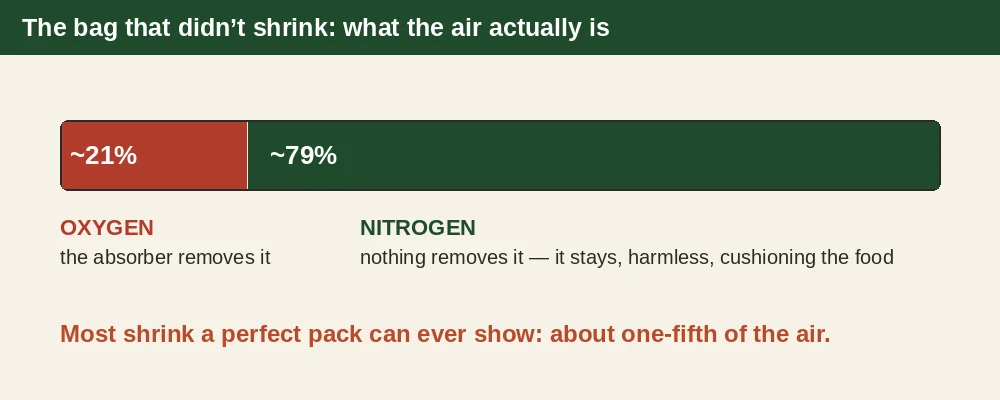
No — a mylar bag that doesn’t shrink has usually worked exactly right. Absorbers remove oxygen, and oxygen is only about a fifth of the air in the bag. The other four-fifths is nitrogen, which stays, so the most contraction a perfect pack ever shows is about one-fifth of its air volume — and flour and fine powders show almost none. Wallaby prints this warning in its own listing because the panic is so common: bags may not shrink like a vacuum bag, no matter how many absorbers you add. A bag that puffs back up over 24 to 48 hours is a different signal — that one earns a seal check, because air is getting in somewhere. And vacuum sealing smooth mylar on a standard home vacuum sealer doesn’t work at all: the machine needs the embossed channels of a vacuum bag to pull air out. Hand-squeeze the loose air out before sealing, let the absorber do the chemistry, and judge the pack a day later by the seal, not by the shrink.
Can I seal mylar with a hair straightener or an iron, or do I need an impulse sealer?
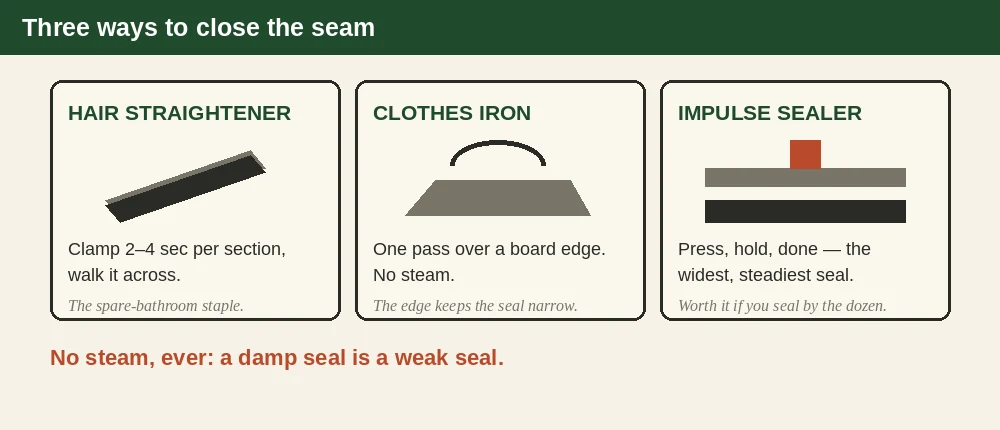
You can seal mylar with a hair straightener or a clothes iron — people do it every packing day — but an impulse sealer makes a wider, more consistent seal for about $40. A straightener works well on quart pouches and reseals: highest heat, metal plates if you have them, clamp two to four seconds per section and walk it across the mouth. A clothes iron on a wool or cotton setting, no steam, run over a board edge, seals gallon bags one pass at a time and forgives nothing — a wrinkle left in the film is a channel leak straight through your seal. Whichever heat you use, the craft rules don’t change: wipe flour dust out of the seal zone, leave four to six inches of clean headspace, smooth the film flat, test-seal a scrap, and tug-test the cooled seal. A zipper top is never the seal — heat-seal above the zip, always. Thick 7-mil bags want a second pass and a longer press whichever tool you choose.
What foods should never go in mylar with an oxygen absorber?
Sugar, salt, and anything still moist should never be sealed in mylar with an oxygen absorber. Sugar sets into a solid brick around an absorber — owners reach for a hammer or a cheese grater — and salt gains nothing, because neither food spoils from oxygen; a desiccant packet, or nothing, is the right pack for both. Moist food is the dangerous case, not the annoying one. Utah State University Extension states it plainly: botulism poisoning may result if moist products are stored in packaging that reduces oxygen, and food packed with absorbers must be dry — about 10% moisture or less. The germ that causes botulism wants exactly the airless, damp room a wrongly packed bag builds. Rice, beans, wheat, and oats from the store sit safely under that line. Home-dried fruit that still bends, jerky that isn’t snap-dry, and vegetables that aren’t brittle do not. Brown rice and nuts are a separate, lesser problem — not safety, but rancid oil within a year or two no matter how well they’re sealed, which is why our dehydrator comparison steers long-term packs toward foods that dry fully.
Do sealed mylar bags still need to go inside a bucket?
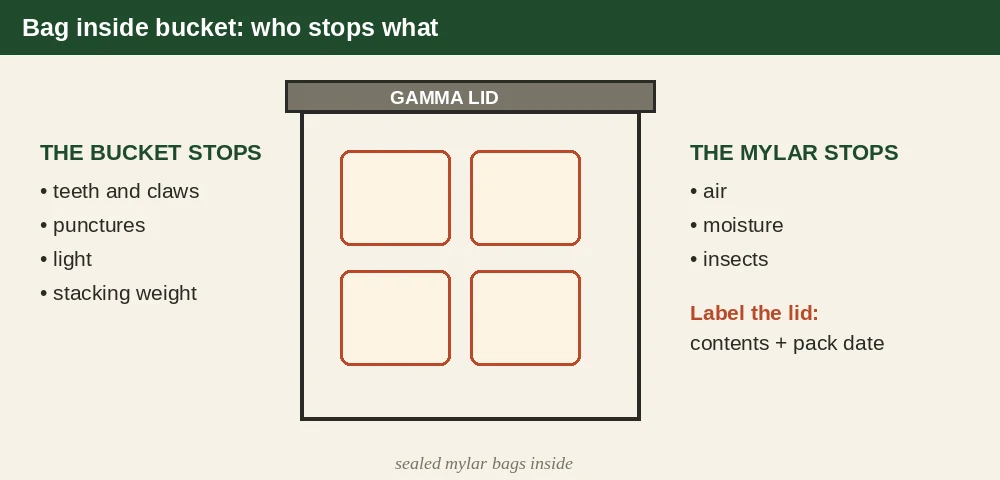
Yes — sealed mylar bags still need a bucket, because mylar stops air, moisture, light, and insects, and stops nothing with teeth. Every serious packing source says the same sentence in different words: a mouse goes through a mylar bag like it isn’t there. The bucket or lidded tote is also the bag’s armor against punctures, stacking weight, and light, and a gasket or Gamma lid keeps the whole package together. Store the buckets cool, dark, and dry, off bare concrete where you can — shelf life roughly halves with every 10.8°F rise, and the coolest corner of the house beats the garage in every state we’ve priced food for. Label the lid with the contents and the pack date. Future you, rotating stock in three years, will not remember what is in the white bucket, and opening it to check breaks the very seal you paid for.
Honest Caveats
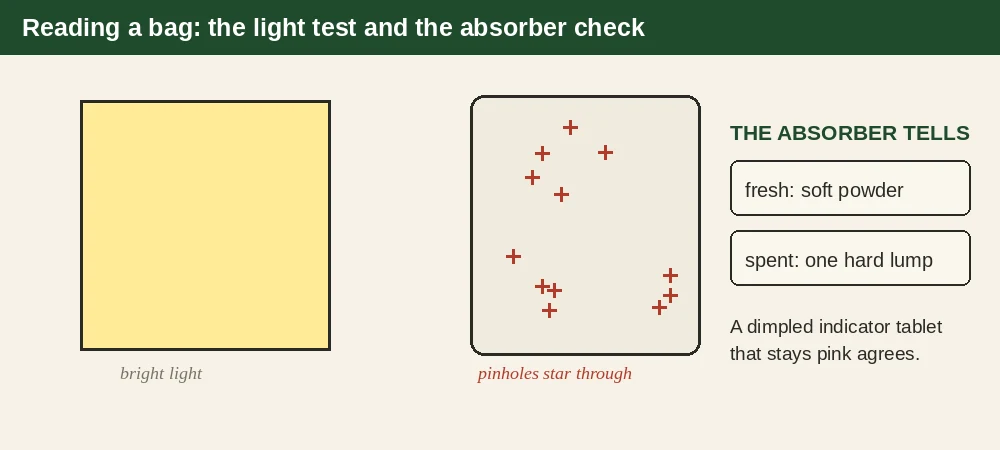
The worst mylar story we found this run wasn’t about thickness at all. Writing in SurvivalBlog in September 2025, a prepper described discovering pinholes through a trusted, video-popular brand of bags only after her freeze-dried food went soft — about 60% of what she had stored was thrown to the chickens, thousands of dollars of food gone, and the brand had no Amazon or website reviews anywhere to warn her. Two lessons, and both are cheap: hold every bag up to a bright light before you fill it — a true foil-core bag goes completely dark, while thin metallised film glows and pinholes show as stars — and buy bags where owner reviews exist to be read. The second caveat is absorber timing. A packet that feels hard or clumped in the pack is already spent; a fresh one feels like soft powder. And an absorber opened at breakfast and left on the counter while you fill bags all afternoon is spent by lunch. Pack in batches, jar the spares, and treat any kit with no oxygen indicator tablet in the absorber pack as a downgrade — that little pink-to-blue tablet is the only proof in the box that the chemistry still works.
Frequently Asked Questions
How many oxygen absorbers do I need for a 1-gallon or 5-gallon mylar bag?
Plan on 300 to 500cc per gallon. A gallon of dense rice does fine with one 300 to 400cc packet; airy foods want 500cc. A 5-gallon bag wants 2,000 to 2,500cc total, split through the fill rather than dropped on top. When in doubt, round up — extra capacity is harmless to dry food.
How thick should mylar bags be — is 5 mil enough, or do I need 7 mil?
Five mil per side is enough for rice, beans, wheat, and oats stored inside a bucket, and it’s the floor packing sources recommend for 10-to-20-year storage. Go to 7 mil per side for sharp-edged food like pasta, for freeze-dried food with hard corners, or for bags that won’t live inside a bucket. Always compare per-side numbers; a “10 mil total” bag and a “5 mil” bag can be the same film.
Why didn’t my mylar bag shrink like a vacuum bag — did the absorber fail?
Almost certainly not. Absorbers remove only the oxygen — about one-fifth of the air — so a fifth is the most volume a good pack ever loses, and powders lose almost none. Judge the pack by its seal after 24 to 48 hours. A bag that puffs back up is the one to open and reseal.
Can I seal mylar bags with a hair straightener or clothes iron, or do I need an impulse sealer?
Both household tools work: a straightener on quart pouches and reseals, an iron (wool setting, no steam, over a board edge) on larger bags. An impulse sealer — $39.99 for the 8-inch METRONIC in this guide — buys consistency, and it’s the tool we’d choose once packing becomes a regular job. Whatever you use, wipe the seal zone clean, smooth out wrinkles, and tug-test after it cools.
What foods should NOT go in mylar with oxygen absorbers?
Sugar (it bricks solid), salt and baking soda (no benefit), and anything over about 10% moisture — moist food in an oxygen-free bag is the one genuinely dangerous pack, per Utah State University Extension, because it’s the environment botulism needs. Dry staples are safe; food that still bends when dried is not ready to seal.
How long will rice last in mylar with an oxygen absorber?
White rice packed in mylar with an absorber, inside a bucket, kept at 75°F or cooler, lasts 25 to 30-plus years in the LDS and University of Georgia Extension storage tables. The same rice in its store bag on a warm shelf is a one-to-two-year food. The bag and the absorber are most of that difference — the bucket and the cool room are the rest.
Sources & freshness: Utah State University Extension food storage guidance; Church of Jesus Christ long-term food storage guide; PackFreshUSA, Wallaby Goods, Discount Mylar Bags, and IMPAK technical pages; SurvivalBlog (September 2025) pinhole account; manufacturer specs for Wallaby, Sukerle, and METRONIC; prices verified October 24, 2026 via Keepa and camelcamelcamel. Prices last checked: October 24, 2026. Last updated: October 30, 2026.
Related reading: sealing for the freezer and the deep pantry is the other half of this job — our vacuum sealers comparison prices Nesco, FoodSaver, and a chamber sealer per seal, including what each does to mylar.
Talk it over with other readers. The Truly Preserved Community on Facebook is where readers compare notes on food storage, water, and backup power — and where your questions help decide what we research next. Join the group →