
Affiliate Disclosure: Truly Preserved is reader-supported. When you buy through links on this page, we may earn a commission at no extra cost to you. As an Amazon Associate, Truly Preserved earns from qualifying purchases. Learn more.
How we researched this comparison. We scored 3 products head to head for this page. The work behind the scores: manufacturer specifications and certification records where they apply, prices checked when this review was written, and patterns across verified owner feedback — a praise or complaint point only counts here when it shows up again and again, not once. The products were chosen to cover the main designs and price points a buyer in this category actually cross-shops. We are a research desk: we do not buy or hands-on test the products, and commissions never change a score. How we research and score →
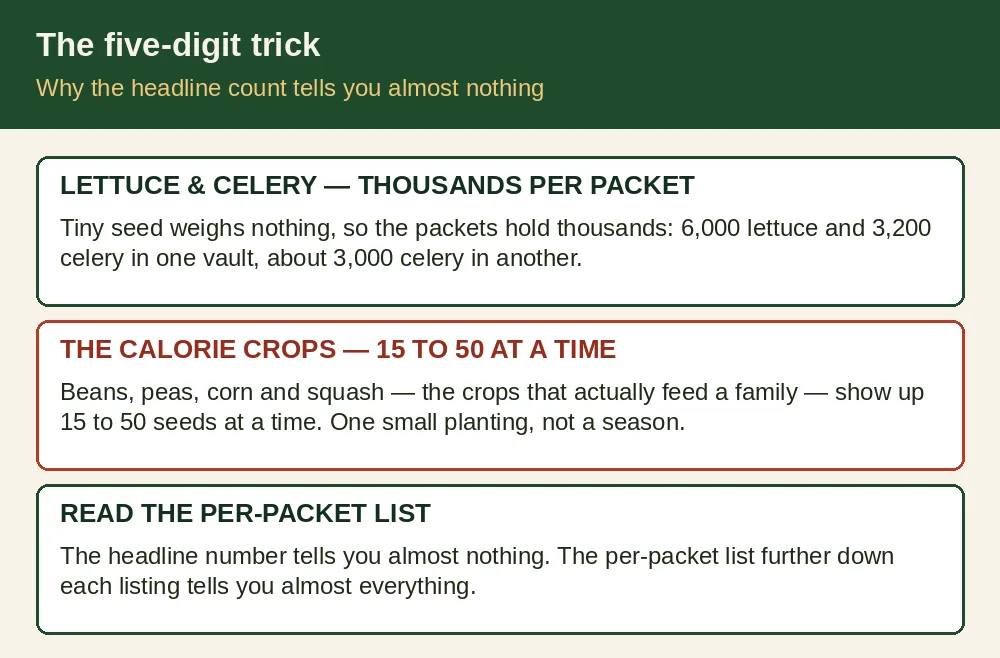
Every seed vault on Amazon leads with a five-digit seed count, and every one of those counts is doing the same quiet trick: most of the seeds in the box are lettuce, celery, and carrot — the tiny ones that weigh nothing — while the crops that actually feed a family, beans, peas, corn, and squash, show up 15 to 50 seeds at a time. This guide to the best heirloom seed vault for long-term storage is built from the makers’ own per-packet counts, their official storage guides, prices verified on October 25, 2026, and aggregated owner feedback. We don’t own these vaults; we did the homework, and the homework starts by recounting the seeds. The Preserve the Seed hub is where this guide lives, next to the seed-saving basics every vault owner needs.
The Short Version
Gardeners Basics Survival Seed Vault Kit, 35 Varieties
See it on AmazonWe may earn a commission at no extra cost to you.
Survival Garden Seeds Home Garden Collection, 30 Pack
See it on AmazonWe may earn a commission at no extra cost to you.
Open Seed Vault 15,000, 32 Variety Pack
See it on AmazonWe may earn a commission at no extra cost to you.
How we chose: Vaults are judged on the per-crop counts behind the headline number, on whether the maker’s storage-life claim survives a read of the maker’s own storage guide, and on what owners report when they actually plant. Prices were checked October 25, 2026 on Keepa and camelcamelcamel. Read our full methodology.
Head-to-Head: The Counts Behind the Counts
| Product | Price | Varieties | Best for |
|---|---|---|---|
| Gardeners Basics Vault Kit Read the review ↓ |
$29.95 | 35 | First vault, exact counts |
| Survival Garden Seeds Home Garden Read the review ↓ |
$29.99 | 30 | Seed savers, dated lots |
| Open Seed Vault 15,000 Read the review ↓ |
$24.99 | 32 | Proven seller, big review base |
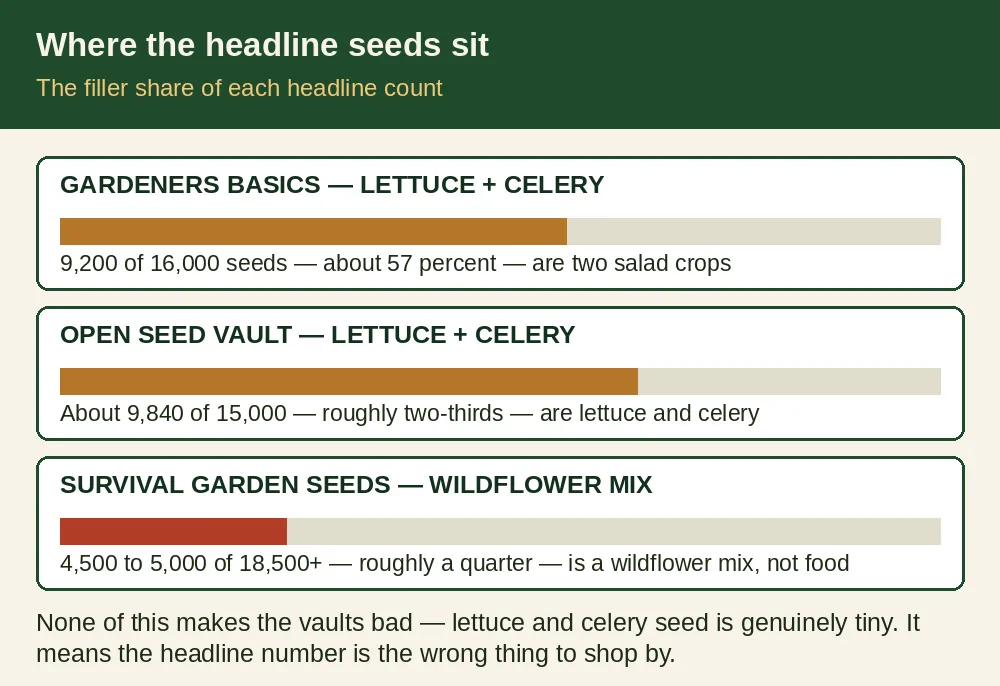
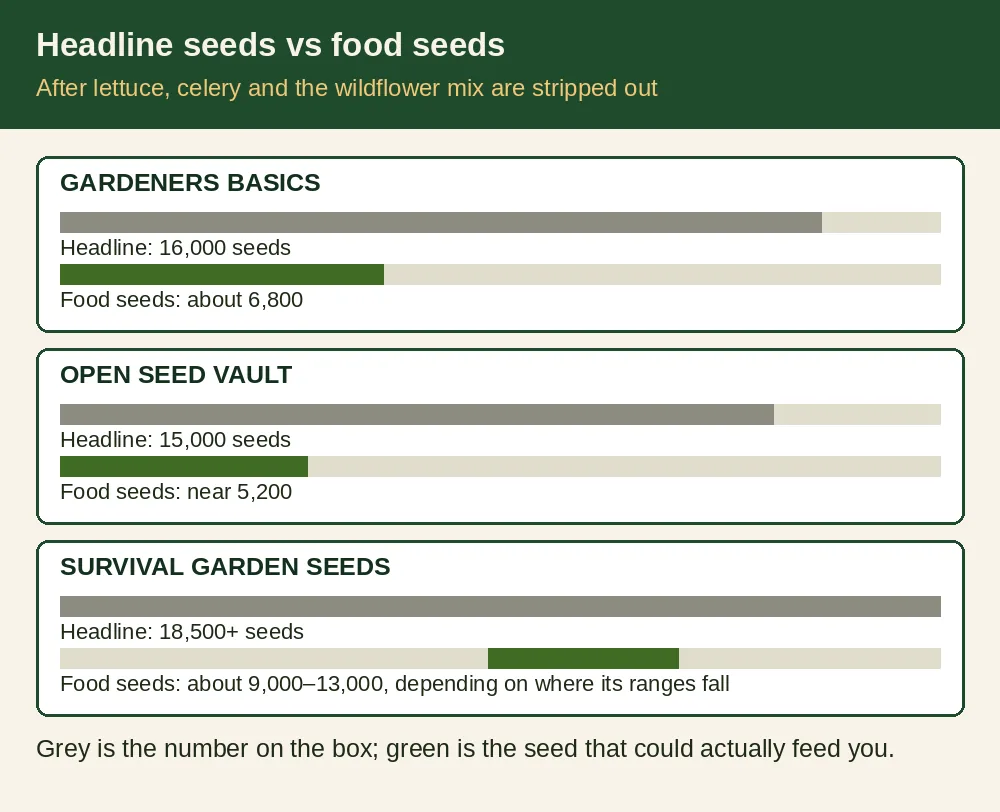
Now the recount. Gardeners Basics’ 16,000 seeds include 6,000 lettuce seeds across three varieties and 3,200 celery — 9,200 of the 16,000, about 57 percent, are two salad crops. Open Seed Vault is steeper: its three lettuces (about 6,840) plus celery (about 3,000) make up roughly two-thirds of the 15,000. Survival Garden Seeds headlines 18,500+, and 4,500 to 5,000 of those are a perennial wildflower mix — pretty, good for pollinators, and not food. None of this makes the vaults bad. Lettuce and celery seed is genuinely tiny, and a few hundred seeds per packet is normal. It does mean the headline number tells you almost nothing, and the per-packet list further down each listing tells you almost everything.
Gardeners Basics Survival Seed Vault Kit, 35 Varieties — Our Score: 8/10
The Gardeners Basics kit is the vault we’d hand a first-time buyer, because it’s the only one of the three that prints an exact seed count for every single variety on its Amazon listing — celery 3,200, corn 40, bush beans 20, sugar snap peas 25 — and lets you judge the mix before money moves.
The 35 packets ride inside a resealable mylar bag with a zip closure, and 35 plant markers come in the box. The varieties are the working garden, not a novelty shelf: three lettuces, two tomatoes, two radishes, beans, peas, limas, corn, squash, zucchini, peppers, and herbs. Owners rate it 4.7 stars across about 9,300 Amazon ratings, and Amazon’s own review summary says germination is the most-mentioned topic, leaning positive roughly two to one — 120 positive mentions against 69 negative out of 189. At the $29.95 Buy Box price on October 25, that’s $0.86 per variety.
Pros
- Exact per-variety counts on the listing — no ranges, no guessing what “16,000+” is made of.
- Resealable mylar outer bag, labeled paper packets, and plant markers included.
- The brand’s own storage guide (updated October 23, 2026) gives the paper-towel germination test and a refresh schedule instead of a forever promise.
Cons
- Its Amazon page claims a “25-Year Shelf Life” that the company’s own storage guide does not support — the guide says most vegetable seed lasts two to five years. Believe the guide.
- A real minority of owners report poor germination or tired seed (69 negative germination mentions; 10 of 24 seed-condition mentions call the seed old).
- Beans at 20 seeds and peas at 25 are one small planting, not a season’s worth with failures.
Buy it if this is your first vault and you want to see exactly what you’re getting. Skip it if you need deep counts of beans, peas, and corn — buy those varieties separately in bulk packets.
Check the current price on Amazon →
Survival Garden Seeds Home Garden Collection, 30 Pack — Our Score: 8/10
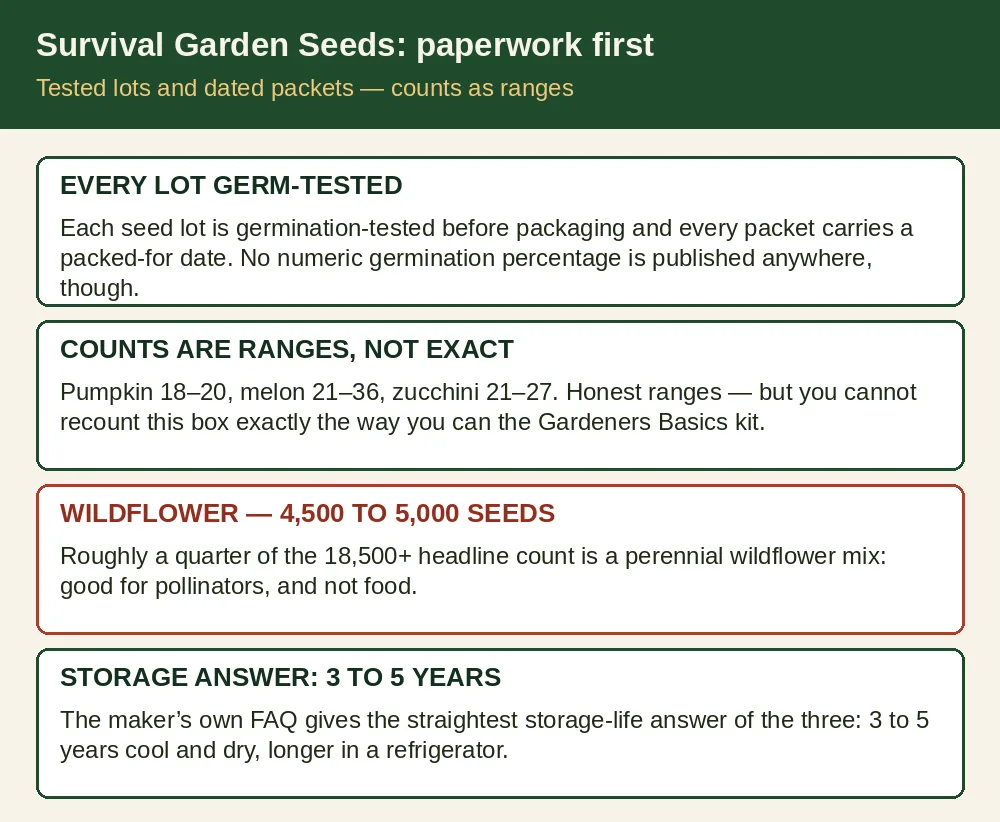
Survival Garden Seeds earns its score on paperwork: every seed lot is germination-tested before packaging, every packet carries a packed-for date, and the company’s FAQ gives the most honest shelf-life answer in this comparison — most seed stays viable 3 to 5 years stored cool and dry, longer in a refrigerator.
The 30 paper packets (instructions and seed-saving tips printed on each) ship sealed inside a waterproof zip bag. The mix leans kitchen garden: two carrots, two lettuces, two tomatoes, two peppers, kale, chard, plus that wildflower mix for pollinators. Owners rate it 4.6 stars across about 2,900 Amazon ratings, and the reviews that name results describe quick, strong sprouting. Two honest limits: the listing gives per-variety counts as ranges (pumpkin 18–20, melon 21–36), so you can’t recount it exactly, and the October 25 Buy Box price was $29.99. That’s $1.00 per variety, or about $1.62 per 1,000 headline seeds.
Pros
- Lot-by-lot germination testing and a packed-for date on every packet — the freshness paper trail the other two don’t match.
- Seed-saving instructions on every packet; the whole brand is built around replanting your own seed.
- The straightest storage-life answer of the three: 3 to 5 years, stated by the maker itself.
Cons
- Roughly a quarter of the headline count is a wildflower mix — pollinator food, not people food.
- Counts are ranges, not exact numbers, and the big-seed crops run thin: pumpkin 18–20, zucchini 21–27.
- No numeric germination percentage is published anywhere — “tested” is the claim, the rate is not.
Buy it if you plan to save seed year to year and want dated, tested lots. Skip it if every seed in the box has to be a food crop.
Check the current price on Amazon →
Open Seed Vault 15,000, 32 Variety Pack — Our Score: 7/10
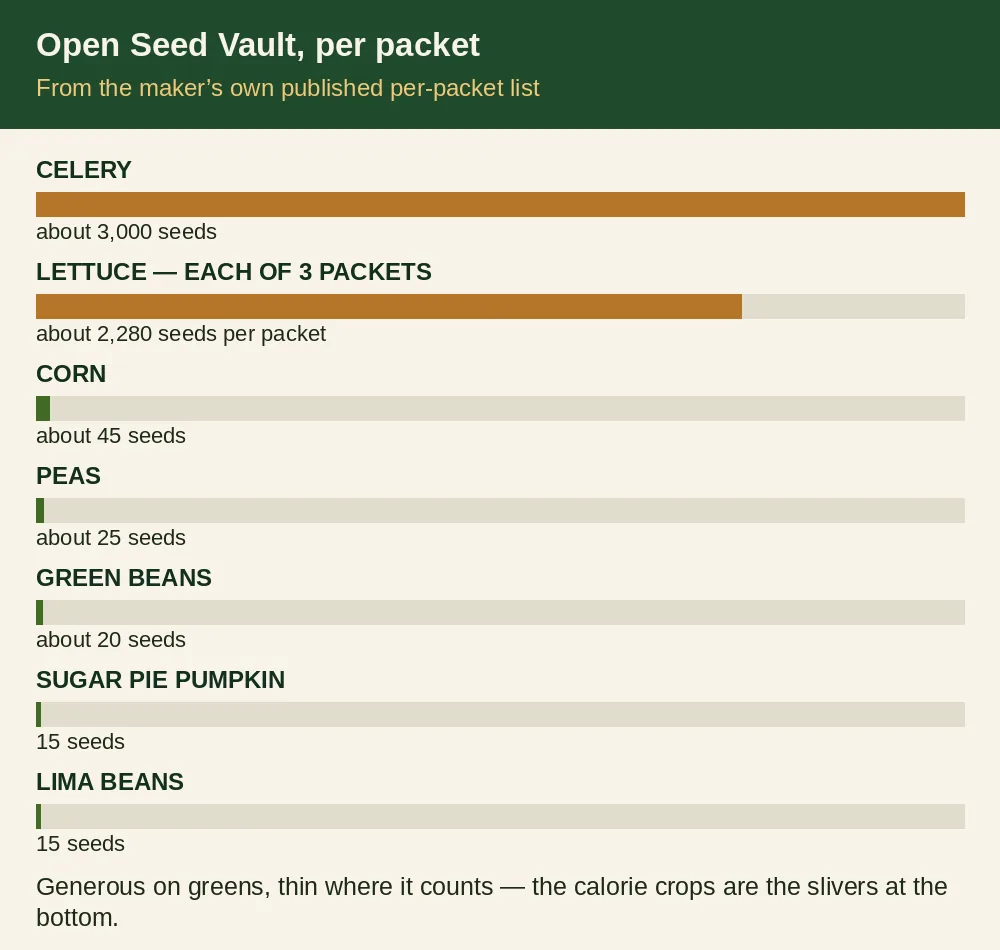
Open Seed Vault is the veteran here — 4.6 stars across roughly 14,600 Amazon ratings, the deepest owner record of the three — and its per-packet list is printed in full, which is how we know its shape: generous on greens, thin where it counts.
The 32 packets cover the staples, and the guide included in the box — 14 pages on growing and seed saving — gets praised by owners. But read the maker’s own numbers: lima beans 15 seeds, sugar pie pumpkin 15, green beans about 20, peas about 25, corn about 45, against about 2,280 seeds in each of three lettuce packets and about 3,000 celery. Review roundups synthesizing owner reports put real-world germination around 80–85 percent for buyers who planted, and the recurring complaints are specific: a packet mislabeled or substituted here and there (one buyer got a different pumpkin variety than listed), and counts on the calorie crops that feel small next to the 15,000 on the box. At $24.99 on October 25 — a third-party Buy Box, with Amazon itself out of stock — it’s the cheapest of the three per variety at $0.78. The catch is where the seeds sit, not the sticker.
Pros
- The deepest owner record in the category — about 14,600 ratings at 4.6 stars.
- Full per-packet counts published, and a growing and seed-saving guide in the box.
- Variety list sticks to practical vegetables a family will actually eat.
Cons
- About two-thirds of the 15,000 are lettuce and celery; beans, limas, peas, and pumpkin run 15–25 seeds each.
- Occasional mislabeled or substituted packets in owner reports.
- A seller Q&A answer claims 20+ years of storage life; the maker publishes no storage guide to back it, so treat that as a sales answer, not a spec.
Buy it if you want the most-reviewed vault and will top up beans and corn separately. Skip it if you’re paying for the headline count — you’re mostly buying lettuce seed.
Check the current price on Amazon →
How many of those seeds will actually feed you?
Open Seed Vault’s calorie crops are the thinnest, and the answer for all three vaults is: fewer than the box implies. Strip out lettuce, celery, and (for Survival Garden Seeds) the wildflower mix, and the food-seed counts land near 5,200 for Open Seed Vault, about 6,800 for Gardeners Basics, and somewhere around 9,000–13,000 for Survival Garden Seeds depending on where its ranges fall. Priced against those working counts, a thousand food seeds cost about $4.84 in the Open Seed Vault, $4.40 in the Gardeners Basics kit, and roughly $2.30–$3.30 in the Survival Garden Seeds pack. The deeper point sits in our bulk staples guide: a vault is not food stored, it’s food that could exist after a season of work. Buy it as a garden plan, not as a pantry line.
How long will a seed vault really stay good?
Gardeners Basics’ own storage guide is the most trustworthy answer in this post, and it contradicts Gardeners Basics’ own Amazon page. The guide says most vegetable seed lasts two to five years in good conditions, onion and parsnip can fade within a year, and cucumber, lettuce, and radish often go five years or more. Survival Garden Seeds’ FAQ lands in the same place: 3 to 5 years, longer refrigerated. Against that, the “25-year” bullet on an Amazon listing and a “20+ years” seller answer are marketing, and we’d plan on the guides. Store the vault cool, dry, and dark, and pack it like the dry goods in our mylar bag guide — with one hard difference: never put an oxygen absorber in with seeds. Seeds are alive; absorbers are for food that isn’t.
Will they sprout when you plant them?
Survival Garden Seeds has the strongest process — every lot tested before packaging — but no maker here publishes the actual percentage, and that absence is the honest headline. What exists is owner evidence: Gardeners Basics’ Amazon review summary runs about two-to-one positive on germination across 189 mentions; roundups of Open Seed Vault planters report roughly 80–85 percent sprouting; Survival Garden Seeds reviewers describe fast, strong germination without a pooled count we could verify. The maker’s own test is the one that matters before you rely on any of them: ten seeds on a damp paper towel, kept moist about a week. If fewer than half come up, Gardeners Basics’ guide says to sow thickly or replace the packet. Test every spring, and plant from the vault every year — a variety you’ve grown is a plan; a packet you’ve never opened is a hope.
What does a usable vault cost to own?
The sticker prices are $29.95, $29.99, and $24.99, but the real cost is the refresh cycle the storage guides describe. Onion, parsnip, and pepper seed fade in a year or two, so a vault kept honest gets topped up a few packets at a time — a few dollars a year if you rotate by planting, a full second purchase in year five if you sealed it and forgot it. Bought per variety, the three run $0.86 (Gardeners Basics), $1.00 (Survival Garden Seeds), and $0.78 (Open Seed Vault). Run your household’s actual food numbers first in our Food & Water Planner — most families need the vault plus stored staples, not the vault instead of them.
Honest caveats
One brand event belongs on the record. In October 2026, Gardeners Basics recalled a 1-pound pouch of Waltham 29 Broccoli sprouting seeds (UPC 848137042889, stamped “Packed for 2027,” sold from September 10, 2026) over possible Salmonella contamination in a supplier lot under FDA investigation. That is a different product from the vault kit reviewed here — the vault’s broccoli packet is a small garden packet, and no source we found says the vault is recalled, and no illnesses had been reported tied to the Gardeners Basics product itself. We report it because a seed company’s supplier handling is part of what you’re buying; check packed-for dates and lot news before you plant, whatever brand you choose. Two more: search results for “Open Seed Vault” mix in unrelated sales funnels using similar names and bigger promises (90-day guarantees, 10-year freshness) that do not belong to the Amazon product reviewed here — buy the listing, not the funnel. And no vault fixes the category’s oldest problem, named in every gardener forum we read: a seed vault on a shelf gives a false sense of security to someone who has never gardened. The first year you grow from it should be a year when mistakes are cheap.
FAQ
How long do survival seeds stay viable?
It depends on the crop, whatever the box says. The makers’ own guides put most vegetable seed at two to five years in cool, dry, dark storage; onion and parsnip fade in about a year, tomato runs about four years, while cucumber, lettuce, and radish often last five years or more. Refrigeration extends life; heat and humidity shorten it fast.
What’s the difference between heirloom and open-pollinated seeds?
All heirloom seeds are open-pollinated, but not all open-pollinated seeds are heirlooms. Open-pollinated means the plant breeds true from saved seed; heirloom adds history — a variety passed down for decades. All three vaults here are heirloom and open-pollinated, which is what makes seed saving possible.
Should I refrigerate or freeze my seed vault?
The refrigerator is the safer default — both Gardeners Basics’ guide and Survival Garden Seeds’ FAQ point there. Freezing can extend life further but only for seed that is very dry; Gardeners Basics cites Purdue Extension advising against home freezing for most gardeners, because moisture plus freezing kills seed.
Can I save seeds from my harvest and replant them?
Yes — that’s the entire point of heirloom seed. Survival Garden Seeds prints seed-saving tips on every packet, and Open Seed Vault includes a 14-page growing and seed-saving guide. Save from your healthiest plants, dry the seed fully, and label it with the variety and year.
How do I test old seeds before I rely on them?
Put ten seeds on a damp paper towel, fold it, keep it moist, and wait about a week. If fewer than half come up, sow thickly or replace the packet — that’s the protocol in Gardeners Basics’ own storage guide.
How big a garden will one vault actually plant?
Smaller than the marketing suggests. Open Seed Vault claims its pack can plant over an acre, but with 15–45 seeds of beans, peas, corn, and squash, the calorie garden from any of these vaults is a few beds, not an acre. Treat a vault as a strong start for a home garden, then add bulk packets of the calorie crops.
Sources & freshness: manufacturer listings and per-packet counts on Amazon (ASINs B08S7S98L2, B08TB3T43F, B00LE4RGOE), Survival Garden Seeds’ official FAQ, Gardeners Basics’ storage guide (updated October 23, 2026), Keepa and camelcamelcamel price records, Amazon owner-review summaries, and Food Poisoning Bulletin’s October 24, 2026 recall report. Prices last checked: October 25, 2026. Last updated: October 30, 2026.
Related reading: once a vault is home, storage decides how much of it is still alive in five years — temperature, moisture, and the freezer rules are in how to store seeds so they actually last.
Talk it over with other readers. The Truly Preserved Community on Facebook is where readers compare notes on food storage, water, and backup power — and where your questions help decide what we research next. Join the group →