
Truly Preserved is reader-supported. If you buy through a link on this page we may earn a commission at no extra cost to you. Nobody pays for placement or scores.
THE SHORT ANSWER
Long-term flour storage, the extension way: before the flour is sealed away, freeze it at 0°F for three to four days — Utah State University Extension’s figure for killing live insects, larvae, and eggs. Then pack the dry flour into a container with a hermetic (airtight) seal — a foil Mylar pouch is the one Utah State names for dry goods — with an oxygen absorber, and store it somewhere that holds a constant 40 to 60°F if you can manage it. Set expectations by flour type: Clemson Extension gives white flour one year in an airtight container in a 65 to 70°F pantry, and says whole wheat flour should not be pantry-stored at all — refrigerate it 6 to 8 months or freeze it up to 2 years.
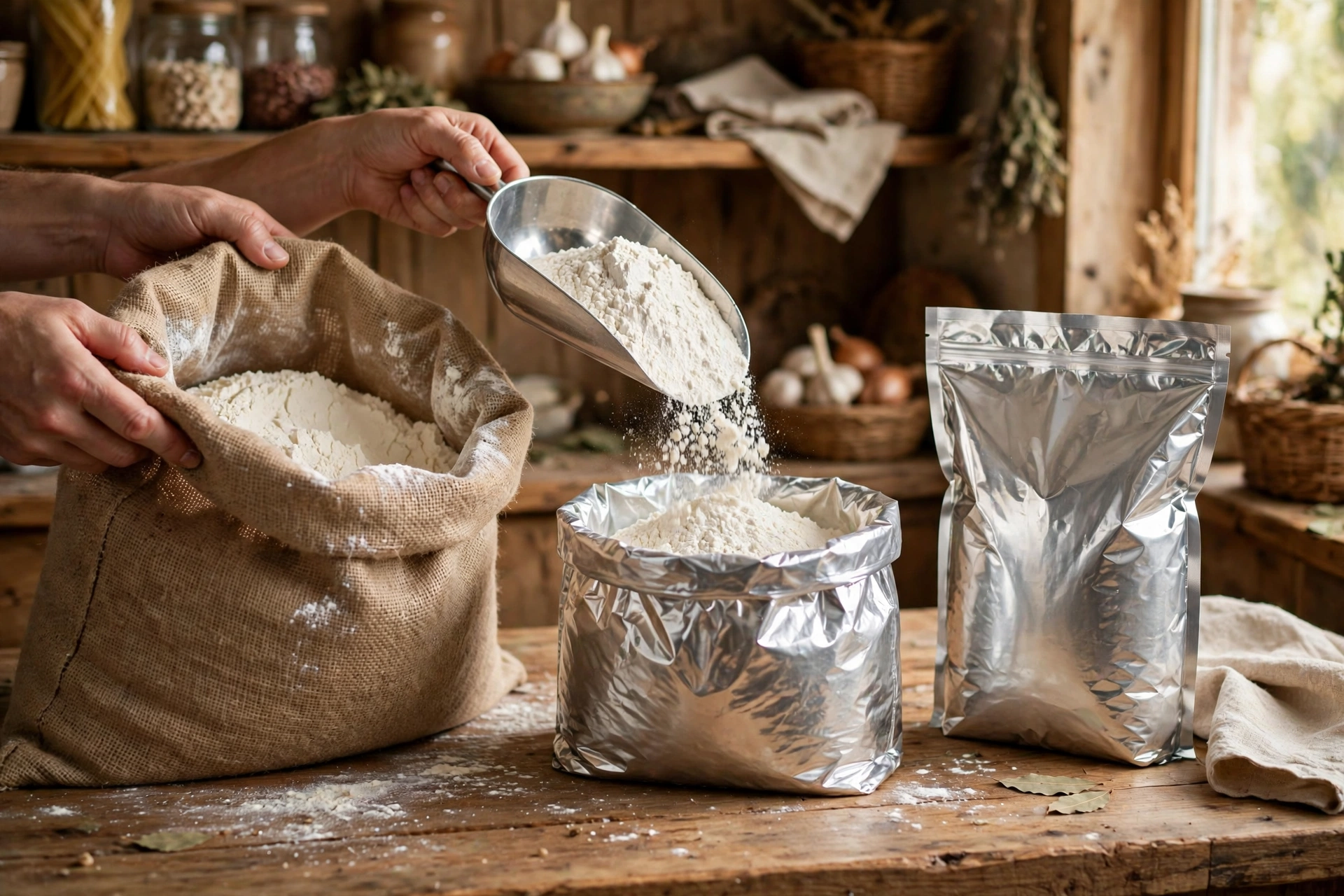
Flour looks like the easiest food in the pantry to store and quietly isn’t. It arrives with insect eggs already in it more often than anyone likes, it drinks moisture and odors from the air, and its oils — especially in whole wheat flour — go rancid on their own schedule. The extension method handles all three problems in order: freeze first to kill what hatches, seal airtight with the oxygen removed, and store cool. Skip the first step and the other two just preserve the infestation.
Storing the rest of the dry goods shelf too? How to store rice for years is the companion method, and the best mylar bags for long-term food storage compares the bags themselves. If weevils are why you are here, start with I found weevils in my stored rice — the same rescue applies.
What You Need
Flour, a freezer that holds 0°F, Mylar pouches or another container with a hermetic seal, oxygen absorbers matched to dry goods, and a heat sealer or impulse sealer for the pouches. Utah State’s packaging guidance names the container family plainly: number 10 cans, sealable food storage buckets, foil pouches, and PETE bottles for dry products — what they share is the airtight seal. Metal cans resist oxygen transfer best over the long term; foil pouches are the practical home choice.

Sukerle 5-Gallon Mylar Bags with Absorbers
Five-gallon 10.5-mil pouches with the 2000cc absorbers included — the bucket-liner format bulk flour is actually bought in.
$42.99 from Amazon
PackFreshUSA 500cc Oxygen Absorbers
Spares and top-ups for the pouches that ship without them — the absorber is the active ingredient of the whole method.
Check Availability
Metronic 8-Inch Impulse Sealer
A hermetic seal is a melted seam, and this is the tool that makes one across a Mylar pouch.
$39.99 from AmazonBefore You Start
Moisture is the gate. Utah State’s rule for foods going into airtight containers with oxygen absorbers: they must be dry — about 10 percent moisture or less — because moist food in a reduced-oxygen package is a botulism risk. Ordinary dry flour from the store meets that bar as it comes; flour that has been sitting open in a humid kitchen may not. If in doubt, store that bag for near-term use and seal a fresh, dry bag for the long term.
How to Store Flour Long-Term, Step by Step
- Freeze the flour first. Put the flour — in its bag or a freezer container — in a deep freezer at 0°F for three to four days. Utah State gives that treatment as the one that kills any live insects, larvae, and eggs.
- Let it return to room temperature before sealing, so condensation does not add moisture to a package that must stay dry.
- Fill the pouches. Pour the flour into Mylar pouches, leaving room at the top for the absorber and the seal. Work one pouch at a time.
- Add the oxygen absorber to each pouch just before sealing — absorbers start working on exposure to air, so the pouch closes within moments of the absorber going in.
- Seal hermetically. Heat-seal the pouch across its full width and check the seam: a long-term package is only as good as its seal.
- Label and store. Date every pouch and store the set somewhere cool, dark, and dry — Utah State’s best-storage figure is a constant 40 to 60°F, and it quotes the USDA rule that every 10.8°F rise in storage temperature cuts shelf life roughly in half.
- Rotate. New pouches go behind old ones; the oldest flour gets baked first.
The Numbers
| Checkpoint | The figure | Source |
|---|---|---|
| Freeze treatment | 0°F for 3 to 4 days kills insects, larvae, and eggs | Utah State Extension |
| Moisture ceiling for sealed storage | About 10 percent or less | Utah State Extension |
| Best storage temperature | Constant 40 to 60°F | Utah State Extension |
| Temperature effect | Shelf life halves per 10.8°F rise | USDA, via Utah State |
| White flour, airtight, 65–70°F pantry | 1 year | Clemson Extension |
| Whole wheat flour | Pantry not recommended; refrigerate 6–8 months or freeze 2 years | Clemson Extension |
Smaller lots round out the system — one-gallon pouches for partial bags, freezer bags for the flour in active use:

Wallaby 1-Gallon Mylar Bags, 10-Pack
One-gallon 9.5-mil pouches — the size a single bag of flour or a partial freeze-dryer run actually fills.
Check Availability
Ziploc Freezer Quart Bags
The freezer-bag half of the method — a box of quart bags handles the overflow that does not go into jars.
$26.48 from AmazonCommon Mistakes
Sealing flour that was never frozen. The freeze step is not superstition — it is the step that kills the eggs already in the flour. Seal first and you have preserved the problem in an oxygen-free pouch.
Expecting whole wheat to behave like white. Clemson does not recommend pantry storage for whole wheat flour at all; its oils go rancid. Refrigerator or freezer, on the figures above.
Storing pouches somewhere warm. A garage that swings to 90°F in summer spends shelf life at double rate by the USDA’s own arithmetic. Cool and constant beats big and convenient.
Trusting a thin plastic tub. Utah State notes plastics let significant oxygen in within 1 to 2 years. For anything meant to sit longer, the foil layer of a Mylar pouch is the point of the exercise.
Storage and Rotation
Keep the pouches in a food-grade bucket or bin once sealed — it protects the foil from punctures and keeps the set together. Date everything, rotate oldest-first, and when a pouch is opened, treat its contents as ordinary pantry flour from that day forward.
Viewers also searched for these items.


ePackageSupply 5-Gallon Buckets, 3-Pack
Food-grade buckets to armor the sealed pouches against punctures and rodents.
$73.99 from Amazon
FoodSaver Elite Vacuum Sealer
The step-up sealer for households rotating dry goods constantly.
$218.56 from AmazonFrequently Asked Questions
Do I really need to freeze flour before storing it?
If the flour is going into long-term sealed storage, yes — Utah State’s treatment is 0°F for three to four days to kill live insects, larvae, and eggs. It is the only step in the process aimed at what is already inside the bag.
How long does white flour keep?
Clemson Extension’s figure is one year in a tightly sealed, airtight container in a cool, dry pantry at 65 to 70°F. Cooler, constant storage is what stretches any flour’s life — Utah State puts the ideal at 40 to 60°F.
Can I store whole wheat flour the same way?
Not on the shelf. Clemson does not recommend pantry storage for whole wheat flour; refrigerate it for 6 to 8 months or freeze it for up to 2 years.
Should I store wheat berries instead?
Utah State raises exactly that option: storing wheat and milling it as needed prolongs quality, because whole kernels outlast their own flour. If you bake often and own a mill, it is the longer game.
Guidance: Utah State University Extension, food storage packaging and food storage guidance (extension.usu.edu), and Clemson Cooperative Extension, “Food Selection & Storage.”
Prices shown on this page were last checked November 26, 2026 — prices change; check before you buy.
Talk it over with other readers
The Truly Preserved Community on Facebook is where readers compare notes on food storage, water, and backup power — and where your questions help decide what we research next.