
Truly Preserved is reader-supported. If you buy through a link on this page we may earn a commission at no extra cost to you. Nobody pays for placement or scores.
THE SHORT ANSWER
This page publishes one salsa and only one: the USDA’s tested Choice Salsa — 6 cups peeled, cored, seeded, and chopped ripe tomatoes; 9 cups diced onions and/or peppers of any variety; 1½ cups commercially bottled lemon or lime juice; and 3 teaspoons canning or pickling salt, yielding about 6 pint jars. No ingredient substitutions are safe: the amounts are the tested recipe, and changing them leaves the tested ground. Simmer the combined salsa 3 minutes, fill pint or half-pint jars with ½-inch headspace, and process 15 minutes in a boiling-water canner at 0–1,000 feet. Every figure on this page comes from that tested recipe, credited at the bottom.
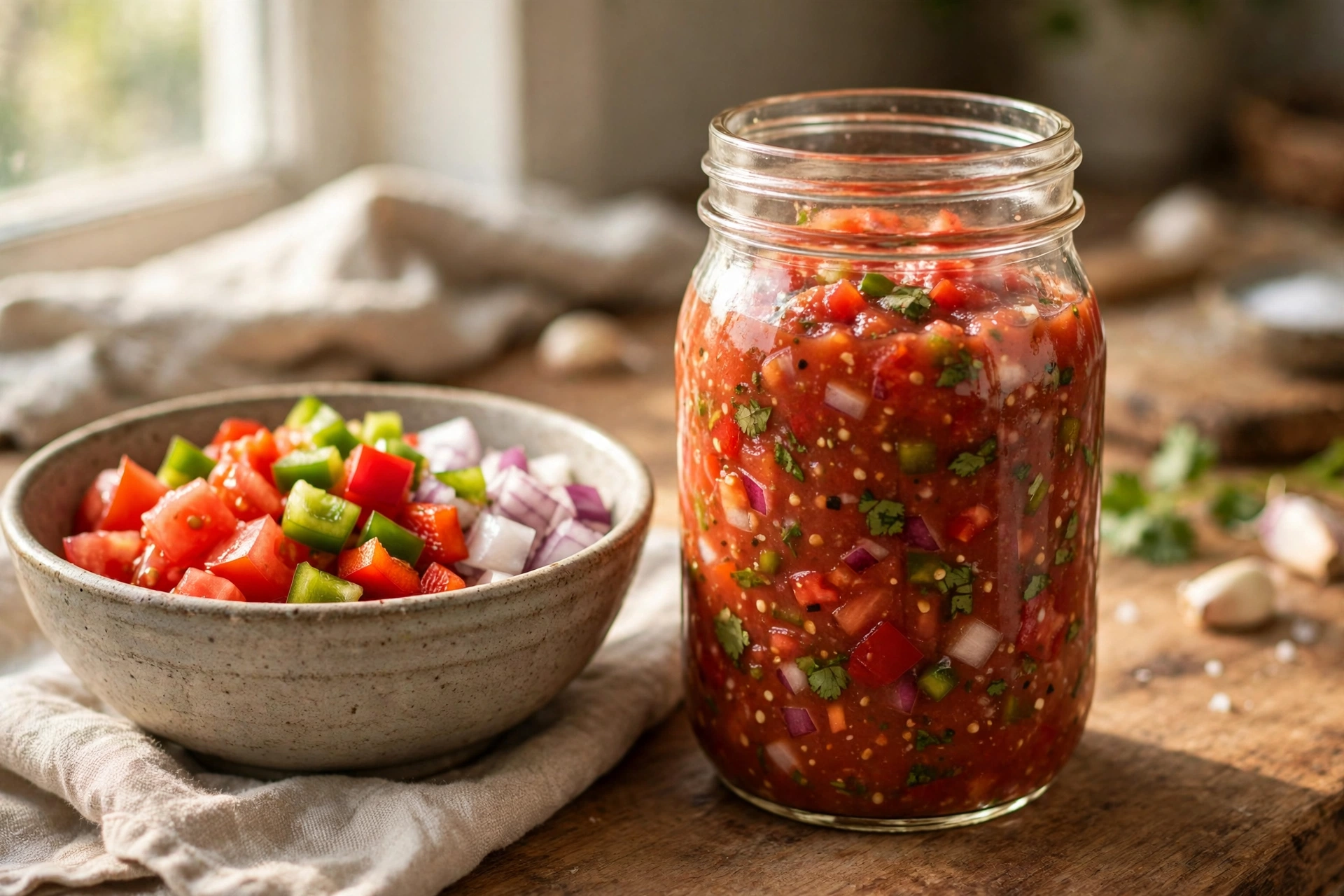
Every canner has a salsa recipe they swear by, and almost none of those recipes can be safely canned — salsa mixes high-acid tomatoes with low-acid peppers and onions, and the safety of the jar lives in the exact proportions. That is why this page exists: one tested recipe, published whole, with its one built-in freedom clearly marked.
The freedom inside Choice Salsa is real but narrow: the 9 cups of diced onions and/or peppers can be any variety, in any mix — that choice is how the heat is set. Everything else is fixed. This guide is part of our preservation guides; the tomato handling underneath it is the same as in how to can tomatoes, and how to can food in mason jars covers the boiling-water process in general.
What You Need
The full ingredient list, exactly as tested: 6 cups peeled, cored, seeded, and chopped ripe tomatoes; 9 cups diced onions and/or peppers of any variety; 1½ cups commercially bottled lemon or lime juice; and 3 teaspoons canning or pickling salt. Yield is about 6 pint jars — pint or half-pint jars are the sizes this recipe is processed in. You also need a boiling-water canner and new lids. Wear plastic or rubber gloves and do not touch your face while handling or cutting hot peppers — that caution is printed in the recipe itself.

Granite Ware 21.5-Quart Water Bath Canner
A 21.5-quart water bath canner is the tested route for Choice Salsa — 15 minutes for pints at low altitude — and holds a full batch with room to spare.
Check Availability
Ball Half-Pint Mason Jars, 12-Pack
Choice Salsa is processed in half-pint or pint jars only, and a batch yields about 6 pints — this 12-pack covers the batch and its sequel.
Check Availability
Ball Regular Mouth Canning Lids, 96 Count
Flat lids are single-use, and salsa is the jar most likely to be made twice in a season. The 96-count box keeps a fresh lid on every jar.
$36.99 from AmazonBefore You Start
Read this before you shop: no ingredient substitutions are safe in this recipe. Choice Salsa is the tested salsa this site publishes, and its safety comes from the tested balance — 6 cups of tomatoes against 9 cups of onions and peppers, acidified with 1½ cups of bottled lemon or lime juice. Do not swap in vinegar for the bottled juice, do not add extra peppers or onions beyond the 9 cups, do not cut the tomatoes back, and do not add ingredients the recipe does not list. The one choice the recipe itself offers is which onions and peppers make up the 9 cups — mild bell peppers at one end, hot peppers at the other. Anything beyond that choice is a fresh salsa: refrigerate it and eat it, do not can it.
How to Can Salsa, Step by Step
- Prepare the onions and peppers. Peel, wash, core, and dice the onions into ¼-inch pieces. Wash and core bell peppers, remove seeds and membranes, and dice into ¼-inch pieces. For hot peppers, wash and remove the stems; keep or remove as much of the seeds and membranes as you wish, depending on the heat you want, and dice into ¼-inch pieces. Together, onions and peppers total 9 cups.
- Prepare the tomatoes. Dip washed tomatoes in boiling water for 30 to 60 seconds or until the skins split, then submerge immediately in cold water. Peel off the loosened skins and remove the cores. Remove the seeds and chop into ¼- to ½-inch pieces — 6 cups in total.
- Combine and cook. Combine the prepared ingredients in a large pot; add the 1½ cups of bottled lemon or lime juice and the 3 teaspoons of salt. Bring to a boil over medium heat while stirring. Reduce the heat and simmer the salsa for an additional 3 minutes, stirring as needed to prevent scorching.
- Fill the jars. Fill the hot salsa into prepared hot jars, leaving ½-inch headspace. If needed, remove air bubbles and re-adjust the headspace to ½ inch. Wipe the rims with a dampened clean paper towel, then adjust lids and bands.
- Process. Process in a boiling-water canner for the time for your altitude in the table below.
- Rest and check. Let the jars cool undisturbed for 12 to 24 hours and check for seals. Refrigerate any leftover salsa after filling jars, and enjoy it freshly made.
The Numbers: Times, Pressures, and Amounts
Boiling-water canner — half-pint or pint jars only:
| Style of pack | Jar size | 0–1,000 ft | 1,001–6,000 ft | Above 6,000 ft |
|---|---|---|---|---|
| Hot | Half-pints or pints | 15 min | 20 | 25 |
Headspace is ½ inch. After processing, let the jars cool undisturbed for 12 to 24 hours and check for seals.
Your own favorite salsa — the untested one — still has a safe home: the freezer. Frozen in portions, it keeps its fresh flavor without pretending to a process it never had.

Ziploc Freezer Quart Bags
Quart freezer bags are how untested fresh salsa gets preserved honestly — frozen flat in meal-size portions, no canner and no guesswork about acidity.
$26.48 from Amazon
FoodSaver Elite Vacuum Sealer
For longer freezer storage of fresh salsa portions — vacuum-sealed bags keep frozen salsa from drying out and taking on freezer flavors.
$218.56 from AmazonCommon Mistakes
Substituting ingredients. The central mistake with salsa. Vinegar for bottled lemon or lime juice, extra peppers, fewer tomatoes, added corn or beans — every one of them walks off the tested recipe, and the tested recipe is the only ground this page stands on.
Canning your own salsa recipe with these times. The 15-minute process belongs to Choice Salsa’s exact proportions and acidity. A different recipe has a different, unknown acidity, and no time on this page is tested for it.
Using quart jars. The recipe is processed in half-pint or pint jars. Quarts are not in the table, so quarts are not an option.
Handling hot peppers bare-handed. The recipe’s own caution: wear plastic or rubber gloves and do not touch your face while handling or cutting hot peppers.
Skipping the simmer. The combined salsa simmers 3 minutes after it boils, before it goes into jars. That step is part of the tested procedure, not a serving suggestion.
Storage and Shelf Life
Store sealed jars in a cool, dark, dry place with the bands removed, labeled with the date and the pepper mix used — future-you will want to know which batch is the hot one. Refrigerate the canned salsa once a jar is opened for use, and refrigerate any leftover salsa from filling day and enjoy it freshly made. A jar with a failed seal goes in the refrigerator and gets eaten first.
Viewers also searched for these items.

Morton Canning and Pickling Salt, 4 lb
The recipe calls for 3 teaspoons of canning or pickling salt — this is that salt, pure and additive-free, the kind that keeps jar liquid clear.
$2.68 from Amazon
Presto 16-Quart Pressure Canner
A 16-quart pressure canner covers the rest of the tomato-season work that is not salsa — the low-acid vegetables that share the harvest, canned by their own tested procedures.
$151.63 from Amazon
Mrs. Wages Pickling and Canning Salt
A second pure pickling and canning salt for the shelf — the recipe's 3 teaspoons assume this kind of salt, with nothing added.
$19.32 from AmazonFrequently Asked Questions
Can I substitute vinegar for the lemon or lime juice?
No. The recipe specifies 1½ cups of commercially bottled lemon or lime juice — the source notes its purpose is to standardize a minimum level of acidity in the recipe. Substitutions are exactly what this recipe does not allow.
Can I make it hotter or milder?
Yes — inside the recipe’s own choice. The 9 cups of diced onions and/or peppers can be any variety in any mix: all bell peppers for mild, hot peppers for heat, and keeping or removing hot-pepper seeds and membranes adjusts it further. The total stays 9 cups.
Can I can my grandmother’s salsa with this process time?
No. The process time is tested for this recipe’s proportions only. Untested salsas can be frozen — see the freezing tools above — or eaten fresh and refrigerated.
Why bottled juice instead of fresh lemons or limes?
The recipe calls for commercially bottled lemon or lime juice because its acidity is standardized — the source states that standardizing a minimum level of acidity is the juice’s purpose in the recipe.
Procedure, times, and amounts: USDA Complete Guide to Home Canning, Guide 3, “Choice Salsa” (developed at The University of Georgia, Athens, for the National Center for Home Food Preservation), via the National Center for Home Food Preservation.
Prices shown on this page were last checked November 26, 2026 — prices change; check before you buy.
Talk it over with other readers
The Truly Preserved Community on Facebook is where readers compare notes on food storage, water, and backup power — and where your questions help decide what we research next.