
Truly Preserved is reader-supported. If you buy through a link on this page we may earn a commission at no extra cost to you. Nobody pays for placement or scores.
THE SHORT ANSWER
Sweet pickle relish: stand 3 quarts of chopped cucumbers, 3 cups each of chopped sweet green and red peppers, and 1 cup of chopped onions in salted ice water — 3/4 cup of pickling salt and 4 cups of ice in 8 cups of water — for 4 hours, drain, re-cover with fresh ice water for another hour, then pour a boiled mixture of 6 cups of white vinegar (5 percent), 2 cups of sugar, and bagged spices over the vegetables, refrigerate 24 hours, reheat to boiling, pack hot at 1/2 inch of headspace, and process half-pints or pints 10 minutes in a boiling water canner at 0–1,000 feet. The batch makes about 9 pints. Every figure on this page comes from the USDA’s tested recipe, credited at the bottom.
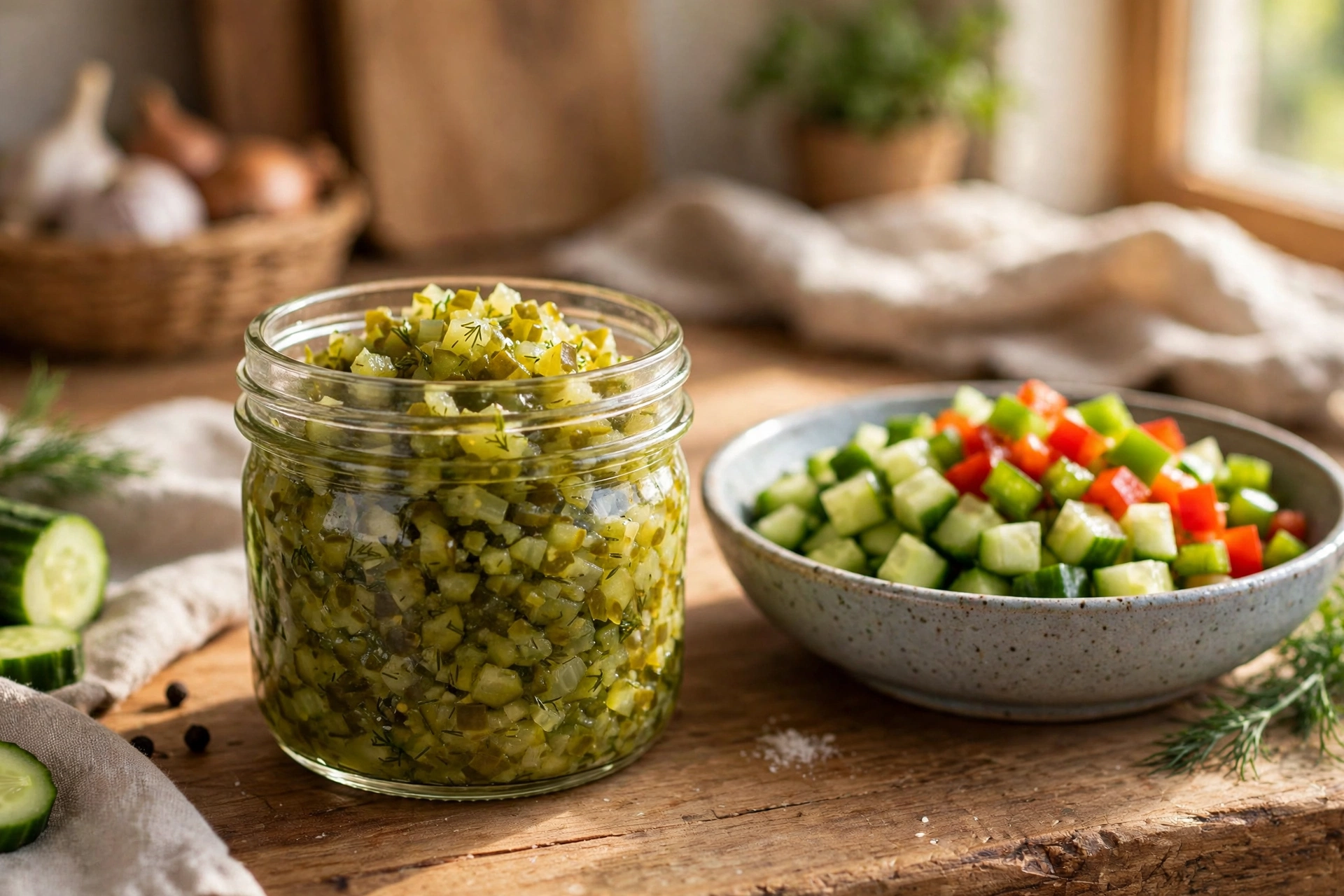
Sweet pickle relish is the jar that disappears fastest at a cookout — hot dogs, burgers, potato salad, and deviled eggs all take a spoonful. It is also the most patient recipe in this set: the chopped vegetables salt and chill, soak in a spiced vinegar mixture in the refrigerator for a full day, and only then get heated, packed, and processed. That long cold soak is not downtime to trim; it is where the relish’s texture and flavor are built.
This guide is part of our preservation guides, and it follows the tested procedure exactly — its quantities, its headspace, and its minutes — rather than a family version adjusted by feel. If you are new to the canner itself, how to can food in mason jars walks the general water-bath process start to finish, and our flagship dill pickle guide covers the cucumber side of the same method. If whole slices are more your style than a chopped relish, the bread-and-butter pickles in this same set use a closely related sweet syrup on cucumber slices.
What You Need
The USDA recipe, as written: 3 quarts of chopped cucumbers; 3 cups each of chopped sweet green and red peppers; 1 cup of chopped onions; 3/4 cup of canning or pickling salt; 4 cups of ice; 8 cups of water; 2 cups of sugar; 4 teaspoons each of mustard seed, turmeric, whole allspice, and whole cloves; and 6 cups of white vinegar (5 percent). The yield is about 9 pints.

Granite Ware 21.5-Quart Water Bath Canner
A boiling-water canner is the processing method every tested pickle procedure on this page uses, and this 21.5-quart model holds a full batch of jars at a rolling boil.
Check Availability
Ball Half-Pint Mason Jars, 12-Pack
The relish is packed hot into half-pints or pints, and this half-pint case suits a condiment jar that gets opened and finished rather than stored open.
Check Availability
Ball Regular Mouth Canning Lids, 96 Count
New lids are what the procedure assumes when it says to adjust lids and process; a fresh flat on every jar is how the seal the storage section depends on actually forms.
$36.99 from AmazonBefore You Start
Plan the clock before you chop anything: this recipe needs 4 hours in the first salted ice water, another hour in fresh ice water, and 24 hours refrigerated in the vinegar mixture before processing day. Starting it the morning you want to can guarantees a shortcut, and the shortcuts are the recipe. The spices go in a spice or cheesecloth bag so they flavor the mixture without ending up loose in every jar, and the vinegar is white vinegar at 5 percent acidity.
How to Make Sweet Pickle Relish, Step by Step
- Salt and chill. Add the cucumbers, peppers, onions, salt, and ice to the water and let stand 4 hours.
- Refresh the ice water. Drain, and re-cover the vegetables with fresh ice water for another hour. Drain again.
- Make the vinegar mixture. Combine the spices in a spice or cheesecloth bag. Add the bag to the sugar and vinegar and heat to boiling.
- Soak overnight. Pour the hot mixture over the drained vegetables, cover, and refrigerate 24 hours.
- Heat and fill. Heat the mixture to boiling and fill hot into clean jars, leaving 1/2-inch headspace.
- Close the jars. Wipe the rims, center new lids, and screw bands down fingertip-tight.
- Process in a boiling water canner for the time for your altitude in the table below.
- Rest and check. Let the jars cool undisturbed, check every seal, and label the jars before shelving.
The Numbers: Processing Times
| Jar size | 0–1,000 ft | 1,001–6,000 ft | Above 6,000 ft |
|---|---|---|---|
| Half-pints or pints | 10 minutes | 15 minutes | 20 minutes |
Headspace is 1/2 inch and the pack is hot. The two cold rests — 4 hours plus 1 hour in ice water, then 24 hours refrigerated in the vinegar mixture — are part of the procedure, not optional prep.
Cucumbers and peppers beyond the relish batch freeze and dehydrate well for winter cooking, and these are the two tools that side of the job runs on.

ThermoPro TP03H Thermometer
Refrigerator storage is the whole safety method for these eggs, and a thermometer is how you know the fridge holding them is actually cold rather than assumed cold.
$8.99 from Amazon
Ziploc Freezer Quart Bags
Quart freezer bags are the simple backup for blanched overflow vegetables and opened-jar leftovers that need to move to the freezer quickly.
$26.48 from AmazonCommon Mistakes
Compressing the schedule. Four hours, another hour, then 24 hours in the refrigerator — a relish rushed through in an afternoon is a different, untested product with a noticeably weaker texture.
Skipping the second ice water. The drain and fresh ice water hour is a written step. It rinses and re-chills the vegetables between the salt soak and the vinegar soak.
Loose spices in the pot. Whole allspice and cloves go in a bag. Loose, they end up in jars, keep intensifying, and turn up as hard bits in a spoonful of relish.
Packing the relish cold. The mixture is heated to boiling and filled hot. Cold-packed relish is not the hot pack the processing time was tested on.
Guessing at the chop. Relish texture is the chop. Pieces far larger than a relish chop heat and soak differently from the vegetables the recipe was built around.
Storage and Shelf Life
Store sealed jars somewhere cool and dark, with the bands removed, and label each jar with the date. Home-canned pickles hold their best quality for about a year; rotate the shelf so the oldest jars get eaten first. A jar that fails to seal goes in the refrigerator and gets eaten first. Once a jar is opened, keep it refrigerated.
Viewers also searched for these items.

Morton Canning and Pickling Salt, 4 lb
The recipe calls for canning or pickling salt by name; this is that salt, without the additives in table salt that cloud pickle brine.
$2.68 from Amazon
Etekcity Digital Kitchen Scale
The batch is built on weighed produce, and a kitchen scale is how you know you actually have the pounds of vegetables the tested ratio was written for.
$9.99 from Amazon
Presto 16-Quart Pressure Canner (01755)
The pressure canner for the low-acid half of the canning season — the green beans and corn that run through the same kitchen in August.
$151.63 from AmazonFrequently Asked Questions
Why does this relish take two days?
Because the procedure is built that way: 4 hours in salted ice water, 1 more hour in fresh ice water, and 24 hours refrigerated in the vinegar mixture before it is heated and processed. The rests build the texture.
Can I leave out the red or green peppers?
The recipe calls for 3 cups each of chopped sweet green and red peppers. That mix is part of the tested batch as written.
What does the turmeric do?
It is one of the four spices at 4 teaspoons each — mustard seed, turmeric, whole allspice, and whole cloves — and it gives the relish its familiar golden-green color.
What jar sizes are tested?
Half-pints or pints, at the same processing time. No quart time is published for this recipe.
Recipe and processing times: USDA Complete Guide to Home Canning, Guide 6, “Pickle Relish,” via the National Center for Home Food Preservation.
Prices shown on this page were last checked November 26, 2026 — prices change; check before you buy.
Talk it over with other readers
The Truly Preserved Community on Facebook is where readers compare notes on food storage, water, and backup power — and where your questions help decide what we research next.