
Truly Preserved is reader-supported. If you buy through a link on this page we may earn a commission at no extra cost to you. Nobody pays for placement or scores.
THE SHORT ANSWER
Your water heater is already a stored supply. The CDC lists water from your home’s tap water heater tank — the tank that connects to the water that comes out of your faucets and showerheads — among the clean water sources inside the home, alongside melted ice cubes made with uncontaminated water, toilet tank water (not the bowl) that is clear and untreated, and liquid from canned fruit and vegetables. FEMA’s drain sequence is short: turn off the electricity or gas to the heater, turn off the water intake valve, open a hot-water faucet to let air in, and draw the water from the drain valve at the bottom of the tank — and refill the tank before turning the power back on. Every step on this page comes from the sources credited at the bottom.
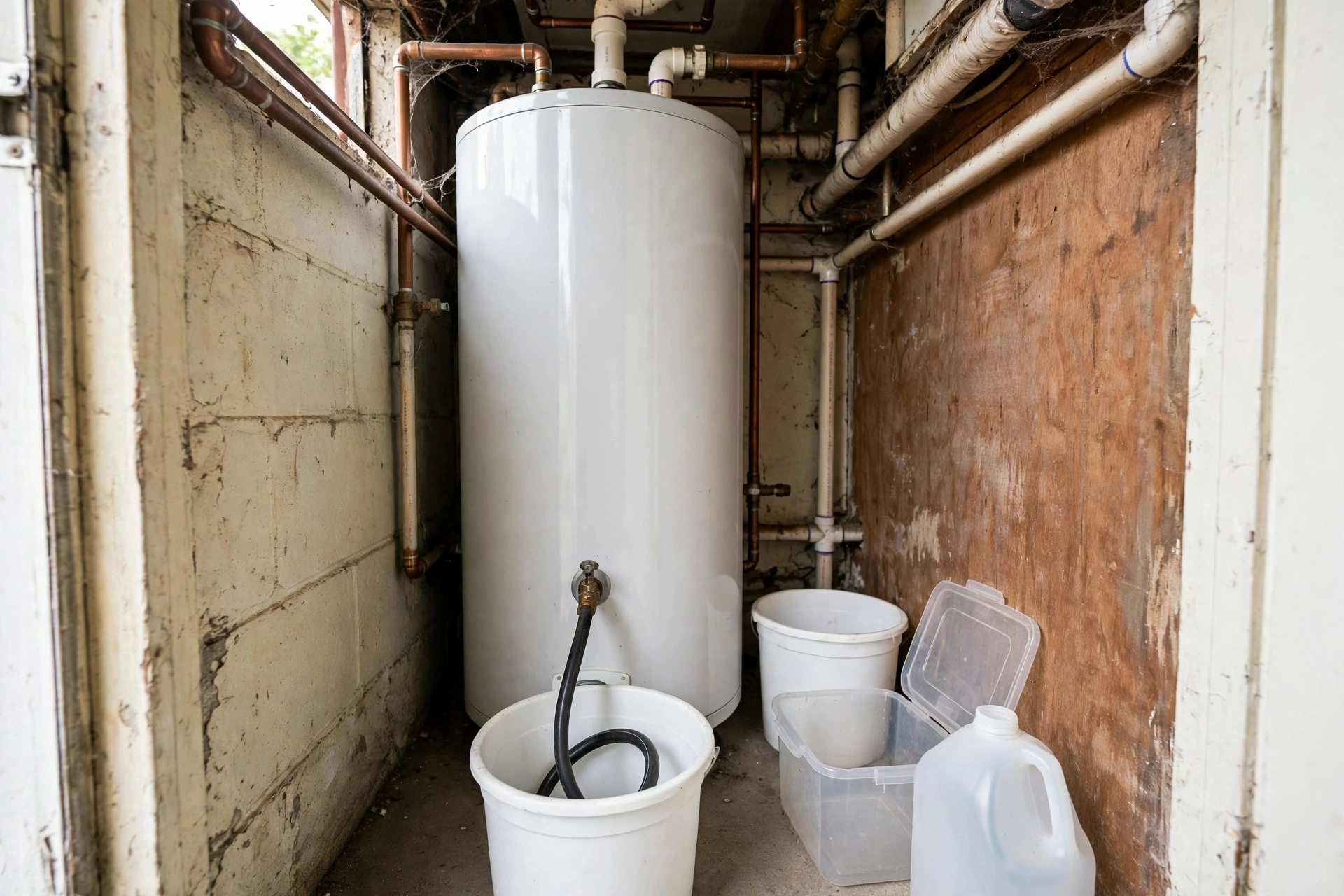
When the taps stop, most homes are sitting on a tank of treated drinking water they have already paid to heat. The water heater is part of the drinking water system — it feeds the faucets and showerheads — which is exactly why the CDC counts it as an emergency source, and exactly why the order of operations matters: drawn carelessly, the same tank can be scalded from, drained against a closed system, or damaged by being reheated empty.
This guide follows the CDC’s identification of the right tank and FEMA’s published drain sequence, in FEMA’s order. This guide is part of our preservation guides; it is the companion to how much water to store, because a heater tank is found water, not a substitute for a stored supply.
What You Need
You need very little: a container to catch the water at the drain valve at the bottom of the tank — FEMA’s sequence assumes you are drawing from that valve — and clean, sanitized containers with tight covers to hold what you draw, the CDC’s standard for stored water. A short hose that fits the drain valve makes the job cleaner, though the federal sequence does not require one. What you do not need is any treatment for the tank water itself if the tank held safe tap water — the CDC lists it among clean and safe sources inside the home.

Reliance Aqua-Tainer, 7 Gallon
A rigid container with a tight cover holds heater water drawn in an emergency, meeting the CDC standard for stored water containers.
Check Availability
Saratoga Farms 5-Gallon Water Containers
Stackable containers keep drawn water dated and separate from the planned stored supply it supplements.
$318.79 from Amazon
ePackageSupply 5-Gallon Buckets, 3-Pack
Sealed buckets catch and carry water from a low drain valve where a tall container will not fit the space.
$73.99 from AmazonBefore You Start
Two identifications before any valve moves. First, the right tank: the CDC stresses that this means the tank that connects to the water from your faucets and showerheads, not the tank used to supply hot water to radiators in older homes — in those homes, use the tap water heater tank, not the home heating system tank. The CDC is blunt elsewhere on the same point: never use water from radiators or boilers that are part of the home heating system. Second, the officials’ word: the CDC says to listen to reports from local officials, and that you may need to shut off the main water valve to your home to prevent contaminants from entering your pipes — protecting the tank’s contents before you draw them.
How to Get Water From a Water Heater, Step by Step
- Turn off the electricity or gas to the heater. FEMA’s sequence starts here, before any water moves: the heater must not be heating a tank you are about to empty.
- Turn off the water intake valve at the tank. This isolates the tank from the house supply, so what you draw is the tank’s stored water and the tank does not refill with water you may not want in it.
- Open a hot-water faucet in the house. FEMA’s reason is mechanical: opening a hot tap lets air into the system so the water will flow from the drain.
- Open the drain valve at the bottom of the tank. Draw the water into clean containers. The drain sits at the bottom of the tank, close to the floor, so a shallow container or a short hose fits where a tall bucket may not.
- Close up and label what you drew. Store the drawn water in clean, sanitized containers with tight covers. If it will sit, treat it like any stored water: label it “drinking water” with the date.
- Refill the tank before turning the power back on. FEMA’s closing caution, and the step that protects the heater: the tank is refilled first, and only then is the electricity or gas restored. FEMA adds that if the gas has been turned off, a professional will be needed to turn it back on.
The Numbers: The Indoor Sources the CDC Lists
This guide’s table is the CDC’s source list itself — the heater in context with the other water already in the house, and the uses the CDC assigns each.
| Indoor source | CDC wording |
|---|---|
| Water heater tank | The tank that connects to the water that comes out of your faucets and showerheads — not a home heating system tank |
| Melted ice cubes | Made with water that was not contaminated |
| Toilet tank (not the bowl) | If it is clear and has not been chemically treated with toilet cleaners such as those that change the color of the water |
| Canned fruit and vegetables | The liquid from the cans |
| Swimming pools and spas | For personal hygiene, cleaning, and related uses — but not for drinking |
The CDC prints no gallon figure for heater tanks on this page — tank sizes vary by home — so this guide prints none. The capacity that matters is the one on your own tank’s label, read in your own utility closet.
The heater is one indoor source among several, and the stored supply is still the plan. These are the containers and the treatment tools — the same kit our guide to how to purify water in an emergency is built around — that sit in front of the heater in any sane order of use.

Sawyer Squeeze Water Filtration System
A squeeze filter treats any replacement source if the tank runs dry and the emergency continues.
Check Availability
GRAYL GeoPress Water Purifier Bottle
A press purifier covers drinking water when indoor sources are exhausted and an outside source must be treated.
$99.95 from AmazonThe heater rewards a rehearsal more than almost any other emergency source in the house. The valves involved — the intake, the drain at the base, the control for the gas or the breaker for the electricity — are ones most people have never touched, in a closet they open twice a year, and an emergency is a poor classroom. Walk the FEMA sequence once in calm conditions, without draining anything: find the intake valve, find the drain valve, find the hot tap you would open, and find the shutoff for the fuel or power. Note which tank is which if your home has a separate heating system, because the CDC’s distinction between the tap water heater tank and a home heating tank is the one identification this whole method stands on. Consider, too, the main water valve the CDC mentions: knowing where it is, and being able to close it to keep contaminants out of your pipes, protects not just the tank but every indoor source on the CDC’s list. Ten calm minutes with a flashlight convert a stressful improvisation into a procedure you have already, in every way that matters, performed.
Common Mistakes
Draining the wrong tank. In older homes with radiators, there are two systems and only one is drinking water. The CDC’s distinction — tap water heater tank, not the home heating system tank — is the whole ballgame, and water from radiators or boilers is never to be used for drinking, cooking, or hygiene.
Turning the power back on with the tank empty. FEMA’s sequence ends with the refill for a reason: a heater fired while empty is a damaged heater. Refill first, restore power second, in that order, every time.
Skipping the hot tap. Without air let into the system, the tank drains slowly or not at all. FEMA includes the open hot-water faucet because the flow depends on it.
Leaving the intake open during a contamination event. The CDC says you may need to shut off the main water valve to keep contaminants out of your home’s pipes. A tank left connected to a contaminated supply is a tank being refilled with the problem.
Drinking pool or spa water because it is plentiful. The CDC assigns pool and spa water to personal hygiene, cleaning, and related uses — not drinking. Volume does not promote it.
Storage and Shelf Life
Water drawn from the heater becomes stored water the moment it leaves the tank, and the CDC’s storage rules apply to it: clean, sanitized containers with tight covers, labeled “drinking water” with the date, kept at 50°F –70°F away from direct sunlight and toxic substances. If the emergency ends with the tank refilled and the supply restored, the heater goes back to being invisible — and the stored shelf, rotated every six months, remains the supply you planned on.
Frequently Asked Questions
How much water is in a water heater?
The CDC page used here prints no figure, because tanks vary. This guide prints none either; the capacity is stated on the label of the tank in your home.
Is water heater water safe to drink as-is?
The CDC lists the tap water heater tank among the sources of clean and safe water inside the home. That listing assumes the tank held your normal tap water; if officials report contamination, their instructions — including shutting off the main valve — come first.
Can I use water from my radiators instead?
No. The CDC says never to use water from radiators or boilers that are part of the home heating system for drinking, cooking, or hygiene, and to be careful in older homes to use the tap water heater tank rather than the heating tank.
What else in the house counts?
On the CDC’s list: melted ice cubes made with uncontaminated water, clear untreated toilet tank water (never the bowl), and liquid from canned fruit and vegetables. Pool and spa water is for hygiene and cleaning only.
Indoor emergency sources: CDC, “How to Find Clean Water in an Emergency”; drain sequence: FEMA, “Food and Water in an Emergency” (FEMA 477), via Centers for Disease Control and Prevention.
Prices shown on this page were last checked November 26, 2026 — prices change; check before you buy.
Talk it over with other readers
The Truly Preserved Community on Facebook is where readers compare notes on food storage, water, and backup power — and where your questions help decide what we research next.