
Truly Preserved is reader-supported. If you buy through a link on this page we may earn a commission at no extra cost to you. Nobody pays for placement or scores.
THE SHORT ANSWER
Canadian bacon, the cure maker’s published recipe: trim a boneless pork loin, rub on 1 tablespoon of Morton Tender Quick mix and 1 teaspoon of granulated sugar for every pound of loin, seal it in a food-grade plastic bag, and refrigerate it to cure for 3 to 5 days. Then soak the loin in cool water for 30 minutes, dry it, slice it ⅛ inch thick, and fry the slices over low heat for about 8 to 10 minutes. Every figure in the recipe comes from Morton Salt’s published meat-curing directions, credited at the bottom; the slicing finish temperature used here is the USDA food safety service’s 145°F for pork.
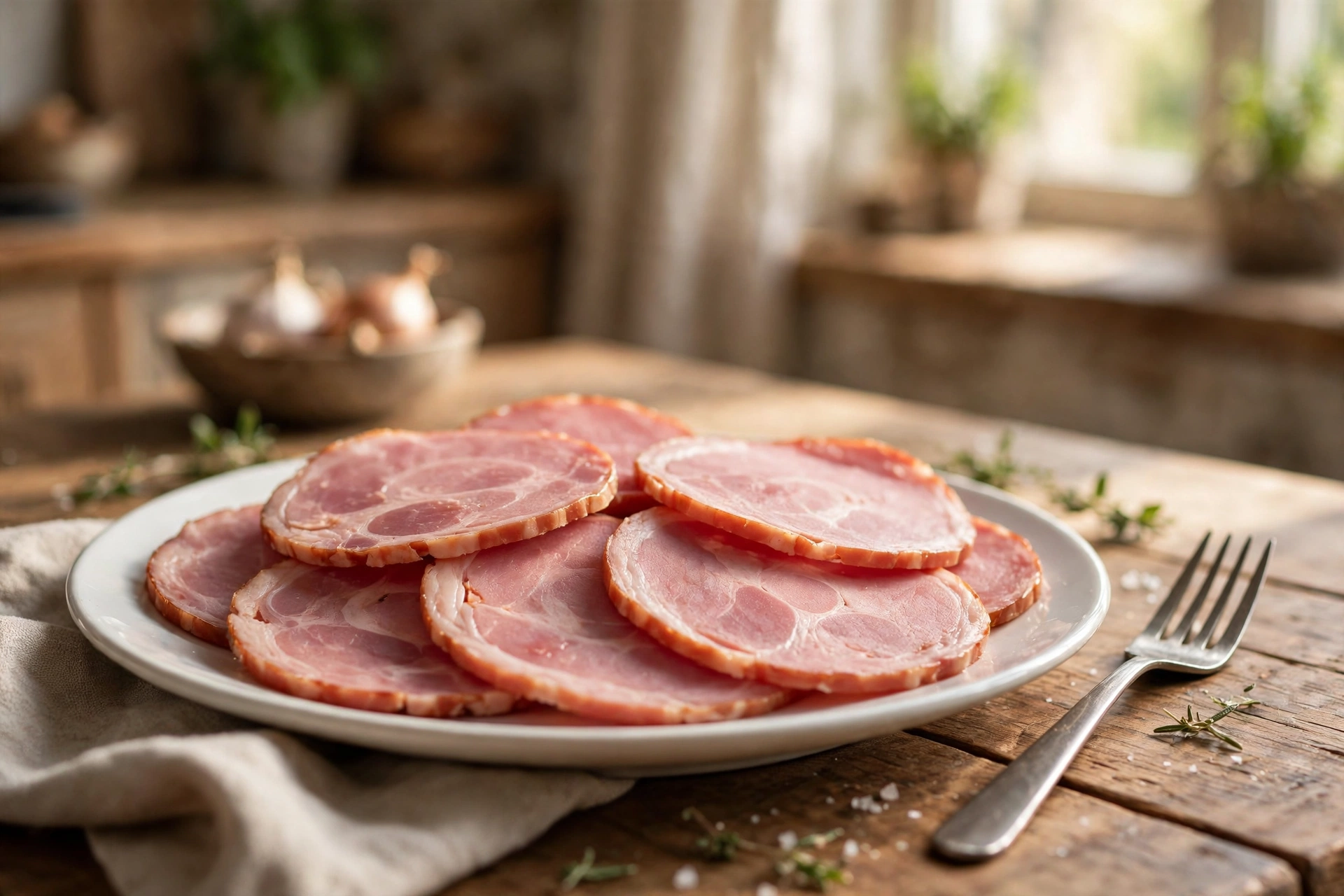
Canadian bacon is not belly bacon. It is made from the boneless pork loin — the lean eye of muscle that runs along the back — cured and sliced into rounds, which is why it eats like a mild ham rather than a strip of bacon. Because the cut is lean and uniform, it is one of the most approachable cures in this section: a short cure, a short soak, and slices that cook in minutes.
A note on the source, stated plainly: we searched for a university-extension recipe written specifically for Canadian bacon and did not find one we could fetch and verify. The recipe below is therefore the cure manufacturer’s own published directions — Morton Salt’s meat-curing recipe for Canadian bacon, using its Tender Quick mix — with the USDA food safety service’s pork temperature as the cooking finish. It is part of our preservation guides collection; the loin cure sits naturally beside how to cure bacon at home, and the cure-product rules live on how to use curing salt safely.
What You Need
One boneless pork loin. The cure is measured per pound of loin: 1 tablespoon of Morton Tender Quick mix per pound, and 1 teaspoon of granulated sugar per pound. Weigh the loin first — the recipe runs on its weight. You also need a food-grade plastic bag, cool water for the soak, and a skillet.

Etekcity Digital Kitchen Scale
The cure is measured per pound of loin — 1 tablespoon of mix per pound — so the loin gets weighed before anything is rubbed on.
$9.99 from Amazon
ThermoPro Instant-Read Thermometer
For cooking the cured loin whole, the finish is the pork figure of 145°F, and a thermometer is the only way to call it.
$8.99 from Amazon
Ziploc Freezer Quart Bags
The cure happens sealed in a food-grade bag in the refrigerator, and finished slices freeze in the same quart size.
$26.48 from AmazonBefore You Start
Three rules. First, the cure amount belongs to Tender Quick mix specifically: 1 tablespoon per pound of loin. Do not substitute Prague Powder #1 into this recipe at the same measure — the products differ, and guessed conversions are how home cures go wrong. Second, trim the fat from the loin before the cure goes on, as the directions direct. Third, the cure happens in the refrigerator for the full 3 to 5 days.
How to Make Canadian Bacon, Step by Step
- Trim the loin. Trim the fat from the boneless pork loin.
- Mix the cure. For each pound of loin, combine 1 tablespoon of Morton Tender Quick mix with 1 teaspoon of granulated sugar.
- Rub it in. Rub the mixture into the loin, over all its surfaces.
- Bag and refrigerate. Place the loin in a food-grade plastic bag, tie the open end, refrigerate, and allow it to cure for 3 to 5 days.
- Soak. Remove the loin from the cure and soak it in cool water for 30 minutes.
- Dry. Pat the loin dry and refrigerate it uncovered to dry slightly before cooking.
- Slice. Cut the cured loin into ⅛-inch-thick slices.
- Fry. Preheat a skillet, brush it with oil, and fry the slices over low heat, turning to brown evenly, about 8 to 10 minutes. For whole-loin cooking before slicing, the food safety service’s pork figure is 145°F with a rest — see the table.
The Numbers: Cure per Pound, Days, and Minutes
| Checkpoint | The figure |
|---|---|
| Morton Tender Quick mix | 1 tablespoon per pound of loin |
| Granulated sugar | 1 teaspoon per pound of loin |
| Curing time, refrigerated | 3 to 5 days |
| Soak in cool water | 30 minutes |
| Slice thickness | ⅛ inch |
| Frying time | About 8 to 10 minutes over low heat |
| Pork finish temperature (USDA FSIS) | 145°F, with a rest, for whole-muscle pork |
A cured loin slices and freezes in breakfast-size portions, and the cured-meat shelf beside it — ham, salt pork, and the rest — runs on the same scale-and-thermometer discipline. Two tools for the portioning step:

Nesco VS-12 Vacuum Sealer
Vacuum-sealed packs of slices are how a whole loin becomes a month of breakfasts without freezer burn.
$108.18 from Amazon
FoodSaver Elite Vacuum Sealer
The step-up sealer for loin day, when one cut becomes a dozen sealed portions at once.
$218.56 from AmazonCommon Mistakes
Guessing the loin’s weight. The cure is 1 tablespoon per pound. An unweighed loin gets an unmeasured cure, in one direction or the other.
Swapping cure products. Tender Quick, Prague Powder #1, and plain salt are three different things. This recipe’s amount was published for Tender Quick only.
Skipping the soak. The 30-minute cool-water soak is part of the recipe, not an optional rinse — it is what keeps the finished slices from eating harsh and salty.
Slicing thick. The recipe’s slice is ⅛ inch. Thick slices fry unevenly in the recipe’s 8 to 10 minutes.
Curing warm or short. The bag belongs in the refrigerator for the full 3 to 5 days. A counter cure is outside the recipe entirely.
Storage and Shelf Life
Keep the cured loin and its slices refrigerated, and freeze portions that will not be eaten within a few days — Canadian bacon freezes well in sealed, slice-ready packs. Cooked slices are ordinary cooked pork: refrigerate promptly and keep them cold.
Viewers also searched for these items.

Morton Canning and Pickling Salt, 4 lb
The pure pickling salt for the wider curing shelf — the brines and dry cures in this section that call for plain salt by weight.
$2.68 from Amazon
Mrs. Wages Pickling and Canning Salt
A second additive-free pickling salt in a resealable pouch, kept beside the curing spices.
$19.32 from Amazon
IRIS USA Airtight Container, 30 lb, with Wheels
Airtight storage for cure mixes and spices between batches, sealed against kitchen humidity.
$23.99 from AmazonFrequently Asked Questions
Is Canadian bacon made from ham?
No. It is cured boneless pork loin — the lean back muscle — which is why it slices into rounds and eats leaner than belly bacon.
Can I smoke the loin instead of frying slices?
The published recipe finishes the meat as fried slices. If you cook the whole cured loin, cook it as whole-muscle pork to the food safety service’s 145°F and let it rest before slicing.
How much cure does a 4-pound loin take?
The recipe’s rate is per pound: 4 tablespoons of Morton Tender Quick mix and 4 teaspoons of granulated sugar for a 4-pound loin.
Why the sugar?
It is part of the published recipe — 1 teaspoon per pound — and it rounds the cure’s salt edge in the finished slices.
Recipe: Morton Salt, “Meat Curing — Canadian Bacon” (manufacturer’s published directions for Morton Tender Quick mix). Pork temperature: USDA Food Safety and Inspection Service, via via the Morton Salt.
Prices shown on this page were last checked November 26, 2026 — prices change; check before you buy.
Talk it over with other readers
The Truly Preserved Community on Facebook is where readers compare notes on food storage, water, and backup power — and where your questions help decide what we research next.