
Truly Preserved is reader-supported. If you buy through a link on this page we may earn a commission at no extra cost to you. Nobody pays for placement or scores.
THE SHORT ANSWER
Curing salt, safely, in one page: Curing Salt #1 (Prague Powder #1) is a manufactured blend of 6.25 percent sodium nitrite and 93.75 percent salt, dyed pink so it can never be mistaken for table salt. In Oregon State University Extension’s bacon recipe it is measured at 1 teaspoon for 5 pounds of pork belly — and that is the shape of every safe use: a tested recipe’s own amount, for the product that recipe names, weighed or measured exactly, with the meat cured cold. The federal ceiling behind the recipes is 200 parts per million of sodium nitrite in the finished product for home curing preparations, and Mississippi State University Extension’s warning is the one to remember: too much nitrate and nitrite can be toxic. Every figure on this page comes from the extension and federal sources credited at the bottom.
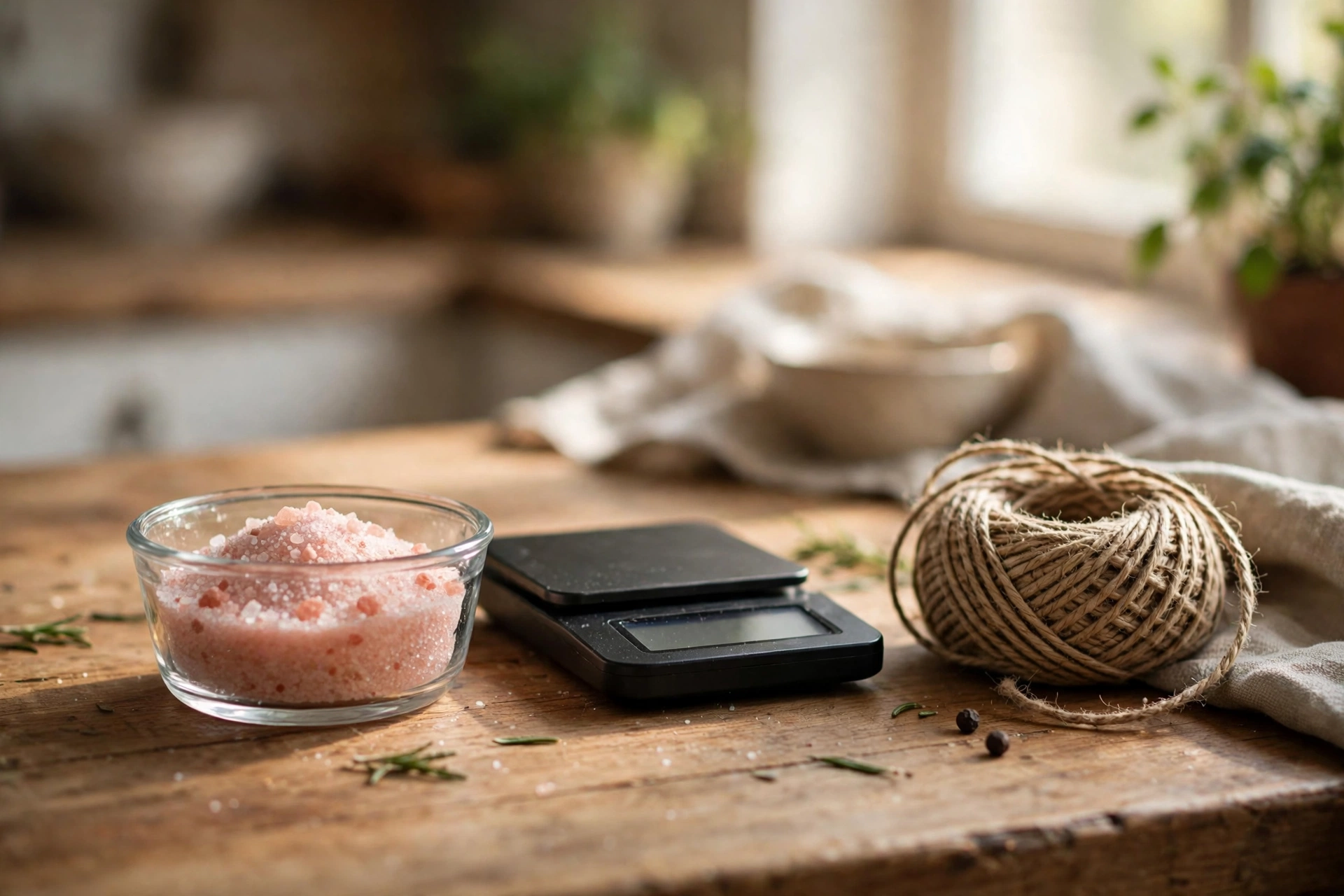
This is the trust page for the whole curing section — the one every other guide here links to when its prose turns to cure safety. It exists because curing salt is the rare kitchen ingredient where the dose is the safety system: sodium nitrite is what holds back botulism in cured meat, fixes the pink color, and builds cured flavor, and it is also, in Oregon State’s plain words, a substance with relatively high toxicity that must be used in the amounts set by researched recipes. Both halves of that sentence are true at once, and home curing works when they are both respected.
This guide is part of our preservation guides. It deliberately contains no recipes of its own: the amounts live in the recipes written for each product — bacon, corned beef, smoked sausage — and this page’s job is the rules that govern all of them: what the products are, how the limits work, and how the salt is handled and stored.
What You Need
Three things, and they are all discipline rather than equipment. The right product for the recipe in front of you. A way to measure it exactly — a kitchen scale for weighed cures, and level measures where a recipe prints spoons. And the recipe itself, from a tested source, followed as the only authority on its own amounts. The products in this section’s recipes are Curing Salt #1 (Prague Powder #1) and Morton Tender Quick mix, and they are not interchangeable.

Hoosier Hill Farm Prague Powder No. 1
Hoosier Hill Farm Prague Powder #1 — the 6.25 percent sodium nitrite blend Oregon State's bacon recipe specifies, in a tub sized for many batches.
$18.99 from Amazon
Etekcity Digital Kitchen Scale
Curing amounts are built on the meat's weight and measured exactly — the scale is the safety equipment on this page.
$9.99 from Amazon
ThermoPro Instant-Read Thermometer
The cure never replaces the cook: every cured meat in this section ends at a thermometer figure, and this is the tool that reads it.
$8.99 from AmazonBefore You Start
Learn the two confusions that cause the injuries. The first is color: pink curing salt is not Himalayan pink salt. They share a color and nothing else — Himalayan salt contains no measured nitrite and cures nothing, and curing salt is dyed pink precisely so it will not be mistaken for a seasoning salt. The second is product-swapping: Cure #1, Cure #2, and Tender Quick are different mixtures with different amounts in their recipes. A spoon of one is never a spoon of another.
How to Use Curing Salt Safely, Step by Step
- Start from a tested recipe. Every amount in this program comes from an extension or manufacturer recipe written for a specific product and a specific meat. If a recipe does not name the cure product and its amount, it is not a curing recipe — it is a rumor.
- Use the product the recipe names. Curing Salt #1 is 6.25 percent sodium nitrite with salt, for cured meats that will be cooked. Curing Salt #2 adds nitrate for long dry-aging — and Oregon State advises against it for bacon, because it produces more nitrosamines when bacon is fried.
- Measure exactly. Oregon State’s bacon recipe measures 1 teaspoon of Curing Salt #1 for 5 pounds of pork belly, alongside 5 tablespoons of salt. Level measures, weighed meat, no heaping, no rounding — the recipe’s amounts are the safety system.
- Never add extra “for safety.” Mississippi State’s warning stands for the whole shelf: too much nitrate and nitrite can be toxic. More cure is a dosing error, not insurance.
- Cure cold. The recipes in this section cure in the refrigerator — Oregon State’s bacon at 40°F — for the recipe’s full time.
- Respect the federal ceilings behind the recipes. Home curing preparations are directed to limit sodium nitrite to not more than 200 parts per million in the finished meat product, and sodium nitrate to not more than 500 parts per million. In bacon specifically, the food safety service caps ingoing nitrite at 200 parts per million for dry-cured bacon and 120 parts per million for pumped and immersion-cured bacon.
- Store it like the chemical it is. Keep curing salt in its original, labeled container, sealed, in a place apart from table salt and seasonings, where it cannot be grabbed by mistake or reached by children. The pink color is a warning label — keep it attached to its name.
- Cook cured meat to its temperature. The cure is not the cook. Every guide in this section ends at a thermometer figure, and the cure never replaces it.
The Numbers: Composition, One Tested Amount, and the Ceilings
| Item | The figure | Source |
|---|---|---|
| Curing Salt #1 composition | 6.25 percent sodium nitrite, 93.75 percent salt | Oregon State Extension PNW 784 |
| Tested amount — bacon recipe | 1 teaspoon of Curing Salt #1 per 5 pounds of pork belly, with 5 tablespoons of salt | Oregon State Extension PNW 784 |
| Bacon cure temperature and time | 40°F refrigerator, 5 to 7 days | Oregon State Extension PNW 784 |
| Home curing ceiling — sodium nitrite | Not more than 200 parts per million in the finished meat product | 21 CFR 172.175 (federal food additive regulation) |
| Home curing ceiling — sodium nitrate | Not more than 500 parts per million in the finished meat product | 21 CFR 172.175 |
| Bacon ceiling — dry-cured | 200 parts per million ingoing sodium nitrite maximum | USDA FSIS (9 CFR 424.22) |
| Bacon ceiling — pumped / immersion-cured | 120 parts per million ingoing maximum | USDA FSIS (9 CFR 424.22) |
| Sodium nitrate in bacon | Not allowed — USDA does not allow sodium nitrate in bacon products | Mississippi State Extension |
The tools that make exact curing possible — a scale that reads small amounts honestly and storage that keeps cure ingredients labeled and apart — are the mid-page shelf here:

IRIS USA Airtight Container, 30 lb, with Wheels
Airtight, clearly separate storage for cure ingredients — kept sealed, dry, and apart from everyday seasonings.
$23.99 from Amazon
Vittles Vault 35 lb Airtight Container
A gasket-sealed vault for the bulk salts on the curing shelf, safe from moisture and mix-ups.
Check AvailabilityCommon Mistakes
Confusing pink curing salt with Himalayan pink salt. Same color, opposite purposes. One is a measured nitrite blend; the other is a table salt. Oregon State calls this confusion out by name.
Converting between cure products. Tender Quick amounts, Cure #1 amounts, and Cure #2 amounts belong to their own recipes. There is no safe spoon-for-spoon conversion, and this program prints none.
Heaping the spoon. A heaped teaspoon of a 6.25 percent nitrite blend is a different dose from a level one. The recipe means the measure as written.
Decanting into an unlabeled jar. The moment curing salt loses its label and its pink context, it becomes a hazard to the next person in the kitchen. Original container, sealed, stored apart.
Curing warm. The recipes cure cold — 40°F in the bacon recipe. A warm cure is outside every recipe on this shelf.
Skipping the cure in a recipe that requires it. The other direction of the same error: where a tested recipe includes nitrite, it is there against botulism in exactly the low-oxygen, cold, smoked conditions curing creates. Follow the recipe whole, or choose a different recipe — do not edit the safety ingredient out.
Storage and Shelf Life
Store curing salt sealed in its original labeled container, dry, and apart from everyday salts and seasonings. No source in this program prints a home shelf-life figure for curing salt, so none is given here — what the sources do require is that the product stay identifiable: labeled, pink, and separate, for as long as it is in the house. If a container’s identity is ever in doubt, the extension answer applies to the ingredient as it does to the meat: throw it out.
Viewers also searched for these items.

Morton Canning and Pickling Salt, 4 lb
The plain pickling salt that partners Cure #1 in the dry-cure recipes — 5 tablespoons of it beside the teaspoon of cure in the bacon recipe.
$2.68 from Amazon
Mrs. Wages Pickling and Canning Salt
A second additive-free pickling salt in a resealable pouch for the shelf's other cures and brines.
$19.32 from Amazon
ePackageSupply 5-Gallon Buckets, 3-Pack
Food-grade buckets for organizing the curing shelf — cure ingredients stored sealed, labeled, and separate.
$73.99 from AmazonFrequently Asked Questions
What is the difference between Curing Salt #1 and #2?
Curing Salt #1 is 6.25 percent sodium nitrite with salt, for cured meats that will be cooked. Curing Salt #2 adds nitrate for long dry-aging, and Oregon State advises against it for bacon because it produces more nitrosamines when the bacon is fried.
How much curing salt is safe?
The amount in a tested recipe for the product you are holding — for example, Oregon State’s 1 teaspoon of Curing Salt #1 per 5 pounds of pork belly. Behind the recipes, federal rules cap home curing preparations at 200 parts per million of sodium nitrite in the finished product.
Is curing salt the same as pink Himalayan salt?
No. Himalayan salt is a seasoning salt with no measured nitrite. Curing salt is a manufactured nitrite blend, dyed pink so the two are never confused.
Can I cure meat with plain salt only?
Some traditional methods in this section are salt-led, and their tested recipes are followed as written. But where a recipe specifies a nitrite cure, the nitrite is a safety ingredient, not a coloring — follow that recipe whole or use a different tested recipe.
Composition, bacon amount, and product guidance: Oregon State University Extension, “Making Cured Bacon at Home,” PNW 784 (2025). Nitrite ceilings: USDA Food Safety and Inspection Service, 9 CFR 424.22, and 21 CFR 172.175. Toxicity and bacon nitrate rule: Mississippi State University Extension, “Curing Pork Products at Home,” via via the Mississippi State University Extension.
Prices shown on this page were last checked November 26, 2026 — prices change; check before you buy.
Talk it over with other readers
The Truly Preserved Community on Facebook is where readers compare notes on food storage, water, and backup power — and where your questions help decide what we research next.