
Affiliate Disclosure: Truly Preserved is reader-supported. When you buy through links on this page, we may earn a commission at no extra cost to you. As an Amazon Associate, Truly Preserved earns from qualifying purchases. Learn more.
How we researched this comparison. We scored 3 products head to head for this page. The work behind the scores: manufacturer specifications and certification records where they apply, prices checked when this review was written, and patterns across verified owner feedback — a praise or complaint point only counts here when it shows up again and again, not once. The products were chosen to cover the main designs and price points a buyer in this category actually cross-shops. We are a research desk: we do not buy or hands-on test the products, and commissions never change a score. How we research and score →
Every power-station comparison on this site until now has been about the big 2,000Wh boxes. This one is about the size most apartment and small-house buyers actually end up with: the 1,000Wh class — enough for a fridge through a workday outage, light enough to carry down stairs, cheap enough to argue for. This comparison is built from published specs, current prices checked on October 27, 2026, and aggregated owner feedback across roughly 10,800 Amazon ratings between the three listings. We don’t own these stations; we did the homework. The headline finding: all three hold about the same battery (1,024–1,070Wh), so this class is won and lost on output, solar input, and how fast the box switches over when the grid drops — not on capacity.

The Short Version
Bluetti Elite 100 V2
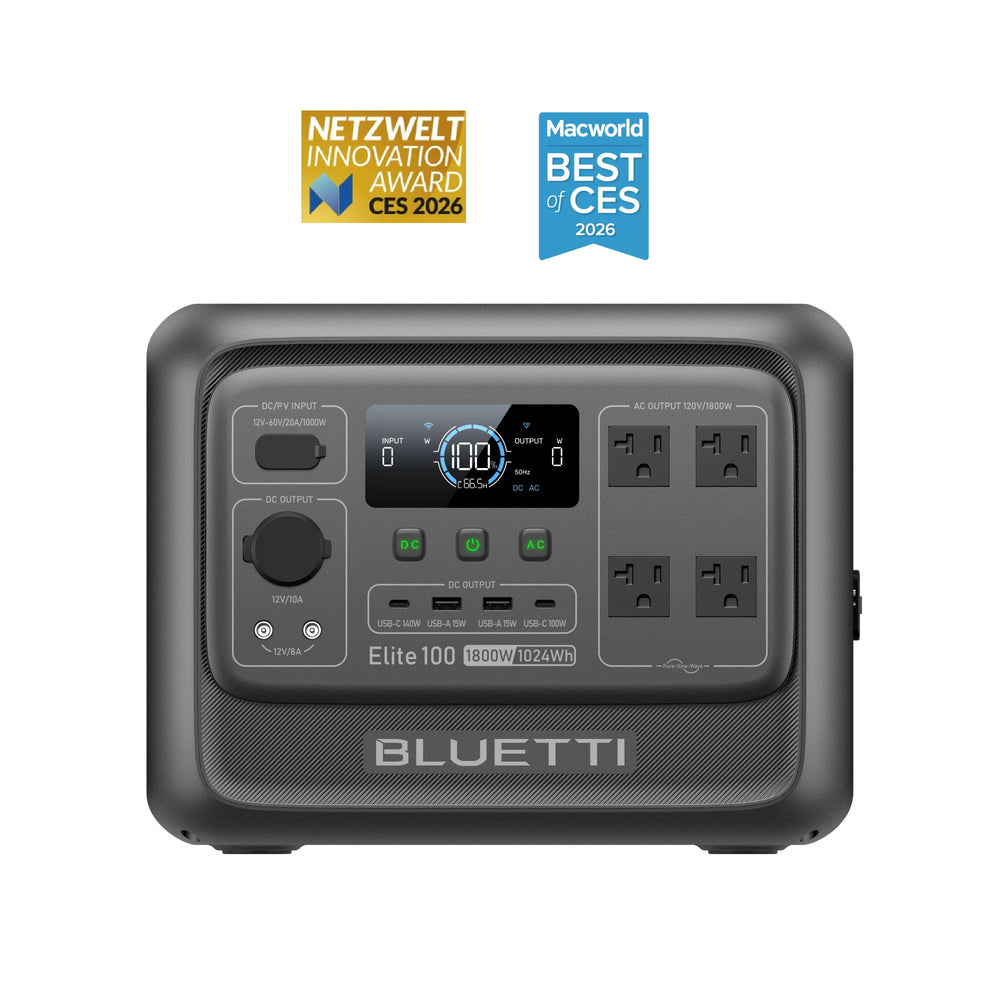
Photo: Bluetti.
See it at BluettiWe may earn a commission at no extra cost to you.
Jackery Explorer 1000 v2
See it on AmazonWe may earn a commission at no extra cost to you.
EcoFlow DELTA 2
See it on AmazonWe may earn a commission at no extra cost to you.
How we chose: we compared the three stations on capacity, output, solar input, charge speed, backup switchover time, weight, battery cycle ratings, and cost per watt-hour at prices verified the same day on the price trackers, and weighed owner feedback across the three listings’ ratings. Scores follow our published rating method.
Head-to-Head Specs
| Station | Price | Capacity | AC output |
|---|---|---|---|
| Bluetti Elite 100 V2 Read the review ↓ |
$489 | 1,024Wh | 1,800W |
| Jackery Explorer 1000 v2 Read the review ↓ |
$499 | 1,070Wh | 1,500W |
| EcoFlow DELTA 2 Read the review ↓ |
No live offer 10/27 | 1,024Wh | 1,800W |
More of the spec sheet, in plain terms: the Bluetti weighs 25.3 lb, charges from a wall at up to 1,200W (80% in about 45 minutes, full in about 70), accepts up to 1,000W of solar per its manual, and switches to battery in 10ms in UPS mode. The Jackery weighs 23.8 lb, charges in about 95 minutes normally or 59 minutes in its app-triggered emergency mode, takes up to 400W of solar, and switches in 20ms. The EcoFlow weighs 27 lb, charges at up to 1,200W (80% in about 50 minutes), takes up to 500W of solar, and its EPS switchover is rated 30ms in its manual. All three use LiFePO4 batteries and can charge and power things at the same time. Prices last checked: October 27, 2026.
Bluetti Elite 100 V2: The Most Muscle per Box Here
Our score: 9/10 — the strongest output, the fastest backup switchover, and a solar ceiling two to two-and-a-half times the others’, at $489 on Bluetti’s own store the day we checked.
The Elite 100 V2 is the output winner: 1,800W continuous from a 1,024Wh battery, a 3,600W surge rating, and a Power Lifting mode rated to 2,700W for resistive loads like a kettle. Its 10ms UPS switchover is the fastest here — the spec that decides whether a desktop or a CPAP rides through the moment the grid drops. The solar story is the real gap, though: Bluetti’s manual rates the DC input at 1,000W, against 500W for the EcoFlow and 400W for the Jackery, so in a multi-day outage with panels out, this is the station that refills while the others are still sipping. Bluetti rates the battery for 4,000+ cycles to 80% capacity and covers it for 5 years. One honest limit: that 1,000W comes through a single input, so using all of it means several panels on one cable run.
What owners love: the output headroom for its size, how quiet it runs at light loads, and two full nights of CPAP per charge in owner reports. What they complain about: across roughly 1,841 Amazon ratings (4.5 stars), fans get distracting under heavy load despite the quiet light-load manners, and the app/Bluetooth setup draws the usual Bluetti grumbles, including that Bluetooth can’t wake the unit from sleep. At $489 on Bluetti’s own store the day we checked (list price $499), it works out to about 48 cents per watt-hour — a cent behind the Jackery, which takes the cheapest-stored-power title; the Bluetti’s case rests on output, solar headroom and switchover speed. Amazon’s Buy Box was $499 the same day, so the direct store was the better buy at this check; our link goes there.
Buy it if: output, fast switchover, or solar refilling decide your outage plan. Skip it if: you’ll carry it daily — the Jackery is lighter and simpler.
Best solar pairing: Bluetti’s 200W or 350W panels (PV200 class and up) — with a 1,000W ceiling, this is the one station here that can actually use three 350W panels. More on panel sizing in our backup power hub.
Our score: 9/10
Check the current price at Bluetti →
Jackery Explorer 1000 v2: The One You Won’t Mind Carrying
Our score: 8/10 — the most watt-hours, the least weight, and the cheapest stored power of the three, with the lowest output and solar ceiling.
Jackery squeezed 1,070Wh — the most capacity in this comparison — into 23.8 lb, the lightest box here by a clear margin. If this station has to live in a closet and come down two flights of stairs when the lights go out, that matters more than spec-sheet bragging. Output is 1,500W (3,000W surge): enough for a fridge, lights, phones, a laptop, and a CPAP, though a big microwave plus anything else will trip it where the Bluetti wouldn’t. Charging is the party trick — about 95 minutes from a wall normally, or 59 minutes flat in the emergency mode you switch on in the app. Jackery rates the battery at 4,000 cycles to 70% capacity (note the softer endpoint than Bluetti’s 80%), and the warranty is 3 years, extended to 5 if you buy through Jackery or an authorized dealer and register.
What owners love: the weight, the quiet running, and the simple bright display. What they complain about: across roughly 3,713 Amazon ratings (4.7 stars), the recurring notes are the 400W solar ceiling (a slow refill off-grid compared with the other two), no way to add an extra battery later, and idle drain when the unit sits switched on. At $499 for 1,070Wh — a marketplace Buy Box price the day we checked, with Amazon’s own offer out of stock — it works out to about 47 cents per watt-hour.
Buy it if: you’ll carry it often, or you want the most fridge hours per dollar. Skip it if: solar recharging is your main plan — its 400W ceiling refills slowest.
Best solar pairing: Jackery’s own SolarSaga 200 panels, two of them to reach the 400W input ceiling; Jackery’s DC8020 connector world is the cleanest inside its own line.
Our score: 8/10
Check the current price on Amazon →
EcoFlow DELTA 2: Strong Kit, Awkward Buying Day
Our score: 7/10 — a genuinely good station and the only expandable one here, scored down because buying it well takes more care than the other two right now.
Start with what’s right: 1,024Wh, 1,800W of output (X-Boost handles resistive loads up to 2,200W on the US spec), 1,200W wall charging with 80% back in about 50 minutes, up to 500W of solar, a battery EcoFlow rates at 3,000 cycles to 80%, a 5-year warranty, and the best app of the three. It’s also the only station here that can grow: one DELTA 2 extra battery takes it to 2,048Wh, and a DELTA Max extra battery to 3,040Wh. The catches are real, though. Its EPS switchover is 30ms — fine for a fridge or lights, but EcoFlow’s own manual warns it isn’t a 0ms UPS and not to run gear off it that can’t tolerate a blink. And on the day we checked, the standalone Amazon listing had no live offer at all: Amazon was out of stock and the trackers’ last-seen third-party price was a stale $599 from October 8, which is why this post prints no price for it. EcoFlow’s own store showed no price for it at this check either, so there is no current figure we can stand behind for it.
What owners love: the fast charging, the app, and the expandability. What they complain about: across roughly 5,335 Amazon ratings (4.7 stars) on the listing, fan noise is the dominant complaint — multiple reviewers measured it as plainly loud under charge or heavy draw — followed by firmware and app glitches arriving with updates.
Buy it if: the extra-battery path matters to you, or you find it at a fair price from EcoFlow directly. Skip it if: you need a true UPS for a desktop — the Bluetti’s 10ms switching is the safer tool here.
Best solar pairing: EcoFlow’s 220W bifacial panel sits comfortably under the 500W input ceiling; a second panel still fits if you want a faster refill.
Our score: 7/10
Check the current price on Amazon →
How long will each one run a full-size fridge?
All three run a typical full-size fridge for roughly 17–19 hours — capacity is nearly identical, so the answer barely separates them. The math: a typical fridge’s EnergyGuide rating of about 430 kWh a year works out to an average draw near 49 watts. Take 85% of each battery as usable — about 870Wh for the Bluetti and EcoFlow, 910Wh for the Jackery — and divide. Keep the door shut and a fridge’s real draw drops further; our fridge runtime guide works the same math by fridge size, and the power station size calculator lets you run it for your own appliances. What actually separates these three in an outage is what else they can run at the same time, and how fast they refill.
Which one charges back up fastest?
The Bluetti Elite 100 V2 refills fastest from a wall outlet — 80% in about 45 minutes, full in about 70 at 1,200W — with the Jackery Explorer 1000 v2 close behind in its 59-minute emergency mode (about 95 minutes normally) and the EcoFlow DELTA 2 reaching 80% in about 50 minutes. On solar the gap widens: the Bluetti accepts up to 1,000W against the EcoFlow’s 500W and the Jackery’s 400W ceiling, so with enough panels out, the Bluetti can refill in roughly a third of the Jackery’s solar time in the same sun. In a rolling outage, refill speed is the spec that decides whether the station is ready for night two.
What does a watt-hour actually cost in each one?
The Jackery Explorer 1000 v2 is the cheapest stored power here at about 47 cents per watt-hour ($499 ÷ 1,070Wh); the Bluetti Elite 100 V2 is a cent behind at about 48 cents ($489 at Bluetti’s own store ÷ 1,024Wh). The EcoFlow DELTA 2 gets no figure: with no live Amazon offer on the day we checked, any per-watt-hour number would rest on a stale price, and we don’t print those. For reference, the 2,000Wh class in our main solar generator comparison runs about 43–51 cents per watt-hour — the 1kWh class is not the penalty box it used to be. Ownership costs past the sticker are mostly time: LiFePO4 batteries in all three are rated in thousands of cycles, and none of the three has a consumable to replace.
Which one should a renter or apartment dweller buy?
The Jackery Explorer 1000 v2 is the apartment pick for most people: lightest at 23.8 lb, quiet, the most capacity, and no installation of any kind — it lives in a closet and comes out when the power does. The Bluetti Elite 100 V2 is the better buy if your outage plan includes a microwave or a kettle, or a desktop that must not blink: its 1,800W output, 3,600W surge, and 10ms switchover cover loads and gear the Jackery can’t always handle. Renters should skip permanent-transfer-switch thinking entirely at this size — every station here is plug-and-play by design. Our backup power hub has the wider picture, and the head-to-head between the bigger boxes is in Bluetti Elite 200 V2 vs Jackery Explorer 2000 v2.
Honest caveats
Four, and they matter. First, buying the EcoFlow takes care right now: its standalone Amazon listing had no live offer at this check, the last tracked third-party price was stale, and bundles with panels or extra batteries wear similar names — read the listing title before paying. (For the record: EcoFlow’s October 2025 recall covered the DELTA Max 2000 only, with a firmware fix; the DELTA 2 is not part of it.) Second, the Jackery’s 20ms “UPS” marketing sits next to Jackery’s own FAQ caution against relying on its stations for medical devices or data servers — treat every station here as backup power, not life-support infrastructure, whatever the switchover number says. Third, cycle-life numbers aren’t like-for-like: Jackery’s 4,000 cycles are rated to 70% remaining capacity, Bluetti’s 4,000+ and EcoFlow’s 3,000 to 80%. Fourth, the Jackery’s $499 was a marketplace Buy Box figure, not an Amazon-direct price, and the Bluetti’s $489 was its own store’s sale price against a $499 list — both move, so if the offers are gone when you look, the makers’ own stores are the comparison to make.
Rated cycle life — read the endpoint, not just the count
Cycles each maker rates its battery for, with the remaining capacity that rating stops at: Jackery’s 4,000 cycles are counted to 70% remaining; Bluetti’s and EcoFlow’s to 80%.
Questions Buyers Ask
Can a 1,000Wh station run a microwave? Sometimes. A compact 700–900W microwave runs fine on the Bluetti’s and EcoFlow’s 1,800W output; a full-size 1,200W microwave plus a fridge starting at the same moment can trip the Jackery’s 1,500W limit. Run one big load at a time and all three cope.
How long will one of these run a CPAP? A typical CPAP without heated humidity draws about 40–60 watts, so figure roughly 14–18 hours on any of the three — about two nights. For riding through the moment the power drops, the switchover specs are the ones to compare: Bluetti 10ms, Jackery 20ms, EcoFlow 30ms EPS (with EcoFlow’s own manual warning that it is not a 0ms UPS).
Can I add an extra battery later? Only the EcoFlow, natively: the DELTA 2 accepts one extra battery (its own, for 2,048Wh total, or a DELTA Max battery for 3,040Wh). The Jackery 1000 v2 has no expansion option. The Bluetti can take a B80 battery externally through an adapter cable in Power Bank Mode — a workaround, not a native expansion port.
Can I leave it plugged in all the time? Yes — all three pass power through while charging, which is how owners keep them topped up as standby backup. Batteries stored full and warm age faster than batteries stored cool at partial charge, so if yours sits for months between outages, the makers’ storage guidance in each manual is worth the two minutes.
Which solar panel should I buy with it? Match the brand if you want zero connector fuss: EcoFlow’s 220W bifacial for the DELTA 2, two SolarSaga 200s for the Jackery, and Bluetti 200W or 350W panels for the Elite 100 V2. The input ceilings (500W / 400W / 1,000W) are the numbers not to exceed.
Sources & freshness: manufacturer product pages, manuals, and listing FAQs (EcoFlow, Jackery, Bluetti), Amazon price and rating data via Keepa and camelcamelcamel, checked October 27, 2026. Prices last checked: October 27, 2026. Last updated: October 30, 2026.
Related reading: once the station is picked, the panel decides how fast it refills — our 200W solar panel comparison prices Bluetti, EcoFlow, and Jackery panels per real watt, connectors included.
Talk it over with other readers. The Truly Preserved Community on Facebook is where readers compare notes on food storage, water, and backup power — and where your questions help decide what we research next. Join the group →