
Affiliate Disclosure: Truly Preserved is reader-supported. When you buy through links on this page, we may earn a commission at no extra cost to you. As an Amazon Associate, Truly Preserved earns from qualifying purchases. Learn more.
How we researched this comparison. We scored 2 products head to head for this page. The work behind the scores: manufacturer specifications and certification records where they apply, prices checked when this review was written, and patterns across verified owner feedback — a praise or complaint point only counts here when it shows up again and again, not once. The products were chosen to cover the main designs and price points a buyer in this category actually cross-shops. We are a research desk: we do not buy or hands-on test the products, and commissions never change a score. How we research and score →
This is the head-to-head readers kept asking for after our six-way water filter comparison: the Big Berkey and the AquaTru Classic, the two countertop systems that sit at opposite ends of how home water filtering works. One is a stainless gravity urn that needs no power and no plumbing. The other is a countertop reverse-osmosis machine that plugs in and strips water down close to pure. This comparison is built from published specs, each maker’s own claims stated the way each maker states them, prices checked on October 27, 2026, and aggregated owner feedback across roughly 1,300 Amazon ratings on the current listings between the two. We don’t own either system; we did the homework — including reading the certification fine print on both, which is where this choice is really decided.

The Short Version
AquaTru Classic
See it on AmazonWe may earn a commission at no extra cost to you.
Big Berkey
See it on AmazonWe may earn a commission at no extra cost to you.
How we chose: we compared the two systems on certified versus claimed contaminant removal, cost per gallon over each filter’s rated life, flow and capacity, power needs, and owner feedback, using each maker’s published data sheet as the source for its own claims. Scores follow our published rating method and match the scores both systems earned in our six-way comparison.
Head-to-Head Specs
| System | Price | How it filters | Filter life |
|---|---|---|---|
| AquaTru Classic Read the review ↓ |
$475 | 4-stage reverse osmosis, electric | 6 mo – 2 yr by stage |
| Big Berkey Read the review ↓ |
$367 | Gravity through 2 Black Berkey elements | ~6,000 gal per pair |
The rest of the sheet, plainly: the Big Berkey holds 2.25 gallons in its lower chamber and, per Berkey’s own product page, filters about 3.5 gallons an hour with two elements fitted. The AquaTru keeps about three-quarters of a gallon (0.75 gal) of filtered water in its clean tank, filters in batches while plugged in, and sends its reject water back into the removable tap-water tank, which you empty and refill. The Berkey needs nothing — no outlet, no water pressure, no drain. The AquaTru needs an outlet and counter space near it. Prices last checked: October 27, 2026.
AquaTru Classic: The Certified One
Our score: 9/10 — the strongest independently certified contaminant removal of any countertop system we’ve covered, held back by needing power and by filter costs that never stop.
AquaTru’s case rests on paperwork, and the paperwork is real: the Classic is certified by IAPMO to NSF/ANSI standards 42, 53, 58, and 401, plus P473 for PFAS, covering 84 contaminants on its published performance data sheet — lead, PFAS, fluoride, pharmaceuticals, and the rest of the list are stated with certified percentages, not adjectives. The four stages (a pre/carbon filter, the RO membrane, and a VOC carbon filter) swap on a schedule the machine tracks for you: pre-filter about every 6 months, VOC filter about yearly, the RO membrane about every 2 years. In exchange you get water stripped close to pure — which cuts both ways, as the taste section below gets into — and a system that is simply dead weight in a power outage.
What owners love: the taste, the TDS meter readings they can check themselves, and not needing a plumber or a hole in the counter. What they complain about: across roughly 1,094 Amazon ratings on the current listing, the recurring notes are the tank size (a gallon at a time is tight for a family filling pots), filter replacement costs landing sooner than expected in hard-water homes, and a minority of leak and pump complaints that AquaTru’s support either fixes or becomes the story. At $475 on Amazon at this check — the same list price AquaTru’s own store shows — it is the pricier way in.
Buy it if: your water is treated city water and certified removal numbers are what you’re paying for. Skip it if: outage use is the point — it cannot filter a drop without electricity.
Our score: 9/10
Check the current price on Amazon →
Big Berkey: The Off-Grid Standard, With an Asterisk
Our score: 7/10 — nothing else filters this much water this cheaply with no power at all; the score is held down by the certification gap and the regulatory fight described below, not by the hardware.
The Big Berkey is two stainless chambers and gravity. Fill the top, and water works down through two Black Berkey elements into the 2.25-gallon lower chamber. Berkey states the elements remove over 200 contaminants — bacteria, viruses, lead, pharmaceuticals, PFAS among them — and rates a pair at about 6,000 gallons before replacement, which for most households is years. A replacement pair runs $166 from Berkey’s own filter store, which is where the running-cost math below gets its 3-cents-a-gallon figure. It works on treated city water and, per Berkey’s claims, on raw sources like ponds and streams in a real emergency — exactly the duty an RO machine can’t touch.
The asterisk: Black Berkey elements are not certified to NSF/ANSI standards by IAPMO, NSF, or WQA. Berkey’s position is that the elements were tested by independent third-party labs using NSF/ANSI 53 protocols and that the results exceed EPA purifier requirements — test reports Berkey publishes. That is a different thing from certification, and in 2023 the EPA ordered Berkey’s dealers to stop selling the elements after classifying them as a pesticide device (the elements are treated to stop bacteria growth), a fight Berkey describes on its own site as ongoing regulatory overreach. Both statements are on the record; which one decides your purchase is the real Berkey question.
What owners love: no power, no plumbing, stainless durability, taste, and elements that last years. What they complain about: across owner reports and the current listing’s ratings, slow flow once the elements age, fiddly priming of new elements, the upfront price, and — since 2023 — periods where genuine elements were hard to find because of the stop-sale fight.
Buy it if: outage and off-grid use is the job and you accept maker’s-test claims in place of certification. Skip it if: you want an independent body, not the maker, standing behind the removal numbers.
Our score: 7/10
Check the current price on Amazon →
What does each gallon actually cost over the filter’s rated life?
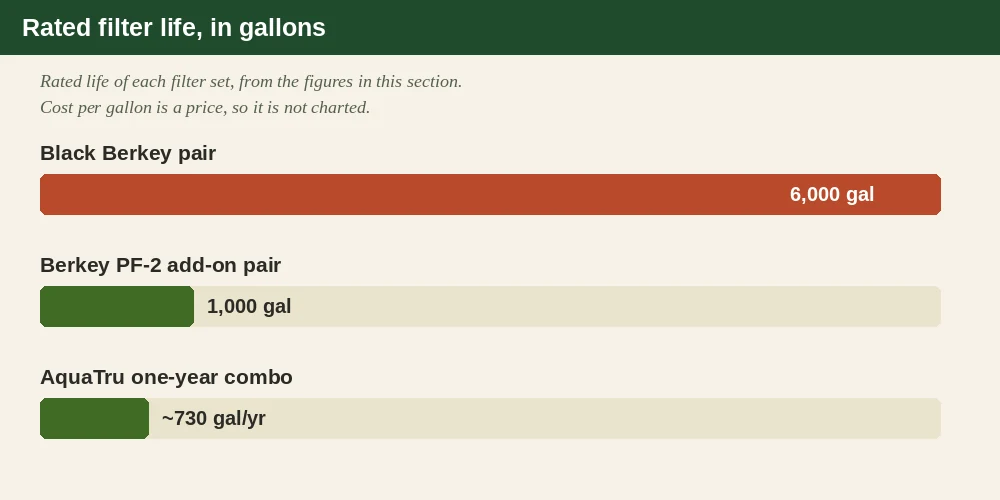
The Big Berkey costs about 3 cents a gallon in filters; the AquaTru Classic costs roughly 14 cents a gallon in filters at a typical household pace, and around 27 cents a gallon once you spread the machine’s price over five years. Berkey math, from Berkey’s own store: a Black Berkey pair is $166 and rated for about 6,000 gallons — $166 ÷ 6,000 is 2.8 cents a gallon, and even counting the $367 system itself, your first 6,000 gallons cost about 6 cents each. One trap in the Berkey math: Black Berkey elements alone do not target fluoride — that takes Berkey’s PF-2 add-on elements at $103 per 1,000 gallons, which pulls the Berkey’s real cost toward 13 cents a gallon on fluoride duty. AquaTru math: its one-year filter combo pack is $99.85 from AquaTru, and a household filtering 2 gallons a day uses about 730 gallons a year — that works out to roughly 14 cents a gallon before the machine. Low-use households pay more per gallon, because the filters expire by the calendar as well as by gallons filtered. Nothing else in this comparison is close: running cost is Berkey’s strongest card, and over 6,000 gallons the gap is roughly $170 of Berkey elements against about $820 of AquaTru filters at that pace.
Which one is actually certified to remove what it claims?
The AquaTru Classic is the certified one: IAPMO certification to NSF/ANSI 42, 53, 58, and 401 plus P473, with 84 contaminants and their reduction percentages printed on AquaTru’s performance data sheet. The Big Berkey is not certified to those standards by any of the major bodies. Berkey states its elements were third-party lab tested following NSF/ANSI 53 test protocols and publishes those reports, and states removals of over 200 contaminants — those are the maker’s claims, presented here the way the maker presents them. If a landlord, a health department, or your own peace of mind needs a certification logo, this section is the whole decision. Our water hub keeps the wider filter picture, including the pitcher and portable options from the six-way comparison.
What happens to each one when the power goes out?
The Big Berkey keeps working exactly as before — gravity doesn’t care about the grid — which is why it stays in our two-week water plan math. The AquaTru Classic stops filtering entirely: its pump needs electricity, so in an outage you have the gallon in its clean tank and nothing more coming. The honest way to hold both facts: plenty of households run an AquaTru daily for certified city-water filtering and keep a gravity system in the closet for the outage case. If you can only pick one and outages are why you’re shopping, the Berkey is the only one of the two still working on day three. Storage for either plan starts with the containers in our water storage container comparison.
Which one makes water you’d rather drink every day?
The AquaTru Classic makes the cleaner-tasting glass for most people on city water — reverse osmosis strips the chlorine taste and the dissolved solids behind it, and owners verify it themselves with the TDS meter, which is half the satisfaction. The Big Berkey keeps the water’s minerals, so its water tastes like water from a good spring rather than the flatter taste RO water has; some owners prefer exactly that, and some add a pinch of minerals back to RO water and call it solved. Neither taste verdict is a health verdict — it’s which glass you’ll actually finish, because the best filter is the one your family drinks from without being nagged.
Honest caveats
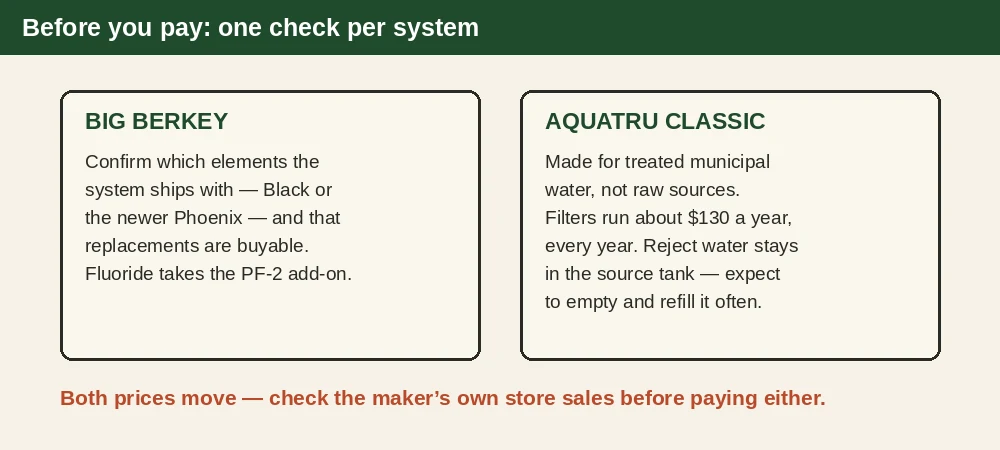
Berkey first: the EPA’s 2023 stop-sale order on Black Berkey elements — issued after the agency classified the treated elements as a pesticide device — disrupted supply and is still part of this product’s story; Berkey disputes the classification and sells through its dealer network, and the $367 price we verified is through those dealers on Amazon, not a Berkey-run store. Availability of genuine elements has wobbled before and could again. As of this check, Berkey’s own store also lists standalone Black Berkey replacement elements as out of stock with no confirmed restock date, and dealers are now shipping systems with Berkey’s newer Phoenix elements alongside the Black ones — confirm which elements a system ships with, and that replacements are actually buyable, before paying. AquaTru’s caveats are quieter: it is made for treated municipal water, not raw sources; its filters cost about $130 a year forever; and a countertop RO makes reject water by design — AquaTru keeps it in the source tank rather than sending it down a drain, but you will be emptying and refilling that tank more often than the gallon-at-a-time clean tank suggests. Finally, both prices move: the AquaTru was $475 on Amazon and the same $475 list at AquaTru’s own store in the same check — watch for the store’s own sales before paying either.
Questions Buyers Ask
Is the Berkey NSF certified? No. Black Berkey elements carry no NSF/ANSI certification from IAPMO, NSF International, or WQA. Berkey says the elements were tested by independent labs using NSF/ANSI 53 protocols and publishes those reports — maker-arranged testing, not certification.
Does the AquaTru work during a power outage? No. Its pump runs on electricity; in an outage you have whatever is in its 0.75-gallon clean tank. The Berkey, being gravity-fed, is unaffected.
How often do the filters actually get changed? AquaTru: pre/carbon about every 6 months, VOC carbon about yearly, RO membrane about every 2 years — a $99.85 one-year combo pack. Berkey: a $166 element pair is rated by Berkey for about 6,000 gallons, which most households take years to reach.
Can either one handle well water or pond water? Berkey positions the Big Berkey for raw and untreated sources as well as city water, with its bacteria and virus claims stated by the maker. AquaTru makes the Classic for treated municipal tap water. If your source is a well, have it tested first either way — no countertop box fixes every well problem.
Which is cheaper to own for ten years? The Berkey, and not closely: about $367 in plus roughly $170–330 of elements across 6,000–12,000 gallons, against the AquaTru’s $475 in plus about $1,000 of filters over the same decade at 2 gallons a day. What the AquaTru’s extra money buys is certification, not water volume.
Does reverse osmosis waste water? Yes, all RO does — it’s how the membrane cleans itself. The AquaTru’s countertop design keeps the reject water in its removable source tank instead of sending it to a drain, so you see exactly how much there is: expect to discard or reuse (plants, cleaning) a meaningful share of every tank you run.
Sources & freshness: Berkey and AquaTru manufacturer product pages and published performance data (berkeyfilters.com, aquatru.com), AquaTru’s IAPMO/NSF performance data sheet as published by the maker, Amazon price and rating data via Keepa and camelcamelcamel, checked October 27, 2026. Prices last checked: October 27, 2026. Last updated: October 30, 2026.
Related reading: both of these systems are scored again against the ProOne Big+ in our best gravity water filters for emergency storage comparison, which is also where the current filter-replacement costs live.
Talk it over with other readers. The Truly Preserved Community on Facebook is where readers compare notes on food storage, water, and backup power — and where your questions help decide what we research next. Join the group →