
Affiliate Disclosure: Truly Preserved is reader-supported. When you buy through links on this page, we may earn a commission at no extra cost to you. As an Amazon Associate, Truly Preserved earns from qualifying purchases. Learn more.
THE SHORT ANSWER
A hot garage costs you most of the shelf life you paid for. The USDA figure that Utah State Extension publishes: for every 10.8°F rise in storage temperature, the shelf life of stored food is cut in half. Run that rule on a garage that sits at 92°F against a 70°F closet and you get two halvings — white rice rated at 25–30 years keeps about 6, and canned goods rated at 3–5 years are spent in about one.
Somebody in a prepper forum put it plainly: their garage thermometer had read 97°F that week, the closet where the rest of the food sat was 71°F, and they wanted to know what the 26-degree difference was doing to the buckets. It’s the right question, because shelf-life numbers — including every figure in our Food Shelf-Life Lookup — are quoted for cool storage. Heat doesn’t just nudge those numbers down. It compounds.
The Rule, and Where It Comes From
The halving rule isn’t prepper folklore. Utah State Extension, in its food storage guidance, states it directly: “The USDA reports that for every 10.8 degrees in temperature rise, the shelf life of stored food is decreased by half.” The same guidance puts the best storage range at a constant 40–60°F. Extension is talking about the chemistry underneath every shelf-life claim: the reactions that stale food, fade color, and drain vitamins run faster as temperature climbs, and they roughly double in speed with each step up. A food’s rated life is the time those reactions take at cool-room temperature. Store it hotter and the same reactions finish sooner.
Two things the rule does not say. It doesn’t say the food becomes dangerous — for properly sealed shelf-stable food, heat spends quality and nutrition first; safety is a separate question we take up in How Do I Tell If Stored Food Has Gone Bad? And it doesn’t care whether the heat came from a garage, an attic, or a sunny spare room. Degrees are degrees.
The Math, Run on Our Own Table
Here is the halving rule applied to two anchor foods from the Shelf-Life Lookup — white rice in mylar (up to 25–30 years, cool) and canned meat and vegetables (3–5 years at best quality, cool) — at the temperatures real storage spots actually reach:
| Storage temperature | Rated life becomes | White rice | Canned goods |
|---|---|---|---|
| 70°F (cool closet) | Full rated life | 25–30 years | 3–5 years |
| 81°F (warm room) | About half | 12–15 years | 1½–2½ years |
| 92°F (hot garage) | About a quarter | 6–7 years | About 1 year |
| 103°F (attic, or a metal shed) | About an eighth | 3–4 years | 5–8 months |
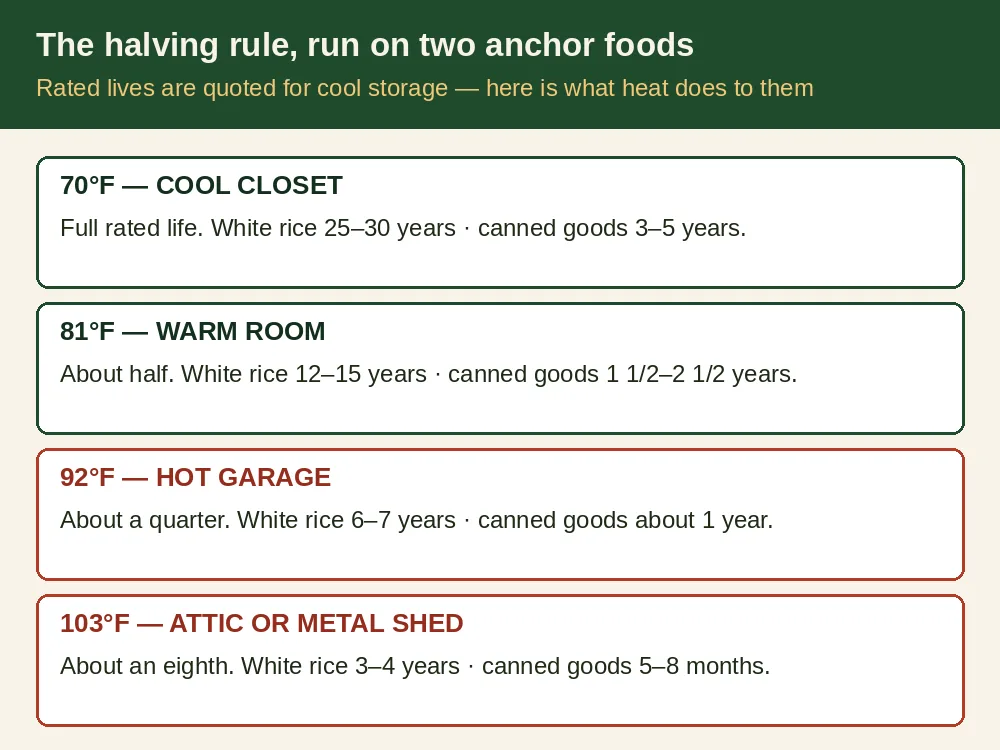
Read the canned-goods column twice. A case of canned chicken bought for a five-year plan is a one-year food in a 92°F garage. And the forum poster’s own numbers — 97°F garage against a 71°F closet — work out to 26 degrees, a little over two halvings: their garage food is aging about five times as fast as the same food would in the closet. Every summer month in that garage spends shelf life like five months indoors.
Heat Damage Is Cumulative — Which Cuts Both Ways
The rule runs on time at temperature, not on the hottest afternoon of the year. A garage that hits 97°F in July but sits at 55°F from November to March spends life fast for a season and slowly the rest of the year; the honest way to picture it is a meter that spins faster when it’s hot. That’s the bad news and the useful news in one: you don’t have to climate-control the garage, you have to get the long-life food out of the summer. The buckets rated in decades belong on an interior closet floor. The garage can keep the short-rotation canned goods you’ll eat this year anyway — at a year of life, they’re spent by eating before they’re spent by heat.
Practical moves, in order of payoff: move the 25-year food inside first (rice, wheat, beans, freeze-dried cans). Put a min/max thermometer where the food actually sits and read the peak, not the morning temperature — garages lie at 8 a.m. Skip the attic entirely; it runs hotter than the garage below it. And if the garage is truly the only space, shade and insulation buy real degrees, and every 10.8 of them doubles what the food keeps.
Follow-Up Questions
What is the best temperature to store food long-term?
A constant 40–60°F is Utah State Extension’s stated best range, and the word to lean on is constant — steady cool beats a spot that swings between cold nights and hot afternoons. Most interior closets and finished basements land at 65–72°F, which costs a little rated life against the ideal and nothing like what a garage costs.
Is a basement better than a garage?
Yes, if it’s dry. A basement typically holds the 50s and 60s year-round — inside or near the ideal range — while a garage swings with the weather. The basement’s enemy is moisture, not heat: keep containers off the floor, watch for damp, and the temperature advantage is real.
Can I move food out of the garage and get the lost life back?
No. The life the heat spent stays spent; moving the food to a cool closet only slows the meter from that day forward. That’s still worth doing this week — a bucket of rice with six garage years behind it keeps far longer from today in a closet than it would left where it is.
Frequently Asked Questions
Does heat make stored food unsafe, or just worse?
Just worse, on its own. For sealed shelf-stable food, heat spends flavor, texture, and vitamins first. Safety turns on the container’s condition — bulges, leaks, broken seals — which is a separate check with its own rules.
My garage only gets hot for three months. Does the rule still apply?
Yes, pro-rated. Three months at 92°F spends about a year of rated life. Add up the hot months across five summers and a garage-stored case of cans has spent its whole quality life even if it never left the shelf.
What about a car trunk or a storage unit?
A trunk in summer is the worst common spot — hotter than an attic. An unconditioned storage unit is a garage by another name; a climate-controlled unit held near 70°F is a closet by another name. The thermometer reading is the whole answer.
Last updated: October 27, 2026. Shelf-life figures from our Food Shelf-Life Lookup; temperature rule per Utah State University Extension’s food storage guidance, citing the USDA.
This question came from our harvest of what readers ask in the forums. See the rest of the list: What People Are Asking About Food Storage.
Talk it over with other readers
The Truly Preserved Community on Facebook is where readers compare notes on food storage, water, and backup power — and where your questions help decide what we research next.