
Affiliate Disclosure: Truly Preserved is reader-supported. When you buy through links on this page, we may earn a commission at no extra cost to you. As an Amazon Associate, Truly Preserved earns from qualifying purchases. Read our full affiliate disclosure.
Last updated: November 1, 2026
THE SHORT ANSWER
Yes. Cold water rehydrates nearly every freeze-dried meal — it just takes longer: plan on 20–60 minutes of soaking instead of the 5–10 minutes hot water needs, stir once or twice, and give dense meat chunks the longest. No stove, no fire, no fuel. Backpackers call it cold soaking, and it works at a dark kitchen table during an outage exactly the way it works on a trail.
The pouch directions say “add boiling water” because boiling water is fast and because the meal tastes better hot. Neither reason is a requirement. Freeze-dried food is a dry sponge; it takes up water at any temperature. Heat speeds the soaking and wakes up the flavors. Cold water gets the same food to edible — on a slower clock, and at room temperature.
Cold-soak times by what is in the pouch
| Meal type | Hot water | Cold soak |
|---|---|---|
| Pasta and noodle meals | 8–10 minutes | 30–45 minutes |
| Rice-based meals | 5–9 minutes | 25–40 minutes |
| Oatmeal and breakfast grains | 3–5 minutes | 15–20 minutes |
| Meals with meat chunks | 9–12 minutes | 45–60 minutes |
| Fruit and vegetables alone | 5 minutes | 15–25 minutes |
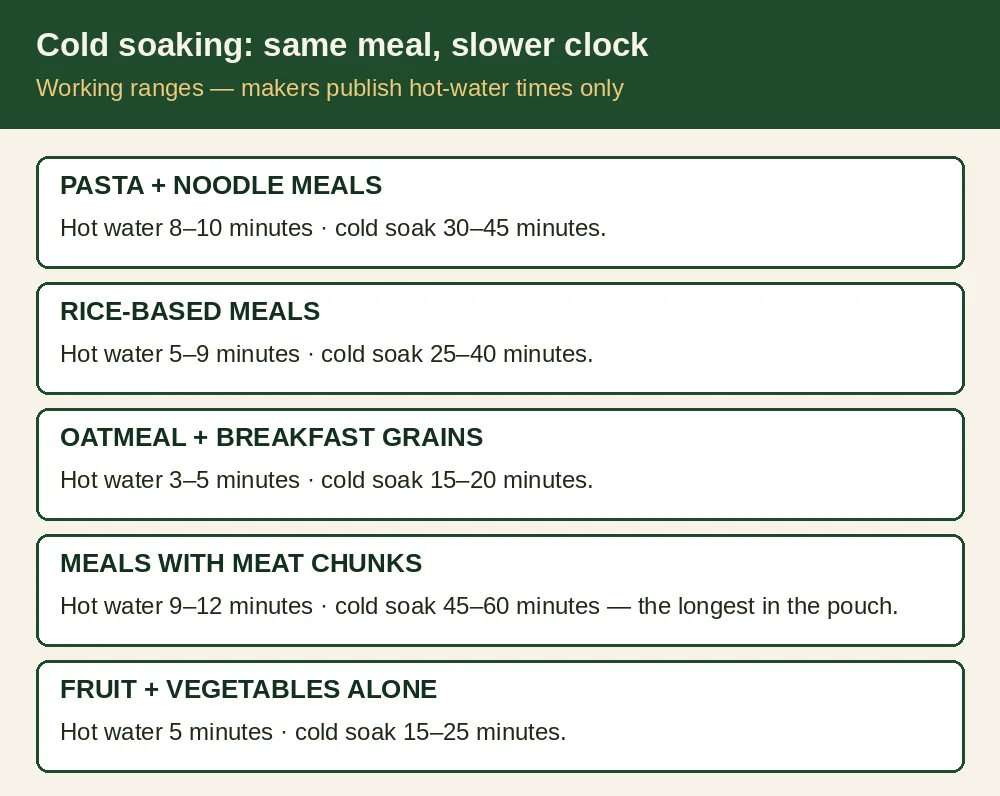
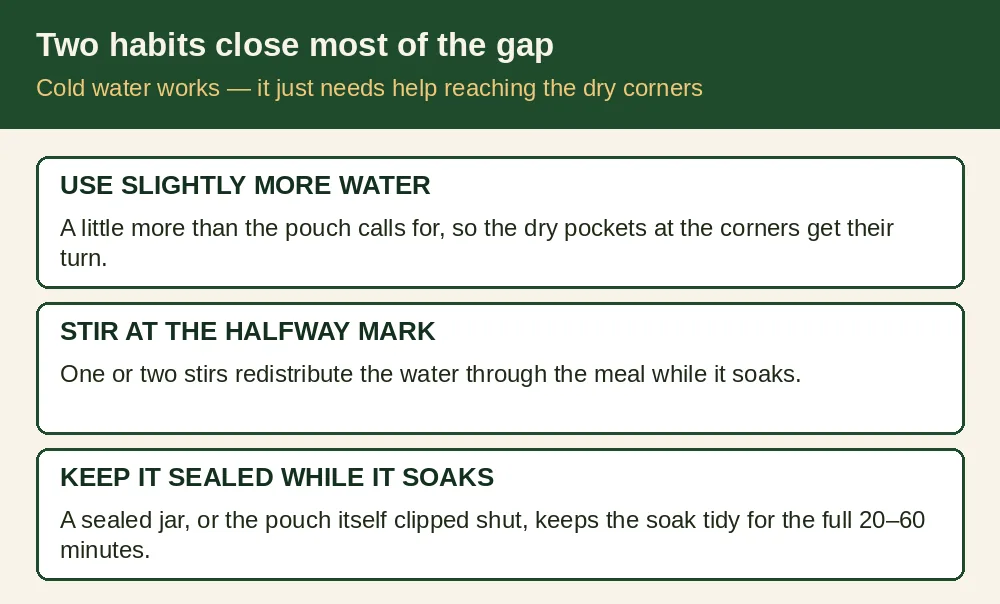
These are working ranges from the way these foods behave, not lab figures — the makers publish hot-water times, and cold times vary with how fine the pieces are cut. Two habits close most of the gap: use slightly more water than the pouch calls for, and stir at the halfway mark so the dry pockets at the corners get their turn. A sealed jar or the pouch itself, clipped shut, keeps it tidy while it soaks.
What cold soaking changes — and what it does not
- Texture: pasta stays a little firmer and sauces a little thinner. Nobody mistakes it for the hot version; nobody goes hungry either.
- Safety: cold soaking does not cook anything. A freeze-dried meal was cooked before it was dried, so it is safe to eat cold-soaked — but treat a soaked meal like fresh food from that moment: eat it within a few hours, do not save a soaked pouch for tomorrow.
- Water budget: cold soaking uses the same water as hot preparation — it comes out of the same stored gallons. Our water math for a family of four already counts cooking water for freeze-dried meals; a no-stove meal does not change that line.
- Fuel budget: this is where cold soaking earns its place. Every meal eaten without the stove stretches generator fuel, propane, and battery power to the fridge and the lights — the loads that actually need them.
One caution on your own batches: meals you freeze-dried from raw meat or eggs are not cold-soak candidates. Those must be cooked after rehydrating. Cold soaking is for food that was cooked before it was dried — which describes every commercial pouch we have reviewed.
Why does rehydrated pasta stay crunchy, and meat stay dry in the middle?
Freeze-dried cooked pasta and dense meat pieces stay crunchy or dry in the middle because water re-enters them from the surface inward — the outside softens first, and the centre is the last place the water reaches. Ten minutes in hot gravy is enough for the small, even pieces in a commercial pouch. A thick home-cut beef chunk, or pasta strands that dried stuck together in a clump, has a much longer road in, and it will still be hard at the centre when the timer goes off.
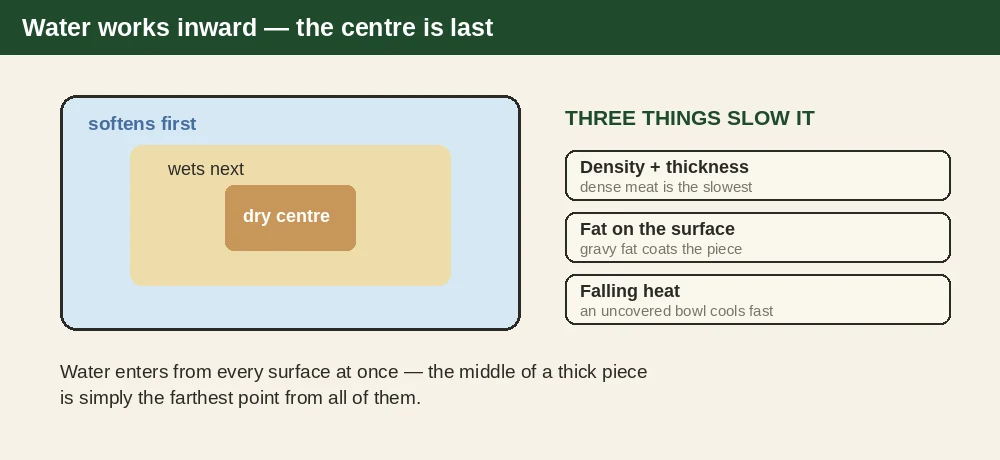
Three things slow the water down:
- Density and thickness: a dense piece of cooked beef or chicken is the slowest thing in the meal. Our cold-soak table above already gives meals with meat chunks the longest times — 9–12 minutes in hot water, 45–60 cold — and those figures assume pouch-size pieces, not stew chunks.
- Fat on the surface: gravy fat and the fat in fatty meat coat the outside of a piece, and water and fat do not mix. The coating does not stop rehydration, but it slows it — one more reason lean, well-trimmed meat comes back better than fatty meat.
- Falling heat: near-boiling gravy poured over cold, dried food loses its heat fast, and an uncovered bowl loses more. Mountain House’s directions — boiling water, stir, then seal the pouch, ready in 15 minutes or less — keep the heat in. A cooling open bowl at minute ten is not working under the same conditions, even if the clock says the same time.
The fixes the evidence supports:
- Use liquid at a full boil, then cover and keep it covered. A lid, a sealed pouch, or a towel over the bowl — anything that holds the heat while the water works inward.
- Give dense pieces more time, not just more water. Owner reports converge on 15–20 minutes in hot liquid for thick meat pieces, against the roughly 10 minutes printed for pouch meals. Stir at the halfway mark, then check the centre of the biggest piece before serving.
- Stir and break things up. Separate pasta strands that dried in a clump, turn meat pieces over, and push the dry corners down into the liquid. A clump rehydrates as one thick piece, because that is what it is.
- Add dried meat to the cooking liquid early. Put freeze-dried beef into the gravy or sauce while it heats, so the meat soaks and heats with the liquid, instead of dropping it into finished sauce at the end and starting the clock from cold.
- Next batch, cut smaller. Small, even pieces, shredded beef instead of chunks, and short pasta shapes instead of long strands are the permanent fix — they are also why the commercial pouches use the piece sizes they do.
Rescuing a batch that is already crunchy: add a splash of hot water, cover it, and give it another five minutes, then check the centre again. Cutting one meat piece in half tells you the truth about the rest — and if it is still dry, the halves now have an open face for the water, so the second soak goes faster than the first.
Questions people also ask
Can I cold-soak a meal and heat it later?
Yes — soak it, then heat it when power or fuel is available. Within a few hours, though; a soaked meal sitting all day is leftovers sitting out, and the fridge rules for leftovers apply.
Does cold water work for coffee and drink mixes?
Drink mixes dissolve in cold water with extra stirring. Instant coffee is the stubborn one — drinkable cold, better warm, and honestly a morale decision more than a food one.
What about just eating it dry?
Fruit, vegetables, and cheese dry-eat fine as snacks. Full entrées dry are a poor idea: the food pulls water from you instead, and a dry pasta brick is nobody’s dinner. Soak the meals.
Related questions
- How long does opened freeze-dried food last?
- How much water does a family of four need for two weeks?
- Automatic backup with no solar: a station a gas generator recharges
This question sits in What People Are Asking About Freeze-Dried Food — the full list of freeze-dried questions from real forums, each with a short answer.
Talk it over with other readers
The Truly Preserved Community on Facebook is where readers compare notes on food storage, water, and backup power — and where your questions help decide what we research next.