
Affiliate Disclosure: Truly Preserved is reader-supported. When you buy through links on this page, we may earn a commission at no extra cost to you. As an Amazon Associate, Truly Preserved earns from qualifying purchases. Read our full affiliate disclosure.
Last updated: October 31, 2026
THE SHORT ANSWER
Yes — and for a house with no useful sun, it is often the best setup on the shelf: a 2kWh-class power station carries the house silently through the night, and a gas or dual-fuel generator runs for an hour or two a day to recharge the station fast and carry the heavy loads while it is on. The station is the battery and the quiet; the generator is the fuel tank and the muscle. A day of outage costs roughly one to two hours of generator noise and one to two gallons of fuel, instead of a generator droning around the clock.
This page exists because of one exact scenario from the EcoFlow community: an oil furnace, two sump pumps, a day of outage, and no solar worth wiring. Post by post, our site had the pieces — the station comparison, the generator comparison, the propane runtime calculator — but nobody had written down the assembled setup. Here it is.
How the day actually runs
| Time | What runs | From what |
|---|---|---|
| Overnight | Fridge, CPAP, furnace fan cycles, lights | The station, silently |
| Morning, 1–2 hours | Station recharging at full AC speed + well pump, laundry, cooking | The generator |
| Daytime | Fridge and light loads | The station |
| Evening, as needed | Top-up recharge if the night looks long | The generator, briefly |
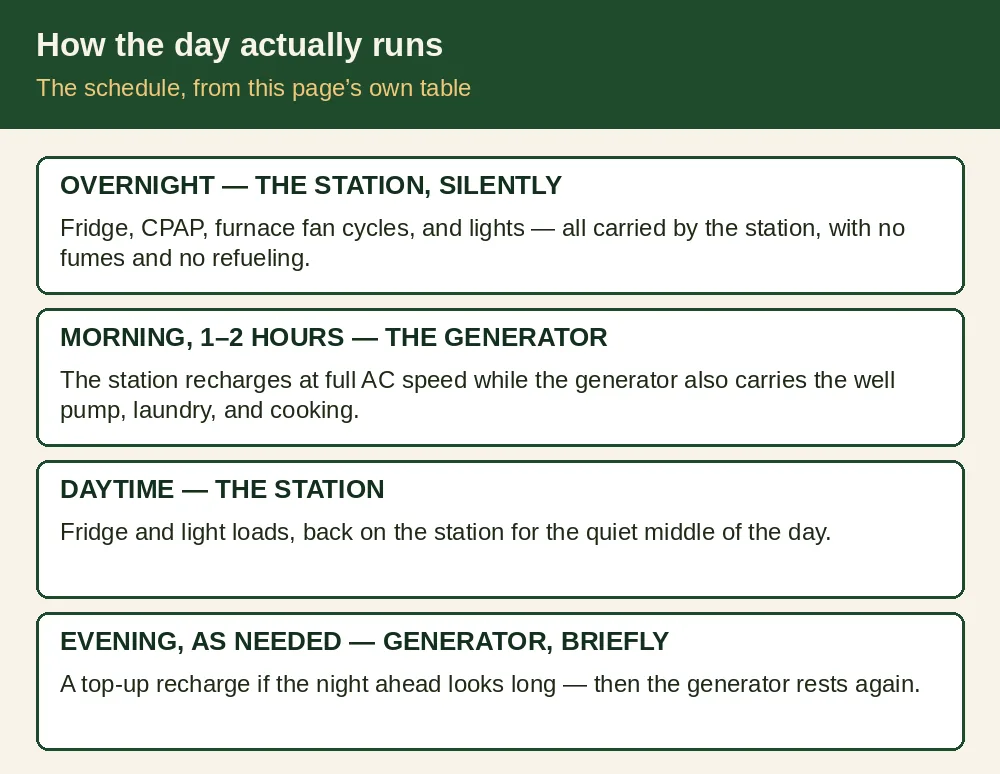
The station does the job it is good at — instant, silent, indoor power with no fumes and no 2 a.m. refueling — and the generator does the job it is good at: making a lot of power cheaply for a short, scheduled run. A 2kWh station accepts a fast AC charge in roughly one and a half to two hours, which is the whole trick: the generator’s noisy hours and the household’s heavy-load hours become the same hours. Do the laundry, run the well pump, cook the real meal, and top the battery in one window.
Sizing the pair for the furnace-and-sumps house
- The station: 2kWh class, 2,200W+ output — it has to start a sump pump, and the surge math on the pump page is the gate. Overnight loads (fridge cycling, furnace fan in bursts, a CPAP at 40 watts) fit inside it with margin.
- The generator: big enough to charge the station and carry one heavy load at once — the 4,250W class in our generator comparison is the honest size for this job; a 2,200W suitcase unit charges the station and little else at the same time.
- 240-volt well pump? Then the generator carries it directly during its run window — the station never touches it. That division, decided in advance, is the difference between a setup and a pile of equipment.
- Fuel: at a gallon or two a day, a week of outage is a manageable fuel pile — and propane stretches it further with no stale-gas problem. Run your exact tank through the propane runtime calculator and your generator’s appetite through the fuel calculator.
- The automatic part: keep the fridge and CPAP plugged into the station full-time if your station supports pass-through charging — the outage you sleep through is the one that never wakes you. “Automatic” in practice means the station is always in line, not that the generator starts itself; a self-starting standby generator is a different, five-figure conversation.
Questions people also ask
Why not just run the generator the whole time?
Fuel, noise, and wear — and carbon monoxide rules that keep it outside, in the rain, at 3 a.m. when it runs dry. A generator sipping fuel around the clock for a 100-watt average load is the worst version of both machines. The station exists to give the generator the night off.
Can I charge the station from a car instead?
Slowly. A vehicle’s 12V output charges a big station at a trickle — fine for a phone-and-lights emergency, not a plan for a fridge and a furnace fan. The generator window is the plan; the car is the fallback’s fallback.
What does this setup cost against a whole-home standby unit?
A fraction — a 2kWh station plus a mid-size portable generator lands in the low thousands against a five-figure installed standby system, and both pieces stay portable and useful the other 360 days a year. What you give up is true automation and the 240V loads running whenever they want.
Related questions
- Will a power station run a sump pump, well pump, or furnace fan?
- How long will a power station run my CPAP?
- Propane Runtime Calculator
This question sits in What People Are Asking About Backup Power — the full list of backup-power questions from real forums, each with a short answer.
Talk it over with other readers
The Truly Preserved Community on Facebook is where readers compare notes on food storage, water, and backup power — and where your questions help decide what we research next.