
Affiliate Disclosure: Truly Preserved is reader-supported. When you buy through links on this page, we may earn a commission at no extra cost to you. As an Amazon Associate, Truly Preserved earns from qualifying purchases. Read our full affiliate disclosure.
Last updated: October 31, 2026
THE SHORT ANSWER
Longer than most people fear — if you turn the heated humidifier off. A CPAP without heated humidity draws about 30–50 watts, so a 1kWh power station runs it roughly 17–29 hours: two to three full nights. With the heated humidifier and heated tube running, draw climbs to roughly 70–90 watts and the same station lasts about one long night. The humidifier setting, not the station size, is the decision that doubles or halves your outage sleep.
This is the backup-power question with a face on it: nobody asks it idly, and “the fridge” math does not answer it. It is also a friendly load — a CPAP is a small, steady draw with no starting surge — so the arithmetic is the same 85%-usable method we use for refrigerators, with your machine’s watts in place of a fridge’s yearly rating.
Runtime by station size and humidifier setting
| Station size | Humidifier off (~40W) | Humidifier on (~80W) |
|---|---|---|
| 500Wh | ~10 hours | ~5 hours |
| 1,000Wh | ~21 hours | ~10 hours |
| 2,000Wh | ~42 hours | ~21 hours |
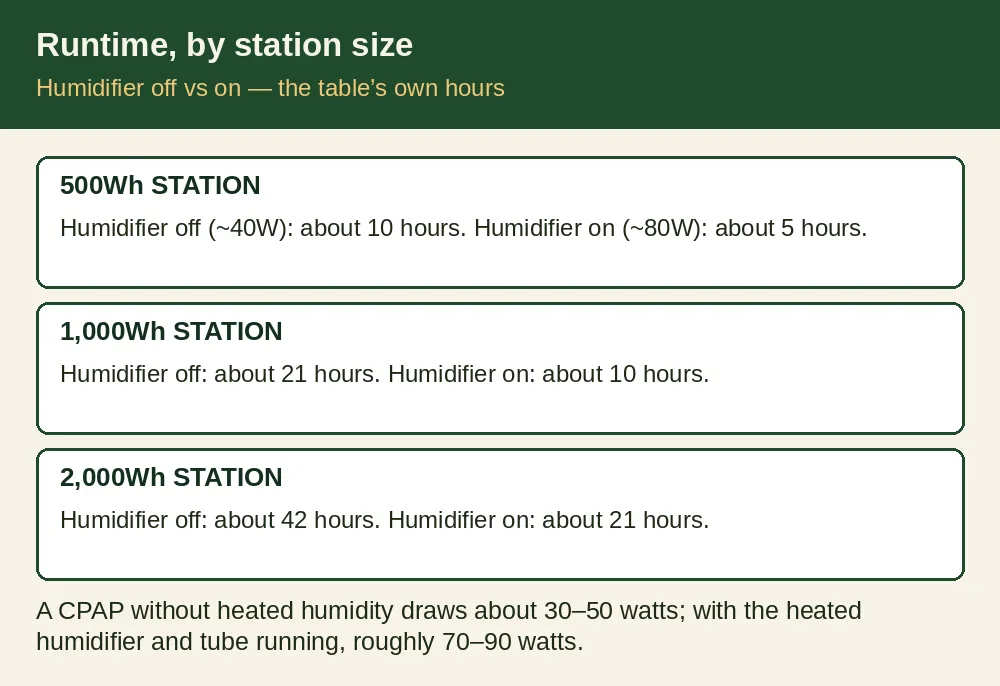
The math is usable watt-hours divided by watts: a 1,000Wh station delivers about 850 usable watt-hours, and 850 ÷ 40W is a little over 21 hours. Your machine’s real draw sits on its power brick’s label — read the output watts, or check the maker’s table; the figures above are the working ranges CPAP owners measure, and the label narrows them to your machine. Mask pressure matters a little, a heated tube matters more, and the humidifier matters most of all, because heating water is the expensive part of the whole device.
Stretching a station across an outage
- Humidifier off, water in the tub anyway: passover humidity — the air picks up some moisture crossing the water with the heat off. Most people sleep fine on it for outage nights.
- A DC converter beats the wall brick: running the CPAP from the station’s 12V output skips the double conversion loss and buys back roughly 10–20% of the night. The converters are maker-specific; match yours to your machine.
- Recharge is the real plan: a station that gives you two nights needs a way back — solar by day, or a generator run in the morning. The recharge setup is the whole subject of automatic backup with no solar.
- Sleep is a medical load: treat it like one in the plan — it gets sized and reserved before the nice-to-have loads, and if outages are long where you live, it is the honest argument for the 2kWh class in our power station comparison.
Questions people also ask
Can I run a CPAP and the fridge on one station?
Yes, on a 2kWh-class station, with the fridge on its duty cycle and the CPAP through the night — the combined math is in our fridge-runtime post. On a 1kWh station, pick: the night you sleep or the food you keep, and most people should sleep.
Does a travel CPAP change the math?
Yes, a lot — travel machines draw roughly half to a third of a home machine, which works out to two to three times the nights from the same station. If outages are your reason to buy, a travel unit as the backup machine is a legitimate strategy.
What about a BiPAP or an oxygen concentrator?
BiPAP draws a little more than CPAP; the same method applies with its label watts. An oxygen concentrator is a different class entirely — 300–600 watts continuous, no nights-from-a-small-station answer — and belongs in a conversation with your supplier about battery and outage planning, not a rule of thumb.
Related questions
- How long will a power station run a refrigerator?
- Will a power station run a sump pump, well pump, or furnace fan?
- Automatic backup with no solar
This question sits in What People Are Asking About Backup Power — the full list of backup-power questions from real forums, each with a short answer.
Talk it over with other readers
The Truly Preserved Community on Facebook is where readers compare notes on food storage, water, and backup power — and where your questions help decide what we research next.