
Affiliate Disclosure: Truly Preserved is reader-supported. When you buy through links on this page, we may earn a commission at no extra cost to you. As an Amazon Associate, Truly Preserved earns from qualifying purchases. Read our full affiliate disclosure.
Last updated: October 31, 2026
THE SHORT ANSWER
Count calories, not servings. A family of four eating 2,000 calories per person per day needs about 24,000 calories for 3 days, 56,000 for a week, and 112,000 for two weeks. In ordinary food that is roughly 38 lb, 89 lb, and 179 lb of food, plus drinks on top — about 6, 15, and 30 gallons at the German government’s 2 litres per person per day.
Governments have started publishing their numbers. Germany’s Federal Office of Civil Protection (BBK) reissued its crisis guide in October 2025 — the first edition in 35 years to name war outright — and tells every household to keep 10 days of food. Sweden mailed its “If Crisis or War Comes” brochure to about five million households and asks for at least a week. The EU’s preparedness strategy and the UK’s new “Be Ready” list both start at 72 hours. Ready.gov, by contrast, gives American households no food quantities at all. So here are the quantities, worked out three ways: by calories, by Germany’s itemised list, and by what the kits on the shelf actually contain.
The number that decides everything: calories per person per day
Every honest version of this answer starts at 2,000 calories per person per day. That is the planning figure US labels are built on, and it is close to what the BBK uses — its 10-day list works out to about 2,200 calories a day. Active teenagers and anyone doing physical work in a crisis will eat more; small children eat less. Across a normal family of four, 2,000 a head averages out, and it has one big advantage over the number on a kit box: it cannot be padded. A “serving” can be 182 calories or 424. A day is a day.
What a family of four needs, by duration
| Duration | Calories for 4 | Food weight | Drinks |
|---|---|---|---|
| 3 days | 24,000 | ~38 lb (17 kg) | ~6 gal (24 L) |
| 1 week | 56,000 | ~89 lb (41 kg) | ~15 gal (56 L) |
| 2 weeks | 112,000 | ~179 lb (81 kg) | ~30 gal (112 L) |
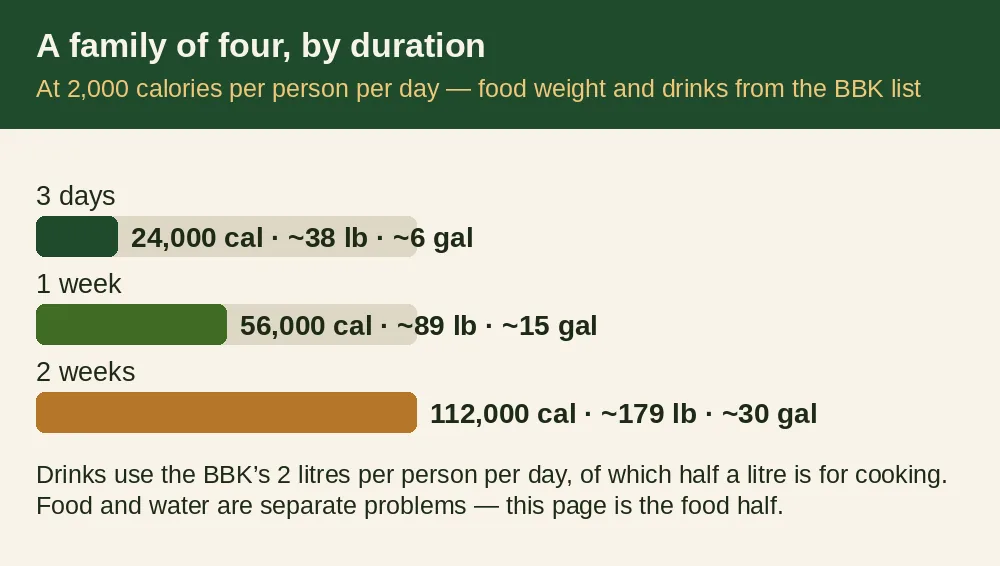
The food weight comes from the BBK’s per-person list below — about 14.5 kg (32 lb) of food per person for 10 days, scaled to each duration. The drinks column uses the BBK’s 2 litres per person per day, of which half a litre (about 2 cups) is for cooking. The US figure you will see elsewhere — a gallon per person per day — covers drinking, cooking, and basic hygiene together; our two-week water breakdown for a family of four works that side of the shelf in full. Food and water are separate problems. This page is the food half.
What that looks like in real food: Germany’s 10-day list
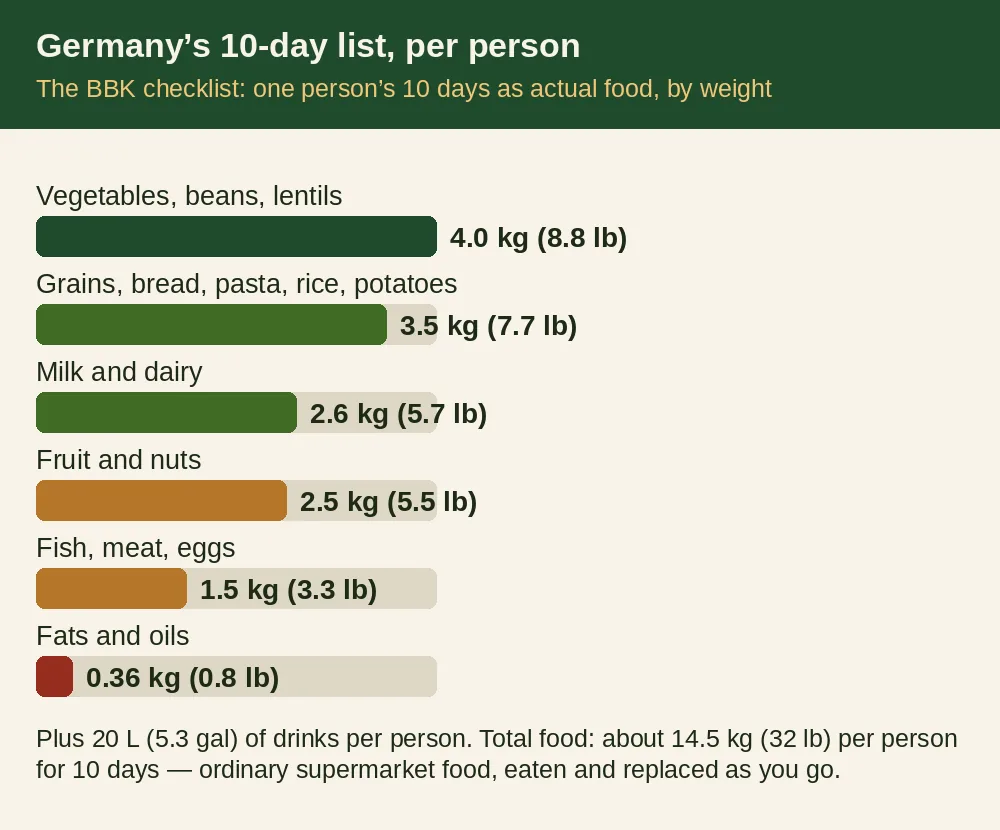
The BBK does not deal in servings. Its checklist gives one person’s 10 days as actual food, by weight:
| Food group | Per person, 10 days | Family of 4, 10 days |
|---|---|---|
| Grains, bread, pasta, rice, potatoes | 3.5 kg (7.7 lb) | 14 kg (31 lb) |
| Vegetables and beans/peas/lentils | 4.0 kg (8.8 lb) | 16 kg (35 lb) |
| Fruit and nuts | 2.5 kg (5.5 lb) | 10 kg (22 lb) |
| Milk and dairy | 2.6 kg (5.7 lb) | 10.4 kg (23 lb) |
| Fish, meat, eggs | 1.5 kg (3.3 lb) | 6 kg (13 lb) |
| Fats and oils | 0.36 kg (0.8 lb) | 1.4 kg (3 lb) |
| Drinks | 20 L (5.3 gal) | 80 L (21 gal) |
Two things worth noticing. First, this is ordinary supermarket food — canned vegetables, pasta, rice, jars of fruit — not specialist gear. The BBK expects you to eat it in normal life and replace it as you go, which is the deep-pantry idea with a government letterhead. Second, the list is a floor built for a sedentary adult at home, not a ceiling: the federal food ministry’s supply calculator trims a couple of lines slightly (grains to 3.3 kg, the protein group to 1.2 kg), and neither version makes room for a hungry teenager. Sweden’s week runs on the same logic with a shorter list: potatoes, cabbage, carrots, and eggs to cook fresh early on, then food that keeps — rice, beans, canned vegetables, powdered milk, dried meat and fish, jam, chocolate, mashed potato — with three litres (about 3 quarts) of water per person per day beside it.
Shelf life is the second deciding number
The German and Swedish lists assume food you rotate: months of shelf life, eaten and replaced as part of normal shopping. That is the cheapest way to hold 3 days or a week, and it fails quietly if the pantry is not actually rotated — the cans at the back are always older than you think. Freeze-dried food trades money for not having to think: 25 to 30 years on the shelf (Mountain House puts a 30-year taste guarantee on its meals; ReadyWise and Augason Farms rate theirs at up to 25 years), no rotation, and a much higher cost per calorie. Our cost-per-serving dataset prices that trade precisely. The practical split most households land on: rotate ordinary food for the first days, and let freeze-dried carry the second week — the part of the plan nobody wants to manage by hand.
The kit math: what the buckets actually cover
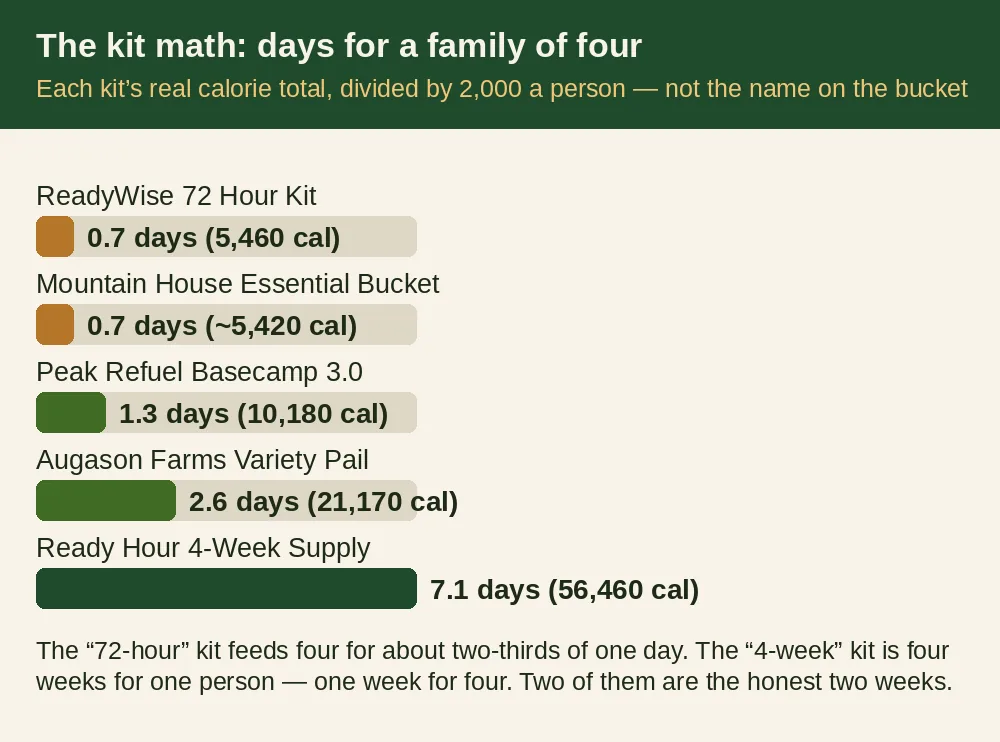
This is where the serving counts fall apart. Divide each kit’s real calorie total by 2,000 and the marketing durations shrink to honest ones:
| Kit | Total calories | Days for 1 person | Days for a family of 4 |
|---|---|---|---|
| ReadyWise 72 Hour Kit | 5,460 | 2.7 | 0.7 |
| Mountain House Essential Bucket | ~5,420* | 2.7 | 0.7 |
| Peak Refuel Basecamp Bucket 3.0 | 10,180 | 5.1 | 1.3 |
| Augason Farms Variety Pail | 21,170 | 10.6 | 2.6 |
| Ready Hour 4-Week Supply | 56,460 | 28.2 | 7.1 |
*Mountain House publishes no calorie total for the Essential Bucket; ~5,420 is our count from the maker’s own pouch labels, worked in our Mountain House vs Peak Refuel comparison. The Ready Hour figure is the maker’s direct-store build (250 servings); the Amazon listing under the same name is a different, 284-serving build — the split is documented in the cost-per-serving dataset, which is also where every calorie total in this table comes from.
Read the last column slowly, because it reverses how these kits are sold. The “72-hour” kit feeds a family of four for about two-thirds of one day. The “4-week” kit is four weeks for one person — for a family of four it is one week, and two of them (112,920 calories between them) is what a two-week family supply actually looks like in kit form. None of this makes the kits bad. It makes the serving count the wrong ruler: across these five kits a “serving” runs from 182 to over 400 calories, which is why the same shelf can honestly hold a 30-serving kit that lasts one person 2.7 days and a 24-serving kit that lasts 5.1.
The kits we’d stock, by the duration you’re covering
For one person, or the car: the ReadyWise 72 Hour Kit — 5,460 calories is a real 2.7 days for one adult, and it is sized and priced like the short bridge it is.
For a family’s first days: the Augason Farms Variety Pail — 21,170 calories of mostly plain ingredients is the closest thing on this list to the BBK table in a single bucket: 10.6 days for one person, 2.6 for four, and the base a rotating pantry builds around.
For calorie-dense top-up: the Peak Refuel Basecamp Bucket 3.0 — at over 400 calories a serving it is the densest food here, 5.1 days for one person from the smallest bucket on the shelf.
For the full two weeks: the Ready Hour 4-Week Supply, bought as a pair for a family of four — one kit is a week for four; two are the honest two weeks. Mountain House’s Essential Bucket sits alongside any of these as the taste pick; its head-to-head with Peak Refuel, including the calorie count Mountain House doesn’t publish, is here.
Prices checked October 28, 2026. We don’t print a price we could not verify today — the tracker record behind these listings was stale at this run’s check — so each link above shows the live price.
Questions people also ask
Can I just buy four 72-hour kits for a family of four?
Four ReadyWise 72 Hour Kits hold 21,840 calories between them. A family of four needs 24,000 for three days, so four kits get you most of the way — about 2.7 days — and a stocked pantry covers the gap. It works; it just isn’t the three full days the name suggests, because the kit’s 72 hours were counted for one person at about 1,820 calories a day.
How much of this can be regular pantry food?
Nearly all of the first week, if you rotate it. The BBK’s 10-day list is supermarket food from end to end — pasta, rice, canned vegetables and fruit, powdered or UHT milk, canned fish. What ordinary food cannot do is sit untouched for a decade: that second week is where freeze-dried earns its price, or where a written rotation habit has to do the same job.
Does the cooking water come out of the food budget?
It comes out of the water budget, and it is easy to under-plan. The BBK’s 2 litres per person per day already includes half a litre for cooking. Freeze-dried meals drink from the same store — roughly two cups of water to rehydrate a pouch meal — so a two-week freeze-dried plan for four quietly needs its water planned alongside it, not after it.
FAQ
How much food does one person need for 3 days?
About 6,000 calories at 2,000 a day — roughly 9.5 lb (4.3 kg) of food on the BBK’s per-person weights, plus about 1.6 gallons (6 L) of drinks. One ReadyWise 72 Hour Kit (5,460 calories) is most of it; one Augason Farms Variety Pail (21,170) covers one person for about 10.6 days.
Is a 30-day food kit enough for a family of four for a month?
No — kit durations are counted per person. A family of four needs about 240,000 calories for 30 days. The largest kit in our dataset, the Ready Hour 4-Week at 56,460 calories, covers the family for about a week. Four of them is the honest month, which is exactly why the calorie column matters more than the name on the bucket.
What is the cheapest way to cover two weeks?
Ordinary food, rotated. Rice, beans, oats, and pasta bought as staples run a fraction of freeze-dried cost per 1,000 calories — our bulk-staples comparison put rice and wheat berries near $1.70–$1.90 per 1,000 calories, against roughly $17–$20 per 1,000 for freeze-dried meals. The catch is rotation: staples only stay cheap if your household actually eats and replaces them.
Related questions
- What a serving really costs: emergency food priced per serving, per meal, and per day
- Mountain House vs Peak Refuel: freeze-dried meals compared
- How much water does a family of four need for two weeks?
- How long does opened freeze-dried food last?
This question came from the current preparedness-guidance wave — governments publishing household numbers while US guidance stays silent. See the full list: What People Are Asking About Food Storage.
Related reading: the kit-by-kit pricing behind these day counts — real calories, cost per 2,000-calorie day, and what a family month actually costs — is in our best 30-day emergency food kit for a family of four comparison.
Talk it over with other readers
The Truly Preserved Community on Facebook is where readers compare notes on food storage, water, and backup power — and where your questions help decide what we research next.