Affiliate Disclosure: Truly Preserved is reader-supported. When you buy through links on this page, we may earn a commission at no extra cost to you. As an Amazon Associate, Truly Preserved earns from qualifying purchases. Read our full affiliate disclosure.
THE SHORT ANSWER
Buy for the food, not the price tag. Under USDA guidance the canner is chosen by acidity: fruits, pickles, jams, and properly acidified tomatoes (pH 4.6 or lower) go in a boiling-water canner; every low-acid food — green beans, corn, meat, soup, chili — must go in a pressure canner, because only a pressure canner reaches the 240° to 250°F that destroys botulism spores. If you will ever can a vegetable or a jar of chili, the pressure canner is the first purchase — and a pressure canner also works as a boiling-water canner for the acid foods. The reverse is never true.
The thread behind this page is a first-timer photographing two canners and asking 67 strangers, “which of these two would you recommend and why?” The honest answer is that the photo was missing the only fact that matters: what do you want to put in jars? Jam and pickles ask for one pot. Green beans ask for the other. This page walks the USDA logic — from Guide 1 of the USDA Complete Guide to Home Canning, “Food acidity and processing methods” and “Recommended canners” — and then names the two starter canners we would point a neighbor at, with the one price we could verify on the maker’s own store today.
The line is pH 4.6, and it is not a preference
Guide 1 states it in one paragraph, and every canning decision you ever make hangs off it. Low-acid foods have pH values higher than 4.6: red meats, seafood, poultry, milk, and all fresh vegetables except for most tomatoes. Acid foods have a pH of 4.6 or lower: fruits, pickles, sauerkraut, jams, jellies, marmalades, and fruit butters. Tomatoes and figs sit close enough to the line that they must be acidified with lemon juice or citric acid to be canned as acid foods.
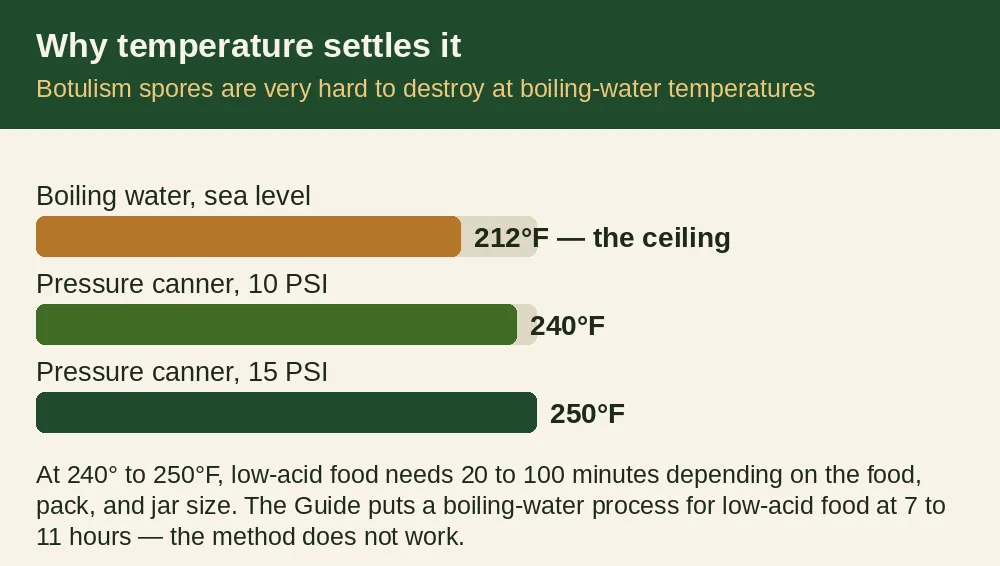
The reason is a bacterium. Botulism spores are, in the Guide’s words, “very hard to destroy at boiling-water temperatures.” A boiling-water canner tops out at the temperature boiling water reaches — 212°F at sea level, less as altitude climbs. A pressure canner operated at 10 to 15 PSI reaches 240° to 250°F, and at those temperatures the time needed to destroy the bacteria in low-acid food runs from 20 to 100 minutes depending on the food, the pack, and the jar size. There is no boiling-water shortcut on that math: the Guide puts the boiling-water time for low-acid food at 7 to 11 hours. So “I only have a water bath canner” is not a reason to water-bath green beans. It is a reason to freeze the green beans this year — NCHFP’s freezing guidance handles them fine — and can them when a pressure canner is in the kitchen.
What each canner actually is, per the Guide
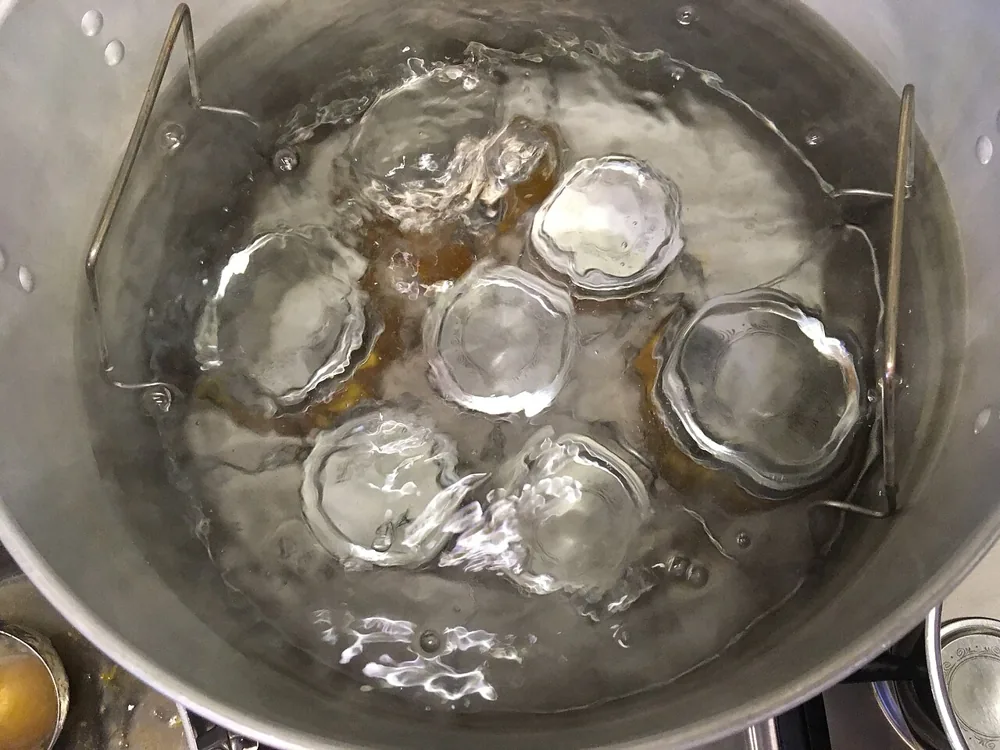
Boiling-water canner. A large pot — aluminum or porcelain-covered steel — with a removable rack and a fitted lid, deep enough that at least 1 inch of briskly boiling water stands over the tops of the jars for the whole process (2 inches for processes over 30 minutes). On an electric range it needs a flat bottom, and it should be no more than 4 inches wider than the element it sits on, or the jars at the edge process cooler than the jars in the middle. That is the entire machine. It is cheap, light, and stores anywhere.
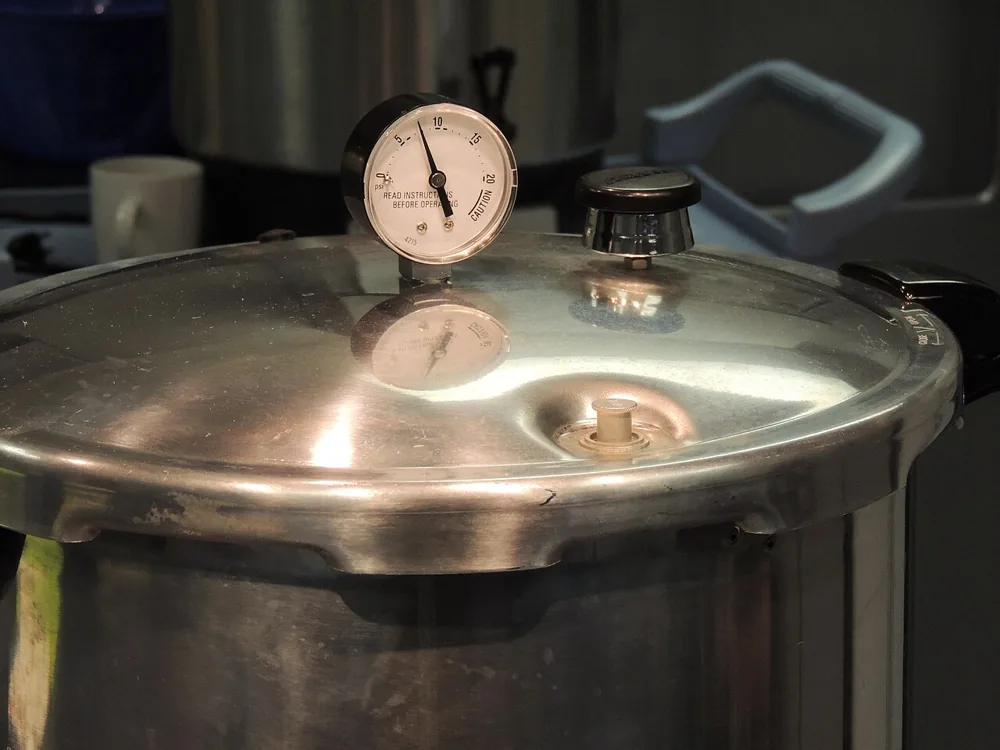
Pressure canner. A heavy pot with a locking lid, a jar rack, a gasket, a safety fuse, and either a dial gauge or a weighted gauge. Two gauges, two habits: a weighted gauge rocks or jiggles to show it is holding pressure and never needs accuracy testing; a dial gauge must be checked for accuracy before use each year, and replaced if it is off by more than 2 pounds, because every pound of pressure is temperature your food is counting on. Every pressure canner, either kind, gets vented for 10 minutes before it is pressurized — trapped air lowers the temperature the gauge promises. Note what a pressure canner is not: a pressure saucepan. Small pressure saucepans are not recommended for canning, and neither is the stovetop pressure cooker on your shelf unless it is built and sold as a canner.
Sizing, in the Guide’s numbers: most canners of both types are designed to hold seven quart jars or eight to nine pints. Small pressure canners hold four quart jars; the big ones take 18 pints in two layers but still only seven quarts. A canner load is a canner load — the batch math on our yield page is built on those seven quarts.
The two starter canners we point people at
One of each type, chosen the way the Guide frames the choice — jar capacity, gauge style, and what the maker publishes about its own pot. No scores: a canner is not a gadget to rank, it is the safety equipment the whole shelf depends on.
Prices last checked: October 29, 2026.
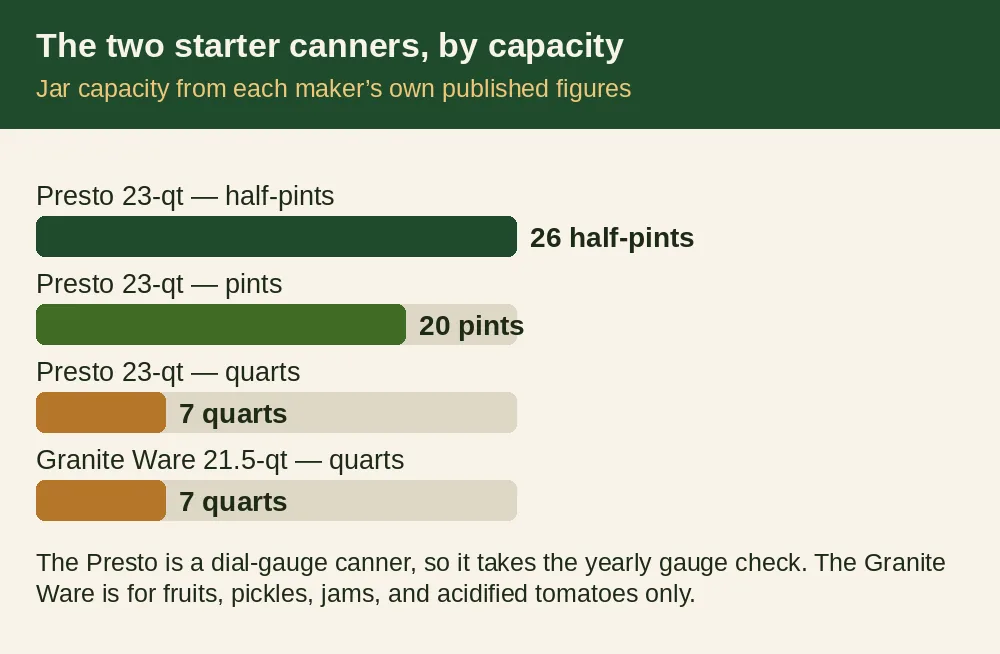
The Presto 23-quart is the pressure canner in the photo in half of these threads, and the specs are why: Presto’s own store lists the 01781 at $185.99 (checked on gopresto.com the day this page published), with a mason-jar capacity of 26 half-pints, 20 pints, or 7 quarts, an easy-to-read dial gauge, and a 12-year limited warranty. It is aluminum, works on regular and smooth-top ranges, and Presto rates it for household burners of 12,000 BTUs or less — check your burner before you fall in love, because a canner your stove cannot drive properly is not a bargain. Being a dial-gauge canner, it takes the yearly gauge check the Guide requires. And because a pressure canner full of water with the weight off is a boiling-water canner, this one pot covers both columns of the acidity table — which is why, if the budget allows one pot and the pantry plans include vegetables, this is the one.
The Granite Ware is the water-bath pot your grandmother’s shelf probably started with: porcelain enamel on steel, a jar rack included, sized for a 7-quart load. We do not print a price for it — we could not verify one on the maker’s own store today, and we do not print prices we cannot check. If your canning plans honestly stop at jam, pickles, salsa with a tested recipe, and fruit, this pot plus jars and lids is the whole investment, and spending pressure-canner money buys you capacity you will never use. The moment a bag of green beans or a pot of chili enters the plan, the answer changes — not because the pot got worse, but because the food crossed pH 4.6.
What a first-timer actually needs, all in
- The canner — chosen by food, above. Rack included with both types; a canner without its rack is not ready to run.
- Mason-type jars — the Guide’s recommended choice, in the sizes your recipes call for. Most beginners live in pints and half-pints and buy quarts when the garden proves them wrong.
- New flat lids for every jar, every run — jars and bands are reused; flat lids are not. Budget them as a per-batch cost, because they are one. (Our used-jar page covers rehabbing secondhand jars and the fingertip rim check they need first.)
- A jar lifter — the Guide’s steps assume one: jars go in and come out upright, gripped below the neck, never tilted and never lifted by the lid.
- The tested recipes themselves — the USDA Complete Guide and NCHFP publish the process time and pressure for the food, the pack, the jar size, and your altitude. The canner is hardware; those tables are the actual instructions.
Questions people also ask
When do I start timing — when the jars go in, or when it boils again?
When the process actually starts, per Guide 1. In a boiling-water canner: jars loaded, water 1 to 2 inches over the tops, heat on high, lid on — the timer starts when the water boils vigorously, and the boil must be maintained the whole process. If the water stops boiling at any point, bring it back to a vigorous boil and begin the timing over, from the beginning. In a pressure canner: vent 10 minutes, pressurize, and start timing when the gauge reaches the recommended pressure or the weighted gauge begins to jiggle or rock as the manufacturer describes. If pressure drops below the recommended amount at any time, bring it back up and start the full timing over. Those restart rules are the safety margin — they are not fussiness.
I only have a water bath canner. Can I water-bath green beans if I do them long enough?
No. Green beans are a low-acid food, and the USDA position is that low-acid foods are processed in a pressure canner at 240° to 250°F — the Guide’s own comparison puts a boiling-water process for low-acid food at 7 to 11 hours, which is the Guide telling you the method does not work, in numbers. Freeze the beans, or borrow a pressure canner. What you cannot do is split the difference.
Is a pressure canner dangerous?
Modern canners are built with the failure modes in mind: vent locks that keep the lid from opening under pressure, safety fuses that relieve excess pressure, and gauges you can have checked every year at many county Extension offices. The Guide’s safety rules are mechanical, not heroic — vent 10 minutes, never force-cool the canner (no cold water over it, no venting it early; forced cooling causes liquid loss and seal failures and can warp older lids), and let it depressurize on its own. Follow the sequence and the pot is boring, which is what you want.
Can I can on a glass-top or electric stove?
The Guide’s rule is about fit: a flat-bottom canner on an electric range, no more than 4 inches wider than the element. Presto rates the 23-quart above for smooth-top ranges and burners up to 12,000 BTUs. Check your stove maker’s own limits too — some glass-top makers restrict canner weight or diameter — and when the stove and the canner disagree, believe the stricter limit. Do not improvise around a stove that cannot hold a steady boil or steady pressure; both processes assume it can.
Where this comes from
USDA Complete Guide to Home Canning (2015 revision), Guide 1 — Principles of Home Canning: “Food acidity and processing methods,” “Process adjustments at high altitudes,” “Recommended canners,” “Boiling-water canners,” “Pressure canners,” “Using boiling-water canners,” and “Using pressure canners.” Product capacities, burner rating, and warranty from Presto’s own product page for the 23-Quart Pressure Canner (01781), checked October 29, 2026; the Granite Ware capacity is the maker’s published figure for the 21.5-quart canner with rack. Photo-permission asks for both brands go out the day this page publishes, per our standing rule.
Related questions
- How many jars and lids do I need for 50 pounds of produce?
- Did I ruin it — is my canning still safe?
- Why do old canning jars still look cloudy after washing?
This question sits in What People Are Asking About Canning — the full list of canning questions from real groups and forums, each answered from USDA and NCHFP guidance.
Talk it over with other readers
The Truly Preserved Community on Facebook is where readers compare notes on food storage, water, and backup power — and where your questions help decide what we research next.