
Truly Preserved is reader-supported. If you buy through a link on this page we may earn a commission at no extra cost to you. Nobody pays for placement or scores.
THE SHORT ANSWER
Yes — heat the meat to 160°F (165°F for poultry) before it goes into the dehydrator, or heat the finished jerky in a 275°F oven for 10 minutes afterward. That’s the USDA Food Safety and Inspection Service recommendation, and the reason is mechanical: in a dehydrator, evaporating moisture soaks up the heat, so raw meat can dry completely without ever getting hot enough to kill Salmonella and E. coli — and bacteria that survive drying become harder to kill, not easier. The heat step is not a formality. It’s the only step in the process that makes jerky safe.
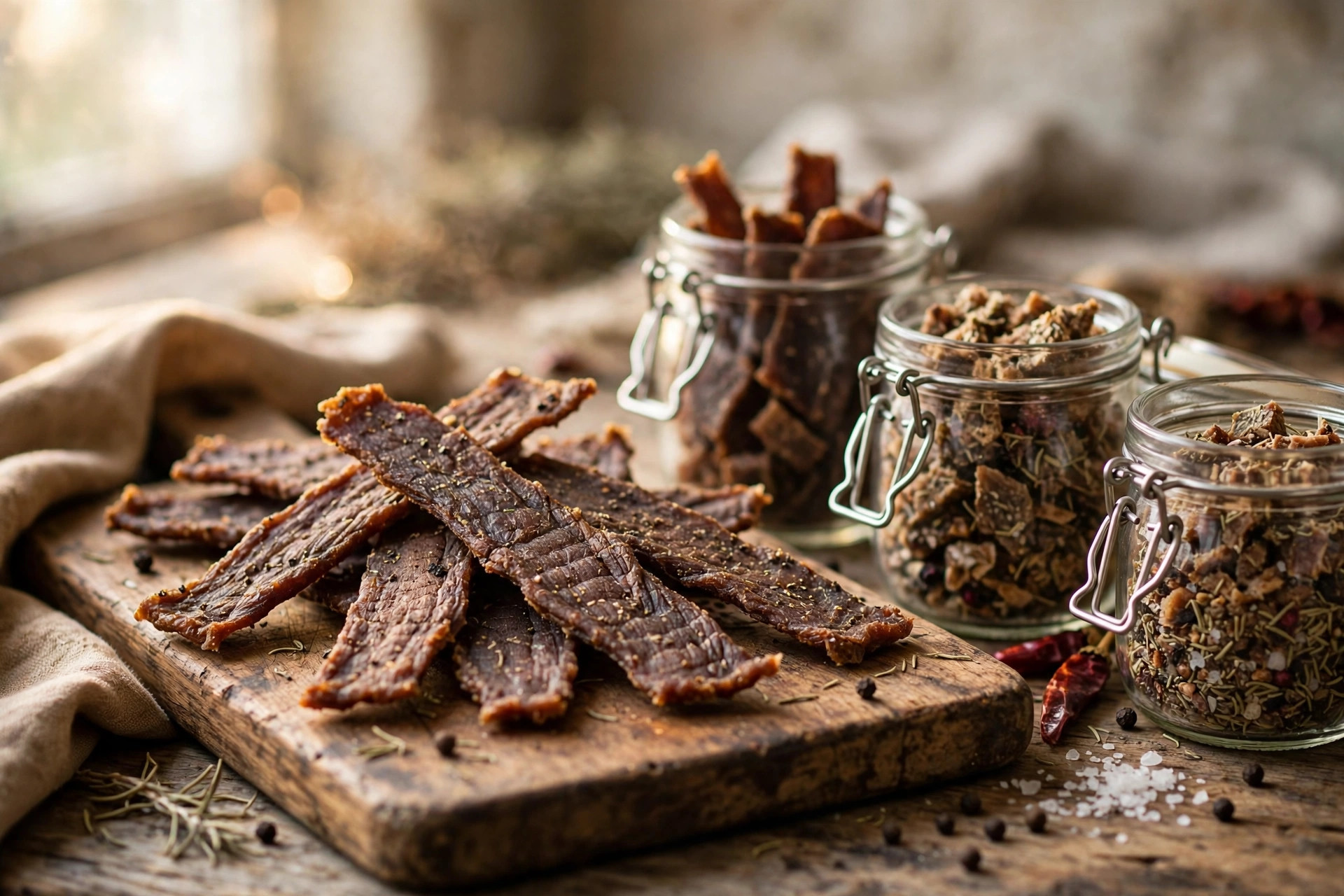
Most dehydrator manuals never mention it, and most forum recipes skip it — marinate, slice, dry at 145°F, done. The jerky tastes right, looks right, and keeps. What it may also do is carry pathogens through the process untouched, because a dehydrator is a warm wind machine, not an oven: FSIS research found pathogenic E. coli surviving drying times of up to 10 hours at temperatures up to 145°F on venison. The meat dries around the bacteria faster than the heat reaches them.
The fix is one step, done either side of the drying. Neither version changes the jerky anyone tastes. Both change what’s living in it.

ThermoPro TP03H Instant-Read Thermometer
The heat step is a measurement, not a vibe — an instant-read probe in the thickest strip is how 160°F gets proven instead of assumed.
$8.99 from Amazon
Excalibur 3926TB Dehydrator
Nine trays and a thermostat that holds the 130–140°F drying band steady across a full load of strips — the dehydrator's half of the safety system.
Check AvailabilityThe Two Tested Routes
| Route | The step | Temperature |
|---|---|---|
| Heat before drying | Steam or roast strips, or heat in marinade | 160°F meat / 165°F poultry |
| Heat after drying | Finished jerky in a preheated oven, 10 minutes | 275°F |
| The drying itself | Steady dehydrator temperature throughout | 130–140°F |
Heating in the marinade is the route most home jerky makers land on: bring the strips in their marinade to the target temperature, measured with a food thermometer in the thickest strip, then drain and dry. The oven finish is the rescue route for a batch already dried — and the only route for a batch you dried raw before you knew. Either way, verify with a thermometer rather than a timer: a dial setting is a claim, a probe in the meat is a measurement. Our jerky dehydrator comparison scores machines on whether they can hold the 130–140°F drying band steadily, which is the dehydrator’s actual job in this process — the killing is done by the heat step, not the box.
Storing It Once It’s Safe
Homemade jerky is a short-storage food by the official clocks: the National Center for Home Food Preservation puts home-dried jerky at about two weeks at room temperature, while USDA guidance allows one to two months for home-dried jerky properly stored — either way, it’s weeks-to-months, not the years of the dry staples. Cool it, condition it the way our conditioning answer sets out for dried foods generally, and keep it airtight; vacuum sealing stretches the clock, refrigeration stretches it further. The full official guidance behind this page is the FSIS fact sheet, “Jerky and Food Safety” — worth reading once, in full, before your next batch.

Survival Garden Seeds, 30 Varieties
Every lot germination-tested with a packed-for date, and the only maker here that tells you plainly most seed lasts 3 to 5 years — not forever.
$29.97 from Amazon
Nesco Snackmaster Pro FD-75A
Two fruit roll sheets and two mesh screens in the box, trays that grow to 12 — and no timer, so batches need a human ending.
$64.39 from Amazon
Follow-Up Questions
Does the marinade make raw jerky safe on its own?
No. FSIS tested it: marinating did not significantly reduce the bacteria. Acid and salt are flavor and a hurdle, not a kill step. The marinade becomes part of the safety system only when it’s the thing you heat the strips in.
My dehydrator goes to 165°F. Is that enough without a separate step?
The dial reaching 165°F isn’t the meat reaching it — evaporation keeps the meat’s internal temperature down until most of the water is gone, which is the whole mechanism behind the recommendation. Verify the meat itself with a probe, or use one of the two tested routes.
What about ground-meat jerky?
Ground meat carries more risk, not less — the surface bacteria are mixed throughout. The same heat step applies, and it’s the case where skipping it is hardest to defend.
Viewers also searched for these items.


Millennium Energy Bars (SOS Food Lab)
Nine real flavors and the only bar here people call genuinely good. Single 400-calorie bars made for go-bags and school kits.
$19.99 from AmazonFrequently Asked Questions
How do I know the jerky is dry enough?
The bend test: a cooled piece cracks but does not break when bent. Dryness and safety are separate checks, though — the bend test says nothing about bacteria, which is what the heat step is for.
Can I heat jerky after drying if I forgot the pre-heat?
Yes — that’s exactly what the 275°F, 10-minute oven finish is for. It’s a tested route, not an improvisation.
Does this apply to fish jerky and turkey jerky?
Poultry is explicit in the guidance at 165°F. Fish follows the same principle — heat to a safe temperature rather than trusting the dryer — with times and handling in the FSIS guidance.
Temperatures and method per USDA FSIS, “Jerky and Food Safety,” and the National Center for Home Food Preservation.
This question came from our harvest of what readers ask in the forums. See the rest of the list: What People Are Asking About Food Storage.
Prices shown on this page were last checked November 26, 2026 — prices change; check before you buy.
Talk it over with other readers
The Truly Preserved Community on Facebook is where readers compare notes on food storage, water, and backup power — and where your questions help decide what we research next.