
Truly Preserved is reader-supported. If you buy through a link on this page we may earn a commission at no extra cost to you. Nobody pays for placement or scores.
THE SHORT ANSWER
Yes — you need a pump, or a spigot fitted before the drum was filled. A full 55-gallon drum holds about 460 pounds of water; tipping it to pour is not an option for anyone. The standard kit is two tools: a bung wrench to open the drum’s caps, and a siphon or rotary drum pump that moves the water into a jug you can carry. Fit the pump, prime it, fill a 5-gallon jug — that’s the whole routine, and it’s the part of drum storage people forget to buy until the day they need the water.
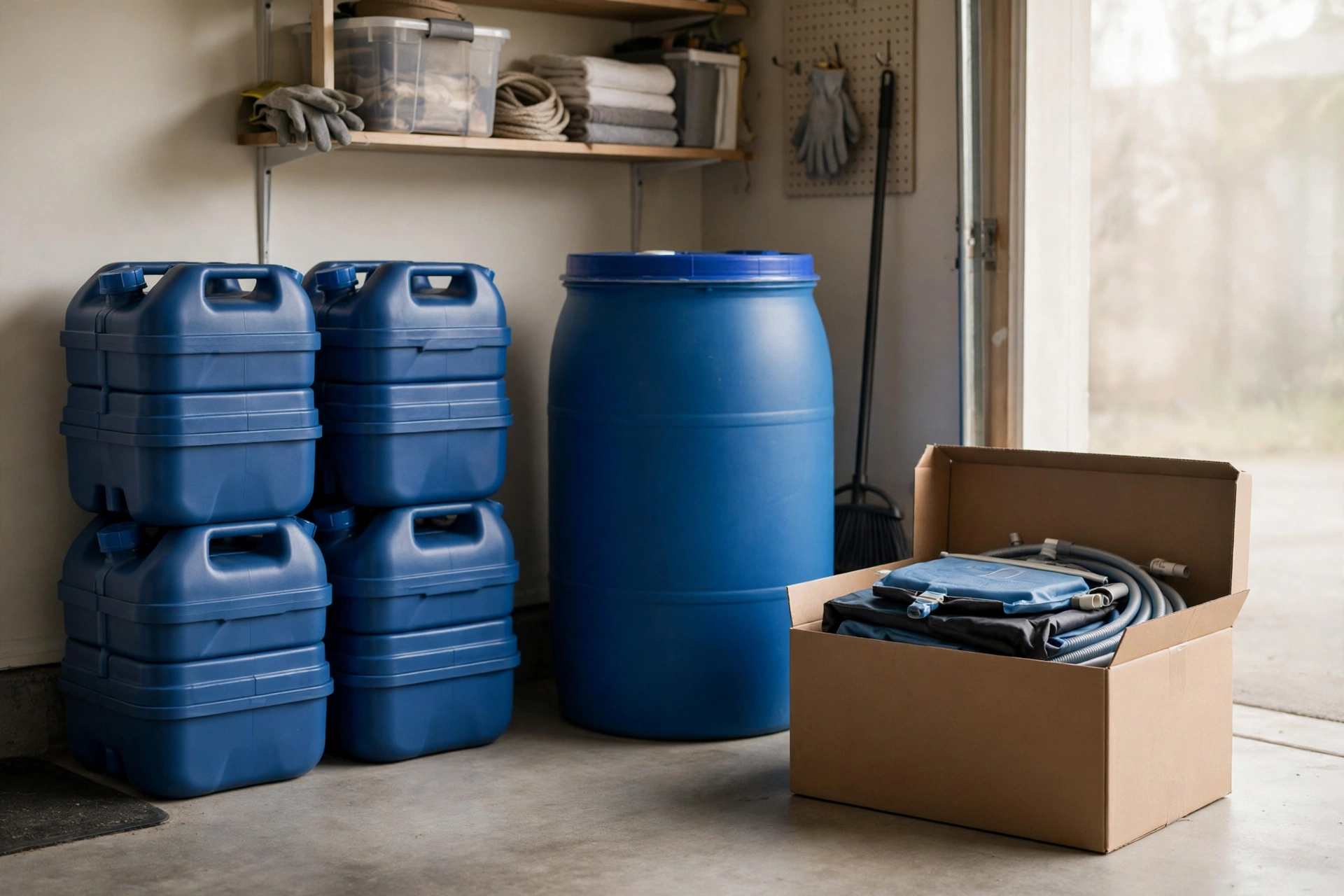
Every drum-storage plan goes the same way: the drum is bought, filled, and sealed with a satisfying sense of completion — and the question of how the water comes back out gets postponed. Then a water-main break or a storm makes it urgent, and the household discovers that 55 gallons of water is not a container. It’s a fixture.
Do the arithmetic once and the pump stops looking optional. Water weighs about 8.3 pounds a gallon; 55 gallons is roughly 460 pounds, plus the drum. Nobody tips that, nobody pours from it, and siphoning by mouth with a hose is the miserable, contamination-friendly improvisation the forums are full of.
The access kit costs less than the drum did.
The Two Tools, and What Each One Does
The bung wrench. A drum’s caps — the bungs — are not hand-tight fittings; they’re recessed plugs made for a purpose-built wrench that fits their cross or hex pattern. The wrong tool (pliers, a screwdriver) chews the plug and still loses. A bung wrench costs a few dollars, lives on top of the drum, and is the difference between a two-minute job and a destroyed cap.
The pump. A siphon pump made for drums drops its intake tube through the bung hole and moves water with a few strokes of priming — the battery and hand models built for 55-gallon drums move several gallons a minute, enough to fill a carry jug without drama. Fit matters: the pump’s tube and collar are sized to the standard 2-inch bung opening, which is the other reason to open the drum with the right wrench and keep the threads clean.
Then the water goes into something a person can carry — a 5- or 6-gallon jug, about 45 pounds full — and the drum gets resealed. Our water storage containers comparison prices the drum route against stackable jugs on exactly this point: the drum wins on cost per gallon and loses on handling, every time.

TeraPump TRDRUM40 Drum Pump
A siphon pump sized for 55-gallon drums — battery-powered transfer at several gallons a minute, so filling a carry jug is a minute's work instead of a wrestling match.
$39.99 from Amazon
DURATECH Drum Wrench
Fits the standard drum bung patterns and opens caps without chewing them — the few-dollar tool the whole system depends on. Keep it on top of the drum.
$18.99 from AmazonKeeping Drum Water Worth Drinking
Access is only half the system. The CDC’s emergency water guidance sets the frame: store at least a gallon per person per day, use food-grade containers, and replace water you filled yourself every six months — the full guidance is in the CDC’s emergency water supply page, and our stored tap water answer works the rotation schedule out. A drum you can’t open is a drum that never gets rotated, which is the practical argument for keeping the wrench and pump with the drum from day one: the six-month rotation is a ten-minute job with the kit, and a project without it. For how much water the drum is actually covering, our per-person water answer runs the household math — one drum is a two-week supply for a household of about four, drinking and basic hygiene included.
Starting from zero instead? The drum, pump, and treatment bundled together is the Augason Farms 55-gallon kit — the finished rigid system our water comparison scores as the cheapest per gallon stored, if it never has to move.
Follow-Up Questions
Can I fit a spigot instead of using a pump?
Yes, if it’s fitted before filling and the drum sits raised on a stand — gravity does the rest. It’s the better setup for a drum in constant rotation; the pump is the better answer for a sealed drum stored as a reserve, because it adds no hole and no leak point below the waterline.
What if my drum is stored on its side?
Side-storage drums are built for a faucet in the bung — that fitting is the access. An upright drum with a faucet fantasy is a pump drum; don’t tip 460 pounds to pretend otherwise.
How do I get the last few gallons out?
The pump’s intake reaches near the bottom; the final gallon or so is tipped out once the drum is light enough to handle safely, at rotation time. Nothing is wasted that a schedule wouldn’t catch.
Viewers also searched for these items.

Saratoga Farms 5-Gallon Stackable
The carry-size containers for daily use off the drum.
$318.79 from Amazon
ZeroWater 12-Cup
A five-stage pitcher that strips dissolved solids down to zero on its included meter — a useful everyday backup when the big gravity can is stored away or already spoken for.
$27.99 from Amazon
Katadyn BeFree AC
The trail favorite: a soft bottle with the filter in the cap — fill, squeeze, drink. The backpacking world's default for fast water.
$49.95 from AmazonFrequently Asked Questions
Can I siphon with a plain hose?
You can, and the forums are full of people who did — once. A garden hose isn’t food-grade, a mouth-started siphon is a contamination route, and the drum pump that replaces the whole performance costs less than the hose did.
Does the pump need to be food-grade?
The parts touching drinking water should be — pumps sold for drum water transfer are; fuel pumps are a different product that happens to fit. Buy the water version.
How long does it take to fill a 5-gallon jug?
About a minute with a powered siphon pump, a few minutes by hand pump. The whole rotation — open, fill jugs, reseal — is a ten-minute job once the kit lives with the drum.
Water weights and storage guidance per the CDC’s emergency water supply publications.
This question came from our harvest of what readers ask in the forums. See the rest of the list: What People Are Asking About Water Storage.
Prices shown on this page were last checked November 26, 2026 — prices change; check before you buy.
Talk it over with other readers
The Truly Preserved Community on Facebook is where readers compare notes on food storage, water, and backup power — and where your questions help decide what we research next.