
Truly Preserved is reader-supported. If you buy through a link on this page we may earn a commission at no extra cost to you. Nobody pays for placement or scores.
The short answer: store 60 pounds of dry beans and legumes per adult per year. That is the figure the classic year-supply tables have carried for decades, and the arithmetic still holds up: 60 pounds works out to about 2.6 ounces of dry beans a day, which cooks up to roughly a cup of beans a day, every day, for a year. This page is about how much beans per person per year — one staple, one person, every duration from 3 days to a full year. If you want family totals across all foods, that is a different page: our family-of-four food breakdown counts calories for the whole shelf, and our two-week water page does the same job for water. Here, it is beans only.
The arithmetic behind the 60 pounds
Sixty pounds a year is 960 ounces divided by 365 days — about 2.6 ounces of dry beans per day. Dry pinto beans carry about 1,550 calories a pound on USDA figures, so 60 pounds holds roughly 93,000 calories, or about 255 calories a day. That is near an eighth of a 2,000-calorie day, which is exactly the job beans are hired for in a storage plan: not the whole diet, but the protein-and-fiber layer that rice and wheat cannot supply on their own.
The cooked math is the part people actually eat. USDA cooking references put one pound of dry pinto beans at about 5¼ cups cooked. Sixty pounds therefore becomes about 315 cups of cooked beans a year — a little under a cup a day. A cup of cooked pinto beans brings about 15 grams of protein and 15 grams of fiber with it, so the 60-pound plan quietly covers a solid share of a day’s protein before any meat, eggs, or dairy enter the picture. Run your own household numbers — people, days, and the rest of the staples — in our Long-Term Food Storage Calculator, which is built to do this same arithmetic for the whole pantry at once.


Millennium Energy Bars (SOS Food Lab)
Nine real flavors and the only bar here people call genuinely good. Single 400-calorie bars made for go-bags and school kits.
$19.99 from Amazon
Clearly Filtered Pitcher
The pitcher for people who read contaminant tables: built to target fluoride, PFAS, and arsenic — the premium end of pitcher filters.
$87.99 from AmazonBeans per person, by duration
| Duration | Per person | Family of four | Calories (per person) |
|---|---|---|---|
| 3 days | 0.5 lb | 2 lb | ~775 |
| 1 week | 1.2 lb | 4.6 lb | ~1,800 |
| 1 month | 5 lb | 20 lb | ~7,750 |
| 3 months | 15 lb | 60 lb | ~23,250 |
| 6 months | 30 lb | 120 lb | ~46,500 |
| 1 year | 60 lb | 240 lb | ~93,000 |
Every row is the same 2.6 ounces a day, scaled. Sixty pounds of dry beans packs into roughly two 5-gallon buckets at about 30 pounds of beans to a filled bucket, so a year for one adult is a two-bucket problem, and a year for a family of four is about eight buckets. Our bulk staples guide prices beans against rice, wheat, and oats per 1,000 calories and covers the packing itself; the Preserve the Pantry page holds the rest of the shelf this page belongs to.
Which beans make up the 60 pounds?
The classic year-supply split behind the 60-pound figure does not put all 60 pounds into one bean. Its legume list runs about 30 pounds of dry beans (pinto, black, kidney, navy), 10 pounds of soybeans, 5 pounds each of lima beans, split peas, and lentils, and 5 pounds of dry soup mix. Copy the shape, not the exact list: store the beans your household already eats, and keep a real share in lentils and split peas. The reason is fuel, and it is the next section.
What do beans cost you in water and fuel?
Dry beans are not a just-add-nothing food, and a storage plan that ignores their cooking cost is lying to itself. USDA cooking references call for about 1¾ quarts of soak water for every pound of dry beans, and the pot needs more water after that. A pound of beans therefore pulls roughly two quarts of water out of your storage before anyone eats — small against a drinking supply, but real, and one more reason the water math and the food math belong on the same shelf plan.
Fuel is the bigger tax. Soaked beans simmer for an hour or more before they soften; unsoaked beans take longer still. On a camp stove or a generator budget, that hour is a cost. Lentils and split peas are the pressure valve: no soak, and they cook in roughly 20 to 30 minutes. A bean plan that is all pinto and kidney is a plan that burns fuel three times as long as it needs to on half its meals. That is why the classic split gives lentils and split peas their own lines instead of treating them as garnish.


COSORI Dehydrator
A fruit roll sheet in the box, temperature set to the degree, and a 48-hour timer that ends the batch before it over-dries.
$135.99 from Amazon
Blue Alpine Medium Select
Faster cycles — 12 to 20 hours on Blue Alpine's figures — quarter-sheet trays, and silicone mats in the box. More machine than a first month needs; the one to read about before you buy twice. Use code TRULYPRESERVED at checkout.
Check the priceWhen should you store 90 pounds — or 146?
Sixty pounds assumes beans are one layer in a full pantry that also holds grains, fats, sugar, and some protein from other foods. Two situations break that assumption. If beans are your main protein — no stored meat to speak of, a vegetarian shelf, or a tight budget leaning on the cheapest protein per pound — plan on about 90 pounds per person per year. That is a quarter-pound of dry beans a day, about 390 calories and a cup and a half cooked, and it is the level most bean-heavy storage plans quietly use.
The extreme case is the rice-and-beans-only shelf, where the pair carries the whole 2,000 calories a day in a two-to-one rice-to-beans mix by weight. There, beans alone run about 146 pounds per person per year — roughly 620 calories a day from beans. We priced and stress-tested the rice-and-beans pairing in our bulk staples guide, and the honest verdict stands: it works as a floor, it fails as a menu. Nobody eats that way for a year without fats, salt, and something green joining the shelf. Treat 146 as the ceiling that proves the point, not a target.
How long do stored beans keep — and what changes as they age?
Properly packed dry beans are among the longest-lived foods on the shelf: the long-term storage tables behind our bulk staples guide put pinto beans at up to 30 years sealed in mylar with an oxygen absorber, cool and dark. What the headline number hides is texture. Beans harden as the years pass. Ten-year beans soak longer and simmer longer than one-year beans, and very old beans sometimes refuse to soften at all no matter how long they cook. They are not spoiled — they are stubborn. The fixes are old ones: a pressure cooker, a pinch of baking soda in the soak water, or grinding the oldest beans into bean flour for flatbreads and thickening soups. Rotate your working stock through normal cooking and let the sealed buckets be the reserve, and you will rarely meet a bean too old to use.
Do children need the full 60 pounds?
No. The 60-pound figure is an adult share. The traditional year-supply worksheets scale children as a fraction of an adult — about half for the youngest, rising to a full share by the early teens — and that matches appetite better than a flat per-head count. A family of two adults and two small children planning a full year is closer to 180 pounds of legumes than 240. The Long-Term Food Storage Calculator applies those child fractions for you, which is one more reason to run the household through it instead of multiplying the adult number by heads.

Palouse Brand Hard Red Wheat Berries
Beans are one leg; berries are another — they store as long and mill into the flour beans cannot become.
$70.95 from Amazon
Augason Farms Long-Grain White Rice
The third leg, in a storage pail instead of a grocery sack.
$66.42 from AmazonFrequently asked questions
How much beans per person per year for a family of four?
At the standard adult share, 240 pounds of dry beans and legumes for four adults for a year — 60 pounds each. With young children counted at partial shares, most families of four land between 180 and 240 pounds.
How many cups is 60 pounds of dry beans?
About 315 cups cooked. One pound of dry pinto beans measures roughly 2⅜ cups dry and cooks up to about 5¼ cups, so 60 pounds is a little under a cooked cup per person per day for a year.
Are beans alone enough protein for a year?
At 60 pounds a year, beans supply roughly 13 to 15 grams of protein a day — a strong base, not the whole requirement. At the 90-pound level they cover more, and rice eaten alongside beans fills the amino-acid gaps each food has on its own. A full-year shelf still needs protein from more than one line.
How long will dry beans last in storage?
Sealed in mylar with oxygen absorbers and kept cool, dry beans are rated up to 30 years in long-term storage tables. Quality fades before safety does: old beans darken, take longer to cook, and may need grinding or pressure cooking to soften.
What is the cheapest way to buy 60 pounds of beans?
Loose bags and the LDS Store’s #10-can cases beat pre-packed pails on cost per 1,000 calories — our bulk staples guide ran that comparison on verified prices. What pre-packed pails sell is the packing already done.
Sources & freshness: USDA FoodData Central and USDA cooking references (dry bean calories and cooked yields); the classic year-supply legume figures carried in Church of Jesus Christ (LDS) Home Production and Storage tables and Brigham Young University storage research; Truly Preserved’s bulk staples dataset (post 451). No product prices are printed on this page.

Vittles Vault Airtight Pet Food Container, 35 lb
Despite the pet-food label, this gamma-sealed bin is a prepper staple for bulk dry goods — 60 pounds of beans needs airtight, pest-proof storage, not the bag they came in.
Check Availability
IRIS USA 30 lb Airtight Storage Container
A 30-pound airtight container splits the year supply into manageable bins you can rotate through the pantry.
$23.99 from Amazon
ePackageSupply 5-Gallon Gamma Seal Lids, 3-Pack
Gamma lids turn standard 5-gallon buckets into screw-top airtight storage — the classic way bulk beans get bucketed for the long term.
$73.99 from AmazonTalk it over with other readers. The Truly Preserved Community on Facebook is where readers compare notes on food storage, water, and backup power — and where your questions help decide what we research next. Join the group →
Viewers also searched for these items.
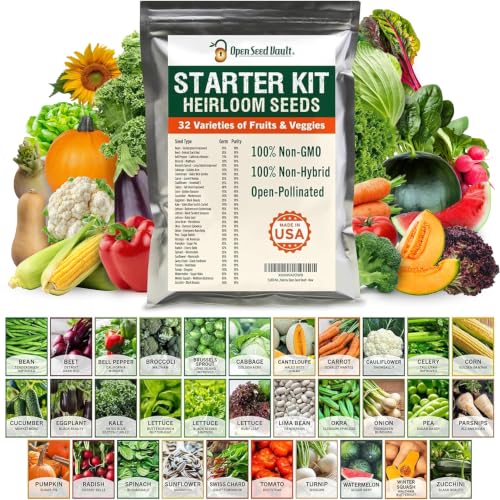
Vegetable & Fruit Seeds
4.6 stars across roughly 14,600 Amazon ratings — the deepest owner record here — but the calorie crops are thin: 15 to 25 seeds of beans, peas, and pumpkin.
$28.99 from Amazon
Clearly Filtered Pitcher
The pitcher for people who read contaminant tables: built to target fluoride, PFAS, and arsenic — the premium end of pitcher filters.
$87.99 from AmazonPrices shown on this page were last checked November 26, 2026 — prices change; check before you buy.