
Truly Preserved is reader-supported. If you buy through a link on this page we may earn a commission at no extra cost to you. Nobody pays for placement or scores.
THE SHORT ANSWER
For loose, pourable berries, use a tray pack: rinse and completely dry the berries, spread them in a single layer on a shallow tray, freeze them, and as soon as they are frozen seal them in an airtight container and return them to the freezer. A sugar pack takes 3/4 cup sugar per quart (1 1/3 pounds) of berries, and a syrup pack uses 40 to 50 percent syrup depending on the sweetness of the fruit. Leave at least 1/2 inch of headspace. Every figure on this page comes from the tested source credited at the bottom.
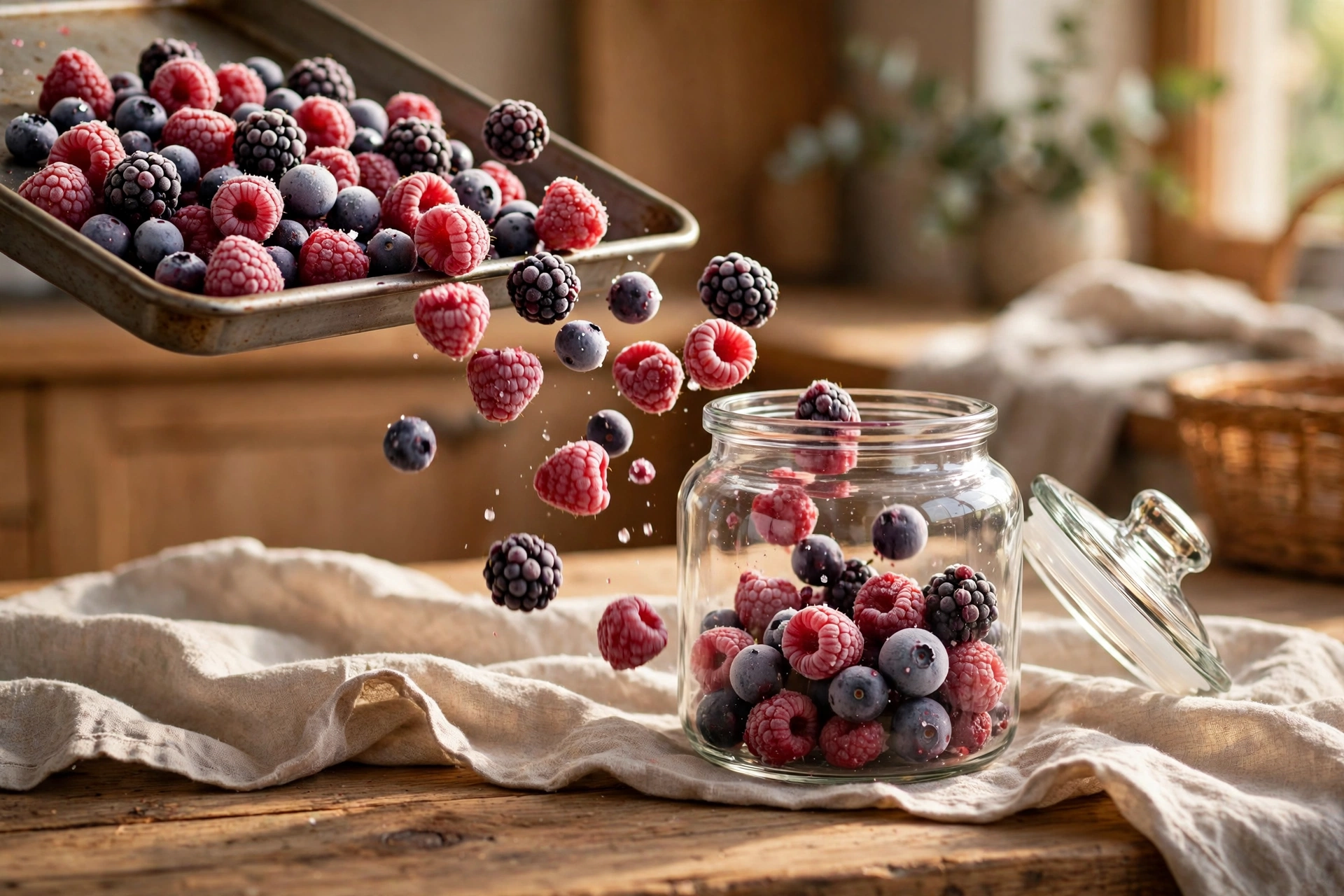
Berries are the freezer’s easiest win and its most common small disappointment: a container of beautiful fruit frozen in a solid, frosty block that has to be chiseled apart. The fix is one extra step — freezing the berries on a tray first, so each berry freezes on its own and pours loose from the container all winter. The National Center for Home Food Preservation lays out several packs for berries, and which one is right depends on how the berries will be eaten: loose for smoothies and baking, sugared for desserts, or in syrup for serving as fruit.
This guide follows the National Center’s tested berry procedures — tray pack, dry pack, sugar pack, syrup pack, and crushed — with its amounts exactly as given. It is part of our preservation guides. Peaches, the other big summer fruit here, need the opposite treatment — covered in syrup with ascorbic acid — in how to freeze peaches, and the vegetable side of the same freezer session is in how to freeze sweet corn.
What You Need
Select fully ripe, firm berries and discard soft, under-ripe, or defective fruit — moldy berries go out at sorting, not into the container. You need a shallow tray, like a cookie sheet, that fits your freezer for the tray pack; freezer containers or bags; and, for the sweetened packs, sugar at 3/4 cup per quart (1 1/3 pounds) of berries for a sugar pack, or syrup at 40 to 50 percent for a syrup pack. Blueberries are the exception to the washing rule, covered below: dry them completely after any rinsing, or the moisture on the skin makes tougher skins.

Ziploc Freezer Quart Bags
Quart freezer bags portion the finished berries flat, so packages freeze fast, stack tight, and thaw one meal at a time instead of in one solid block.
$26.48 from Amazon
FoodSaver Elite Vacuum Sealer
A vacuum sealer pulls the air that causes freezer burn off every package, which is how this batch keeps its quality through the full storage window this page gives.
$218.56 from AmazonBefore You Start
Two things decide whether frozen berries stay loose and bright. First, dryness: berries for a tray or dry pack need to be completely dry before freezing for best quality — surface water is what welds a tray of berries into a sheet of ice. Second, speed at the end: tray-frozen berries go into their container as soon as they are frozen and straight back into the freezer, because loose berries left sitting out pick up moisture and freezer burn starts early. Leave at least 1/2-inch headspace in containers so expanding fruit does not break them open, and keep the freezer at 0°F or below.
How to Freeze Berries, Step by Step
- Sort and wash — with one exception. Select fully ripe, firm berries. Wash carefully in cold water, discarding soft, under-ripe or defective fruit. Blueberries are the exception: do not wash them before freezing if you can avoid it, because washing results in a tougher skinned product — and if you do rinse them, dry them completely.
- Dry the berries completely. Drain washed berries and let them dry fully. For the tray and dry packs this step is the quality step: completely dry berries freeze loose and keep tender skins.
- Tray pack for loose berries. Spread the rinsed, completely dried berries in a single layer on a shallow tray, like a cookie sheet, keeping them from touching as much as the tray allows. Freeze them on the tray.
- Pack as soon as they are frozen. As soon as the tray berries freeze, seal them in an airtight container and place them back into the freezer so they do not get freezer burn. Leave at least 1/2-inch headspace.
- Or sugar pack. Gently mix 3/4 cup sugar with 1 quart (1 1/3 pounds) of berries. Let the mixture sit a short time until the juice is drawn out and the sugar dissolved, then fill containers, leaving headspace, seal, and freeze.
- Or syrup pack. Pack berries into containers and cover with cold 40 to 50 percent syrup, depending on the sweetness of the fruit. Leave headspace, seal, and freeze.
- Or crush or purée. For berries headed for recipes, crush or purée them and mix 1 cup (or 1 1/8 cups) sugar with each quart (2 pounds) of crushed or puréed berries. Pack into containers, leaving headspace, seal, and freeze.
The Numbers: Pack Amounts and Headspace
Berries are one of the few foods where the pack is a real choice, so the amounts for each pack are set out side by side. All of them are the source’s figures, per quart of berries unless stated.
| Pack | Amount | Notes |
|---|---|---|
| Tray pack / dry pack | No sugar or syrup | Single layer on a shallow tray; pack as soon as frozen; at least 1/2-inch headspace |
| Sugar pack | 3/4 cup sugar per quart (1 1/3 pounds) berries | Let sit until juice is drawn out and sugar dissolved |
| Syrup pack | Cold 40 to 50 percent syrup, to cover | Strength depends on sweetness of fruit |
| Crushed or puréed | 1 cup (or 1 1/8 cups) sugar per quart (2 pounds) crushed berries | For berries used as an ingredient in other recipes |
| Type of pack | Wide-top pint | Wide-top quart | Narrow-top pint | Narrow-top quart |
|---|---|---|---|---|
| Dry pack | 1/2 inch | 1/2 inch | 1/2 inch | 1/2 inch |
| Liquid pack | 1/2 inch | 1 inch | 3/4 inch | 1 1/2 inches |
The dry-pack row covers tray- and dry-packed berries; the liquid-pack row covers syrup packs and crushed or puréed berries in juice. Either way, the source’s floor is at least 1/2-inch headspace — containers filled to the lid can break open as the fruit expands.
Loose tray-frozen berries are only as good as the seal that follows them. The two products below handle that second half of the job — sealing berries so they pour loose months later, and portioning them for the smoothies and bakes they are headed for.

Etekcity Digital Kitchen Scale
A kitchen scale turns a garden pile into known pounds, which is what the per-pound ratios and yield figures in this guide are planned from.
$9.99 from Amazon
IRIS USA Airtight Container, 30 lb, with Wheels
As soon as the tray berries freeze solid, they go into an airtight container like this one — the step that keeps freezer burn off them for the months ahead.
$23.99 from AmazonCommon Mistakes
Packing berries straight into a container and calling it done. A plain dry pack works, but unless the berries are tray packed first they most likely clump together and are difficult to separate into individual berries. The tray step is what makes a bag pourable.
Washing blueberries and freezing them wet. Washing blueberries results in a tougher skinned product, and wet skins freeze tougher still. Skip the wash, or rinse and dry them completely before they go on the tray.
Leaving tray berries in the freezer uncovered. The tray is a step, not storage. As soon as the berries freeze, seal them in an airtight container and return them to the freezer — exposed berries take on freezer burn fast.
Skipping the headspace. Leave at least 1/2-inch headspace between the berries and the lid. Fruit expands as it freezes, and a brim-full rigid container can break open.
Freezing soft or moldy berries in the mix. Select fully ripe, firm berries and discard soft, under-ripe or defective fruit at the sorting table. Freezing does not improve a berry; it preserves the one that went in.
Storage and Shelf Life
Keep the freezer at 0°F or below the whole time. The National Center lists fruits and vegetables at 8 to 12 months of approximate storage at 0°F when the food has been prepared and packaged correctly, and those times are about quality — properly frozen food held at 0°F does not become unsafe at the end of them, it simply tastes less like the day it was picked. Label every package with the contents and the date, keep a simple list of what went in, and arrange the freezer so the oldest packages get used first. A package that warms up, loses its seal, or comes back from a long power cut with ice crystals melted away should move to the front of the meal plan rather than back into long storage — and if the power question is the one you are planning around, how to keep food safe if the power goes out covers what stays safe and for how long. Berries frozen loose are the most forgiving food in the freezer to use: pour out what a recipe needs, reseal the container, and put it straight back — no thawing the whole batch to get a cup of blueberries.
Viewers also searched for these items.

Nesco VS-12 Vacuum Sealer
Seal the tray-frozen berries in measured portions — a suction sealer pulls the air that freezer-burns them.
$108.18 from Amazon
COSORI Dehydrator
The drying route for the berries that will not fit the freezer — dried berries keep in a jar on the shelf.
$135.99 from Amazon
Thrive Life: Freeze-Dried Blueberries - Pantry Can Size
Freeze-dried blueberries, ready to eat — the shelf-stable end of the same harvest, and the taste benchmark for your own dried batch.
$60.00 from AmazonFrequently Asked Questions
Should I wash blueberries before freezing?
No — the source is direct that washing results in a tougher skinned product. If you do rinse them, dry them completely before freezing, and wash them when you take them out to use instead.
What is a tray pack?
Berries spread in a single layer on a shallow tray and frozen, then sealed in a container as soon as they are frozen. It keeps each berry separate, so they stay loose and easy to pour and measure.
How much sugar goes in a sugar pack?
3/4 cup sugar gently mixed with 1 quart (1 1/3 pounds) of berries, left a short time until the juice is drawn out and the sugar dissolved.
How much headspace do berries need?
At least 1/2 inch in every case — 1/2 inch for a dry pack in any container, and for a liquid pack, 1/2 inch in a wide-top pint, 1 inch in a wide-top quart, 3/4 inch in a narrow-top pint, and 1 1/2 inches in a narrow-top quart.
Procedure and pack amounts: National Center for Home Food Preservation, “Freezing Blackberries or Dewberries” and “Brrrrr Berries,” from So Easy to Preserve, 6th ed., University of Georgia Cooperative Extension, via the: National Center for Home Food Preservation.
Prices shown on this page were last checked November 26, 2026 — prices change; check before you buy.
Talk it over with other readers
The Truly Preserved Community on Facebook is where readers compare notes on food storage, water, and backup power — and where your questions help decide what we research next.