
Truly Preserved is reader-supported. If you buy through a link on this page we may earn a commission at no extra cost to you. Nobody pays for placement or scores.
THE SHORT ANSWER
Pickled eggs are REFRIGERATOR ONLY. There are no home canning directions for pickled eggs and no tested shelf-stable procedure — the National Center for Home Food Preservation says so in its first line on the subject. The method: pack no more than 12 peeled, hard-cooked eggs loosely into a warm, pre-sterilized quart jar, cover them completely with a pickling solution that has been brought to a boil and simmered 5 minutes, close the jar, and refrigerate immediately. Small eggs season in 1 to 2 weeks, medium or large eggs in 2 to 4 weeks, and the eggs are used within 3 to 4 months for best quality. Every figure on this page comes from that source, credited at the bottom.
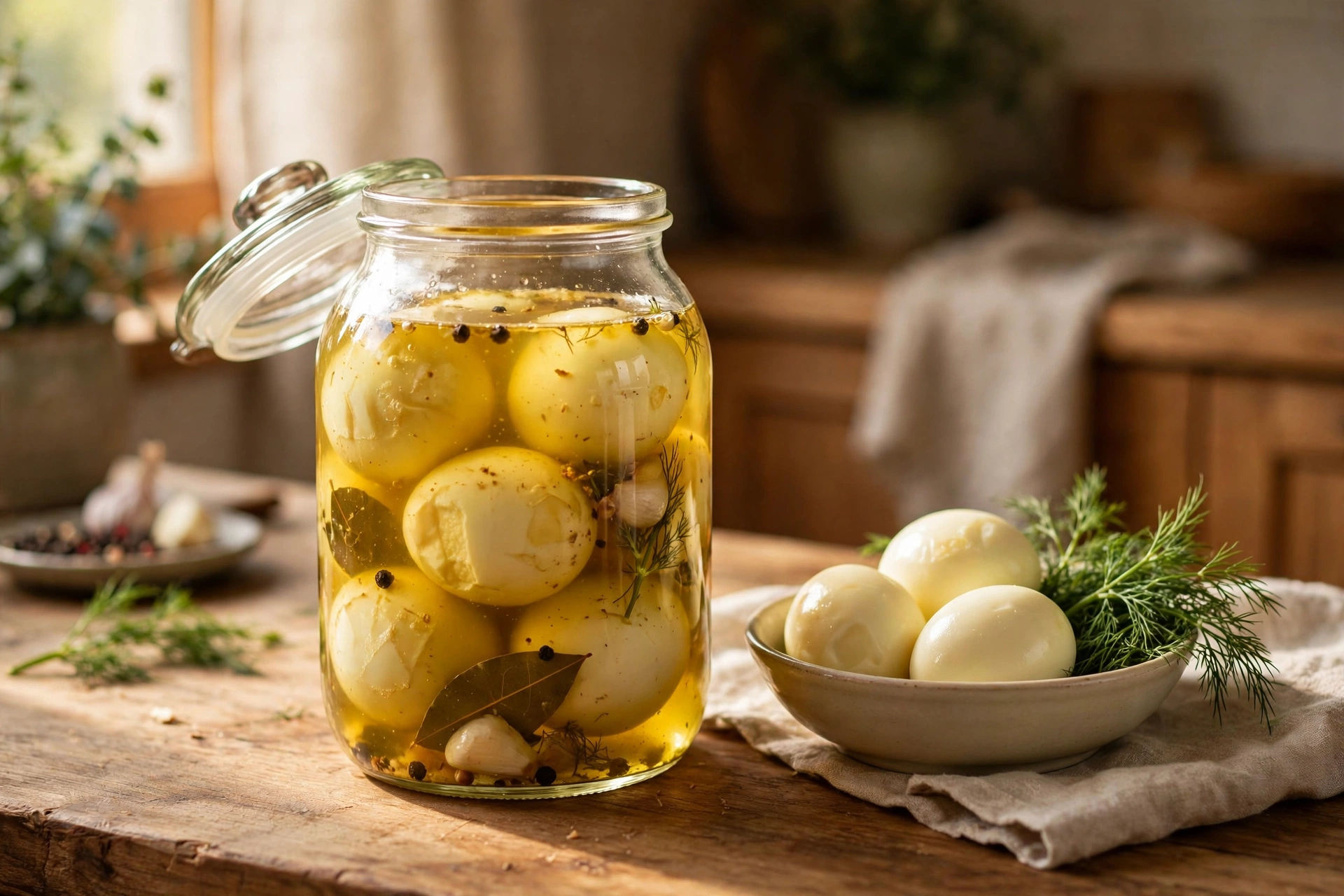
Pickled eggs are the old tavern jar made at home: peeled hard-cooked eggs in a spiced vinegar solution, eaten as a snack, sliced over salads, or chopped into egg salad with a sharp edge. They are also the one guide in this set that does not end with jars on a pantry shelf, and this page will not pretend otherwise. Home pickled eggs live in the refrigerator from the moment the hot solution goes over them until the last egg is eaten — that is not a conservative reading of the source, it is the source’s own opening statement.
This guide is part of our preservation guides, and it follows the tested procedure exactly — its quantities, its headspace, and its minutes — rather than a family version adjusted by feel. If you are new to the canner itself, how to can food in mason jars walks the general water-bath process start to finish, and our flagship dill pickle guide covers the cucumber side of the same method. Every other guide in this set is a shelf-stable water-bath pickle like the dill pickles; this one is included alongside them because readers ask for it in the same breath, and because the honest version of it — fridge only, with the source’s times — is the version worth printing.
What You Need
For the dilled eggs recipe used on this page, from the source’s set of refrigerator recipes: 12 peeled, hard-cooked eggs; 1-1/2 cups of white vinegar; 1 cup of water; 3/4 teaspoon of dill weed; 1/4 teaspoon of white pepper; 3 teaspoons of salt; 1/4 teaspoon of mustard seed; 1/2 teaspoon of onion juice or minced onion; and 1/2 teaspoon of minced garlic or 1 peeled garlic clove. You also need a quart jar that closes tightly — a quart-size canning jar holds about one dozen medium eggs — and refrigerator space it will occupy for weeks.

Morton Canning and Pickling Salt, 4 lb
Canning and pickling salt dissolves clean in the brine, with none of the cloudiness table salt's additives can cause — the salt these pickling recipes assume.
$2.68 from Amazon
Ball Half-Pint Mason Jars, 12-Pack
Half-pint jars in the same line suit a half batch for a smaller household, keeping a second flavor from taking up a full quart of refrigerator space.
Check Availability
Ball Regular Mouth Canning Lids, 96 Count
A tight-closing lid is part of the method here: the source specifies a container that can be closed or sealed tightly, with the eggs covered the whole time.
$36.99 from AmazonBefore You Start
Read this part twice. There are no home canning directions for pickled eggs: every recipe the source publishes for them is for storage in the refrigerator. Pickled eggs should never be at room temperature except for serving time, limited to no more than 2 hours in the temperature danger zone of 40 to 140 degrees F — and the source’s caution is blunt that home pickled eggs stored at room temperature have caused botulism. The jar matters too: use a warm, pre-sterilized quart jar, pack no more than one dozen eggs loosely, and make sure there is plenty of solution to completely cover the eggs for the whole storage period.
How to Make Pickled Eggs, Step by Step
- Hard-cook the eggs. Using the source’s peeling method for fresh eggs: make a pinhole in the large end of each egg, place the eggs in a single layer in a saucepan, and cover with cold water to an inch above the layer. Cover, bring to a boil, remove from the burner, and let sit 15 to 18 minutes, adjusting 3 minutes up or down for larger or smaller eggs.
- Chill and peel. Move the eggs to ice water for one minute, then back into simmering water for ten seconds, and peel immediately, cracking the shells all over and starting at the large end.
- Prepare the jar. Pack no more than one dozen peeled eggs loosely into a warm, pre-sterilized quart jar. Small or medium eggs are the source’s good choice for pickling, so the seasoning can penetrate.
- Make the solution. Combine the vinegar, water, dill weed, white pepper, salt, mustard seed, onion, and garlic. Bring all the ingredients except the eggs to a boil, reduce the heat, and simmer 5 minutes.
- Cover the eggs. Pour the hot pickling solution over the eggs in the jar, making sure the eggs are completely covered.
- Close and refrigerate. Cover the jar and refrigerate immediately. From this point the jar stays refrigerated at all times, out only for serving.
- Wait for the seasoning. Give small eggs 1 to 2 weeks to season; medium or large eggs may require 2 to 4 weeks to become well seasoned.
The Numbers: Refrigerator Storage Times
There is no processing table for this food, because there is no canning process for it. The numbers that govern pickled eggs are the source’s refrigerator figures:
| What | Source figure |
|---|---|
| Seasoning time, small eggs | 1 to 2 weeks |
| Seasoning time, medium or large eggs | 2 to 4 weeks |
| Use within, for best quality | 3 to 4 months, refrigerated |
| Maximum time at room temperature (serving only) | No more than 2 hours, in the 40 to 140 degrees F danger zone |
| Eggs per quart jar | No more than one dozen, packed loosely |
| Solution simmer before pouring | 5 minutes |
Eggs stay completely covered with the pickling solution during storage, in a container closed or sealed tightly, refrigerated at all times.
A household making pickled eggs usually has other short-window foods moving through the same refrigerator, and these are the two tools that side of the kitchen runs on.

SOLIGT Glass Fermentation Weights, 4-Pack
The other road for cucumbers: weights that hold a ferment under its brine, in the same wide-mouth jars.
$11.99 from Amazon
Ziploc Freezer Quart Bags
Freezer bags cover the overflow jobs around an egg batch, from peeled spares held for tomorrow's batch to the sandwich fillings the finished eggs end up in.
$26.48 from AmazonCommon Mistakes
Putting a jar on the pantry shelf. This is the dangerous one, and the source names the outcome: home pickled eggs stored at room temperature have caused botulism. There is no processing step that makes a home jar of pickled eggs shelf-stable.
Leaving the jar out at a party. Serving time is the only exception to refrigeration, and it is capped at no more than 2 hours in the 40 to 140 degree F danger zone. After that, the jar goes back in the cold — or the eggs are done.
Crowding the jar. No more than one dozen eggs, packed loosely, in a quart jar, with plenty of solution. A forced extra egg leaves eggs uncovered and unevenly seasoned.
Eating them in the first few days. The eggs require time to season — 1 to 2 weeks for small eggs, 2 to 4 weeks for medium or large. An egg tasted on day three is a hard-cooked egg in vinegar, not a pickled egg.
Letting the solution level drop. The eggs are to be completely covered with the pickling solution during storage. An egg sitting above the line is outside the method.
Storage and Shelf Life
Keep the jar refrigerated at all times, the eggs completely covered with solution, and use the eggs within 3 to 4 months for best quality. There is no shelf storage for this food at any point — not before opening, not after. Out of the refrigerator, the jar is on serving time only, capped at no more than 2 hours. If a jar has sat out past that window or spent time on a counter being ‘stored,’ the source’s caution about room-temperature pickled eggs and botulism is the reason to throw it out rather than taste-test it.
Viewers also searched for these items.

ThermoPro Instant-Read Thermometer
Refrigerator storage is the whole safety method for these eggs, and a thermometer is how you know the fridge holding them is actually cold rather than assumed cold.
$8.99 from Amazon
Etekcity Digital Kitchen Scale
A scale helps split a double batch evenly between jars, so each quart ends up loosely packed with plenty of solution to cover, as the method requires.
$9.99 from Amazon
Nesco VS-12 Vacuum Sealer
A vacuum sealer handles the refrigerator's other short-window foods, stretching the leftovers that accumulate while a quart of eggs seasons for its weeks.
$108.18 from AmazonFrequently Asked Questions
Can pickled eggs be canned for the pantry shelf?
No. The source’s first line on the subject is that there are no home canning directions for pickled eggs. Every recipe it publishes for them is for refrigerator storage.
How long do pickled eggs keep?
In the refrigerator, use them within 3 to 4 months for best quality — with the jar refrigerated at all times and the eggs completely covered with solution.
How long before they are ready to eat?
Small eggs usually take 1 to 2 weeks to season; medium or large eggs may require 2 to 4 weeks to become well seasoned.
Can I leave the jar out while serving?
Only for serving time, and no more than 2 hours in the temperature danger zone of 40 to 140 degrees F. Then it goes straight back into the refrigerator.
Guidance, recipes, and storage times: National Center for Home Food Preservation, “Pickled Eggs” (reviewed April 2014), via the National Center for Home Food Preservation.
Prices shown on this page were last checked November 26, 2026 — prices change; check before you buy.
Talk it over with other readers
The Truly Preserved Community on Facebook is where readers compare notes on food storage, water, and backup power — and where your questions help decide what we research next.