
Truly Preserved is reader-supported. If you buy through a link on this page we may earn a commission at no extra cost to you. Nobody pays for placement or scores.
THE SHORT ANSWER
Pickled dilled okra: wash and trim 7 pounds of small okra pods, fill pint jars firmly with the whole pods at 1/2 inch of headspace with 1 garlic clove in each jar, cover with a boiling solution of 6 cups of vinegar (5 percent) and 6 cups of water with 2/3 cup of pickling salt, 6 small hot peppers, and 4 teaspoons of dill seed, and process pints 10 minutes in a boiling water canner at 0–1,000 feet. The batch makes 8 to 9 pints. Every figure on this page comes from the tested recipe, credited at the bottom.
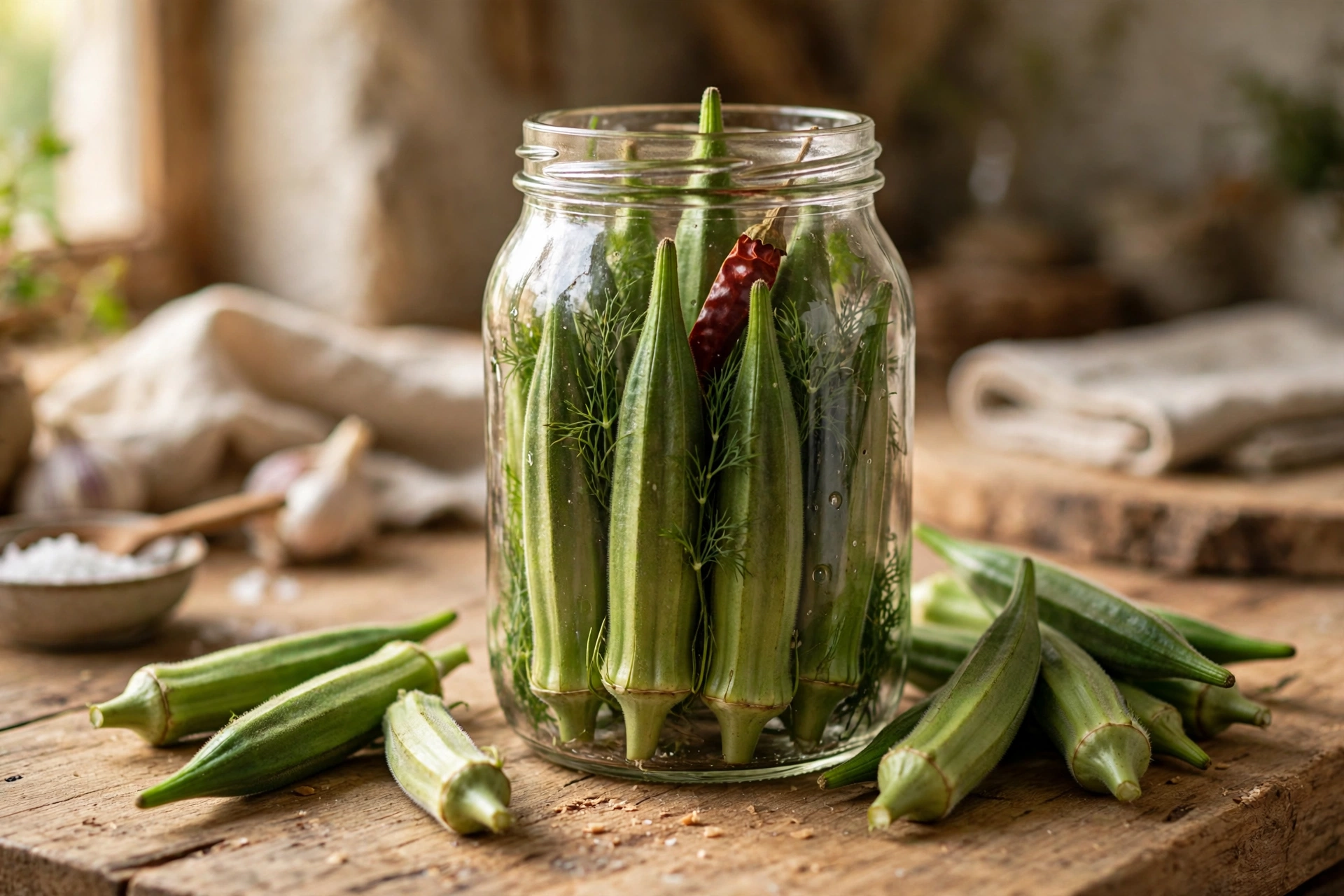
Pickled okra is the Southern relish-tray staple that converts people who think they do not like okra: whole small pods, dilled and garlicky, with none of the slipperiness that gives the fresh vegetable its reputation. Pickling is also the practical way to keep a summer okra patch — the pods come daily, they toughen fast, and this recipe takes 7 pounds at a time into jars that wait on the shelf instead of overwhelming the refrigerator.
This guide is part of our preservation guides, and it follows the tested procedure exactly — its quantities, its headspace, and its minutes — rather than a family version adjusted by feel. If you are new to the canner itself, how to can food in mason jars walks the general water-bath process start to finish, and our flagship dill pickle guide covers the cucumber side of the same method.
What You Need
The tested recipe, as written: 7 pounds of small okra pods; 6 small hot peppers; 4 teaspoons of dill seed; 8 to 9 garlic cloves; 2/3 cup of canning or pickling salt; 6 cups of water; and 6 cups of vinegar (5 percent). The yield is 8 to 9 pints, and the recipe packs the pods whole in pint jars.

Granite Ware 21.5-Quart Water Bath Canner
A boiling-water canner is the processing method every tested pickle procedure on this page uses, and this 21.5-quart model holds a full batch of jars at a rolling boil.
Check Availability
Ball Half-Pint Mason Jars, 12-Pack
The recipe packs whole pods in pint jars and yields 8 to 9 pints; this half-pint case covers the smaller jars in the same line for the short pods at the end of the batch.
Check Availability
Ball Regular Mouth Canning Lids, 96 Count
New lids are what the procedure assumes when it says to adjust lids and process; a fresh flat on every jar is how the seal the storage section depends on actually forms.
$36.99 from AmazonBefore You Start
Small pods are the recipe, not a preference: the batch is built on 7 pounds of small okra pods, packed whole, and a large woody pod does not pickle into tenderness. The brine is an even split — 6 cups of vinegar at 5 percent acidity to 6 cups of water — and that proportion is the tested one for a low-acid vegetable; do not tip it toward water because the pods seem mild. Wash and trim the pods, but keep them whole, as the procedure directs.
How to Make Pickled Okra, Step by Step
- Wash and trim. Wash the okra and trim it, keeping the pods whole.
- Pack the jars. Fill jars firmly with the whole okra, leaving 1/2-inch headspace.
- Add the garlic. Place 1 garlic clove in each jar.
- Make the solution. Combine the salt, hot peppers, dill seed, water, and vinegar in a large saucepan and bring to a boil.
- Cover and close. Pour the hot pickling solution over the okra, leaving 1/2-inch headspace. Wipe the rims, center new lids, and screw bands down fingertip-tight.
- Process in a boiling water canner for the time for your altitude in the table below.
- Rest and check. Let the jars cool undisturbed, check every seal, and label the jars before shelving.
The Numbers: Processing Times
| Jar size | 0–1,000 ft | 1,001–6,000 ft | Above 6,000 ft |
|---|---|---|---|
| Pints | 10 minutes | 15 minutes | 20 minutes |
Headspace is 1/2 inch and the pack is raw — the pods go in uncooked and the boiling solution and the process do the work. The recipe is written for pints.
Okra beyond the pickle batch freezes well for gumbos and skillets later in the year, and these are the two tools that side of the job runs on.

ThermoPro TP03H Thermometer
Refrigerator storage is the whole safety method for these eggs, and a thermometer is how you know the fridge holding them is actually cold rather than assumed cold.
$8.99 from Amazon
Ziploc Freezer Quart Bags
Quart freezer bags are the simple backup for blanched overflow vegetables and opened-jar leftovers that need to move to the freezer quickly.
$26.48 from AmazonCommon Mistakes
Starting with big pods. The recipe specifies small okra pods. Oversized pods are fibrous before they ever meet brine, and pickling preserves texture — it does not reverse it.
Cutting the pods. The procedure packs them whole. Cut okra releases far more of its characteristic texture into the jar than the whole-pod pack this recipe was tested on.
Packing loosely. The recipe says fill jars firmly. Loose pods float, shift, and leave tops above the solution line once the jars settle.
Tipping the brine toward water. Six cups of vinegar to 6 cups of water is the tested split for this jar. A milder brine mixed by feel is an untested jar.
Skipping the garlic count. One clove per jar, from a batch total of 8 to 9 cloves for 8 to 9 pints — that per-jar placement is how the flavor distributes evenly.
Storage and Shelf Life
Store sealed jars somewhere cool and dark, with the bands removed, and label each jar with the date. Home-canned pickles hold their best quality for about a year; rotate the shelf so the oldest jars get eaten first. A jar that fails to seal goes in the refrigerator and gets eaten first. Once a jar is opened, keep it refrigerated.
Viewers also searched for these items.

Morton Canning and Pickling Salt, 4 lb
The recipe calls for canning or pickling salt by name; this is that salt, without the additives in table salt that cloud pickle brine.
$2.68 from Amazon
Etekcity Digital Kitchen Scale
The batch is built on weighed produce, and a kitchen scale is how you know you actually have the pounds of vegetables the tested ratio was written for.
$9.99 from Amazon
SOLIGT Glass Fermentation Weights, 4-Pack
Glass fermentation weights are the spare for the crock side of pickling, holding fermented vegetables under their brine when part of the harvest goes that route instead.
$11.99 from AmazonFrequently Asked Questions
Why does pickled okra not taste slimy?
Because the pods are packed whole and raw in a vinegar solution, rather than cut and cooked the way fresh okra usually is. Keeping the pods whole, as the procedure directs, is the main texture decision in the recipe.
Can I leave out the hot peppers?
The batch as tested includes 6 small hot peppers in the solution. This page prints the recipe as written; the peppers are part of the tested batch.
How much dill goes in?
4 teaspoons of dill seed for the batch, combined in the solution with the salt, peppers, water, and vinegar — it is not measured per jar.
What jar size is tested?
Pints, yielding 8 to 9 of them. No other jar size is given in the recipe’s table.
Recipe and processing times: USDA Complete Guide to Home Canning, Guide 6, “Pickled Dilled Okra,” via the National Center for Home Food Preservation.
Prices shown on this page were last checked November 26, 2026 — prices change; check before you buy.
Talk it over with other readers
The Truly Preserved Community on Facebook is where readers compare notes on food storage, water, and backup power — and where your questions help decide what we research next.