
Truly Preserved is reader-supported. If you buy through a link on this page we may earn a commission at no extra cost to you. Nobody pays for placement or scores.
THE SHORT ANSWER
Iodine is a label-driven method. The CDC groups it with the other chemical disinfectants and gives one instruction for tablets and drops: follow the instructions on the label or package, because chemical disinfectants are made to disinfect specific amounts of water. The CDC is equally plain about the limits — iodine kills viruses and bacteria but will not kill Cryptosporidium, and people who are pregnant, have thyroid problems, or have a hypersensitivity to iodine should avoid water disinfected with iodine, as should anyone for more than a few weeks at a time. Boiling remains the CDC’s best method. Every statement on this page comes from the CDC guidance credited at the bottom.
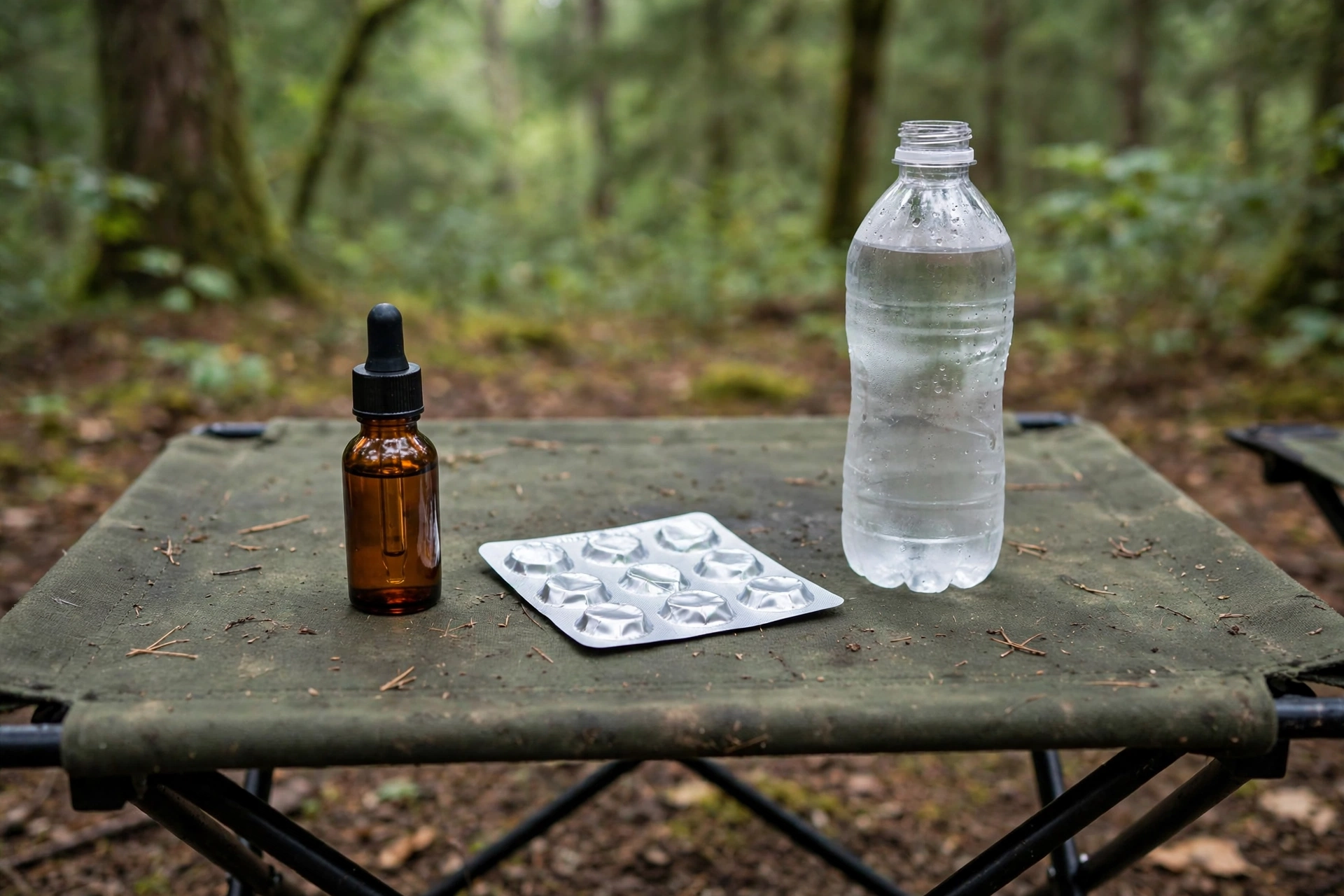
Iodine earned its place in kits for honest reasons: it is light, it keeps, and it works on the bacteria and viruses that make most emergency water dangerous. It is also the method most often oversold. A tablet is not a universal answer — it is a measured dose for a measured amount of water, with a named parasite it does not kill and named people who should not drink the result.
This guide follows the CDC’s framing exactly, including where the CDC stops: it prints no universal drops-per-gallon figure for iodine, so this page prints none and says why. This guide is part of our preservation guides; the bleach method with its full CDC dose tables is in how to purify water in an emergency.
What You Need
What you need is the iodine product itself — tablets or drops — in its original package, because the package carries the dose. The CDC names the forms directly: iodine, tablets with iodine (tetraglycine hydroperiodide), and chlorine or chlorine dioxide tablets are the chemical options it discusses. You also need a clean container of a size your product’s label actually covers, and, if the water is cloudy, a clean cloth, paper towel, or coffee filter to clear it first.

Sawyer Squeeze Water Filtration System
A squeeze filter clears cloudy water and removes parasites before iodine is added to kill the viruses and bacteria a filter leaves behind.
Check Availability
Katadyn BeFree AC
A bottle filter for treating water a bottle at a time, sized to the specific amounts chemical disinfectant labels are written for.
$49.95 from Amazon
GRAYL GeoPress Water Purifier Bottle
A press purifier for households that want filtration and purification in one vessel when iodine is not suitable for everyone.
$99.95 from AmazonBefore You Start
Three CDC limits decide whether iodine is even the right tool. First, Cryptosporidium: iodine will not kill it, and neither will chlorine tablets — the CDC says chlorine dioxide tablets will kill Cryptosporidium as long as you follow the instructions correctly, and that boiling kills it outright. Second, the people: pregnant people, people with thyroid problems, and people with a hypersensitivity to iodine should avoid iodine-disinfected water. Third, the clock: no one should drink water disinfected with iodine for more than a few weeks at a time.
How to Purify Water With Iodine, Step by Step
- Clear the water first. If the water is cloudy, first filter it through a clean cloth, paper towel, or coffee filter, or let it settle and draw off the clear water. The CDC puts this step before every disinfection method.
- Read the package before the water. Follow the instructions on the label or package of the iodine tablets or drops. The CDC’s point is practical: chemical disinfectants are made to disinfect specific amounts of water, so the dose belongs to the product, not to a universal chart.
- Match the amount of water to the dose. Measure the water you are treating so it is the amount your product’s instructions are written for — no more, treated with a dose meant for less.
- Add the iodine as directed and wait as directed. The waiting time is part of the product’s instructions. This page does not substitute a wait from the bleach method, because the CDC prints the 30-minute wait for bleach, not for iodine.
- Store what you treated. Store disinfected water in clean, sanitized containers with tight covers — the CDC’s closing step for disinfected water generally.
- Know when to switch methods. If Cryptosporidium may be in the water, iodine is the wrong tool: boil the water, or use chlorine dioxide tablets exactly as their instructions direct, per the CDC.
The Numbers: What the CDC Prints — and What It Does Not
The honest table for iodine is short, because the CDC deliberately leaves the dose to the product label. What it does print are the limits, the boiling benchmark, and the bleach comparison.
| Item | CDC figure or wording |
|---|---|
| Iodine dose | Follow the instructions on the label or package — disinfectants are made for specific amounts of water |
| Iodine and Cryptosporidium | Will not kill Cryptosporidium |
| Chlorine dioxide and Cryptosporidium | Will kill Cryptosporidium as long as you follow the instructions correctly |
| Boiling benchmark | Rolling boil for 1 minute; 3 minutes at elevations above 6,500 feet |
| Duration limit for iodine water | No one should drink it for more than a few weeks at a time |
There is no CDC drops-per-gallon or tablets-per-gallon figure for iodine on the source page, and inventing one from another product’s label is exactly the error the CDC’s label instruction exists to prevent. The omission is logged in this guide’s records.
A filter changes the iodine job for the better: the CDC’s sequence is to filter first, then add a chemical disinfectant to kill the viruses and bacteria a filter leaves behind. These are the two filter forms that pair with that sequence.

Berkey Big Berkey
A gravity system covers the household members the CDC says should avoid iodine, without a separate boiling routine.
Check Availability
ProOne Big+
A second gravity filter option for daily treated water during the weeks iodine should not be relied on.
$160.97 from AmazonIt helps to place iodine honestly among its neighbours. The CDC’s order of confidence starts with boiling, which it calls the best way to kill germs in water, and treats every chemical method as a partial substitute: disinfectants kill viruses and bacteria, but do not work as well as boiling against some parasites. Within the chemicals, the differences are specific, not vibes. Iodine and chlorine tablets share the Cryptosporidium gap. Chlorine dioxide, used exactly as its instructions direct, closes that gap. Bleach has the fullest printed CDC dose tables of any chemical method, which is why our flagship guide builds on it. Iodine’s genuine advantages are weight, shelf presence, and silence — no fuel, no flame, no waiting for a pot. Those advantages are real in a pack or a car kit. At a kitchen table with a working stove, they buy nothing, and the method with the wider coverage is sitting in the cupboard. Choose iodine where its advantages are the ones the situation rewards, respect the three limits the CDC prints for it, and it will do exactly the job its label promises — no more, and honestly stated, no less.
Common Mistakes
Using a dose remembered from another product. Tablets and drops differ by maker and strength. The CDC’s instruction — follow the label or package — is the method; a remembered number is not.
Trusting iodine against Cryptosporidium. The CDC states it directly: iodine kills most germs but will not kill Cryptosporidium. Water that may carry it needs boiling or correctly used chlorine dioxide.
Treating cloudy water as-is. Disinfectants work poorly when particles shelter germs. The CDC’s first step for cloudy water is to filter it through a clean cloth, paper towel, or coffee filter, or let it settle.
Making iodine the household’s long-term supply. The CDC’s limit is a few weeks at a time, for anyone. Iodine is a short emergency bridge, not a standing water system.
Serving it to someone the CDC names. Pregnant people, people with thyroid problems, and people with a hypersensitivity to iodine should avoid water disinfected with iodine. In a mixed household, that means a second method for them — boiling covers everyone.
Storage and Shelf Life
Treated water keeps the way the CDC closes every disinfection method: in clean, sanitized containers with tight covers. Iodine-treated water carries its own extra limit — it is not to be drunk for more than a few weeks at a time — so it belongs in small, dated batches made to be used, not in the long-term store. For water you are keeping, the storage rules are in our guide to rotating stored water.
Frequently Asked Questions
How many drops of iodine per gallon does the CDC recommend?
The CDC page used here prints no drops-per-gallon figure for iodine. It instructs you to follow the label or package, because chemical disinfectants are made to disinfect specific amounts of water. Any number on this page would have to be invented, so none is printed.
Does iodine kill everything bleach does?
Not quite, and the shared gap matters: the CDC says disinfectants do not work as well as boiling for some germs, including Cryptosporidium and Giardia, and states specifically that iodine will not kill Cryptosporidium.
Who should not drink iodine-treated water?
The CDC names three groups — people who are pregnant, people with thyroid problems, and people with a hypersensitivity to iodine — and adds that no one should drink it for more than a few weeks at a time.
Is boiling better?
The CDC calls boiling the best way to kill germs in water: a rolling boil for 1 minute, or 3 minutes at elevations above 6,500 feet. Iodine’s advantage is that it needs no fuel or heat, not that it covers more ground.
Procedure and limits: CDC, “How to Make Water Safe in an Emergency”, via Centers for Disease Control and Prevention.
Prices shown on this page were last checked November 26, 2026 — prices change; check before you buy.
Talk it over with other readers
The Truly Preserved Community on Facebook is where readers compare notes on food storage, water, and backup power — and where your questions help decide what we research next.