
Truly Preserved is reader-supported. If you buy through a link on this page we may earn a commission at no extra cost to you. Nobody pays for placement or scores.
THE SHORT ANSWER
Start with the limit the sources state plainly: harvested rainwater is not potable. Rutgers Cooperative Extension says it should not be used for drinking or cooking, and the EPA’s reuse summaries treat roof-collected rainwater as a non-potable supply for uses such as garden watering, washing, and flushing. Stored the extension way — in a food-grade barrel of 50–60 gallons, covered with window screening, with a screened overflow on an 8–10 foot hose, checked for larvae if water stands after 72 hours — it is a dependable garden and outdoor supply. Every figure on this page comes from the sources credited at the bottom.
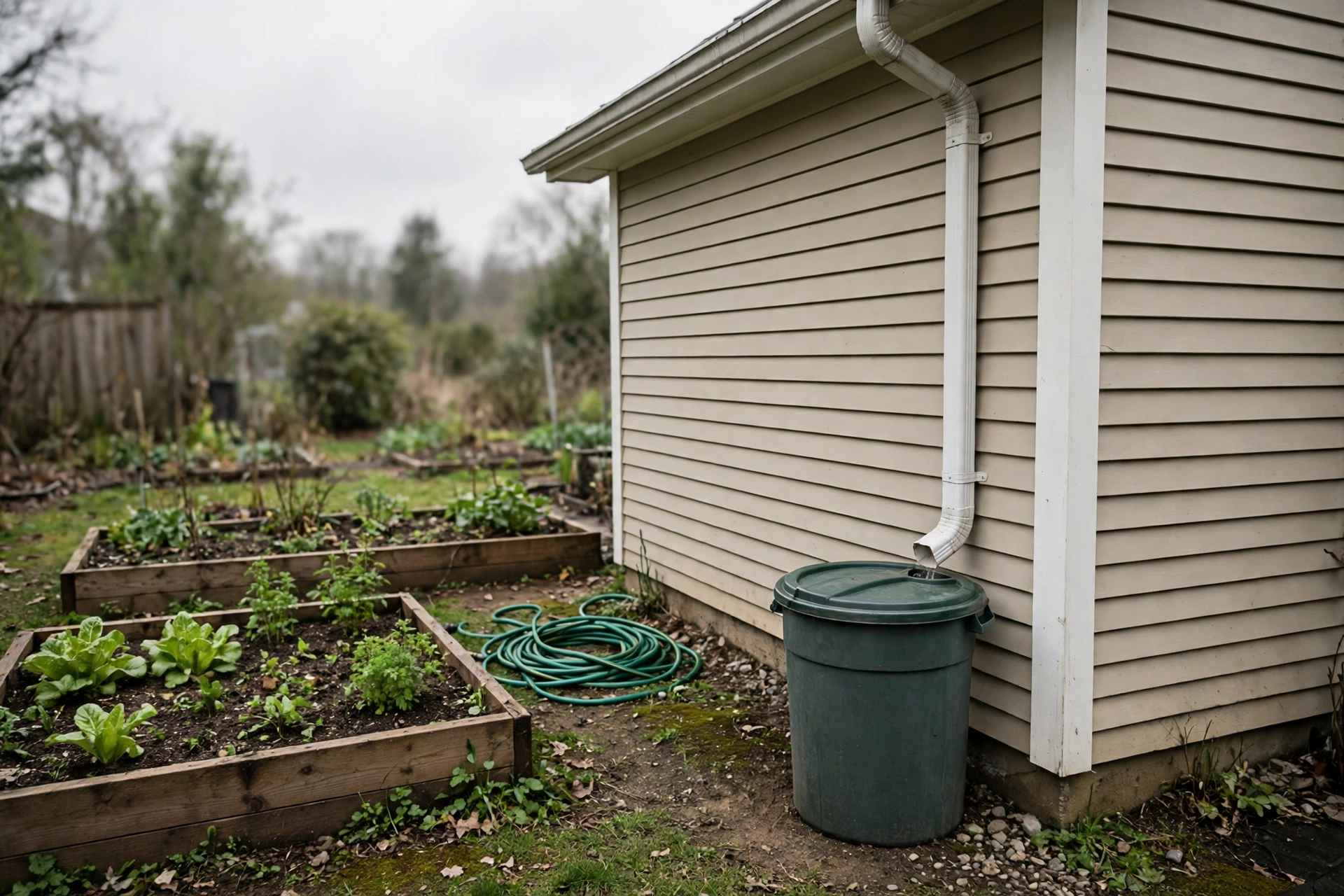
Rainwater is the one water source that arrives at the house for free, on a schedule nobody controls. A barrel under a downspout turns a roof into a catchment and a storm into stored water for the garden, the lawn, and outdoor washing. What it does not turn into, on the sources used here, is drinking water — and a guide that blurred that line would be doing its readers a disservice.
This guide follows Rutgers Cooperative Extension’s rain barrel guidance for the build and the upkeep, with the EPA’s non-potable framing stated up front. This guide is part of our preservation guides; for water that is meant to be drunk, start with how much water to store and how to purify water in an emergency.
What You Need
The extension’s barrel is specific: reconditioned 50–60 gallon food-grade drums made of high-density polyethylene (HDPE), with a faucet near the bottom and an overflow hose adapter near the top. You also need window screening material that fits tightly over the top, a garden hose at least 8–10 feet long for the overflow, and a white cup or container for checking the water — the extension’s chosen tool for spotting larvae against a light background.

Augason Farms 55-Gallon Water Storage Kit
A 55-gallon kit in the same size class as the extension's 50–60 gallon drums, for households setting up barrel storage at a downspout.
Check Availability
TeraPump Drum Pump
A drum pump moves stored barrel water to cans and beds without tipping a full, heavy barrel.
$39.99 from Amazon
DURATECH Drum Wrench
A bung wrench opens and reseals drum fittings for the occasional bleach-solution cleaning the extension recommends.
$18.99 from AmazonBefore You Start
Two checks come first. The barrel’s past: the drums in the extension design are food-grade, and a barrel that held harmful chemicals has no place in the system. And the use: decide now that this water is for the garden and outdoors. Rutgers states that harvested rainwater is not potable and should not be used for drinking or cooking, and that limit does not soften because the water looks clear.
How to Store Rainwater in a Barrel, Step by Step
- Set the barrel at the downspout. The barrel collects rainwater from a roof via the gutter’s downspout. Place it where the downspout can be directed into the screened top.
- Cover the top with screening. The top of the barrel should be covered with window screening material that fits tightly, to prevent mosquitoes from reaching the harvested rainwater. On a screw-top barrel the screen sits under the lid; on a closed-top barrel it is held over the top, hanging over the sides.
- Fit the overflow with a long hose. Attach a garden hose at least 8–10 feet long to the overflow adapter — that length discourages mosquitoes from traveling up the hose — and screen the inside of the adapter as well. Lead the overflow to a pervious surface such as the garden or lawn.
- Use the water promptly after rain. Using the water for the garden or other intended uses shortly after a rain event leaves room to capture the next event and deprives mosquitoes of habitat at the same time.
- Check standing water. If water remains after 72 hours, check the barrel for mosquito larvae: scoop water with a white cup or container so larvae and pupae show against the light background.
- Clean it occasionally. Clean the barrel with a dilute bleach solution occasionally and rinse; the extension notes this removes food for larvae and the microbial growth that causes bad smells.
- Take it out of service for winter. Rain barrels should be removed in the winter and placed in a storage shed, or turned upside down and secured.
The Numbers: Barrel Size, Rainfall, and Mosquito Timing
Extension figures for what a roof delivers, what a barrel holds, and how fast mosquitoes move.
| Item | Extension figure |
|---|---|
| Typical barrel in the design | 50–60 gallon food-grade drums (HDPE) |
| Rainfall example | During a 1.25 inch rain event, approximately 600 gallons will drain from an 800 square foot roof area |
| Typical event | Most rain events in New Jersey are less than 0.5 inches, yielding 240 gallons or less from an 800 square foot roof |
| Overflow hose length | At least 8–10 foot long |
| Larvae check | If water remains after 72 hours, check for mosquito larvae |
| Egg hatch | Some eggs hatch in 48–72 hours |
| Egg to adult, warmest weather | Some species can proceed from egg to adult in 5–7 days |
Read the rainfall rows honestly: one barrel holds a tenth of what a single 1.25-inch event sends off that roof. Barrels are linked together, and overflow is routed away, precisely because storage — not catchment — is the small number in this system.
Rainwater’s honest partner is a drinking-water filter for the sources that can be made safe. When rain is falling and taps are not running, these are the tools for the water you will actually drink.

Sawyer Squeeze Water Filtration System
A squeeze filter for the drinking supply that runs alongside the barrel, since rainwater here is a non-potable garden source.
Check Availability
GRAYL GeoPress Water Purifier Bottle
A press purifier makes a treatable source safe to drink when rain is plentiful but the barrel water is not for drinking.
$99.95 from AmazonExpectations decide whether a rain barrel feels like a success. A barrel is not a reservoir in the drinking-water sense; it is a buffer between a roof that delivers water in sudden hundreds of gallons and a garden that wants it in slow tens. The extension’s own arithmetic makes the point: even a modest roof in an ordinary rain event produces several barrels’ worth of water, so the system’s real skill is not capture but routing — linked barrels where there is room, an overflow led somewhere pervious where there is not, and a habit of drawing the barrel down on the garden between storms so the next event has somewhere to go. Kept that way, the barrel earns its footprint every wet month: plants watered without touching the metered supply, runoff slowed instead of dumped into the street drain, and a standing outdoor reserve for washing and cleaning jobs that never needed drinking water in the first place. The failures all come from asking it to be something else — a sealed archive, an emergency drinking supply, a set-and-forget ornament. It is a working garden tool that happens to hold water, and the extension guidance treats it exactly that way.
Common Mistakes
Drinking the barrel water in an emergency. Rutgers is explicit: harvested rainwater is not potable and should not be used for drinking or cooking. An emergency changes your options, not the water — use a source the CDC lists and treat it, as our purifying guide covers.
Leaving the top unscreened. An open or loosely covered barrel is mosquito habitat with a roof over it. The screening is not an accessory; in the extension design it is the lid system.
A short overflow stub. The extension specifies a hose at least 8–10 feet long on the overflow, partly to discourage mosquitoes traveling up it. A short open overflow fails on drainage and on mosquitoes at once.
Letting water stand unchecked. Water standing past 72 hours gets a larvae check, because in the warmest weather some species go from egg to adult in 5–7 days. A barrel nobody looks into is a nursery.
Storing through winter in place. The extension’s instruction is to remove barrels in the winter or turn them upside down and secure them — not to leave a full barrel to freeze in position.
Storage and Shelf Life
Stored rainwater is a working supply, not an archive: the extension’s rhythm is to use it shortly after each rain event, keep the barrel screened and the overflow clear, clean it occasionally with a dilute bleach solution and rinse, and retire it for winter. There is no drinking-water shelf life to quote for it, because the sources do not present it as drinking water at all — its storage guidance is about mosquitoes, smell, and readiness for the next storm.
Frequently Asked Questions
Can I drink stored rainwater if I boil it?
This page’s sources do not present barrel water as a drinking supply: Rutgers says harvested rainwater is not potable and should not be used for drinking or cooking. The CDC’s list of outside sources that could be made safe by treatment does include rainwater, and its treatment guidance is in our purifying guide — but a garden barrel system is built and kept as a non-potable supply.
How much rain does a barrel actually catch?
On the extension’s example, an 800 square foot roof drains approximately 600 gallons in a 1.25-inch rain event, and 240 gallons or less in the more typical event of less than 0.5 inches — against a barrel of 50–60 gallons. Expect to link barrels and route overflow.
How do I keep mosquitoes out?
Tight window screening over the top, a screened overflow on a hose at least 8–10 feet long, prompt use of the water, and a larvae check if water remains after 72 hours. The extension also describes Bti products sold as Mosquito Dunks, labeled for use in rain barrels.
What is rain barrel water good for?
The extension’s list is garden and outdoor work: watering the garden and the lawn, washing the dog, and similar purposes — with drinking and cooking expressly excluded.
Rain barrel figures and limits: Rutgers Cooperative Extension, Fact Sheet FS1240, “Rain Barrels and Mosquitoes,” with EPA onsite non-potable reuse framing, via Rutgers Cooperative Extension.
Prices shown on this page were last checked November 26, 2026 — prices change; check before you buy.
Talk it over with other readers
The Truly Preserved Community on Facebook is where readers compare notes on food storage, water, and backup power — and where your questions help decide what we research next.