
Truly Preserved is reader-supported. If you buy through a link on this page we may earn a commission at no extra cost to you. Nobody pays for placement or scores.
THE SHORT ANSWER
Here is the honest answer the sources support: stored water does not “expire” the way food does, and the CDC does not publish a checklist of signs that stored water has gone bad. What it publishes instead are rules that make the question mostly unnecessary — replace water you filled yourself every six months, observe the expiration date on store-bought water, label every container with its storage date, and keep it at 50°F –70°F away from sunlight and toxic substances. The one sensory warning the CDC does print, in its emergency guidance, is not to drink water that has an unusual odor or color. Every statement on this page comes from the CDC guidance credited at the bottom.
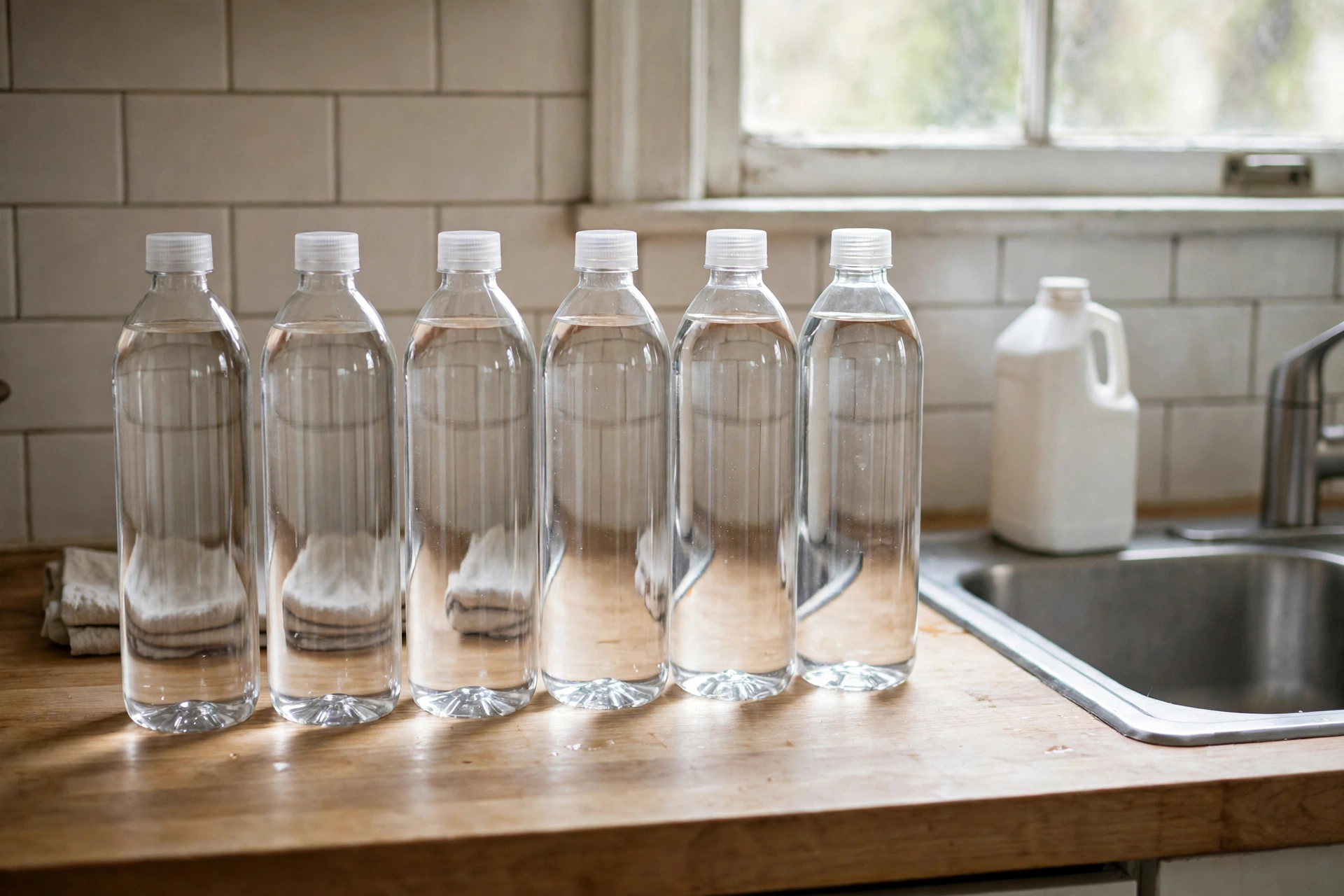
Every household with a water shelf eventually holds a jug up to the light and asks the same question: is this still good? The internet answers with confident checklists — smell this, look for that, taste a sip. The federal sources used for this guide do not answer that way, and the difference matters, because a checklist the CDC never wrote can talk a reader into drinking water the CDC would have had them replace months earlier.
This guide reports the CDC’s actual framing: a replacement schedule instead of a spoilage test, a printed date for bottled water, storage conditions that prevent most problems, and one clear warning sign the CDC does state. This guide is part of our preservation guides; the schedule itself is worked through in how to rotate stored water.
What You Need
What you need for this check is mostly information you already stored: the date label the CDC tells you to write on every container — “drinking water” and the storage date — and the expiration date on any commercially bottled water. The CDC calls unopened, commercially bottled water the safest and most reliable source of water in an emergency, and its date is the manufacturer’s, printed on the package. For home-filled containers, the date that matters is the one you wrote.

Reliance Aqua-Tainer, 7 Gallon
A fresh rigid container replaces a suspect jug outright, so a failed check never tempts anyone into keeping doubtful water.
Check Availability
Saratoga Farms 5-Gallon Water Containers
Stackable dated containers make the six-month replacement visible at a glance, which is the whole checking system.
$318.79 from Amazon
ePackageSupply 5-Gallon Buckets, 3-Pack
Sealed buckets hold the replacement fill while suspect containers are washed, sanitized and air-dried.
$73.99 from AmazonBefore You Start
Before you judge any jug, separate what the sources say from what they do not. The CDC prints no list of spoilage signs for stored water — no smell test, no slime test, no taste test — and this page will not assemble one from folklore. What the CDC’s emergency guidance does say is direct: do not drink water that has an unusual odor or color, or that you know or suspect might be contaminated with fuel or toxic chemicals. Beyond that warning, the verdict on a container comes from its date and its storage conditions, not from an inspection.
How to Check Stored Water, Step by Step
- Start with the label, not the water. Read the storage date. If the water is home-filled and the date is six months old or older, the CDC’s instruction is to replace it — the check is over before it starts.
- Check bottled water against its printed date. For store-bought water, the CDC says to observe the expiration date. Past the date, rotate it out on the same principle.
- Ask where it has been sitting. The CDC’s conditions are a place at 50°F –70°F, away from direct sunlight, and away from toxic substances such as gasoline or pesticides. Water stored beside fuel or in a hot, sunlit spot has been stored against the guidance, whatever its date says.
- Apply the one warning the CDC prints. Do not drink water that has an unusual odor or color, or that you know or suspect might be contaminated with fuel or toxic chemicals. That is the CDC’s wording in its emergency guidance, and it is the only sensory verdict this page will give you.
- When the record is missing, treat that as the answer. An undated container of unknown age, from unknown storage, cannot be cleared by looking at it. Replace it, sanitize the container, refill it, and label it — the procedure is short and the guess is not worth it.
- Reset the system as you go. Each container you clear out goes through the CDC refill: wash with soap, sanitize with 1 teaspoon of unscented liquid household chlorine bleach in 1 quart (4 cups) of water, wait at least 30 seconds, air-dry, refill, and write the new date.
The Numbers: Dates and Conditions Instead of a Spoilage Test
The CDC’s published figures for stored water are intervals and conditions. There is no published table of bad-water signs, and the empty space in this table is the finding.
| Question | What the CDC prints |
|---|---|
| How long does home-filled water keep? | Replace the water every six months |
| How long does store-bought water keep? | Observe the expiration date on the package |
| Storage temperature | 50°F –70°F |
| Storage place | Away from direct sunlight; away from toxic substances such as gasoline or pesticides |
| Published list of spoilage signs | None printed in the CDC storage guidance |
| Warning the CDC does print | Do not drink water that has an unusual odor or color |
A page that invented five more rows for that last section would read better and serve worse. The omission is deliberate, and it is logged in this guide’s records.
If doubtful water is what you have, the answer is treatment, not a closer look. These are the tools for making a replacement supply safe when a stored container fails its check.

Sawyer Squeeze Water Filtration System
A squeeze filter is the first step in treating replacement water from a new source when the stored supply is condemned.
Check Availability
GRAYL GeoPress Water Purifier Bottle
A press purifier makes doubtful water safe when replacement from the tap is not available during an outage.
$99.95 from AmazonThere is a reason the agencies answer this question with a schedule instead of a test, and it is worth understanding rather than just obeying. The things that can make stored water unsafe are, in the main, not things a household can see, smell, or taste at the levels that matter — and the things a household can see and smell, like flatness or a faint plastic note from the container, are not the CDC’s stated dangers. A sensory checklist therefore fails in both directions at once: it condemns good water for tasting stale and clears questionable water for looking bright. The date-and-conditions system fails in neither. It asks three questions anyone can answer without expertise — when was this filled, what is it, and where has it been sitting — and it gives a verdict that follows from the guidance rather than from a guess. That is also why the one sensory warning the CDC does print is drawn so narrowly: an unusual odor or color is not a hint to investigate further, it is an instruction to stop. Everything short of that bright line is handled by the calendar, and the calendar, unlike a sniff, can be checked by anyone in the house.
Common Mistakes
Trusting a sniff and a sip. The CDC prints exactly one sensory warning — unusual odor or color — and no taste test at all. A small exploratory sip is the one check this guide will never suggest.
Assuming clear water is safe water. Nothing in the CDC storage guidance clears water because it looks clear. The clearance comes from the date, the container, and the storage conditions.
Keeping undated containers “just in case.” An undated jug cannot be rotated, because rotation runs on the written date. The CDC’s label instruction is what makes the whole system checkable.
Storing water next to fuel and calling it fine. The CDC names gasoline and pesticides as substances to keep containers away from. A jug that has sat against that rule has a storage problem before it has a date problem.
Pouring suspect water back into a clean container. A container that held doubtful water gets the full wash and sanitize before it holds drinking water again — the CDC sequence, not a rinse.
Storage and Shelf Life
Storage is the prevention half of this whole question: containers labeled “drinking water” with the storage date, kept at 50°F –70°F, away from direct sunlight and away from toxic substances such as gasoline or pesticides, and replaced every six months if you filled them yourself. Water kept that way rarely needs a verdict. Water kept any other way gets replaced, not judged — and the replacement procedure is the rotation in our rotation guide.
Frequently Asked Questions
Does stored water expire?
Not on the CDC’s framing. The CDC gives home-filled water a replacement interval — every six months — and tells you to observe the expiration date on store-bought water. It does not describe stored water spoiling on a date the way food does.
What are the signs water has gone bad?
The CDC storage guidance prints no list of signs. Its emergency guidance gives one warning: do not drink water that has an unusual odor or color, or that you know or suspect might be contaminated with fuel or toxic chemicals. This page reports that framing rather than inventing a longer checklist.
My jug is eight months old but looks and smells fine. Keep it?
The CDC’s rule for water you filled yourself is replacement every six months, and it is not conditioned on how the water looks. Rotate it out, sanitize the container, and refill.
Can I treat old stored water instead of replacing it?
Treatment is the CDC’s answer for water of uncertain quality in an emergency, and our purifying guide covers it. As a storage practice, though, replacement is cheaper, simpler, and what the guidance prescribes.
Storage rules and warning signs: CDC, “How to Create an Emergency Water Supply” and CDC emergency guidance on water with an unusual odor or color, via Centers for Disease Control and Prevention.
Prices shown on this page were last checked November 26, 2026 — prices change; check before you buy.
Talk it over with other readers
The Truly Preserved Community on Facebook is where readers compare notes on food storage, water, and backup power — and where your questions help decide what we research next.