
Truly Preserved is reader-supported. If you buy through a link on this page we may earn a commission at no extra cost to you. Nobody pays for placement or scores.
A 100W panel will not refill a big power station in a morning, and any seller who says otherwise is selling. What this class does well is quieter: it keeps a small station topped up, stretches a 1,000Wh box through a long outage, and travels in a car trunk without a fight. Expect about 70–80 real watts in strong sun from a panel rated at 100. The honest differences between these six are weight, the plug on the end of the cable, and how the panel holds up in owner reports — not the number on the box, which is within 20 watts across the whole group once you count the 110W and 120W panels we let in and say so plainly below.
Short answer: the EcoFlow 110W is the one we would buy for most stations, the Anker SOLIX PS100 is the one we would carry any distance, and the Bluetti PV120 is the pick when you want the most watts this class offers and can live with the carry weight. If your station is bigger than 1,000Wh and solar is your main refill plan, skip this class entirely and read our 200W panel comparison instead.
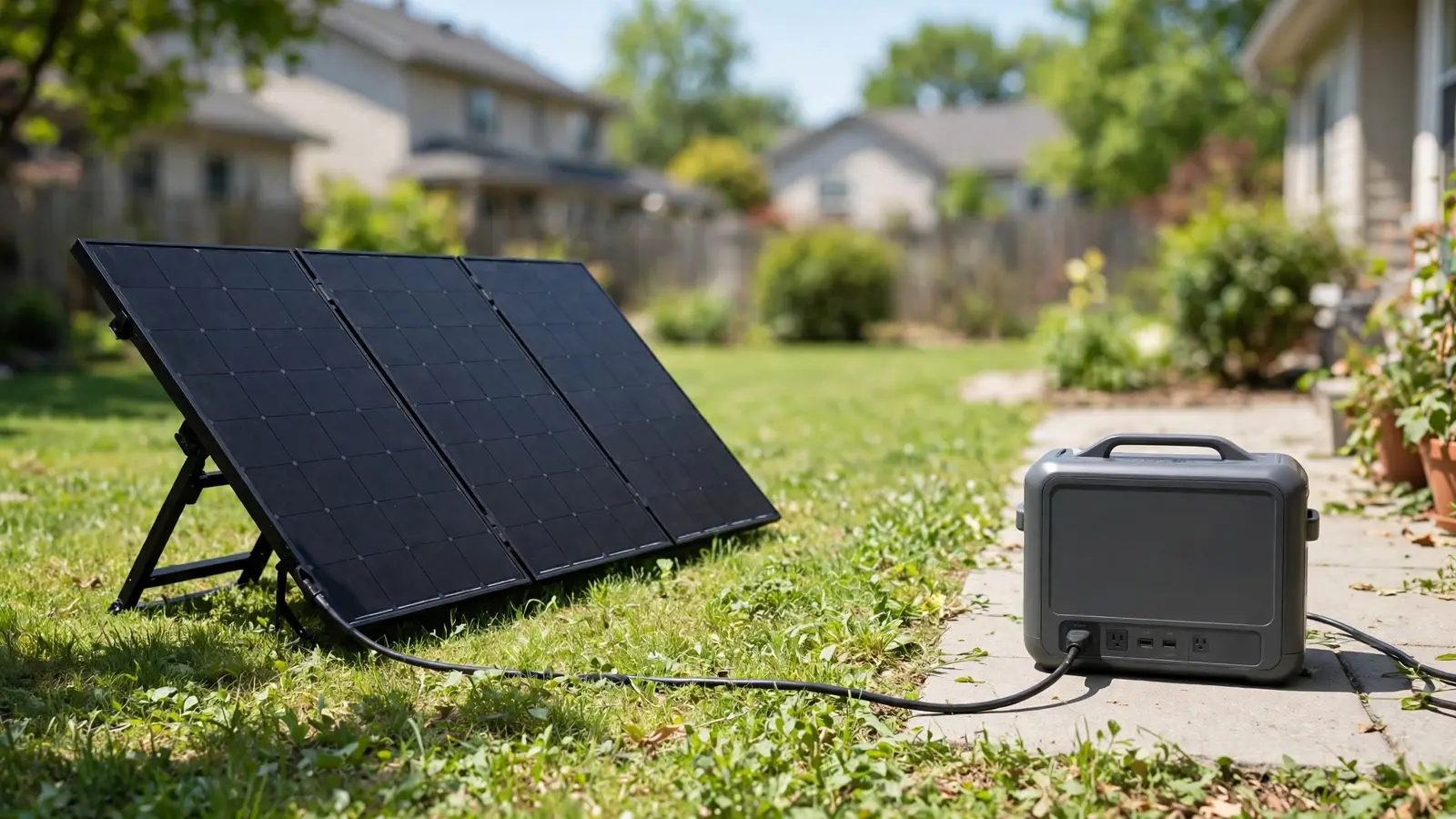
The Short Version

Score out of 10
EcoFlow 110W
110W rating, IP68 sealing, and standard MC4 plugs that pair with almost any station through the cable in the box.
Check Availability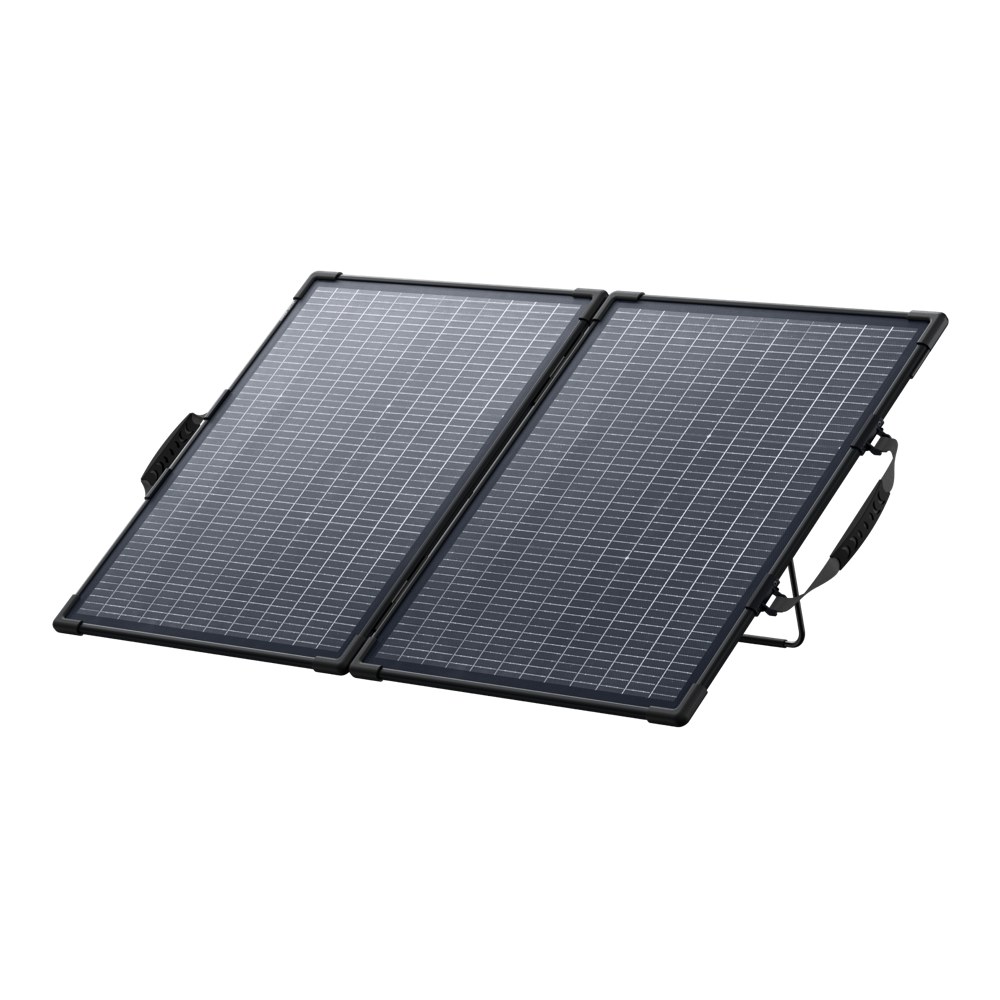
Score out of 10
Anker SOLIX PS100
6.2 lb of bifacial panel with a 5-year warranty — the one that lives in the car and actually gets used.
Check the price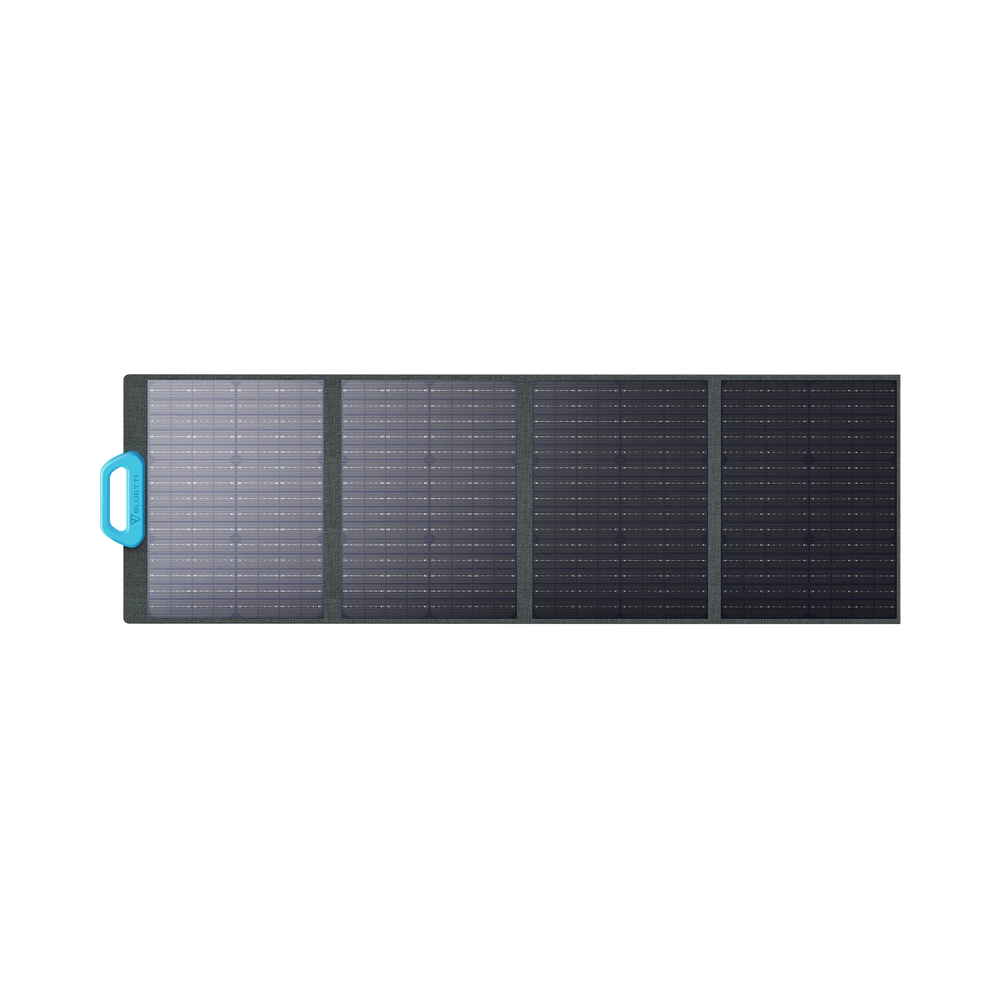
Score out of 10
Bluetti PV120
A 120W panel wearing a 100W-class badge: about 20% more panel for the same spot in the trunk, at 12.6 lb.
Check AvailabilityHow we chose: we compared the makers’ published electrical specs side by side and read the owner feedback on the current listings — about 1,700 ratings for the Renogy suitcase, about 1,800 for the Jackery, roughly 460 for the Bluetti’s current listing, about 420 for the EcoFlow, and about 500 for the ALLPOWERS. The Anker’s owner record is still small, so its score leans harder on the spec sheet and the warranty, and we say so in its section. Scores weigh real-world output per rated watt, connector fit, carry weight, weather sealing, and warranty. Panel prices in this class swing with sales every few weeks, so we print none here — each button above shows today’s number at the store. Read our full methodology.
Scores out of 100
All six panels, from the verdict cards and review sections on this page. Higher is better.
Head-to-Head Specs
| Panel | Rated | Weight | Best for |
|---|---|---|---|
| EcoFlow 110W | 110W | 8.8 lb | Most stations |
| Anker SOLIX PS100 | 100W | 6.2 lb | Carrying it |
| Bluetti PV120 | 120W | 12.6 lb | Most watts |
| Jackery SolarSaga 100 | 100W | 7.9 lb | Jackery stations |
| ALLPOWERS SP027 | 100W | 7.9 lb | Mixed-brand kits |
| Renogy 100W Suitcase | 100W | 17.4 lb | 12V batteries too |
Two honest notes on that table. First, the class is not pure: the EcoFlow is rated 110W and the Bluetti 120W, and both earn their place because readers cross-shop them against every 100W panel on the shelf — we flag the extra watts wherever they change a verdict. Second, read the weight column before the watt column. Every panel here makes roughly the same power per rated watt; they do not weigh roughly the same, and the panel you will actually carry out to the yard is the panel that charges your station.
EcoFlow 110W — the one we would buy for most stations
The EcoFlow 110W is the panel we would buy first in this class. Our score: 88/100. The rating is 110W from monocrystalline cells at 22–23% efficiency, with Voc 21.8V, Vmp 18.4V, and Imp 6.0A. The connector is standard MC4, and EcoFlow includes the MC4-to-XT60 cable its own stations take, so the same panel feeds an EcoFlow box out of the case and almost anything else through that station’s own solar cable. The panel itself weighs 8.8 lb (13.2 lb in its kickstand case), folds to about 20 x 17 inches, and carries an IP68 rating — the strongest weather sealing on this page alongside the Anker.
Amazon’s current listing shows 4.4 stars across about 422 ratings. The praise that repeats is the case: it doubles as the kickstand, so setup is open, lean, plug. Owners also report the expected 60–80W in real sun without treating that as a defect, which tells you the expectations were set right. The complaints repeat too: the case adds real weight over the bare panel, and the panel is not the cheapest way to buy 100-ish watts. Neither complaint is a surprise, and neither stops it being the default pick.
Pros: highest true-100-class rating here at 110W; MC4 plus the XT60 cable in the box; IP68; case-and-stand in one. Cons: 13.2 lb as you actually carry it; mid-pack owner record so far.
Buy it if you want one panel that pairs with whatever station you own now or buy next. Skip it if every pound matters — the Anker below carries easier.

Honda EU2200i
The small-inverter benchmark: sips fuel at light loads, and the quietest name in the class.
$1,199.00 from Amazon
Champion 4250 Dual Fuel Inverter
The mid-size pick: runs on gasoline or propane — and propane is the fuel that never goes stale.
$695.00 from Amazon
Millennium Energy Bars (SOS Food Lab)
Nine real flavors and the only bar here people call genuinely good. Single 400-calorie bars made for go-bags and school kits.
$19.99 from AmazonAnker SOLIX PS100 — the lightest panel here, with the longest warranty
Score out of 10
- Weight100.5 oz (2849 g)
- Size (L × W × H)23.62 × 0.67 × 40.55 in
The Anker SOLIX PS100 is the carry pick, and it is not close. Our score: 87/100. The current bifacial version weighs 6.2 lb — about 30% lighter than a typical 100W folding panel — and folds to 20.1 x 23.6 x 2.5 inches. The cells are N-type bifacial monocrystalline, rated 100W at 25% or better claimed efficiency, with a PV output of 21.6V at 4.63A and Voc 25.9V. It connects by MC4, ships with solar cables plus an XT60i adapter cable for Anker stations, is rated IP68, and Anker covers it for 5 years — the longest warranty on this page by years, not months.
The honest catch is the record. This panel is new enough that its verified owner base is still small next to the Renogy’s or Jackery’s thousands, so we are leaning on Anker’s published specs and the warranty more than on a deep pile of owner reports, and we flag that plainly rather than dressing it up. What owner feedback exists praises the weight and the setup speed, which matches what the spec sheet promises. If a long track record matters more to you than a light carry, the EcoFlow above is the safer buy today.
Pros: 6.2 lb; bifacial N-type cells; IP68; 5-year warranty; cables for both MC4 and Anker XT60i in the box. Cons: thin owner record so far; bifacial gains are small on grass, like every panel here.
Buy it if the panel will live in a car, camper, or closet and get carried out often. Skip it if you want a panel thousands of owners have already vouched for.
Bluetti PV120 — the 120W panel in a 100W comparison, on purpose
The Bluetti PV120 is here honestly: it is a 120W panel, and we include it because it sits on the same shelf, folds to nearly the same footprint, and gives you about a fifth more panel for the same spot in the trunk. Our score: 86/100. The specs: 120W of monocrystalline cells under an ETFE coating at up to 23.4% efficiency, Voc 24.4V, Vmp 19.6V, Imp 6.1A, standard MC4 connectors, and an IP65 junction box. It folds to 21 x 18.5 inches — the smallest folded footprint here — and weighs 12.57 lb, the second-heaviest carry on the page.
Bluetti’s current Amazon listing shows 4.6 stars across about 463 ratings (an older PV120 listing carries about 1,280 more at 4.5 stars). Owners praise the build and the kickstands, and the output reports line up with the rating: this panel in good sun does what a strong 100W panel does on its best day, on an ordinary one. The complaints are the weight and Bluetti’s short panel warranty next to Anker’s five years. Judge it as what it is — the most watts in this class, at a carry cost — and it earns its place.
Pros: 120W rating; smallest folded size here; MC4 fits nearly anything; strong owner ratings. Cons: 12.6 lb; short warranty for the class; it is not, strictly, a 100W panel.
Buy it if your station takes 120W or more of solar input and the panel mostly rides in a vehicle. Skip it if you will carry it far, or your station caps solar input at 100W.
Jackery SolarSaga 100 — the home-team panel for Jackery owners
The Jackery SolarSaga 100 follows the same pattern as its 200W sibling in our 200W comparison: buy it if your station says Jackery on the front, price it twice if it does not. Our score: 85/100. The current version is bifacial, rated 100W at up to 24.3% claimed efficiency, Voc 24.8V, Vmp 18V, Imp 5.55A, with USB-A and USB-C ports on the panel for a phone while the station charges. It weighs 7.94 lb, folds to about 24 x 21 inches, and is rated IP65.
Amazon’s listing shows 4.6 stars across about 1,834 ratings — with the Renogy, the deepest owner record here. Owners praise the setup speed and the carry handle, and complain about the same two things they complain about in the 200W class: the price per watt, and the cable. The attached cable ends in Jackery’s DC8020 plug, which drops straight into an Explorer station and needs an adapter for everything else. Jackery’s panel warranty runs longer than most of this class, which softens the price a little; it does not change the plug.
Pros: plug-and-play with Jackery stations; deep owner record; light at 7.9 lb; USB ports on the panel. Cons: DC8020 plug needs adapters for other brands; rarely the cheapest watts on the shelf.
Buy it if you own a Jackery Explorer and want zero adapter fuss. Skip it if your station is any other brand — the EcoFlow gives you more watts and a standard plug.
ALLPOWERS SP027 100W — the adapter kit in the box is the point
The ALLPOWERS SP027 sells on flexibility, and for a mixed-brand household that is a real virtue. Our score: 82/100. The panel is rated 100W from monocrystalline cells at up to 22% efficiency, Voc 22.4V, Vmp 18V, Imp 5.4A. It weighs 7.9 lb and folds to 20 x 25.6 x 1.2 inches. The box is the story: alongside the MC4-compatible solar connector you get cables and adapters for XT60, 8mm DC, 5.5 x 2.5mm, 5.5 x 2.1mm, and 3.5 x 1.35mm — nearly every input a small station has shipped with in the last five years, no separate adapter order. The manual rates it IP66 and covers it for 18 months.
Amazon’s listing shows 4.2 stars across about 497 ratings — the lowest average on this page, and we do not hide that. The praise is the adapter kit and the price when it is on sale; the complaints that repeat are output that lands at the low end of the class and a kickstand setup owners call flimsy next to the EcoFlow’s case. At the right sale price it is a sensible second panel; at full price the EcoFlow and Anker are better buys.
Pros: every common adapter in the box; light at 7.9 lb; often the cheapest ticket in the class on sale. Cons: lowest owner average here at 4.2 stars; 22% efficiency trails the leaders; 18-month warranty.
Buy it if your household runs two brands of station and one panel has to feed both. Skip it if it is not on sale — the gap to the EcoFlow is worth paying at full price.
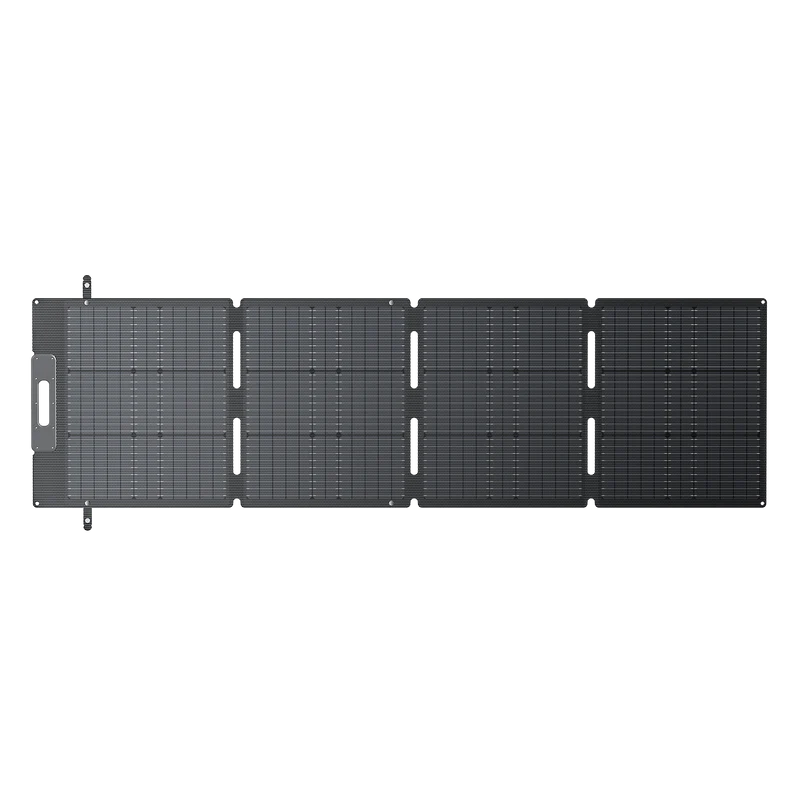
Bluetti PV200
Cheapest watts here at $1.75 per rated watt, and plain MC4 plugs fit almost any station.
$329.99 from Bluetti
Anker SOLIX C1000
The C1000 passes power through while it charges — the compact station our power comparisons recommend for always-on duty.
Check the price
Honda EU3200i
The EU2200i's bigger brother: 3,200 watts of the same Honda quiet, for loads a step beyond a fridge and freezer — at Honda money.
$2,799.00 from AmazonRenogy 100W Suitcase — a battery charger first, a station panel second
The Renogy 100W Suitcase is the odd one out, and its section exists so nobody buys it by mistake for the wrong job. Our score: 76/100 — for charging power stations. The kit is two 50W panels in a hard folding case with a pre-installed 20A Voyager charge controller, alligator-clip battery cable, and adjustable kickstand. Current N-type builds rate the cells at 25% efficiency, with Vmp 18.65V, Imp 5.6A, and Voc 21.47V. It folds to about 27 x 16 x 3 inches and weighs 17.4 lb — more than double the Anker.
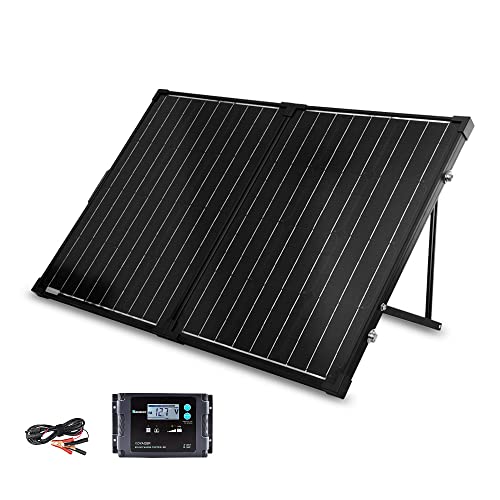
For a bare 12V battery — the RV house battery, the trolling motor, the cabin bank — this is a complete kit in one case, and its owner record says it works: 4.6 stars across about 1,698 ratings on Amazon, the deepest base here alongside the Jackery. But a power station already has a charge controller inside it. Feeding one through the Renogy’s controller is the wrong path; you would use the panel’s solar connectors direct and leave the controller out of the chain, at which point you are carrying 17.4 lb to do a 7 lb panel’s job. Buy it for the battery. For a station, buy anything above it on this page.
Pros: complete 12V battery kit with controller included; rugged case; deep, happy owner record. Cons: 17.4 lb; the built-in controller is dead weight for station owners; bulkiest fold here.
Buy it if you also charge bare 12V batteries and want one kit for both jobs. Skip it if the panel will only ever feed a power station.
What does a 100W panel actually deliver in a day?
About 70 to 80 watts in strong midday sun, and roughly 300 to 400 watt-hours across a good day if you turn the panel to follow the sun a few times. The rating is a lab number: full 1,000 W/m² light, cool cells, perfect angle. Heat, haze, a flat lay on the grass, and the hour of the day all take their cut, and they take it from every brand on this page in about the same proportion.
Run that against a 1,000Wh station and the math is plain: at a realistic 75W average input, refilling from empty takes about 13 hours of strong sun — call it three good days, or two long summer days with the panel repositioned. One 100W panel does not refill a 1kWh station overnight-and-a-morning; it keeps a lightly used station from sliding backwards. A fridge eats roughly 1,000–1,200Wh a day, so one panel covers about a third of a fridge habit. Two of these panels, or one from the 200W class, is where a fridge-first outage plan starts to hold. Our Solar Recharge Time Calculator runs the same math for your station size and your sun hours — use it before you buy the second panel, not after.

EcoFlow DELTA 2 Max
The bigger box in the same comparison, for households whose outage list runs past the basics and needs more stored energy before solar or a generator has to help.
$977.00 from Amazon
Bluetti Elite 200 V2
The station our home-backup comparison leads with for fridge, lights and router duty: 2,073.6Wh of capacity and 2,600W of output, so a microwave and a fridge compressor can run at the same time.
Check the price
Jackery Explorer 2000 v2
By far the lightest and quietest 2kWh box here — the same class as the Bluetti, in a station one person can actually move room to room.
$999.00 from AmazonWill this panel plug into your power station?
Mostly yes, with one exception to watch. The EcoFlow 110W, Anker SOLIX PS100, Bluetti PV120, and ALLPOWERS SP027 all speak MC4, the standard solar plug, and the EcoFlow, Anker, and ALLPOWERS boxes include the XT60-style cable many stations take. The Jackery SolarSaga 100 is the odd one: its cable ends in Jackery’s DC8020 plug, perfect for an Explorer and an adapter purchase for everything else. The Renogy suitcase connects by MC4 too — just take its battery controller out of the chain first, as its section explains. Check the voltage window as well: every panel here sits between about 21V and 26V open-circuit, safely inside the solar input range of the 1kWh-class stations in our solar generator comparison, and two in series stay inside most larger stations’ limits.
Who should buy which panel?
- You own an EcoFlow, Bluetti, or Anker station and want one panel that just works: the EcoFlow 110W.
- The panel lives in the car or gets carried to where the sun is: the Anker SOLIX PS100, at 6.2 lb with a 5-year warranty.
- Your station accepts more than 100W of solar and you want the fastest refill this class gives: the Bluetti PV120.
- Your station is a Jackery Explorer: the Jackery SolarSaga 100 — the plug alone settles it.
- Two brands of station share one panel, or you catch it on a deep sale: the ALLPOWERS SP027.
- You charge bare 12V batteries as well as a station: the Renogy 100W Suitcase, controller and all.
- Your station is 2,000Wh or bigger and solar is the main refill plan: none of these — start with the 200W panel comparison and the stations in our solar generator comparison.


Anker SOLIX PS200 Bifacial
The C1000 and F2000 default — 200W through the standard plug.
$499.99 from Amazon
Renogy 100W Rigid Panel
The rigid budget standard — the label figures are the RNG-100D's standard test numbers.
$76.49 from AmazonHonest caveats
Three, plainly. First, bifacial gains are real but modest at ground level: the rear face only earns when light bounces up from pale ground or concrete, so on grass plan on the front rating and treat anything extra as a gift — that applies to the Anker and the Jackery here. Second, names in this class are slippery: EcoFlow sells both an older 110W and a newer lightweight 110W, Jackery sells a SolarSaga 100, a 100 Air, and a 100 Prime, and Bluetti’s 120W panel is sometimes titled as a 100W panel on storefronts. Check the model name and the spec table on the listing against the numbers in our review sections before you pay. Third, none of these panels should live outside for good: IP65, IP66, and IP68 ratings cover rain and dust during use, not seasons of weather, and every maker here builds them to fold away.
FAQ
How long will a 100W panel take to charge a 1,000Wh power station?
About three good days of sun from empty, at a realistic 70–80W average input and a few panel turns a day. A 100W panel is a top-up tool for a station that size, not a same-day refill; a 500Wh station refills in about a day and a half on the same math. Our Solar Recharge Time Calculator works it out for your exact station and sun hours.
Can I mix a panel brand with a different brand of power station?
Yes, as long as the plug matches or adapts and the panel’s open-circuit voltage sits inside the station’s solar input window. MC4 panels — the EcoFlow, Anker, Bluetti, and ALLPOWERS on this page — mix the easiest. The station’s charge controller cannot tell whose name is on the glass.
Is the Bluetti PV120 too much panel for a small station?
Only if your station’s solar input caps at 100W or its voltage window is narrow — check the station’s spec line for maximum solar input before buying. A station that accepts 120W or more simply charges a little faster; a station cannot be hurt by a panel whose voltage stays inside its stated window.
Can I connect two 100W panels together?
Yes. Two in parallel double the current at the same voltage; two in series double the voltage to roughly 42–52V open-circuit for the panels here. Series suits these low-voltage panels well, provided the combined voltage stays under your station’s solar input maximum. Never series-connect past that limit.
Do these panels work on cloudy days?
At a fraction of rating — roughly a fifth to a quarter under heavy overcast. A gray stretch turns a three-day refill into a week. Panels are fair-weather fuel; size the battery for the gray days, not the panel for the sunny ones.
Sources: manufacturer spec pages and manuals (EcoFlow, Anker, Bluetti, Jackery, ALLPOWERS, Renogy) and Amazon listing rating records checked November 2, 2026. Prices last checked: November 5, 2026.
Talk it over with other readers. The Truly Preserved Community on Facebook is where readers compare notes on food storage, water, and backup power — and where your questions help decide what we research next. Join the group →
Viewers also searched for these items.

Generac GP3300i
The big-name alternative: 3,300 watts from the brand most people already know from whole-house standby units.
$719.00 from Amazon
Jackery Explorer 1000 V2
The most capacity (1,070Wh) in the lightest box (23.8 lb), the longest fridge runtime here, and a 59-minute emergency fast-charge.
$559.00 from Amazon
Renogy 200W Monocrystalline Panel
The rigid 200W (RSP200D) — same pairing rules, roof-mount money.
$271.99 from AmazonPrices shown on this page were last checked November 26, 2026 — prices change; check before you buy.
How we researched this comparison. We scored 6 products head to head for this page. The work behind the scores: manufacturer specifications and certification records where they apply, prices checked when this review was written, and patterns across verified owner feedback — a praise or complaint point only counts here when it shows up again and again, not once. The products were chosen to cover the main designs and price points a buyer in this category actually cross-shops. We work from research only: we do not buy or hands-on test the products, and commissions never change a score. How we research and score →