
Truly Preserved is reader-supported. If you buy through a link on this page we may earn a commission at no extra cost to you. Nobody pays for placement or scores.
Short answer first: almost any panel with MC4 plugs will charge a Bluetti station, as long as the panel’s open-circuit voltage stays inside the station’s solar input window. Bluetti’s own panels plug straight in. So do Renogy’s and EcoFlow’s 110W. Two kinds need a cheap adapter cable first: EcoFlow’s NextGen 220W, which ends in an XT60 plug, and Jackery’s SolarSaga panels, which end in a DC8020 plug.
The one number that can actually hurt a station is voltage. Every station below has a ceiling — 60V on most, 145V on the AC200L, and a tight 28V on the little EB3A. A single panel never gets near the big ceilings. Strings of panels wired in series, and cold mornings, are where the trouble lives, and both are covered below with the math shown.
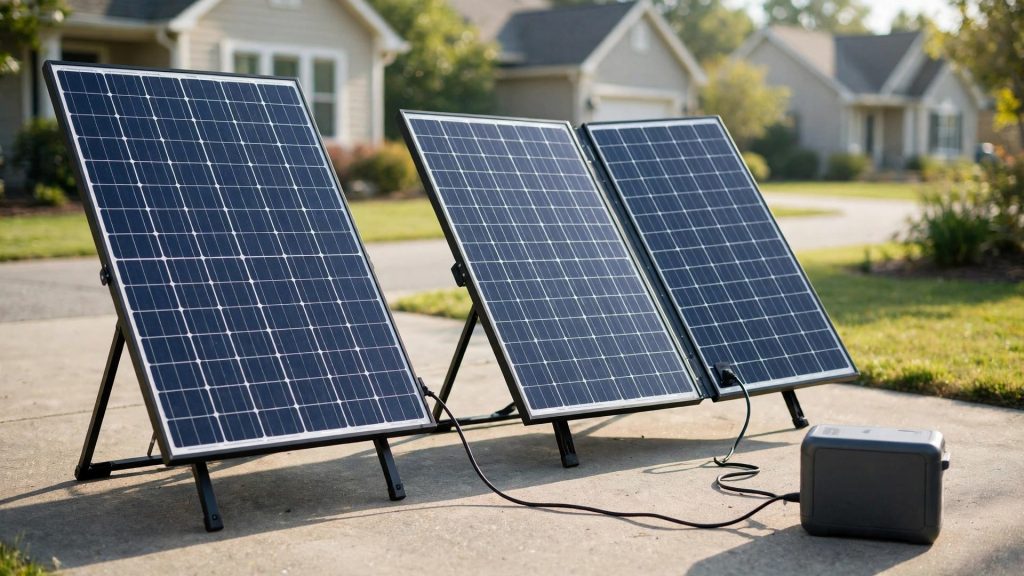
MC4 panels plug straight in — Bluetti PV120, PV200 and PV350, Renogy 100W and 200W, and EcoFlow 110W all end in MC4 and work with every station here, one panel at a time. Adapter first: EcoFlow NextGen 220W (XT60 end) and both Jackery SolarSaga panels (DC8020 end) need a short adapter cable to MC4. The voltage ceilings: 60V on the Elite 200 V2, Elite 100 V2 and AC180; 145V on the AC200L; just 28V on the EB3A — and cold weather pushes a panel’s voltage up, so leave room.
The ceilings: what each Bluetti station can take
These are Bluetti’s own figures, from the product pages and user manuals we checked on November 2, 2026. The station figures here match the solar numbers in our solar generator comparison and the Elite 200 V2 head-to-head.
| Station | Max solar input | Voltage window | Solar cable in the box |
|---|---|---|---|
| Elite 200 V2 | 1,000W | 12–60V | MC4 to XT60 |
| Elite 100 V2 | 1,000W | 12–60V | MC4 to XT60 |
| AC200L | 1,200W | 12–145V | MC4 lead |
| AC180 | 500W | 12–60V | MC4 lead |
| EB3A | 200W | 12–28V | MC4 to DC7909 |
Three things to pull out of that table. First, the current limits ride along with the watt caps: 20A on both Elites, 15A on the AC200L, 10A on the AC180, and 8.5A on the EB3A. A panel that offers more current than the station takes is not a problem — the station simply clips it — but it does mean oversized panels waste some of what you paid for on the small boxes.
Second, Bluetti allows series and parallel wiring on all five stations, and its manuals say so in plain words — what matters is that the finished string stays inside the window above. Series adds the voltages together and keeps the current the same; parallel keeps the voltage and adds the currents. On the 60V stations, parallel is usually the safer way to grow an array. On the AC200L, with 145V to work with, series strings are easy.
Third, the EB3A is the picky one. A 28V ceiling means one panel at a time, full stop — and even single panels need a second look on cold mornings, which is the next section but one.
Which panels plug in, and which need an adapter
| Panel | Plugs in? | Adapter needed | Watch out |
|---|---|---|---|
| Bluetti PV120 (120W) | Yes — all five | None | EB3A: one only |
| Bluetti PV200 (200W) | Yes — all five | None | EB3A: one only |
| Bluetti PV350 (350W) | Four of five | None | Not for EB3A |
| Renogy 100W rigid | Yes — all five | None | No stand included |
| Renogy 200W suitcase | Yes — all five | None | Skip its controller |
| EcoFlow 110W | Yes — all five | None | Small output |
| EcoFlow NextGen 220W | Yes — all five | XT60-to-MC4 cable | Ends in XT60 |
| Jackery SolarSaga 100 | With adapter | DC8020-to-MC4 cable | No MC4 on panel |
| Jackery SolarSaga 200 | With adapter | DC8020-to-MC4 cable | No MC4 on panel |
What the short cells mean, panel by panel:
- Bluetti PV120 and PV200 end in standard MC4, and every station here ships with an MC4 lead — they plug straight in, including the EB3A, which Bluetti sells in its own bundles with these panels. One at a time on the EB3A, never two in series.
- Bluetti PV350 is a 46.5V panel. That is fine on the four bigger stations and flatly too much for the EB3A’s 28V window — no adapter fixes voltage.
- Renogy’s panels end in MC4 leads like Bluetti’s own. The 200W suitcase ships with a charge controller for charging bare batteries; a power station already has one built in, so plug the panels’ MC4 leads straight into the station and leave the controller in the case.
- EcoFlow 110W ends in MC4 and plugs straight in. The NextGen 220W ends in a fixed XT60 cable, so it needs an XT60-to-MC4 adapter cable before it meets the MC4 lead Bluetti ships — a few dollars, and the only catch on an otherwise easy panel.
- Jackery SolarSaga 100 and 200 end in Jackery’s DC8020 plug, made for Jackery stations. A DC8020-to-MC4 adapter cable makes either one a normal MC4 panel that any Bluetti here will accept. Without it, there is no way to connect them — the plugs are a different shape, not just a different name.

Honda EU2200i
The small-inverter benchmark: sips fuel at light loads, and the quietest name in the class.
$1,199.00 from Amazon
Bluetti Elite 200 V2
The station our home-backup comparison leads with for fridge, lights and router duty: 2,073.6Wh of capacity and 2,600W of output, so a microwave and a fridge compressor can run at the same time.
Check the price
Champion 4250 Dual Fuel Inverter
The mid-size pick: runs on gasoline or propane — and propane is the fuel that never goes stale.
$695.00 from AmazonThe cold-morning rule: voltage climbs when panels freeze
A panel’s Voc is rated at 77°F (25°C) in a lab. Real panels on a frosty roof or a cold driveway run colder than that, and voltage rises as the temperature falls. The planning allowance the solar trade uses is roughly +25% on Voc for freezing weather. Run every string through that allowance before you plug it in, not after.
Here is the worked example that catches people. Two Bluetti PV200 panels in series give 26.1V + 26.1V = 52.2V — comfortably under the Elite 200 V2’s 60V ceiling on a mild day, and a setup plenty of owners run all summer. Add the cold allowance: 52.2V × 1.25 = 65.3V. On a bright January morning, that same string is over the ceiling. The station’s protection should refuse the input rather than charge, but “should” is not where you want a $900 box living. The fix costs nothing: wire the pair in parallel instead (26.1V, double the current — 19.4A against the Elites’ 20A limit, which fits), or save series strings for the AC200L and its 145V window.
The same rule is why the EB3A wants low-voltage panels in cold country. At lab temperature every single panel in the table above fits its 28V window. With the cold allowance applied, the panels rated at 24–26V Voc — the PV120, PV200, Renogy 100W and both SolarSagas — pencil out over 28V, while the low-voltage panels stay under it: EcoFlow 110W (21.7V, about 27.1V cold), EcoFlow NextGen 220W (21.4V, about 26.8V cold) and the Renogy suitcase (21.8V, about 27.3V cold). Bluetti’s own EB3A bundles pair it with the PV120 and PV200, and in mild weather that is the maker’s pairing and it works. If your outages come with frost, the low-voltage panels are the honest pick for this one station.
The panels, one by one
Every figure below is the maker’s published spec. Our 200W panel comparison covers the PV200, NextGen 220W and SolarSaga 200 in full, and the 100W panel comparison does the same for the small panels.
Bluetti PV120
Plugs straight into all five stations. It is the panel Bluetti pairs with the EB3A, and the right size for topping off an AC180 between outages — expect roughly 90–100W at midday, not the full 120W. Doubling up works in parallel on the Elite stations; skip series pairs on any 60V station, because two of these run past 60V with the cold allowance.
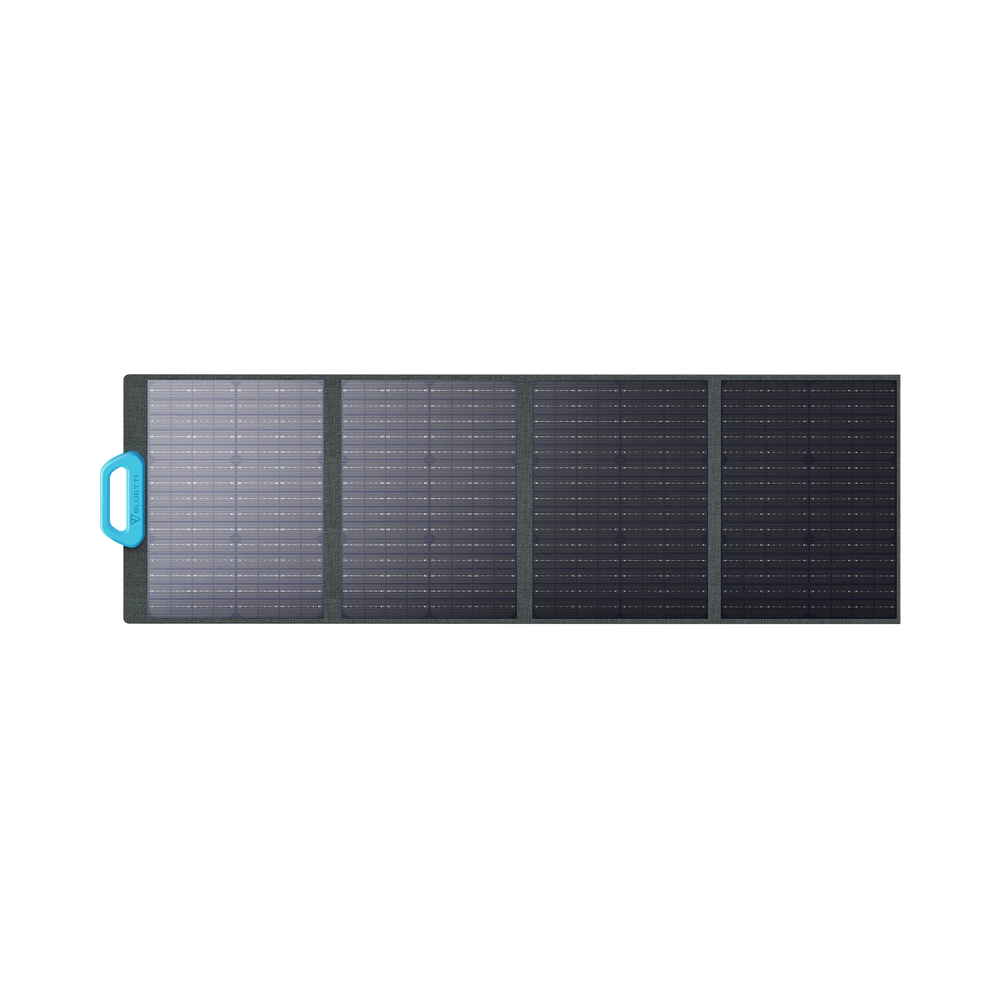
Bluetti PV200
The default choice, and the cheapest honest watt in our 200W comparison. One panel suits the EB3A and AC180; two in parallel are the refill setup for the Elite stations (worked out below); two in series belong on the AC200L only. On the AC180, run one — a second panel in parallel offers more current than its 10A input can take, and series breaks the cold rule.
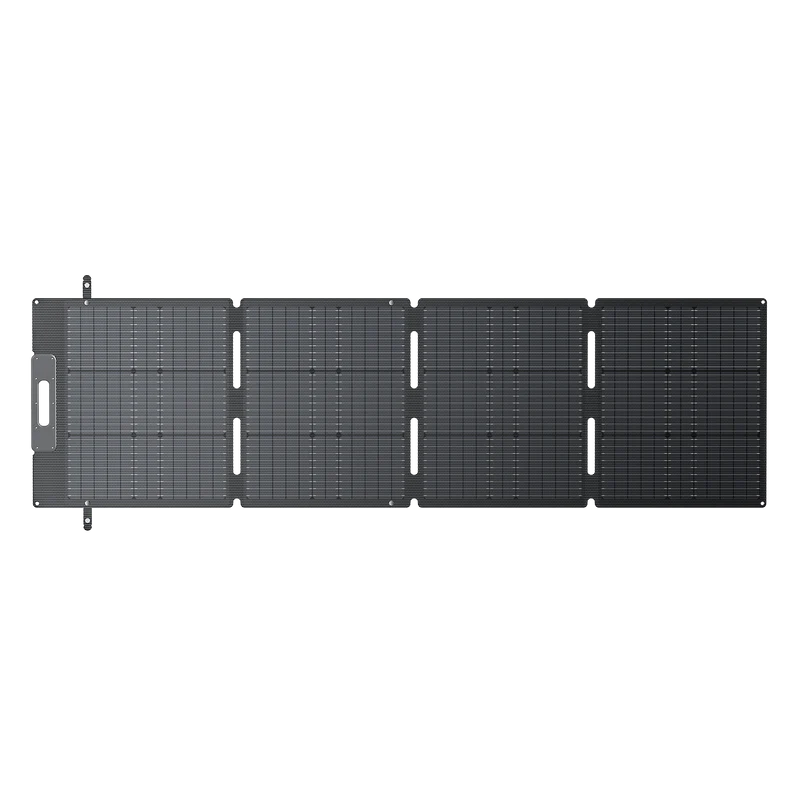
Bluetti PV350
One panel, most of a refill for the big stations — and the only Bluetti panel that does not fit the EB3A at all, because 46.5V is over its 28V window before weather enters into it. On the 60V stations keep it single: cold math puts one at about 58V, inside the limit with little to spare, and two in series (93V) are AC200L territory only.

- Weight489.6 oz (13880 g)
- Size (L × W × H)35.6 × 24.1 × 2.5 in
Renogy 100W Rigid Panel
The framed panel RVers bolt to roofs, and the cheapest watts here if you already own one. It plugs straight into all five stations, one at a time. It is a rigid panel — no kickstand, no carry case — so it wants a mount, a rack, or a sunny fence line. Renogy sells several 100W variants with slightly different labels; the figures here are the standard RNG-100D’s, and the label on the back of your panel is the one that counts.

Renogy 200W Suitcase
Two 100W panels hinged in one case. Its low 21.8V open-circuit voltage makes it the easiest 200W fit for the EB3A — the only 200W-class panel here that stays under 28V even with the full cold allowance. Plug its MC4 leads straight into the station and leave the bundled battery charge controller out of the line; the station has its own. Renogy’s rigid 200W panel (RSP200D, Voc 23.0V) follows the same rules if yours lives on a roof.
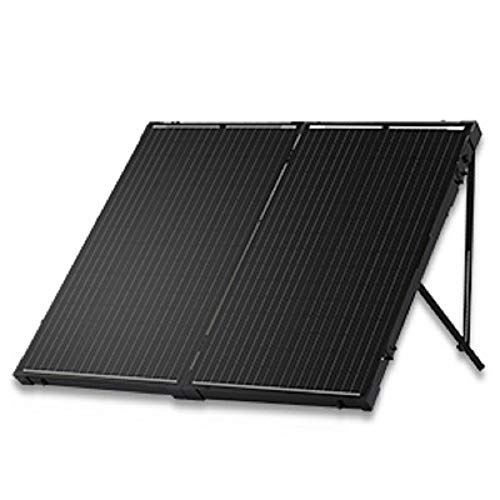
- Weight455.4 oz (12909 g)
- Size (L × W × H)35.6 × 25.9 × 3.1 in
EcoFlow 110W
Ends in MC4, plugs straight into all five stations, and its low voltage gives it the widest cold-weather margin on the EB3A of any panel here. The trade is size: 110W is a top-off panel for the big stations, not a refill plan. For an EB3A or an AC180 that lives in a cold garage, it is a genuinely good match.

- Weight140.7 oz (3990 g)
- Size (L × W × H)20 × 16 × 0.8 in
EcoFlow NextGen 220W
The strongest panel in our 200W comparison, with one catch for Bluetti owners: its built-in cable ends in XT60, so budget for an XT60-to-MC4 adapter cable. Electrically it fits all five stations — on the EB3A the station simply caps it at its own 200W and 8.5A limits, so you are paying for watts the little box cannot use. It earns its price on the AC180 and the Elites.

- Weight254 oz (7200 g)
- Size (L × W × H)22.5 × 1.3 × 23.6 in
Jackery SolarSaga 100
A good panel wearing the wrong plug. SolarSaga panels end in Jackery’s DC8020 connector, so every Bluetti hookup starts with a DC8020-to-MC4 adapter cable. With one, it behaves like any other 100W MC4 panel on all five stations. If you are buying new for a Bluetti, the MC4-native panels above save the extra part; if a SolarSaga already sits in your garage, the adapter is cheaper than a new panel.
Jackery SolarSaga 200
Same plug story as its little brother: DC8020 out of the panel, so a DC8020-to-MC4 adapter cable is part of the kit for any Bluetti. After that it is a solid 200W panel for all five stations, one at a time on the EB3A. Households that own both brands end up here often, and the adapter cable is the whole fix — there is no electrical reason a Jackery panel cannot feed a Bluetti box.
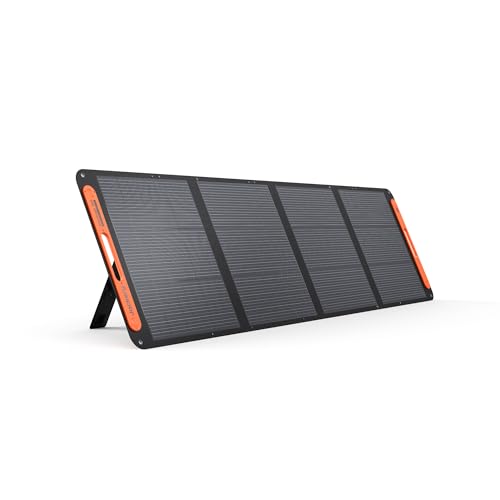
- Weight229.3 oz (6500 g)
- Size (L × W × H)10 × 10 × 10 in
Already own a panel?
Any panel — any brand, any age — works with these stations if three things line up: the plug is MC4 or adapts to it, the panel’s Voc (with the cold allowance if you get freezing weather) sits inside the station’s window from the first table, and the wattage is at or under the station’s cap, or close enough that clipping does not bother you. The label on the back of the panel prints its Voc. That one number settles most of this page for whatever is already in your garage.
How fast will it refill?
Compatibility is only half the question — the other half is whether the array you can legally connect refills the box in a day. Worked example: an Elite 200 V2 (2,073.6Wh) with two PV200 panels in parallel. That is 400W of panel, 26.1V, and 19.4A — inside the station’s 60V and 20A limits with room to spare. Panels deliver roughly 80% of their rating in good midday sun, so plan on about 320W going in: a full refill from empty takes around 6½ hours of strong sun. Across a normal day, expect roughly 1,500–1,700Wh banked — enough to cover a chest freezer’s whole day (about 590Wh, from our freezer runtime math) and still gain ground.
Run your own pairing through the solar recharge time calculator before you buy the second panel — it uses your station size and panel watts, and it is the fastest way to find out whether your plan refills in a day or merely slows the drain. If you are still choosing the station itself, the full solar generator comparison and the Elite 200 V2 vs Jackery Explorer 2000 v2 head-to-head carry the output, price, and owner-feedback side of that decision.
Viewers also searched for these items.


Jackery Explorer 2000 v2
By far the lightest and quietest 2kWh box here — the same class as the Bluetti, in a station one person can actually move room to room.
$999.00 from AmazonQuestions people ask
Can I use a Jackery or EcoFlow panel with a Bluetti station?
Yes. The station’s charge controller reads voltage and current, not logos. EcoFlow’s 110W plugs straight in; the NextGen 220W needs an XT60-to-MC4 cable; Jackery’s SolarSaga panels need a DC8020-to-MC4 cable. After the plug, the only test is the voltage window in the first table.
Can I mix two different panels in one string?
Bluetti’s own guidance is no — panels wired together should be the same model. Mixed panels pull each other off their best working voltage, and the string performs closer to the weaker panel. Same-model pairs, wired in parallel on the 60V stations, are the setup this page is built around.
What happens if I go over the voltage ceiling?
Best case, the station refuses the input and does not charge. Worst case, repeated over-voltage damages the input. Neither is worth testing — the check takes a minute: add up the Voc of every panel in a series string, add the 25% cold allowance if the panels will see freezing mornings, and compare it with your station’s window before anything gets plugged in.
Does the EB3A really only take one panel?
One at a time, yes — 200W and 28V leave no room for a string. Two small panels in parallel stay under the voltage ceiling but offer up to double the current the EB3A can take (8.5A), so the second panel mostly goes to waste. One right-sized panel, aimed well and moved twice a day, beats two panels clipped by the input.
Sources: Bluetti’s official product pages, user manuals, and solar compatibility guide for the Elite 200 V2, Elite 100 V2, AC200L, AC180, and EB3A; the makers’ published panel specifications (Bluetti, Renogy, EcoFlow, Jackery); all checked November 2, 2026. Prices last checked: November 2, 2026.
Talk it over with other readers. The Truly Preserved Community on Facebook is where readers compare notes on food storage, water, and backup power — and where your questions help decide what we research next. Join the group →
Shopping for a different station brand? The same voltage-and-plug method runs through our sibling compatibility guides — which solar panels work with an Anker SOLIX power station and which solar panels work with an EcoFlow power station — each with its own station ceilings and cold-weather voltage math.
Prices shown on this page were last checked November 26, 2026 — prices change; check before you buy.
How we researched this guide. We lined up the five Bluetti stations our readers own most against nine panels from four brands, using only the makers’ own published numbers: Bluetti’s product pages and user manuals for the station input limits, and each panel maker’s spec sheet for open-circuit voltage (Voc), working voltage (Vmp), and connectors. No panel was bought or tested — we work from research, not hands-on testing. Where two sources disagreed, the station’s user manual won. How we research and score →