
Truly Preserved is reader-supported. If you buy through a link on this page we may earn a commission at no extra cost to you. Nobody pays for placement or scores.
Short answer first: an Anker SOLIX station will charge from almost any panel whose open-circuit voltage fits inside the station’s solar input window, as long as you have the XT60 cable every SOLIX station uses. Anker’s own panels ship with that cable. The traps are at the two ends of the line: the little C300 caps out at 28V, which rules out Anker’s own two bigger panels, and the PS200 and PS400 sit so close to the 60V ceiling of the bigger stations that they wire in parallel only — never in series. Get those two facts right and the rest is arithmetic.
C300 and C300 DC owners: the Anker SOLIX PS100 is the only current Anker panel that fits your 11–28V input — the PS200 and PS400 are 48V-class panels and cannot be used at all. C1000, F2000 and F3800 owners: the PS200 and PS400 plug straight in, one panel per string, with pairs wired in parallel to fill the input. Third-party panels: fine when the spec sheet shows a Voc inside your station’s window — the Renogy 100W rigid and the EcoFlow 110W both qualify, even for the C300.
The ceilings: what each Anker SOLIX station can take

These are Anker’s own figures, from the user guides and spec tables we checked on November 12, 2026. Every SOLIX station takes solar through an XT60 or XT-60i port, and every one clips extra current without complaint — it is voltage that can lock you out or do damage, so voltage is the column to read first.
| Station | Max solar input | Voltage window | Current cap |
|---|---|---|---|
| C300 / C300 DC | 100W | 11–28V | 8.2A |
| C800 | 200W | 11–60V | 10A |
| C1000 | 600W | 11–60V | 12.5A |
| C1000 Gen 2 | 600W | 11–60V | 14.5A |
| F2000 | 1,000W | 11–60V | 20A |
| F3800 | 2,400W (2 ports) | 11–60V per port | 25A per port |
Two things stand out. First, the C300 is the picky eater of the line: a 28V ceiling and a 100W cap mean one small panel, chosen by its spec sheet and not its wattage label. Second, every bigger SOLIX station shares the same 60V ceiling — generous for single panels and parallel pairs, and a hard wall for series strings of the big Anker panels, because a PS200 or PS400 already sits at 57.6V on its own. The F3800 gets its 2,400W by splitting the job across two independent 1,200W ports, not by raising the voltage.
Which panels fit?
Panel voltages below are the makers’ published figures: Anker’s bifacial datasheet for its own panels, and the spec sheets behind our 200W panel comparison. This run we are printing no prices — panel pricing moved too much between Anker’s store and Amazon during our checks to quote honestly — so the deciding columns are voltage, plug, and fit.
| Panel | Voc / Vmp | Connector | Fits |
|---|---|---|---|
| Anker SOLIX PS100 Bifacial | 25.9V / 21.6V | XT-60i cable in the box | Every SOLIX station, incl. the C300 |
| Anker SOLIX PS200 Bifacial | 57.6V / 48V | XT-60i cable in the box | 60V stations only — never the C300 |
| Anker SOLIX PS400 Bifacial | 57.6V / 48V | XT-60i cable in the box | 60V stations only — never the C300 |
| Renogy 100W rigid | 24.3V / 20.4V | MC4 leads (XT60 cable separate) | C300 and 60V stations |
| EcoFlow 110W | 21.7V / 18.5V | MC4 + XT60 cable in the box | C300 and 60V stations |
Read the first three rows as one story. Anker builds its two big panels at a 48V working voltage, which is efficient for the big stations and completely locks them out of the C300. The PS100 is the bridge panel — the only one in the current Anker line a C300 can take, and a useful building block everywhere else. The two third-party rows are there because they solve the C300 problem for less: both sit comfortably under 28V, and the Renogy does it as a rigid panel you mount once and stop thinking about.
Anker SOLIX PS100 Bifacial — the only panel a C300 can take

The PS100 Bifacial is the default Anker panel for small stations, and the only current Anker panel that fits the C300 at all. Our score: 9/10.
Electrically it is a 12V-class panel: 21.6V at maximum power, 25.9V open-circuit. Against the C300’s 28V ceiling that margin is thinner than we would like — panel voltage rises as the temperature falls — but this is Anker’s own recommended pairing; the C300’s guide names the maker’s 100W panel as the match, and the station and panel were designed against each other. The warning belongs on third-party panels instead: a C300 owner shopping elsewhere has to see a Voc under 28V printed on the spec sheet, not assume a “100W panel” is automatically safe. Plenty of 100W panels run 24V-class and fit; some run higher and do not.
On the 60V stations the PS100 earns its keep a second way: two in series total 51.8V, a legal 200W string under the ceiling, and at 6.2 lb a panel it is the one in this line you can actually carry to where the sun is. It is rated IP68, bifacial, and ships with two 8.2 ft solar cables and the XT-60i cable, so there is nothing else to buy. What it cannot do is refill a big battery quickly — 100W is a top-up rate for a C1000, not a recharge plan.
- Pros: the only current Anker panel for the C300; 6.2 lb and IP68; series pairs stay legal on 60V stations; cables in the box.
- Cons: thin voltage margin on the C300 by design; 100W is slow against any battery over ~500Wh.
Buy it if you own a C300 or C300 DC, or you want the lightest panel in the line for a C800. Skip it as the sole panel for a C1000 or larger — you will wait all day.
Anker SOLIX PS200 Bifacial — the C1000 and F2000 default

The PS200 Bifacial is the panel most C1000 and F2000 owners should start with. Our score: 8/10.
It is a 48V panel — 48V at maximum power, 57.6V open-circuit — which is why the fit column above reads the way it does: it suits the 60V stations and is named in Anker’s own C300 listing as not compatible with the little station. One panel gives a C1000 a working 200W input; three wired in parallel reach the station’s 600W cap with room to spare on current (three times the panel’s 4.38A short-circuit current is about 13.1A, under the Gen 2’s 14.5A cap). An F2000 takes the same panel up to its 1,000W ceiling in parallel, though at that size the PS400 below is the tidier buy.
At 10.6 lb folded to about 27 × 31 inches, it is a carry-it-to-the-yard panel rather than a backpacking one, and the bifacial cells are worth up to 10% more over pale ground by Anker’s rating — snow, sand, and concrete are the surfaces where the back face earns anything. We hold no tracked link for this panel, so it is named here in plain text; Anker sells it through its own store and Amazon.
- Pros: right-sized for the 600W and 1,000W stations; parallel wiring is simple and stays legal; IP68; 5-year cover.
- Cons: cannot touch a C300; one panel alone refills a C1000 slowly; premium price class for its watts.
Buy it if your station is a C1000, C1000 Gen 2, or F2000 and you want the matched panel with no adapter math. Skip it if you own a C300 — it will not work, at all.
Anker SOLIX PS400 Bifacial — 400W through one plug

The PS400 Bifacial is the most solar a single folding panel can push into a SOLIX station. Our score: 8/10.
Same 48V electrical family as the PS200 — 57.6V open-circuit, 8.33A at maximum power — so the same rules apply: 60V stations only, parallel only, never the C300. Where it earns its place is the F2000 and F3800: one PS400 is 400W of an F2000’s 1,000W input through a single connection, and two in parallel make 800W at about 17.5A of short-circuit current, inside the F2000’s 20A cap. On an F3800 port it is a building block toward 1,200W per side.
The honest costs are size and weight: 21.9 lb, and over 90 inches long unfolded. That is roughly half the weight of the original PS400 it replaces — that first version ran 35.3 lb and has sold out at Anker’s store — but it is still a panel one person wrestles into position, and wind catches it. Owners who set up and tear down daily should read that sentence twice; owners who park a panel for a weekend should not care. Like the PS200, it is named here without a tracked link.
- Pros: 400W per connection; halves the panel count on F2000/F3800 setups; half the weight of the panel it replaced.
- Cons: 21.9 lb and awkward unfolded; 60V stations only; overkill for a C800’s 200W input.
Buy it if you are feeding an F2000 or F3800 and want the fewest panels and cables. Skip it for a C800 — the station clips it to 200W and you carried the extra weight for nothing.
Renogy 100W rigid — the budget building block
The Renogy 100W is the value answer for fixed SOLIX setups, exactly as it was in our EcoFlow guide. Our score: 8/10.

Its 24.3V open-circuit voltage fits every station on this page, the C300 included, and its standard MC4 leads mean an MC4-to-XT60 solar charging cable is the one extra purchase — Anker sells one, and so does everyone else. Wire two in parallel for 200W into a C800, or in series for 48.6V into a C1000; both stay inside the windows with the cold allowance applied. The owner record is the deepest in this guide by an order of magnitude — in our EcoFlow checks it stood at 4.6 stars across roughly 7,021 ratings — with the praise aimed at what a rigid panel should do: arrive flat, mount easily, produce near its rating.
What you give up against the folding panels is the fold itself: no case, no kickstand, no carry handle. A rigid panel is a roof, a rack, or a ground frame. For a station that lives at home and panels that can live outside with it, that trade is the right one — and it is the only route on this page to a permanent array a C300 can drink from.
- Pros: fits every SOLIX station including the C300; deepest owner record here; standard MC4; made to be mounted and left.
- Cons: rigid — bring your own mount; XT60 cable bought separately; not a take-it-camping panel.
Buy it if your Anker station stays home and you are building watts on a budget. Skip it if the panels ride in a vehicle or get set up fresh each trip.
EcoFlow 110W — the cross-brand panel with the safest C300 voltage
The EcoFlow 110W is the interesting outsider: a rival maker’s folding panel that happens to fit Anker’s smallest station better than most. Our score: 7/10.

- Weight140.7 oz (3990 g)
- Size (L × W × H)20 × 16 × 0.8 in
The number that matters is 21.7V open-circuit — the lowest on this page, and the widest margin under the C300’s 28V ceiling of any panel here, Anker’s own included. Its solar charging cable is in the box and ends in XT60, which is the plug family Anker’s ports take. On the 60V stations it works the same way, as a small folding panel among bigger options.
Why only 7, then: it is a 110W panel priced in the matched-panel class, and on any station bigger than a C300 its watts are expensive next to a PS200. Its home turf is narrow and real — a C300 owner who wants a folding panel, a cable in the box, and the most voltage headroom on the page buys this one and stops worrying about frosty mornings.
- Pros: lowest Voc here — the safest C300 fit; XT60 cable in the box; folds and travels.
- Cons: matched-panel money for 110W; a bit player on the big stations.
Buy it if you own a C300 and want a folding panel with voltage margin to spare. Skip it for a C1000 or larger, where the PS200 does more for the money.
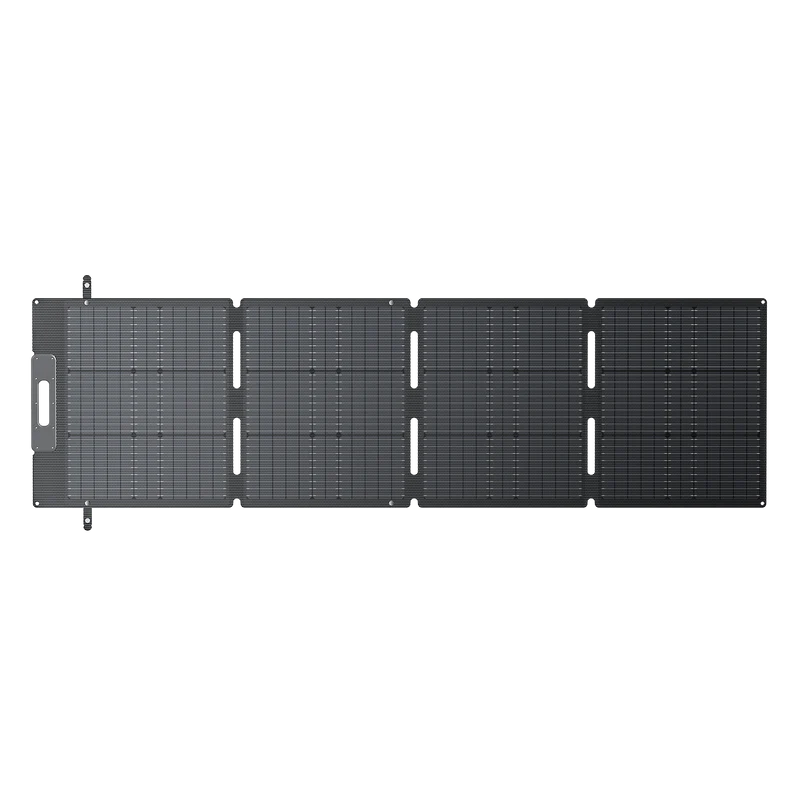
Bluetti PV200
Cheapest watts here at $1.75 per rated watt, and plain MC4 plugs fit almost any station.
$329.99 from Bluetti
EcoFlow DELTA 2 Max
The bigger box in the same comparison, for households whose outage list runs past the basics and needs more stored energy before solar or a generator has to help.
$977.00 from Amazon
Honda EU2200i
The small-inverter benchmark: sips fuel at light loads, and the quietest name in the class.
$1,199.00 from AmazonParallel or series: Anker’s rule is parallel
Anker’s own guides settle this one: the C1000 Gen 2 manual instructs owners to connect panels in parallel and keep total open-circuit voltage at or under 60V, and the F3800 guide repeats the 60V-per-port ceiling. The reason is the PS200 and PS400 themselves — at 57.6V each, two in series would present 115.2V to a 60V port. There is no wiring trick that makes that safe, and no reason to try: parallel pairs add current instead, and every station on this page has current headroom sized for exactly that.
Series still has one legal use here — low-voltage panels. Two PS100s in series make 51.8V and 200W; two Renogy 100Ws make 48.6V. Both fit the 60V stations, neither fits the C300, whose owners get one panel and no wiring decision to make. Whichever way you wire, run the finished string’s Voc through the +25% cold allowance before you plug it in — panel voltage climbs as the temperature drops, and the planning figure the solar trade uses is about a quarter more on a freezing morning. Our Solar Recharge-Time Calculator turns the array you settle on into an honest refill time for your battery.
How much panel does your station actually need?
Plan on panel watts × 4 to 5 good sun hours × 0.75 for real-world losses — heat, angle, and wiring eat the rest. On that math a 100W panel banks roughly 300–375Wh a day, a 200W panel 600–750Wh, and a 400W panel 1,200–1,500Wh. Set that against the battery: a C1000 holds 1,056Wh, so one PS200 is a two-day refill plan and three in parallel are a one-day plan. The F2000’s 2,048Wh wants the full 1,000W of input to turn around in a day of good sun. Buying panel to match the battery, not the brochure, is the whole game — a station that only ever sees a fridge and a CPAP overnight does not need its solar input maxed.
Viewers also searched for these items.

Jackery Explorer 1000 V2
The most capacity (1,070Wh) in the lightest box (23.8 lb), the longest fridge runtime here, and a 59-minute emergency fast-charge.
$559.00 from Amazon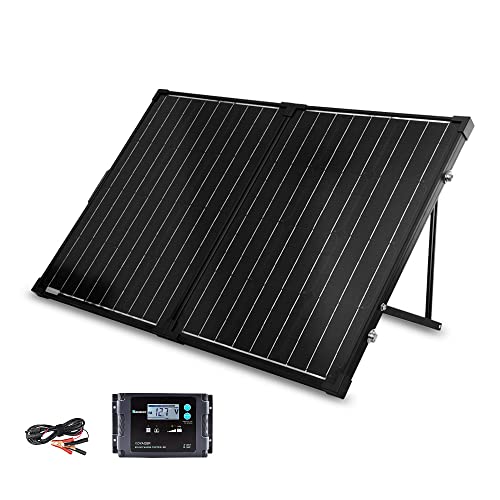
Renogy 100W Solar Suitcase
A folding suitcase panel from Renogy for the same job — easy to store with the station and quick to set out when the power goes.
$154.98 from AmazonFrequently asked questions
Can I use a non-Anker solar panel with an Anker SOLIX power station?
Yes. Compatibility is voltage, current, and plug — not brand. Any panel whose Voc, with the cold allowance, sits inside your station’s window will charge it, as long as you have the XT60 solar charging cable Anker’s ports use. The Renogy 100W and EcoFlow 110W on this page are the standing examples.
Why won’t an Anker PS200 charge my C300?
Voltage. The PS200 is a 48V-class panel with a 57.6V open-circuit voltage, and the C300’s solar input is an 11–28V window with a 100W cap. Anker’s own C300 listing names the PS200 and PS400 as not compatible. The panel a C300 takes is the PS100 class — Anker’s, or a third-party panel with a spec-sheet Voc under 28V.
How many solar panels can a SOLIX C1000 take?
Up to 600W inside an 11–60V window. The clean setups are three PS200s in parallel (600W, about 13.1A of short-circuit current against a 14.5A cap on the Gen 2), a PS400 plus a PS200 in parallel, or low-voltage panels in a series-parallel mix that stays under 60V cold. Two PS200s in series — 115.2V — is the one arrangement to never build.
Can I mix panel brands on one Anker station?
In parallel, panels of similar working voltage can share a port, and the station simply clips what it cannot use. Keep the string’s combined Voc under the ceiling, expect the weakest panel to set the pace, and do not mix voltages in series. For most owners, matched panels are simpler and lose nothing.
Do Anker SOLIX stations charge from solar while powering appliances?
Yes. Solar input offsets what your loads draw, and the battery makes up the difference — which is why refill times stretch while the station is working. Size the array against what the station uses in a day, not just the battery’s size.
The same compatibility method runs through the rest of the power shelf: our EcoFlow panel guide and Bluetti panel guide work the same voltage math for those stations, and our best power station for CPAP guide works out which box deserves the array in the first place.
Sources & freshness: Anker SOLIX user guides and support pages (station input windows, parallel-wiring rule, C300 compatibility exclusions), Anker’s bifacial panel datasheet (PS100/PS200/PS400 Voc, Vmp, weight), Renogy and EcoFlow published spec sheets, all checked November 12, 2026. No prices printed this run — see the panel table note.
Talk it over with other readers. The Truly Preserved Community on Facebook is where readers compare notes on food storage, water, and backup power — and where your questions help decide what we research next. Join the group →
Prices shown on this page were last checked November 26, 2026 — prices change; check before you buy.
How we researched this guide. We lined up the Anker SOLIX stations our readers own most against Anker’s own panels and the third-party panels that actually fit them, using only published numbers: Anker’s user guides and support pages for each station’s solar input window, and each panel maker’s datasheet for open-circuit voltage (Voc), working voltage (Vmp), and connectors. Anker SOLIX is a direct program for this site through Rakuten, which is why the PS100’s link runs to Anker’s own store. Where a panel has no tracked link in our registry — the PS200 and PS400 — it is named in plain text rather than linked on a guess. No panel was bought or tested — we work from research, not hands-on testing. Where two sources disagreed, the station’s manual won. How we research and score →