
Truly Preserved is reader-supported. If you buy through a link on this page we may earn a commission at no extra cost to you. Nobody pays for placement or scores.
THE SHORT ANSWER
No. Harvest Right’s own pump pages name three approved oils, and only one of them is Harvest Right’s: Harvest Right Oil, Robinair Premium High Vacuum Pump Oil, and JB Industries Black Gold Vacuum Pump Oil. Any of the three is a correct fill. What you cannot do is treat vacuum pump oil as interchangeable — the popular Dairyland oil is named by Harvest Right as one to keep out of its Premier pump, and the change interval depends on which pump you own: drain, filter, and refill every 4–5 batches on the standard pump, every 20–30 batches on the Premier, and never on the oil-free.
Three separate owners asked some version of “do you have to buy oil from Harvest Right?” in the freeze-drying groups inside three days in late October, and the answers they got back were the usual mix — brand loyalty, farm-store substitutes, and one report of oil coming out full of water and brown grit after ten runs. The question has a documented answer, because Harvest Right publishes its approved list on its own pump pages. What follows is built from those pages and Harvest Right’s FAQ, checked against Stay Fresh’s oil-change guide — the other freeze dryer maker whose pumps our readers own — with the disagreements between the two makers left visible instead of smoothed over.
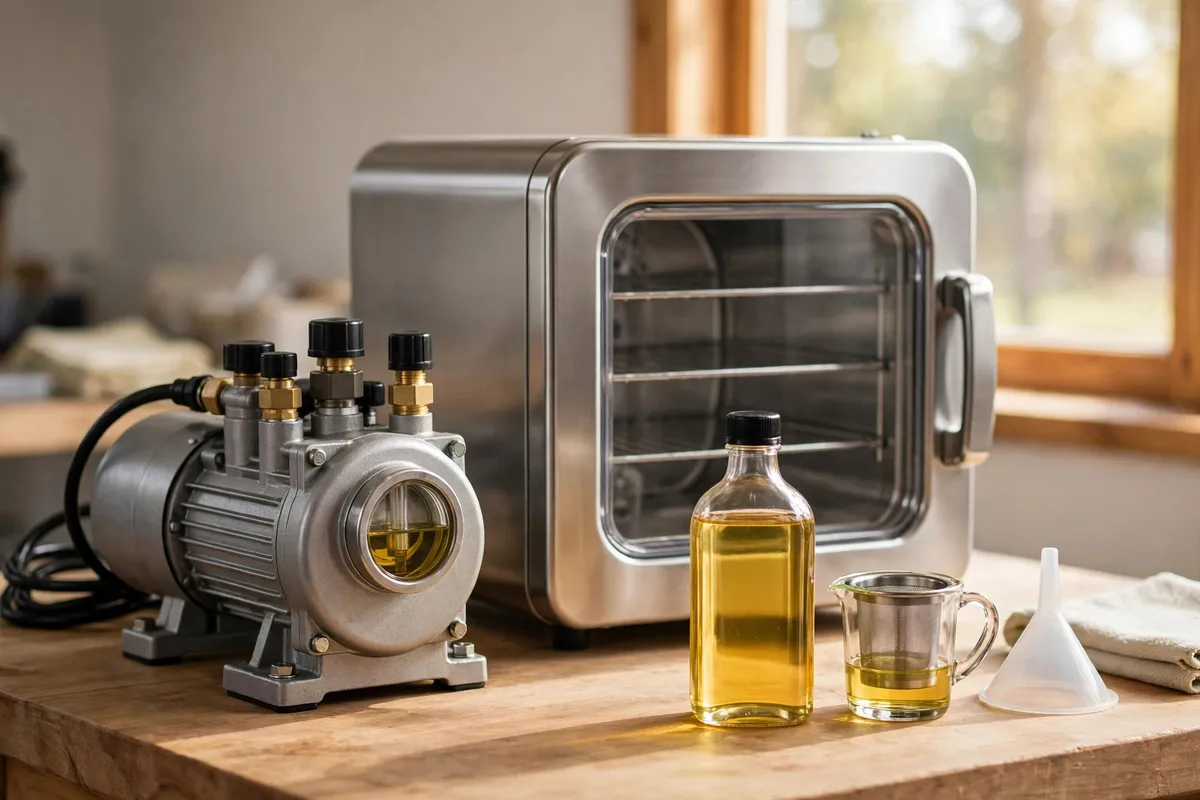
The approved list is three oils long
Every Harvest Right pump page carries the same technical specification, word for word: “Oil: Harvest Right Oil, Robinair Premium High Vacuum Pump Oil or JB Industries Black Gold Vacuum Pump Oil Only.” The company’s FAQ adds the instruction behind the list — “Only use Harvest Right approved oil.” That is the whole universe for a Harvest Right pump: the house brand, an HVAC-industry staple from Robinair (a Bosch brand), and JB Industries’ Black Gold, an ISO 46 non-detergent oil. JB sells Black Gold on exactly the property that matters in a vacuum pump — a non-detergent formula, because detergent additives are blended to hold contaminants suspended in the oil, and a vacuum pump wants the opposite behavior.
Stay Fresh writes its rule the other way. Its oil guide approves JB Black Gold and Robinair by name, then opens the door wider: any vacuum pump oil with a viscosity of ISO 40–60. So the two makers land in slightly different places — Harvest Right names oils, Stay Fresh names a specification — and the two named third-party oils sit inside both makers’ rules. If you own one of each machine, Robinair Premium or Black Gold is the bottle that is legal in both pumps.
Prices checked November 3, 2026.

Robinair 13203 Vacuum Pump Oil
Named on Harvest Right's approved list and in Stay Fresh's guide. Engineered to hold viscosity at high running temperatures and to start clean in cold rooms.
$16.79 from Amazon
JB Black Gold Pump Oil
The second named oil on both makers' lists: ISO 46, non-detergent. A gallon covers years of standard-pump filter cycles and Premier changes alike.
$54.50 from AmazonThe Dairyland split: fine in one pump, banned in the other
Dairyland vacuum pump oil is the substitute owners reach for — it is sold for dairy milking-machine pumps, it is everywhere in farm country, and it is genuinely recommended by Stay Fresh, whose guide names it “exclusively for standard oil pumps” for the corrosion protection it gives the pump’s internals. Harvest Right’s Premier pump page carries the opposite instruction in plain words: “Do not use Dairyland vacuum pump oil in the Premier pump.” Read together, the two makers are not contradicting each other. Dairyland is a standard-pump oil. The Premier is a different design — its gas ballast keeps water from staying in the oil, which is why its oil stays clear for dozens of batches — and Harvest Right approves exactly two third-party oils for it. The rule that keeps you out of trouble: match the oil to the pump you own, not to the pump the person answering you owns.
Which oil, which pump, how often
| Pump | Approved oil | Interval |
|---|---|---|
| Harvest Right Standard | HR Oil, Robinair Premium, or JB Black Gold | Drain, filter, refill every 4–5 batches |
| Harvest Right Premier | Same three — never Dairyland | Change every 20–30 batches, or at once if cloudy |
| Harvest Right Oil-Free | None — no oil | No oil maintenance at all |
| Stay Fresh Standard | JB Black Gold, Robinair, Dairyland, or ISO 40–60 | Filter or change every 3–5 cycles, or if murky |
| Stay Fresh Industrial | Same as its standard pump | Change every 30 batches or 1,000 hours |
The intervals come from each maker’s own pages — Harvest Right’s FAQ for its two pumps, Stay Fresh’s oil guide for its two. Two honest complications. First, Harvest Right phrases the Premier interval with some spread: the FAQ says 20–30 batches, the pump page says you will not need a change until 20 or more batches and that the oil often stays pristine past 30 — the working rule is the FAQ’s 20–30, with the oil’s appearance allowed to overrule the count. Second, our own Harvest Right size comparison prints “every 20–30 batches” as the general oil line, which describes the Premier pump current machines ship with; owners of the older standard pump should use the 4–5 batch figure in the table, not the one in the comparison. On cost, our cost-per-pound accounting budgets about a dollar of oil per batch on a Medium — the oil is cheap; the pump it protects is not.

Sour Patch Kids (5 lb)
The bulk bag is the economical way to run candy mode: sour gummies sit squarely in the low-fat, high-sugar family that puffs into crisp bites in the dryer, and five pounds fills a lot of trays.
$20.99 from Amazon
Nesco VS-12
A full-featured countertop sealer for bagging batches before they go into storage.
$108.18 from Amazon
Filter it or replace it?
On the standard pumps, the routine is not “change” the way a car changes oil — it is drain, filter, and put the same oil back. Harvest Right’s maintenance writing says owners filter and reuse their oil through multiple filter cycles before replacing it outright, and the filter pitcher that ships with the machine is built for exactly that. Stay Fresh’s guide describes the same ritual from its side — pitcher, steel mesh, paper filter, layers of tissue — and adds the step people forget: if the level comes back low after filtering, top up with new oil. Replace instead of filtering when the oil will not come clean: dark and dirty after filtering, gritty, or carrying the brown grit one owner reported after ten runs. Grit is debris the oil picked up inside the pump; filtering through paper takes out the particles but an oil charge that has been carrying grit and water has done its service. Fresh oil is a few dollars a change. A pump is not.
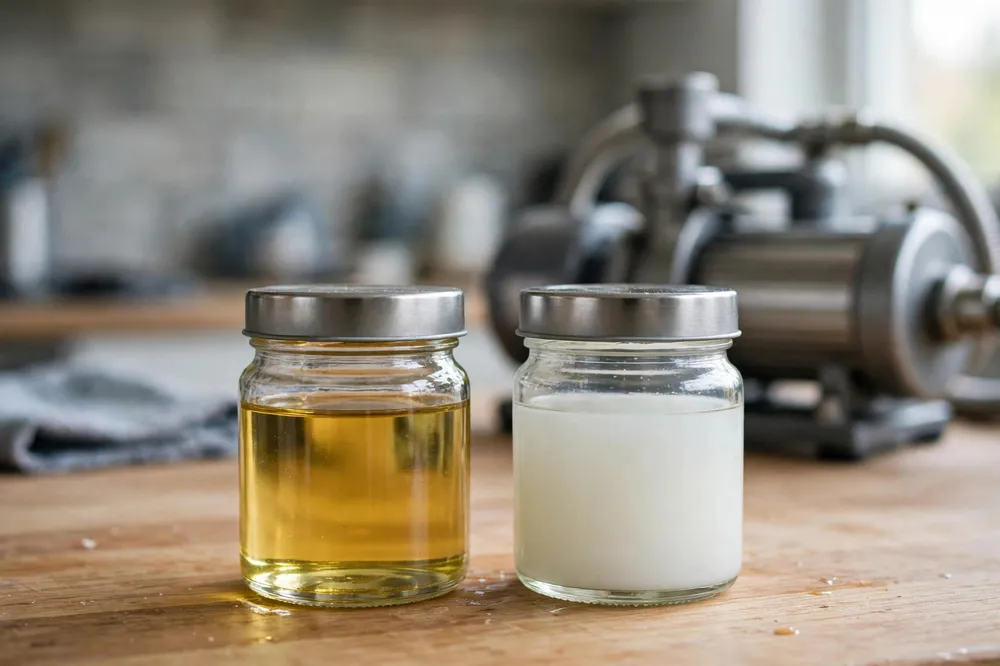
What the sight glass is telling you
The sight glass is the whole diagnostic. Stay Fresh’s guide draws the line precisely: oil that has gone yellow but stays clear is still usable — the color is pigment from food, and it does not affect performance. Oil that looks murky or milky has water mixed into it, and that oil gets filtered or changed before the next batch, whichever pump it sits in. Harvest Right’s FAQ gives the Premier the same rule in shorter form: change every 20–30 batches, “or immediately if it turns cloudy or dirty.” Water gets in from the food — every batch sends its moisture past the pump — and from habits: one owner’s cloudy oil followed runs made with the drain valve open, and Harvest Right warns Premier owners to keep the gas ballast switch open, because running with it closed lets moisture build up in the oil, cuts the pump’s efficiency, and stretches batch times.
Level matters alongside clarity, and here Harvest Right’s own pages phrase the fill line two ways — the Troubleshooting Guide’s vacuum checklist says oil filled to the middle of the sight glass, while the current FAQ says fill slightly above the three-quarter mark. Stay Fresh’s manual says the middle line. We are not going to pretend those agree. What every source agrees on is the failure at the top of the glass: overfilling saturates the pump’s demister — the mist filter — which is the one fill mistake both makers warn about by name. Visible in the glass, clear, and short of stuffed is the state that satisfies every version of the instruction. And if cloudy oil is why your machine stopped pulling vacuum, the diagnosis continues on our companion page: why your freeze dryer says “unable to achieve vacuum.”
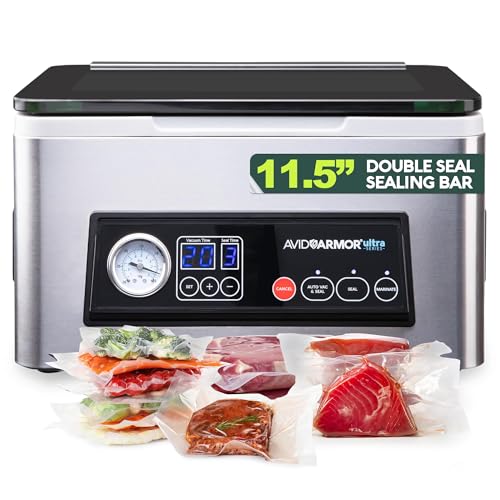
Avid Armor USV20
The chamber machine: soups, marinades and smooth cheap pouches — if it fits in an 11 x 10 pouch.
$349.00 from Amazon
Questions people also ask
How often do I have to change the vacuum pump oil?
It depends on the pump, which is why the answers online sound contradictory. Harvest Right’s FAQ: every 4–5 batches on the standard pump (drain, filter, refill), every 20–30 batches on the Premier. Stay Fresh: every 3–5 cycles on its standard pump, every 30 batches or 1,000 hours on its industrial pump. The oil-free pump never. Any pump’s interval is overruled by cloudy oil — that change happens now, not at the count.
Is the oil-free pump upgrade worth it?
Our size comparison prices the upgrade at $1,495 and gives the verdict we still stand by: at a few dollars of oil and a two-minute filter job per change, the oil-free pump buys convenience, not capability — owners who run the machine constantly call it worth it, owners who run it weekly mostly do not. The oil math on this page is the math behind that verdict.
Can I top up with a different oil than what’s in the pump?
Stay within the approved list for your pump and the question mostly answers itself — the named oils are all high-vacuum mineral oils of the same class. What neither maker sanctions is topping up with an oil outside the list, or stretching a cloudy charge with a splash of fresh oil and calling it changed. If the glass says the oil is done, drain it.
What happens if I just never change it?
The oil stops sealing. A vacuum pump’s oil is what lets it pull deep vacuum at all, and waterlogged, dirty oil pulls a shallower vacuum on every run — batches lengthen, then the machine starts failing its vacuum deadlines and showing the error our vacuum diagnosis page walks through. Harvest Right’s maintenance guide lists never changing the pump oil among the habits that shorten pump life. The two-minute job is the cheap version of the repair.
Related questions
- Why does my freeze dryer say “Unable to achieve vacuum”?
- Harvest Right freeze dryer sizes compared
- What freeze-drying actually costs per pound
- Home freeze dryers compared
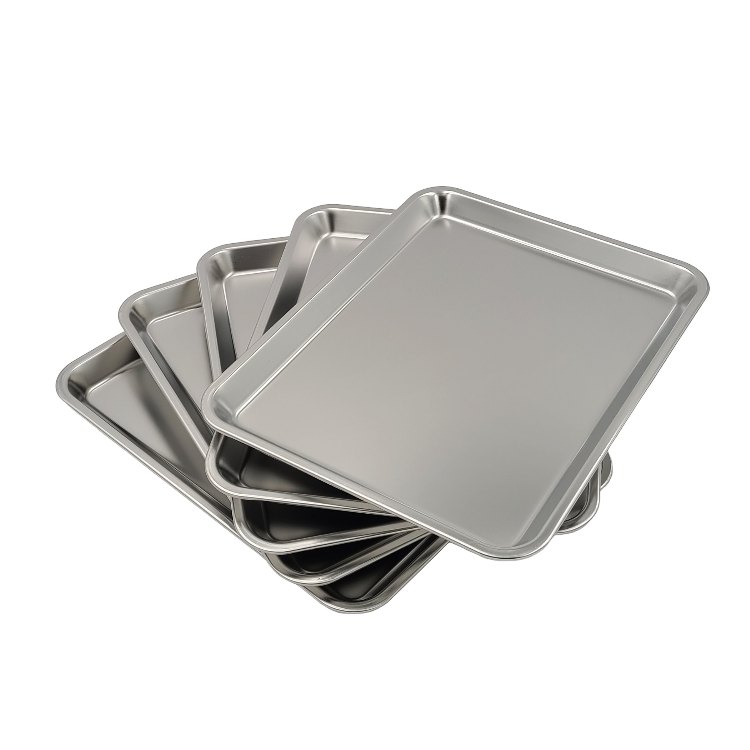
Blue Alpine Freeze Dryer Trays, Medium
Extra trays let you prep the next load while a batch runs, instead of waiting on the set in the machine. Use code TRULYPRESERVED at checkout for 10% off.
$66.71 from Blue Alpine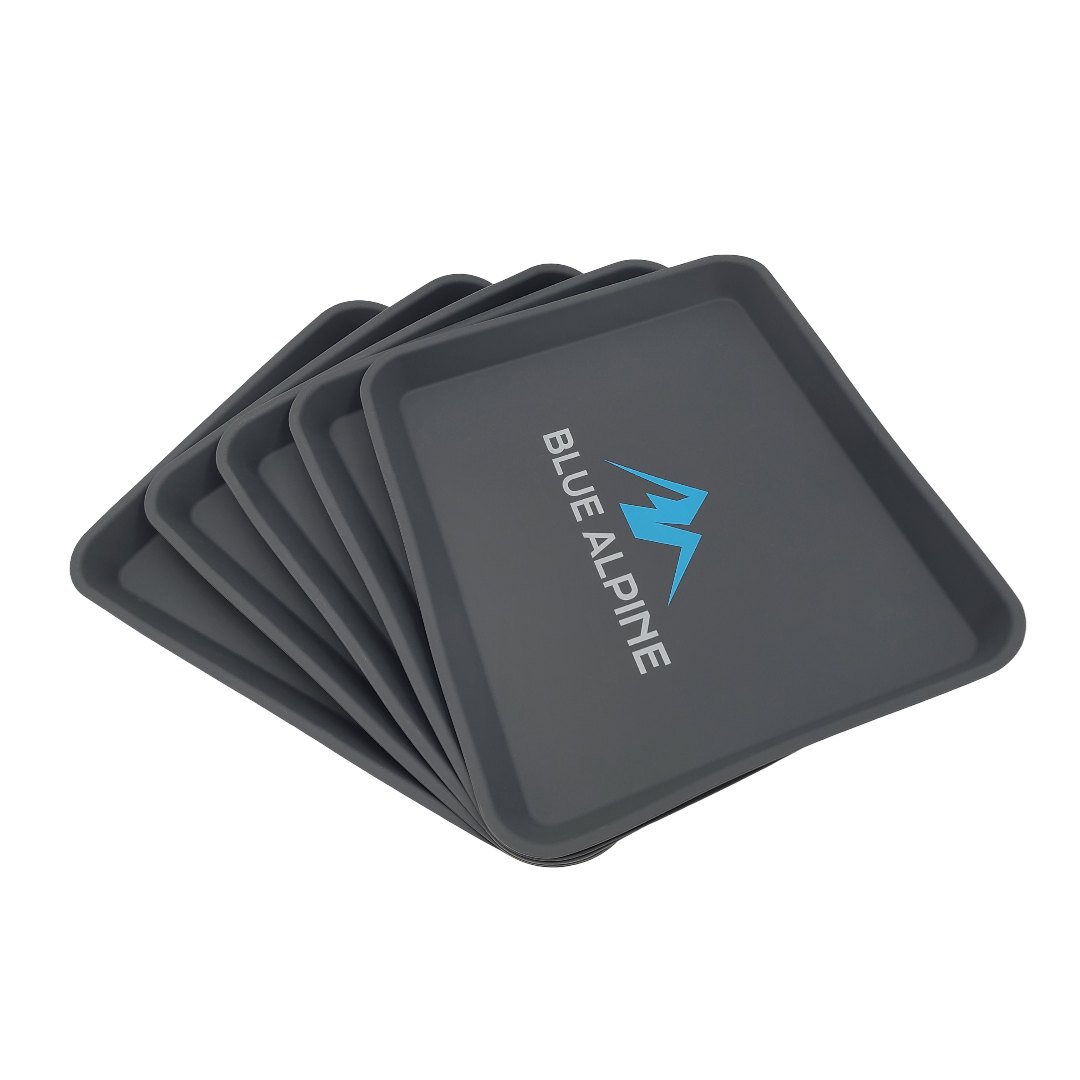
Blue Alpine Silicone Mats, Medium
Silicone tray liners keep sticky foods from bonding to the tray, so finished batches come off clean instead of tearing. Use code TRULYPRESERVED at checkout for 10% off.
$29.08 from Blue Alpine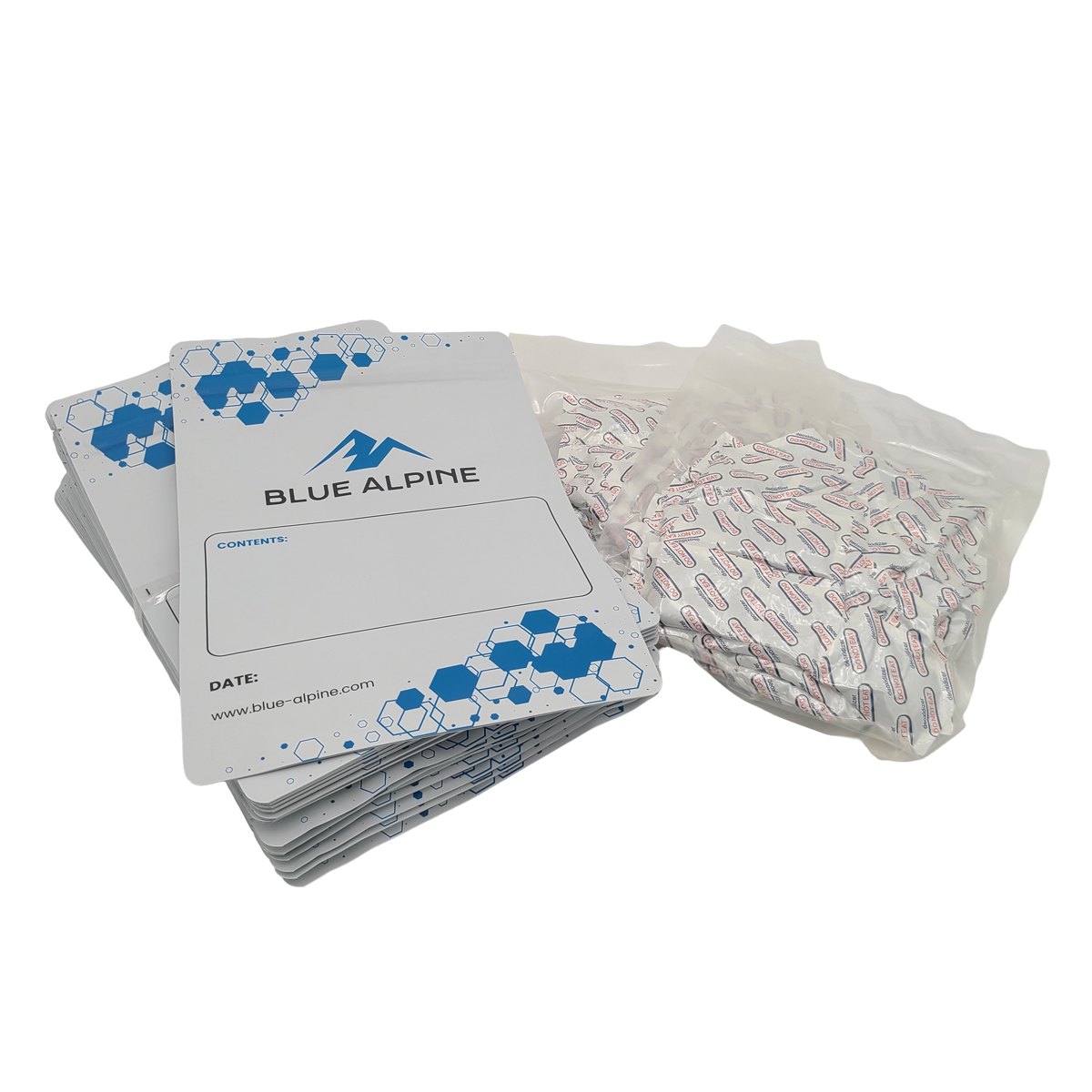
Blue Alpine Mylar Bags with Oxygen Absorbers
Once a batch completes, mylar bags with absorbers are how the food gets sealed for storage instead of sitting out. Use code TRULYPRESERVED at checkout for 10% off.
$32.39 from Blue AlpineThis question sits in What People Are Asking About Freeze-Dried Food — the full list of freeze-dried questions from real forums, each with a short answer.
Viewers also searched for these items.

COSORI Dehydrator
And the dehydrator side — a tenth of the price, and the right tool for the high-fat half of the list.
$135.99 from Amazon
Thrive Life: Freeze-Dried Blueberries - Pantry Can Size
Freeze-dried food by the can, no machine: the same long-life ingredients the kits are built from, bought a can at a time.
$60.00 from Amazon
Blue Alpine Medium Select
Higher cooling capacity shortens batch times, and owners praise the customer service. Up to 15 lbs per batch — the fastest route from harvest to a shelf that lasts decades. Use code TRULYPRESERVED at checkout for 3% off.
Check the pricePrices shown on this page were last checked November 26, 2026 — prices change; check before you buy.
Talk it over with other readers
The Truly Preserved Community on Facebook is where readers compare notes on food storage, water, and backup power — and where your questions help decide what we research next.