
Truly Preserved is reader-supported. If you buy through a link on this page we may earn a commission at no extra cost to you. Nobody pays for placement or scores.
THE SHORT ANSWER
Most vegetable seeds last 2 to 5 years stored cool and dry — but the crop decides where in that range you land. Onion seed is the sprinter at about 1 year; corn and peppers run about 2; beans, carrots and peas about 3; tomatoes about 4; and broccoli, cabbage, cucumber, lettuce and radish about 5, on Iowa State University Extension’s table. Those years assume proper storage — seed kept warm or damp can fall short of them, and seed kept colder and drier often beats them. The years are a planning guide, not a verdict: a ten-seed germination test settles any specific packet.
Ask five gardeners how long seeds last and you will get the honest answer “it depends” five times — on the crop, on the storage, on what you mean by “last.” The extension services at least put numbers on the dependence, and this page is built from their tables read side by side on November 11, 2026: Iowa State University Extension’s viability table in full, checked against University of Illinois Extension’s figures and Colorado State Extension’s fact sheet 7.221, the same sources behind our seed storage guide. Where the tables agree, we print the number plainly. Where they fight — and on lettuce they are five years apart — we print the fight, because a vault planned on the generous number and stored on the strict one is a vault with a hole in it.
How long do vegetable seeds last, crop by crop?
Vegetable seeds last from about 1 year for onions to about 5 years for the cabbage family, cucumbers and radish, on Iowa State Extension’s table for seed stored properly. Here is that table, grouped the way a gardener actually triages a drawer:
| Expected life | Crops (Iowa State Extension) |
|---|---|
| About 1 year | Onions |
| About 2 years | Corn, peppers |
| About 3 years | Asparagus, beans, carrots, peas |
| About 4 years | Beets, pumpkins, squash, tomatoes, watermelon |
| About 5 years | Broccoli, cabbage, cauliflower, cucumber, lettuce, muskmelon, radishes, spinach |
Read the table the way Iowa State frames it: these years assume ideal storage, the germination rate still declines every year inside the window, and the guide “does not replace a germination test.” For seed much older than its crop’s row, Iowa State’s advice is blunt — discard it and buy new rather than spending time testing it. Inside the window, the packet is a candidate. Past it, the burden of proof flips to the towel.
The pattern inside the table is worth seeing once. The short-lived end is not random: onion, corn and pepper seed carry higher oil or thinner reserves and simply age faster, and the carrot family’s cousins — parsley and parsnip, at about 1 year on the other extension tables — sit down there with them. The long-lived end is dominated by the cabbage family and the cucurbits, hard-coated seed that waits well. If you remember nothing else, remember the two ends: replace onions yearly, and stop apologizing for five-year-old cucumber seed.
Where do the extension services disagree?
The extension services disagree most on lettuce — 1 year at Colorado State, 5 at Iowa State, 6 at Illinois — and on spinach and carrots, and that disagreement is information, not noise. Lettuce is the extreme case, and our storage guide flagged it before this page existed: Colorado State’s fact sheet 7.221 allows lettuce about a year, the older Harrington-and-Minges chart lineage allows it six, and Iowa State splits toward the generous end at five. Our planning line, stated there and kept here: count lettuce at 1 to 2 years in your own rotation, and let a germination test argue for more.
Spinach runs 5 years at Iowa State and Wisconsin, about 3 at Illinois, and 2 to 3 at Kansas State. Carrots are 3 at Iowa State and Illinois, 4 on the Purdue/Knott’s handbook chart. Notice what agrees everywhere: nobody puts onion past a year or two, nobody puts corn past two, and tomato sits at 4 on every table we read. Plan tightest on the crops where the sources converge at a short number, test the crops where they argue, and never build a vault rotation on the single most generous figure in print for any crop.
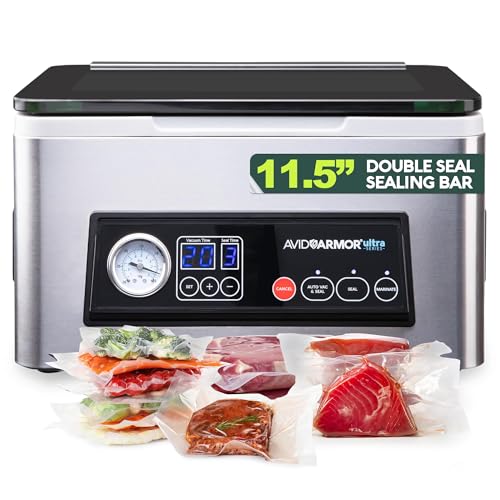
Avid Armor USV20
The chamber machine: soups, marinades and smooth cheap pouches — if it fits in an 11 x 10 pouch.
$349.00 from Amazon
ThermoPro TP03H Thermometer
A one-second probe for the storage shelf and the sprouting tray — both verdicts turn on the actual temperature, not the thermostat.
$8.99 from Amazon
What does “last” mean — when is seed actually done?
A seed is done when its germination falls below the point where sowing it is worth the row — and that point arrives gradually, with vigor going first. Federal standards give the idea a floor: vegetable seed sold in interstate commerce without a low-germination warning has to meet minimums like 80% for lettuce and peas, 75% for tomatoes and cabbage, and 55% for carrots and peppers (7 CFR 201.31). A fresh packet starts at or above its crop’s floor. Each year of storage walks it down from there, and the walk is not even: Illinois Extension warns that vigor — how fast and how strongly seedlings grow — declines before the sprout count does, so an old lot can still germinate on a towel and then stall in soil.
There is a cleaner way to picture the slide, from the seed-storage research our storage guide cites: at room conditions around 68°F and 50% humidity, half the seed in a lot had lost the ability to germinate after about 4.6 years for lettuce and 13.9 years for pea. Half-life, not cliff edge. A packet at its half-life is not dead; it is a coin flip per seed, which is exactly why the answer to an old packet is a count, not a date. Our companion page, can you plant expired seeds, walks through that count — the ten-seed towel test, and the 70% and 50% lines the extension services plant their flags on.

COSORI Dehydrator
Stainless trays, a 48-hour timer, digital controls to the degree, and the quietest run of the three at under 48 dB.
$135.99 from Amazon

Blue Alpine Medium Select
Higher cooling capacity shortens batch times, and owners praise the customer service. Up to 15 lbs per batch — the fastest route from harvest to a shelf that lasts decades. Use code TRULYPRESERVED at checkout for 3% off.
Check the priceHow much do storage conditions move these numbers?
Storage conditions move these numbers by multiples, not by months. The working rule from Colorado State Extension is Harrington’s: storage life roughly halves for every 10°F rise in temperature and every 1% rise in seed moisture, and seed kept below 8% moisture and below 40°F can last 10 years or more — past every figure in the crop table above. Run the rule the other direction and a packet’s five-year rating becomes a two-summer rating in a 90°F garage. The crop table is a statement about seed that was stored properly; it was never a promise about seed that was stored anywhere.
That is also the practical order of operations for a drawer audit. First ask where the packet lived. A cool, sealed jar in a closet or fridge keeps the table’s numbers believable. A shed, a garage, or a kitchen drawer over the stove discounts them before the crop is even considered. Then ask the crop. Then, for anything you will actually depend on, test — ten to twenty seeds, a damp towel, a warm spot, a count. The full storage protocol — drying, sealing, fridge versus freezer, and why the oxygen absorber stays out of the seed jar — is laid out in how to store seeds so they actually last.
How does this change what a seed vault should hold?

A seed vault should hold its short-lived crops in small, fresh, rotating stock and its long-lived crops in depth — the opposite of how the kits are sold. Vault kits advertise a single shelf-life number for the whole box, but the box obeys the table on this page: the onion and pepper seed inside a “25-year” vault is on a 1-to-2-year clock under household storage, while its cucumber and cabbage seed genuinely can wait out five. In our heirloom seed vault comparison we recounted what is actually inside the three big kits, variety by variety — roughly two-thirds of one kit’s headline count is lettuce and celery — and the makers’ own storage guides quietly agree with the extension tables, putting most crops at 2 to 5 years. Buy the vault for the long-lived bulk if you like. Then pull the onions, peppers, corn and lettuce out of the deep-storage plan and into an annual grow-out or replacement rotation, and test the rest every year or two. A vault audited that way can do the job it was bought for. A vault sealed and forgotten cannot, whatever the box says.


Millennium Energy Bars (SOS Food Lab)
Nine real flavors and the only bar here people call genuinely good. Single 400-calorie bars made for go-bags and school kits.
$19.99 from Amazon
Thrive Life: Freeze-Dried Blueberries - Pantry Can Size
Freeze-dried food by the can, no machine: the same long-life ingredients the kits are built from, bought a can at a time.
$60.00 from AmazonQuestions readers ask next
How long do tomato seeds last?
Tomato seeds last about 4 years stored properly, on both the Iowa State and Illinois tables — one of the figures every source agrees on. Tomato is also the crop most often reported sprouting well past its table life from cold, dry storage; test old packets rather than tossing them.
How long do pepper seeds last?
Pepper seeds last about 2 years, near the short end of the table with corn. Pepper seed is also slow and particular about warmth when it does sprout, so an old packet that tests marginal is worth replacing rather than nursing — the season is too short to spend on weak pepper starts.
Do heirloom seeds last longer than hybrid seeds?
No — heirloom and hybrid seed of the same crop age at about the same rate. What makes heirloom seed the vault choice is not longevity; it is that saved seed grows true to the parent, so a variety can be renewed by growing it out. The renewal is the longevity strategy.
Can seeds last 10 years or more?
Yes, under genebank conditions — Colorado State puts seed below 8% moisture and below 40°F at 10 years or more, and the USDA’s own seed bank stores at 0°F. Household storage rarely holds those numbers for a decade, which is why the crop table, not the genebank figure, is the planning tool.

Score out of 10
ThermoPro TP49 Hygrometer
The ten-year verdict depends on the temperature the food actually lived at — a min/max hygrometer in the storage room replaces guessing with the number.
$8.54 from Amazon
Survival Garden Seeds, Home Garden Vault
A vault packed for home gardeners — the other name our seed comparison scores.
$29.97 from AmazonFrequently asked questions
How long do vegetable seeds last?
Most vegetable seeds last 2 to 5 years stored cool and dry. Onion seed lasts about 1 year, corn and peppers about 2, beans, carrots and peas about 3, tomatoes about 4, and broccoli, cabbage, cucumber, lettuce and radish about 5 (Iowa State University Extension).
Which vegetable seeds last the longest?
The cabbage family (broccoli, cabbage, cauliflower), cucumber, radish, muskmelon and spinach sit at the long end at about 5 years on Iowa State’s table, with lettuce at 5 there and up to 6 at Illinois — though Colorado State allows lettuce only about 1 year, the widest disagreement in the tables.
Which vegetable seeds go bad fastest?
Onion seed goes bad fastest at about 1 year, with parsley and parsnip at about 1 year on the other extension tables. Corn and peppers follow at about 2 years. These are the crops to buy fresh, in small quantities, every season or two.
Does the packet date tell me when seeds expire?
No. The packet’s “packed for” year records the season the seed was tested and packed for, not an expiration date. Seed declines gradually from that season on, at a speed set by the crop and by storage temperature and moisture — which is why a germination test, not the date, settles an old packet.
Sources & freshness: Iowa State University Extension, “How to Store Seeds and Test Germination Rates” (yardandgarden.extension.iastate.edu), read in full November 11, 2026; University of Illinois Extension seed viability guidance; Colorado State Extension fact sheet 7.221; federal minimum germination standards, 7 CFR 201.31.
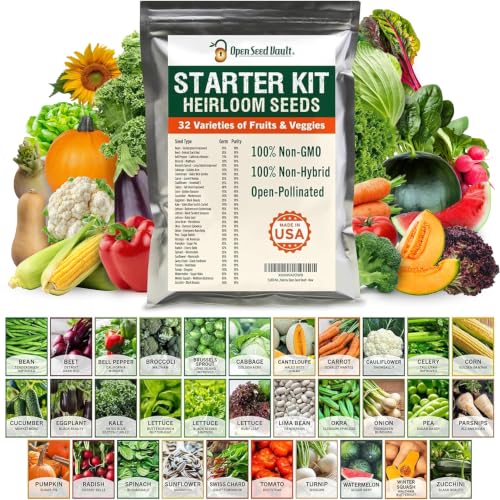
Open Seed Vault, 32 Varieties
Thirty-two heirloom varieties in one vault — a broad restock for the crops whose stored seed has run past its years.
$28.99 from Amazon
Wallaby 1-Gallon Mylar Bags
The lifespans above assume cool, dry and dark — sealed mylar is what keeps moisture and light off packets between seasons.
Check Availability
PackFreshUSA 300cc Oxygen Absorbers
An absorber in the sealed bag strips the oxygen that ages stored seed and food alike.
Check AvailabilityMore answers like this one: this page lives on the Preserve the Seed page, beside our seed storage protocol and the vault recount — and its companion, can you plant expired seeds, carries the germination test that settles any single packet.
Talk it over with other readers. The Truly Preserved Community on Facebook is where readers compare notes on food storage, water, and backup power — and where your questions help decide what we research next. Join the group →
Viewers also searched for these items.


Prices shown on this page were last checked November 26, 2026 — prices change; check before you buy.