
Truly Preserved is reader-supported. If you buy through a link on this page we may earn a commission at no extra cost to you. Nobody pays for placement or scores.
THE SHORT ANSWER
Break open the thickest pieces on the tray. Fully dry freeze-dried food snaps or crumbles, and the center feels room-temperature and bone dry — never cold, soft, or damp. If you want proof instead of a guess, use the weigh test: weigh the tray, run two more hours of dry time, and weigh again. When the weight stops dropping, the water is gone. A piece that feels cool in the middle still holds ice, and ice left in the bag is the batch that molds in storage.
Every freeze dryer owner hits this moment: the machine says the batch is done, the food looks dry, and somewhere in the middle of the tray sits one thick strawberry or chicken chunk that nobody is sure about. The stakes are real. Food sealed with moisture left inside doesn’t keep for years — it keeps for weeks, then molds inside a sealed bag you trusted. This is the check the whole batch turns on, and it takes about a minute.
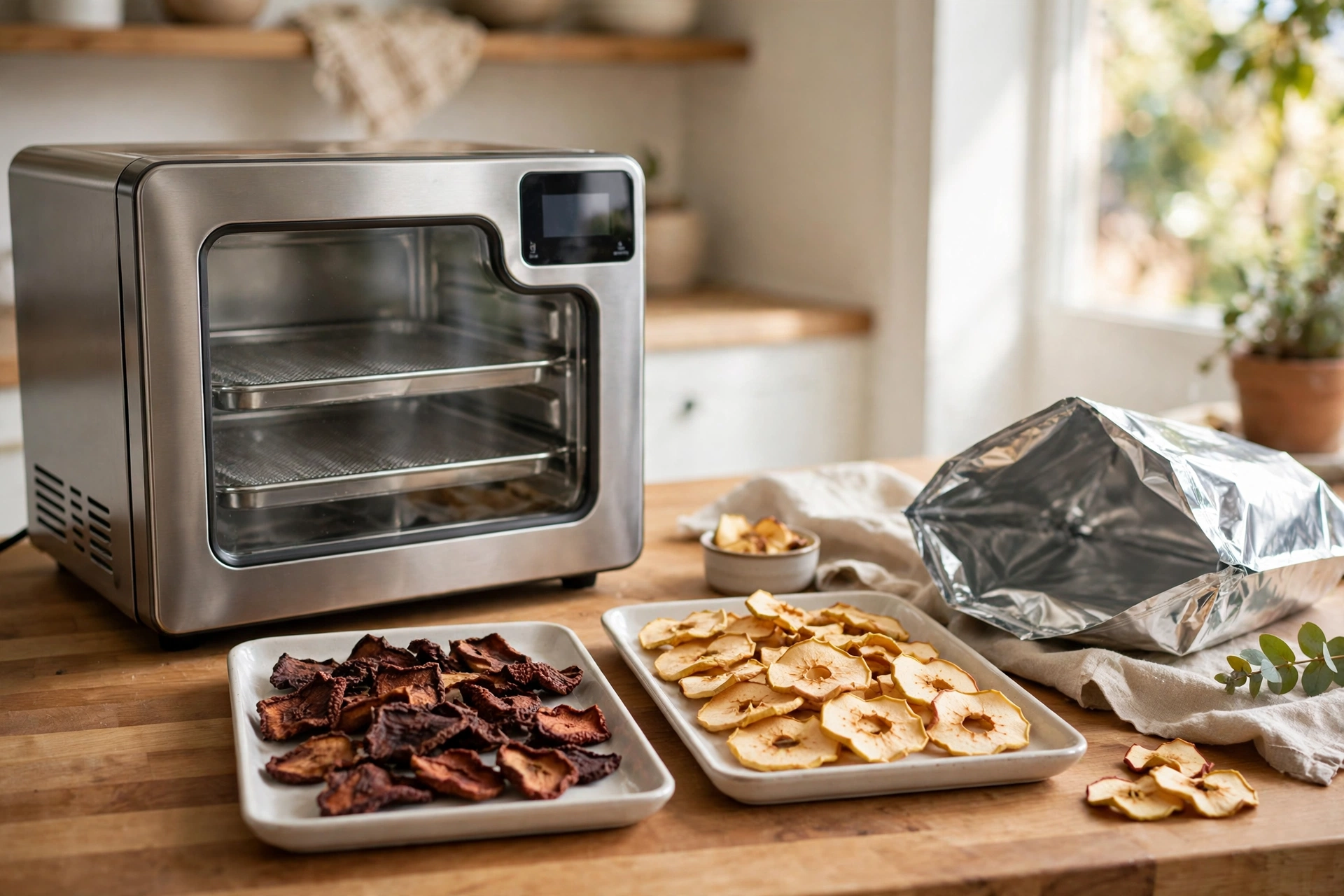
Harvest Right’s own guidance makes the same point from the maker’s side: the machine’s sensor reads conditions in the chamber, not the center of your thickest piece of food. The final call is yours, made by hand, on the worst piece on the tray — not the average one.
The Three Checks, in the Order Owners Actually Use Them
1. The break test. Take the thickest pieces — the center of a chicken breast chunk, the fat end of a strawberry, the middle of a banana slice stack — and break them open. A fully dry piece snaps cleanly or crumbles. If it bends, tears like leather, or shows a darker, denser core, it is not done, no matter how dry the surface feels.
2. The cold check. Hold the broken piece against your lip or the inside of your wrist, the way you’d test a baby bottle. Any coolness at all means ice is still in the center, sublimating slowly and chilling the piece. Room-temperature all the way through is the pass mark. This is the test experienced owners trust most, because it catches the exact failure the break test can miss: a piece that snaps at the edges and still hides a frozen core.
3. The weigh test. For a batch you intend to store for years, stop guessing entirely. Weigh a tray of food, put it back for two more hours of dry time, and weigh it again on the same scale. If the weight dropped, water was still leaving — keep drying and repeat. When two weighings in a row match, the batch is as dry as the machine can make it. Owners who store food for a living use this as the sign-off, and it costs nothing but a kitchen scale and patience.

Etekcity Kitchen Scale (EK6015)
The weigh test on this page needs a scale that reads consistently to the gram — weigh the tray, dry two more hours, weigh again, and let the number settle the argument.
$9.99 from Amazon
Wallaby 1-Gallon Mylar Bags
The bags our mylar guide scores highest — what a batch that passed the weigh test deserves to be sealed in, with an oxygen absorber sized to the bag.
Check AvailabilityWhy the Machine’s “Done” Isn’t the Whole Answer
A freeze dryer decides a batch is finished from temperature and pressure readings inside the chamber. Thick, dense, or sugary pieces lag behind everything else on the tray — a tray of sliced apples can be done while the one whole strawberry in the corner is still frozen in the middle. Load a tray with mixed thicknesses and the machine is timing the average, not the exception. That’s also why batches of even, uniform pieces dry predictably, and why the times in our food-by-food freeze-drying times are ranges rather than promises: the thickest piece on the tray sets the real finish line.
Sugar deserves its own warning. High-sugar foods — ripe bananas, peaches, candy — can feel dry and still hold moisture bound up in the sugar, and they soften fast once bagged if they went in under-dried. Give sugary trays the weigh test, not just the break test.
If It Isn’t Dry: Extra Dry Time, Not Hope
The fix is simple and cheap: put the tray back and add dry time in two-hour blocks, then check again. Two hours of electricity costs cents. A molded bag discovered in year three costs the whole batch. And if food has already been bagged and turns soft, it isn’t automatically lost — our answer on re-freeze-drying food that has gone soft covers when a second run saves it and when mold or an off smell ends the discussion.
One related habit worth building: how you load the tray decides how even the drying is. Food that goes in already frozen dries faster and more evenly — the full reasoning is in do you need to pre-freeze food before freeze drying?

Blue Alpine Medium Select
Higher cooling capacity shortens batch times, and owners praise the customer service. Up to 15 lbs per batch — the fastest route from harvest to a shelf that lasts decades. Use code TRULYPRESERVED at checkout for 3% off.
Check the price
COOQUI 12-Inch Tortilla Warmer
An insulated fabric warmer sized for full-size flour tortillas. Thirty to forty-five seconds in the microwave and it holds the stack warm and soft for up to an hour at the table.
$19.99 from Amazon
JB Black Gold Pump Oil
The second oil owners keep for the same change — either beats the waterlogged oil already in the pump.
$54.50 from AmazonFollow-Up Questions
Can you over-dry freeze-dried food?
Not in any way that harms it. Extra hours in the machine cost a little electricity and nothing else — the food can’t get “too dry” for storage. Under-drying is the only direction that ruins batches, which is why experienced owners always err on the side of more time.
Does the food need to cool down before I check it?
Check it warm, straight off the tray — that’s when the cold-center test works, because a piece still holding ice feels noticeably cooler than the dry pieces around it. If you let the whole tray sit and equalize to room temperature first, you’ve thrown away your most sensitive instrument.
What about the moisture meter some owners poke into pieces?
Pin moisture meters are built for wood and building materials, and their readings on food are rough at best. The break test, the cold check, and the weigh test answer the question directly, with tools already in the kitchen.
Viewers also searched for these items.


Sour Patch Kids (5 lb)
The bulk bag is the economical way to feed a freeze dryer — one bag fills several tray loads, and the pieces are the standard size every candy-mode timing is written for.
$20.99 from Amazon
Robinair 13203 Vacuum Pump Oil
The budget-friendly vacuum pump oil that does the same job for owners who change oil on a strict every-batch schedule and go through it faster.
$16.79 from AmazonFrequently Asked Questions
How dry does freeze-dried food need to be for long-term storage?
Dry enough that no piece holds a cold, soft, or damp center — in practice, down to a few percent moisture, where mold and bacteria have nothing to work with. The weigh test is how you confirm you’ve arrived: stable weight across two extra hours of dry time.
My batch feels dry but a few pieces are chewy. Is the whole tray bad?
No — sort it. The chewy pieces go back in for more dry time; the pieces that snap and feel room-temperature through the center are done. Mixed trays are normal, and finishing the laggards separately is standard practice.
What happens if I seal food that still has moisture in it?
The trapped moisture redistributes through the bag, softening the dry pieces and feeding mold. It’s the single most common way home freeze-dried food fails in storage — and the reason the checks on this page exist.
Dryness checks per Harvest Right’s published guidance — How do I know when my freeze-dried food is completely dry? — and Utah State University Extension freeze-drying guidance.
This question came from our harvest of what readers ask in the forums. See the rest of the list: What People Are Asking About Freeze-Dried Food.
Prices shown on this page were last checked November 26, 2026 — prices change; check before you buy.
Talk it over with other readers
The Truly Preserved Community on Facebook is where readers compare notes on food storage, water, and backup power — and where your questions help decide what we research next.