
Truly Preserved is reader-supported. If you buy through a link on this page we may earn a commission at no extra cost to you. Nobody pays for placement or scores.
THE SHORT ANSWER
The CDC’s emergency method: use regular, unscented household liquid bleach — in the US it is typically 5 to 9 percent sodium hypochlorite — and first check the label, because if the label gives drinking-water directions, those win. Otherwise: for clear water, add 8 drops of bleach per gallon (a little less than 1/8 teaspoon), stir well, and let it stand at least 30 minutes before drinking. If the water is cloudy, murky, colored, or very cold, filter it through a clean cloth first, then double the dose — 16 drops per gallon (1/4 teaspoon). Disinfected water gets stored in clean, sanitized containers with tight covers.
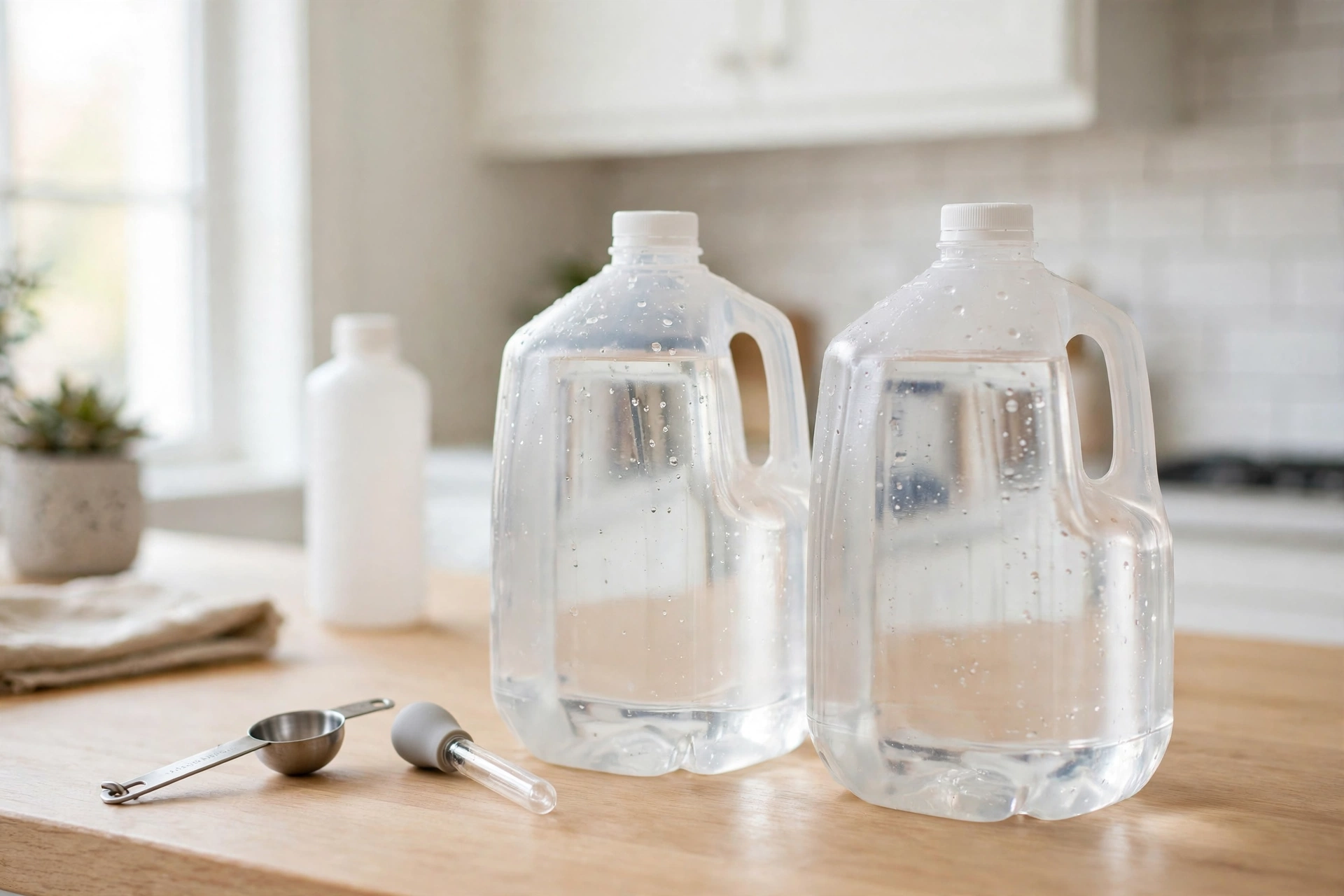
When the tap cannot be trusted — a boil notice, a flood, a well that took storm water — bleach is the disinfectant already sitting in most laundry rooms, and the CDC publishes exact doses for it. Exact is the operative word. This is a procedure measured in drops, and the difference between disinfecting a gallon and flavoring it is a factor of two in the wrong direction. The figures below are the CDC’s, from its emergency water guidance, with the source credited at the bottom.
Building the storage side too? Water storage containers compared covers the vessels, and how long you can store tap water covers the rotation clock.
What You Need
Regular, unscented household liquid chlorine bleach — not scented, not splash-less, not color-safe. In the United States the CDC notes it will typically be between 5 and 9 percent sodium hypochlorite, and the dosing table below is written for that range. A medicine dropper or a teaspoon for measuring, a clean container for the treated water, and a clean cloth, paper towel, or coffee filter if the water starts out cloudy.

Reliance Aqua-Tainer, 7 Gallon
The food-grade container with a spigot that emergency storage is built around — one holds a person's CDC baseline for a week.
Check Availability
Sawyer Squeeze Water Filtration System
Bleach disinfects; it does not filter. The Squeeze handles sediment and the organisms a filter is for, before or instead.
Check Availability
Saratoga Farms 5-Gallon Water Containers
Stackable 5-gallon storage for the household supply the CDC's 1-gallon-per-person-per-day math adds up to.
$318.79 from AmazonBefore You Start
Read the bleach label first. The CDC’s instruction order is explicit: follow the label’s directions for disinfecting drinking water if it has them; if it does not, check the sodium hypochlorite percentage on the label and use the table for the 5 to 9 percent range. And if the water is cloudy, murky, colored, or very cold, the dose doubles — but the water gets filtered or settled and drawn off clear first, because bleach works on what it can reach.
How to Disinfect Water with Bleach, Step by Step
- Start with the clearest water you have. If it is cloudy, filter it through a clean cloth, paper towel, or coffee filter — or let it settle and draw off the clear water.
- Measure the bleach. For clear water with 5 to 9 percent bleach: 2 drops per quart, 8 drops per gallon, 40 drops per 5 gallons. Cloudy, murky, colored, or very cold water gets double those amounts.
- Stir the mixture well.
- Let it stand at least 30 minutes before drinking it. The wait is part of the dose — bleach disinfects on contact time, not on contact.
- Store it covered. Keep the disinfected water in clean, sanitized containers with tight covers, out of the reach of the emergency that made you treat it.
The Numbers: CDC Dosing Table (bleach at 5–9% sodium hypochlorite)
| Water amount | Drops | Milliliters | Measuring spoon |
|---|---|---|---|
| 1 quart / 1 liter | 2 drops | 0.1 mL | Too small to measure |
| 1 gallon | 8 drops | 1/2 mL | A little less than 1/8 teaspoon |
| 5 gallons | 40 drops | 2 1/2 mL | 1/2 teaspoon |
Cloudy, murky, colored, or very cold water: filter or settle it first, then double every figure in the table — 16 drops (1/4 teaspoon) per gallon is the one to remember. Contact time is at least 30 minutes for every batch.
Bulk backup storage rounds out the system — food-grade buckets for volume, heavy bags for transport:

ePackageSupply 5-Gallon Buckets, 3-Pack
Food-grade buckets with gamma lids — the rigid outer layer that keeps bags and bulk storage safe from pests and crushing.
$73.99 from Amazon
Ziploc Freezer Quart Bags
The freezer-bag half of the method — a box of quart bags handles the overflow that does not go into jars.
$26.48 from AmazonSanitizing the Storage Container
The CDC’s container routine, from its emergency water supply guidance: wash the container with soap and rinse it completely. Then mix 1 teaspoon of unscented liquid household chlorine bleach (5 to 9 percent) in 1 quart of water, pour it in, cover the container tightly, and shake it so the solution touches all the inside surfaces. Wait at least 30 seconds, then pour the solution out. Use FDA-approved food-grade water storage containers, and never a container that previously held toxic chemicals such as bleach or pesticides. The CDC’s storage baseline: at least 1 gallon of water per person per day for 3 days, and water you fill yourself gets replaced every 6 months.
Common Mistakes
Scented or splash-less bleach. The CDC’s method is written for regular, unscented liquid chlorine bleach. Scented, color-safe, and splash-less formulas are different products with different chemistry.
Skipping the 30 minutes. Dosed water is not disinfected water until the contact time has passed. Stir, cover, and wait the full half hour.
Dosing cloudy water at the clear-water rate. Cloudy, colored, or very cold water takes double — after filtering or settling. The single dose in cloudy water is the classic under-treatment.
Storing treated water in a dirty jug. A sanitized container with a tight cover is part of the method. The sanitizing mix is 1 teaspoon of bleach per quart of water, 30 seconds of contact, poured out before filling.
Viewers also searched for these items.

GRAYL GeoPress Water Purifier Bottle
The purifier bottle for the water you meet away from the house supply.
$99.95 from Amazon
LifeStraw Home Water Filter Pitcher
Everyday filtration for the tap water that never needed bleach at all.
$51.99 from Amazon
ZeroWater 12-Cup Filter Pitcher
Certified filtration for everyday tap water — the pitcher that keeps bleach a backup instead of a routine.
$27.99 from AmazonFrequently Asked Questions
How many drops of bleach make a gallon of water safe?
Per the CDC, 8 drops of regular unscented bleach (5 to 9 percent sodium hypochlorite) per gallon of clear water — 16 drops if the water is cloudy, murky, colored, or very cold, after filtering or settling it. Stir and wait at least 30 minutes.
What if my bleach label has drinking-water directions?
Follow them. The CDC puts the label’s own directions first; its table is the fallback when the label has none.
Can I use scented bleach?
No — the CDC method specifies regular, unscented household liquid chlorine bleach.
How long does stored emergency water keep?
The CDC advises replacing water you filled yourself every 6 months, and storing at least 1 gallon per person per day for 3 days as the baseline supply.
Method, doses, and container guidance: Centers for Disease Control and Prevention, “How to Make Water Safe in an Emergency” and “How to Create an Emergency Water Supply” (cdc.gov/water-emergency).
Prices shown on this page were last checked November 26, 2026 — prices change; check before you buy.
Talk it over with other readers
The Truly Preserved Community on Facebook is where readers compare notes on food storage, water, and backup power — and where your questions help decide what we research next.