
Truly Preserved is reader-supported. If you buy through a link on this page we may earn a commission at no extra cost to you. Nobody pays for placement or scores.
THE SHORT ANSWER
Pickled carrots: cut 2-3/4 pounds of peeled carrots into rounds about 1/2 inch thick, simmer them until half-cooked — about 10 minutes — in a boiled solution of 5-1/2 cups of white distilled vinegar (5 percent), 1 cup of water, 2 cups of sugar, and 2 teaspoons of canning salt, pack hot into pint jars over mustard and celery seed at 1/2 inch of headspace for the liquid, and process pints 15 minutes in a boiling water canner at 0–1,000 feet. The batch makes about 4 pint jars, and the source says to let the jars sit 3 to 5 days before eating for best flavor. Plain carrots are a low-acid vegetable for the pressure canner — it is this vinegar solution that makes these a water-bath pickle. Every figure comes from the tested recipe, credited at the bottom.
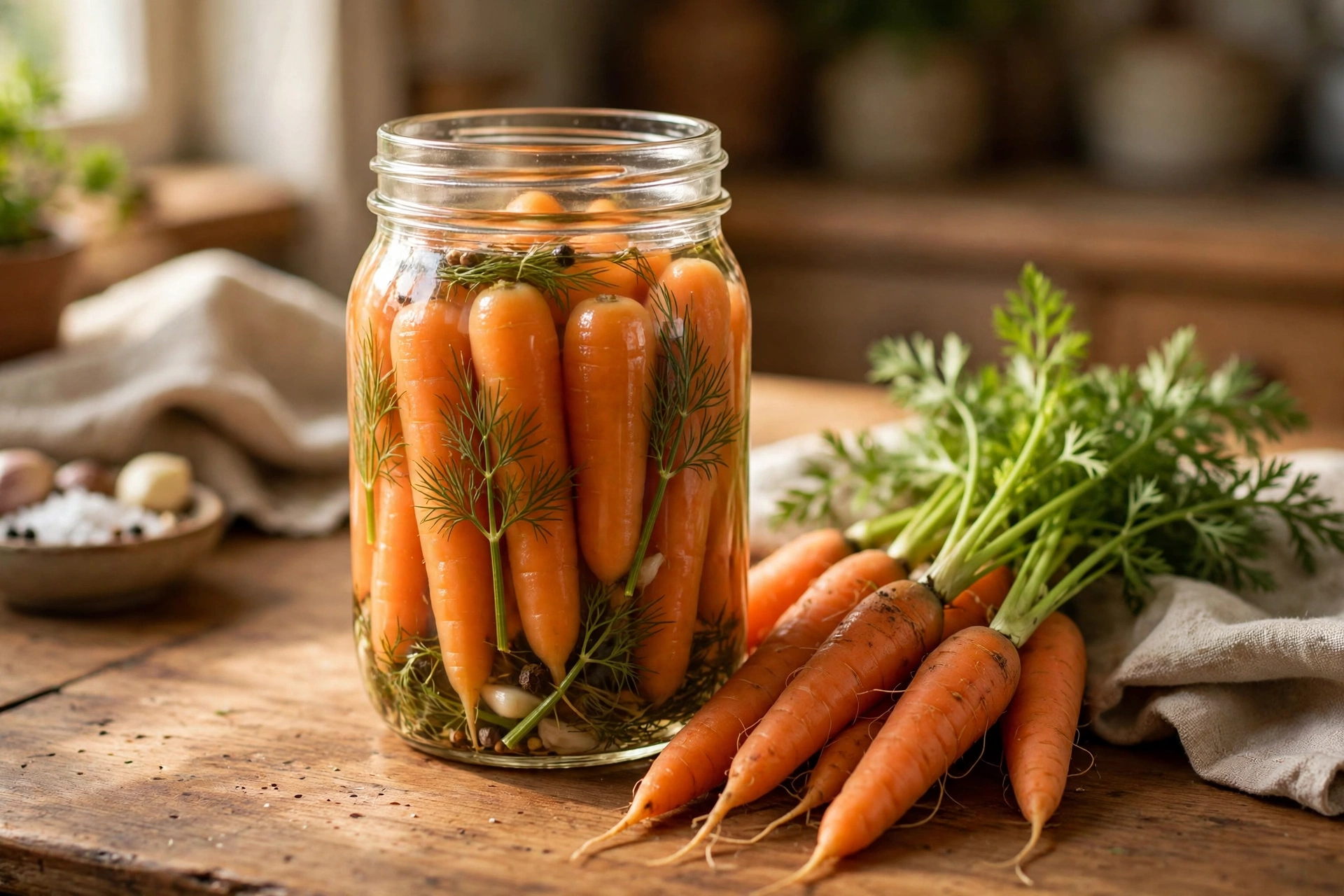
Pickled carrots are the bright jar in the pantry: orange, sweet, sharp, and ready to eat out of hand, on a relish tray, or chopped into salads. They are also a useful answer to the carrot problem — the harvest that arrives all at once, too much for the crisper drawer and too good to waste. This tested recipe is a small, manageable batch at about 4 pints, built on an unusually vinegar-forward solution, which is exactly what a low-acid root vegetable needs to become a safe water-bath pickle.
This guide is part of our preservation guides, and it follows the tested procedure exactly — its quantities, its headspace, and its minutes — rather than a family version adjusted by feel. If you are new to the canner itself, how to can food in mason jars walks the general water-bath process start to finish, and our flagship dill pickle guide covers the cucumber side of the same method. The same vinegar logic is what separates this page from plain canned carrots, just as it separates the dilly beans in this set from their pressure-canned counterpart.
What You Need
The tested recipe, as written: 2-3/4 pounds of peeled carrots (about 3-1/2 pounds as purchased); 5-1/2 cups of white distilled vinegar (5 percent); 1 cup of water; 2 cups of sugar; 2 teaspoons of canning salt; 8 teaspoons of mustard seed; and 4 teaspoons of celery seed. The yield is about 4 pint jars, and the recipe is written for pints.

Granite Ware 21.5-Quart Water Bath Canner
A boiling-water canner is the processing method every tested pickle procedure on this page uses, and this 21.5-quart model holds a full batch of jars at a rolling boil.
Check Availability
Ball Half-Pint Mason Jars, 12-Pack
The recipe is written for pint jars and yields about 4 pints; this half-pint case covers the smaller jars in the same line for tasting jars and gifts from the same batch.
Check Availability
Ball Regular Mouth Canning Lids, 96 Count
New lids are what the procedure assumes when it says to adjust lids and process; a fresh flat on every jar is how the seal the storage section depends on actually forms.
$36.99 from AmazonBefore You Start
Wash the carrots twice — the recipe says to wash and peel them well, then wash again after peeling. Carrots come out of the ground, and that second wash is a written step, not a flourish. Cut the rounds about 1/2 inch thick so the half-cook and the process treat every piece the same. And respect the vinegar measure: 5-1/2 cups of 5 percent vinegar to 1 cup of water is a deliberately sharp ratio, and it is the ratio the safety of a pickled low-acid vegetable rests on — do not soften it.
How to Make Pickled Carrots, Step by Step
- Wash, peel, wash again. Wash and peel the carrots well, wash again after peeling, and cut them into rounds approximately 1/2 inch thick.
- Make the solution. Combine the vinegar, water, sugar, and canning salt in a large pot, bring to a boil, and boil gently 3 minutes.
- Half-cook the carrots. Add the carrots, bring the pot back to a boil, then reduce the heat to a simmer and heat until the carrots are half-cooked, about 10 minutes.
- Season the jars. Meanwhile, place 2 teaspoons of mustard seed and 1 teaspoon of celery seed in the bottom of each clean, hot pint jar.
- Fill the jars. Fill hot jars with the hot carrots, leaving 1-inch headspace, then cover with the hot pickling liquid, leaving 1/2-inch headspace. Remove air bubbles and adjust headspace if needed.
- Close the jars. Wipe the rims with a dampened clean paper towel and adjust the two-piece canning lids fingertip-tight.
- Process in a boiling water canner for the time for your altitude in the table below.
- Rest, check, and wait. Let the jars cool undisturbed 12 to 24 hours and check the seals, then allow the carrots to sit in the processed jars 3 to 5 days before eating, for best flavor development.
The Numbers: Processing Times
| Jar size | 0–1,000 ft | 1,001–6,000 ft | Above 6,000 ft |
|---|---|---|---|
| Pints | 15 minutes | 20 minutes | 25 minutes |
This recipe has two headspace figures, and both matter: the carrots are packed to 1 inch, then the hot liquid is added to 1/2 inch. The recipe is pints only — no quart time is published.
Carrots beyond the pickle batch dehydrate into soup-ready pieces and freeze well for winter cooking, and these are the two tools that side of the job runs on.

ThermoPro TP03H Thermometer
Refrigerator storage is the whole safety method for these eggs, and a thermometer is how you know the fridge holding them is actually cold rather than assumed cold.
$8.99 from Amazon
Ziploc Freezer Quart Bags
Quart freezer bags are the simple backup for blanched overflow vegetables and opened-jar leftovers that need to move to the freezer quickly.
$26.48 from AmazonCommon Mistakes
Washing only once. The recipe washes before peeling and again after. Skipping the second wash carries field soil straight into a jar meant to sit on a shelf.
Cooking the carrots through. The simmer stops at half-cooked, about 10 minutes. Fully cooked carrots go soft in the jar during processing, and the recipe’s texture depends on stopping early.
Cutting uneven rounds. The rounds are approximately 1/2 inch thick so every piece half-cooks and processes alike. Wedges and thick chunks are a different pack than the one tested.
Using one headspace number for both steps. Carrots to 1 inch, liquid to 1/2 inch. Collapsing those into a single fill line overfills or underfills every jar.
Eating them the next day. The source gives the jars 3 to 5 days before eating for best flavor development. Day-one carrots taste like vinegar, not like the finished pickle.
Storage and Shelf Life
Store sealed jars somewhere cool and dark, with the bands removed, and label each jar with the date. Home-canned pickles hold their best quality for about a year; rotate the shelf so the oldest jars get eaten first. A jar that fails to seal goes in the refrigerator and gets eaten first. Once a jar is opened, keep it refrigerated. Give this batch its 3 to 5 days in the jar before the first taste.
Viewers also searched for these items.

Morton Canning and Pickling Salt, 4 lb
The recipe calls for canning or pickling salt by name; this is that salt, without the additives in table salt that cloud pickle brine.
$2.68 from Amazon
Etekcity Digital Kitchen Scale
The batch is built on weighed produce, and a kitchen scale is how you know you actually have the pounds of vegetables the tested ratio was written for.
$9.99 from Amazon
SOLIGT Glass Fermentation Weights, 4-Pack
Glass fermentation weights are the spare for the crock side of pickling, holding fermented vegetables under their brine when part of the harvest goes that route instead.
$11.99 from AmazonFrequently Asked Questions
Can I use baby carrots?
The source publishes a companion version for baby carrots — 8-1/2 cups of peeled baby carrots in the same solution, with the same process — alongside this rounds recipe. Either way, the jar sizes and times are the pints in the table.
Why is there so much vinegar compared with water?
Because carrots are a low-acid vegetable and the vinegar is doing the preserving work: 5-1/2 cups of vinegar to 1 cup of water is the tested ratio, and it is not one to soften.
Why two different headspaces?
The carrots themselves are packed leaving 1 inch, and the hot liquid is then added leaving 1/2 inch. Both figures are printed in the procedure, in that order.
Can I make quarts?
No quart time is published for this recipe. It is written for pint jars, yielding about 4 of them.
Recipe and processing times: “Pickled Carrots” and “Pickled Baby Carrots,” developed at the University of Georgia for the National Center for Home Food Preservation (Guide 6), via the National Center for Home Food Preservation.
Prices shown on this page were last checked November 26, 2026 — prices change; check before you buy.
Talk it over with other readers
The Truly Preserved Community on Facebook is where readers compare notes on food storage, water, and backup power — and where your questions help decide what we research next.