
Truly Preserved is reader-supported. If you buy through a link on this page we may earn a commission at no extra cost to you. Nobody pays for placement or scores.
THE SHORT ANSWER
Rotation is one date and one interval. The CDC says to label each container “drinking water” with its storage date and to replace water you filled yourself every six months; Ready.gov gives the same six-month replacement for water that has not been commercially bottled. Store-bought water follows a different rule: the CDC says to observe the expiration date on it. Keep containers at 50°F –70°F, away from direct sunlight and away from gasoline or pesticides, and the rotation itself is just the refill procedure done on schedule. Every figure on this page comes from the federal guidance credited at the bottom.
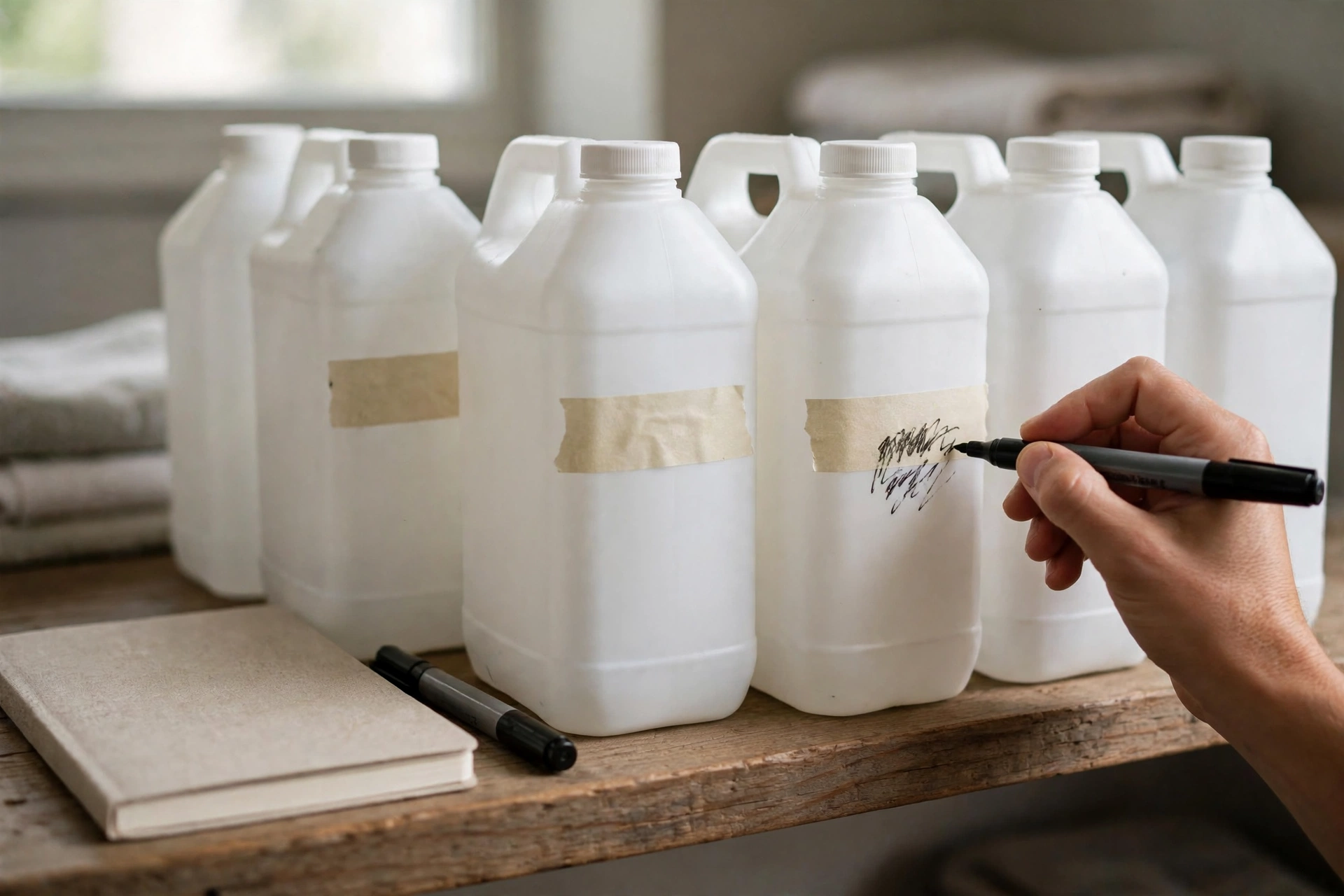
Stored water fails quietly. Nobody opens a jug, tastes it, and announces a problem — the supply simply sits, month after month, until an emergency asks whether anyone remembers when it was filled. Rotation is the habit that prevents that question: a written date on every container and a standing six-month appointment to use the old water, clean the containers, and refill them.
This guide is part of our preservation guides and works from the CDC and Ready.gov wording exactly: what the interval is, which water it applies to, and which water follows a printed date instead. It sits between our drum guide, how to store water in a 55-gallon drum, and how to purify water in an emergency for water that has to be treated rather than rotated.
What You Need
The only equipment rotation needs is the containers you already own, soap, and unscented liquid household chlorine bleach for sanitizing them at each refill — the CDC’s solution is 1 teaspoon of bleach in 1 quart (4 cups) of water, from bleach containing 5%–9% sodium hypochlorite. You also need a way to use the old water rather than pour it out: cooking, cleaning, and plants are the usual outlets, though the federal pages do not prescribe a use — they prescribe the replacement.

Reliance Aqua-Tainer, 7 Gallon
A rigid 7-gallon container with a spigot makes rotation practical, since the oldest water can be used first without lifting and pouring a full jug.
Check Availability
Saratoga Farms 5-Gallon Water Containers
Stackable 5-gallon containers let a household stagger fill dates, so only part of the supply comes due in any one month.
$318.79 from Amazon
ePackageSupply 5-Gallon Buckets, 3-Pack
Sealed 5-gallon buckets give rotation water a clean second home for cleaning and flushing use while drinking containers are refilled.
$73.99 from AmazonBefore You Start
Know which of your water is which before the date arrives. Home-filled containers run on the six-month rule. Unopened commercially bottled water — which the CDC calls the safest and most reliable source of water in an emergency — runs on the expiration date printed on it. Mixing the two systems up, in either direction, either wastes good water or leaves old water standing past its rule.
How to Rotate Stored Water, Step by Step
- Read the dates first. Work from the label the CDC tells you to write: “drinking water” and the storage date. Any home-filled container at or past six months is in this rotation, oldest first.
- Use or empty the old water. Take the due containers out of storage. The federal instruction is replacement — the old water leaves and fresh water takes its place.
- Wash each container. Wash the storage container with soap and rinse completely with water, exactly as at the first fill.
- Sanitize each container. Mix 1 teaspoon of unscented liquid household chlorine bleach in 1 quart (4 cups) of water. Cover the container tightly, shake it well so the solution touches all inside surfaces, wait at least 30 seconds, pour it out, and let the empty container air-dry.
- Refill and reseal. Pour clean water into the sanitized container and cover it with a tight lid.
- Write the new date. Label the container “drinking water” with the new storage date. The next rotation is six months from that date, not from when you happen to remember it.
- Return it to the right place. Back to a place at 50°F –70°F, away from direct sunlight and away from toxic substances such as gasoline or pesticides.
The Numbers: Rotation Intervals and Storage Conditions
Two kinds of stored water, two different clocks — plus the conditions both clocks assume.
| Stored water | Rule as printed | Source |
|---|---|---|
| Water you filled into containers | Replace every six months | CDC; Ready.gov (water not commercially bottled) |
| Store-bought bottled water | Observe the expiration date | CDC |
| Sanitizing solution at refill | 1 teaspoon bleach in 1 quart (4 cups) water; wait at least 30 seconds | CDC |
| Storage temperature | 50°F –70°F | CDC |
Neither federal page prints a longer interval for any home-filled container, and neither prints one for a drum, a jug, or a bottle separately. Six months is the whole rule for water you filled yourself.
Rotation day is also the natural day to check the treatment side of the supply — the filter and purifier that would take over if stored water ran out mid-emergency.

Sawyer Squeeze Water Filtration System
The squeeze filter that takes over if an emergency outlasts the stored supply, worth checking and flushing on rotation day.
Check Availability
GRAYL GeoPress Water Purifier Bottle
A press purifier for making a new source safe when rotation reveals the stored total was never enough.
$99.95 from AmazonThe practical trick with rotation is to make it small and frequent in feel even though the rule is twice a year. A household that fills every container on the same weekend faces one heavy rotation day and, humanly, starts postponing it. A household that staggers its fill dates — a few containers this month, a few more next — turns the same six-month rule into a light, rolling habit where some water is always young, some is mid-life, and only a manageable batch ever comes due at once. The federal pages do not prescribe the staggering; they prescribe the interval and the label. But the label is what makes staggering possible, because the date on each container, not a household-wide birthday, is what the six-month rule actually reads. However you arrange it, keep the sequence itself unchanged: read the date, empty the old water, wash, sanitize, wait, air-dry, refill, reseal, and write the new date where the next rotation can see it. Rotation done in that order, on that interval, is the entire difference between a water supply and a shelf of souvenirs from the last time you felt prepared.
Common Mistakes
Rotating by memory. If the date is not on the container, the rotation is a guess. The CDC’s label instruction — “drinking water” plus the storage date — exists precisely so the interval can be checked at a glance.
Applying the bottled-water date to home-filled jugs. The expiration-date rule belongs to commercially bottled water. Water you filled yourself carries the six-month replacement rule, whatever the jug once held.
Topping off instead of replacing. The instruction is to replace the water. Adding fresh water to old water restarts nothing; the container’s date is the date of the water in it.
Skipping the sanitize step on refill. A refill is a fresh fill, and the CDC’s cleaning sequence — wash, sanitize, wait at least 30 seconds, air-dry — applies every time, not just the first.
Rotating into a worse spot. Containers that come back from rotation day and land in sunlight or beside the fuel shelf are being stored against the CDC’s conditions for the whole next interval.
Storage and Shelf Life
Between rotations, storage does the work: containers kept at 50°F –70°F, away from direct sunlight, and away from toxic substances such as gasoline or pesticides. When you take water out between rotations, the CDC’s handling rules protect the rest of the supply — use a clean scoop or device each time, and do not touch the water or the insides of the container with your hands.
Frequently Asked Questions
Does stored water expire like food?
The federal pages do not frame it that way. They give home-filled water a replacement interval — every six months — and tell you to observe the expiration date on store-bought water. The full discussion is in our guide on how to tell if stored water has gone bad.
What do I do with the old water?
The federal guidance prescribes replacing it, not a particular use for it. Households commonly send rotation water to cooking, cleaning, or the garden; what matters to the rule is that fresh water, a sanitized container, and a new date replace it.
Does a 55-gallon drum rotate on the same schedule?
Yes, on the printed rules: the six-month replacement is stated for water you filled into containers, with no separate drum interval published. Our drum guide walks through the fill itself.
What if I miss a rotation?
Rotate as soon as you catch it: empty, wash, sanitize, refill, and write the new date. The system recovers in one pass; what it cannot survive is another six months of forgetting.
Rotation and storage figures: CDC, “How to Create an Emergency Water Supply,” and Ready.gov, “Water”, via Centers for Disease Control and Prevention.
Prices shown on this page were last checked November 26, 2026 — prices change; check before you buy.
Talk it over with other readers
The Truly Preserved Community on Facebook is where readers compare notes on food storage, water, and backup power — and where your questions help decide what we research next.