
Truly Preserved is reader-supported. If you buy through a link on this page we may earn a commission at no extra cost to you. Nobody pays for placement or scores.
THE SHORT ANSWER
Ready.gov’s working method is one multiplication: store at least 1 gallon of water per person per day for several days, for drinking and sanitation. The CDC puts days on the same gallon — at least 1 gallon per person, per day for 3 days, and try to store a 2-week supply if possible. A normally active person needs about three-quarters of a gallon of fluid daily, from water and other beverages, which is why the stored gallon is a planning allowance and not a drinking target. Store more for the people and conditions the sources name, and never ration drinking water unless authorities order it. Every figure on this page comes from the federal guidance credited at the bottom.
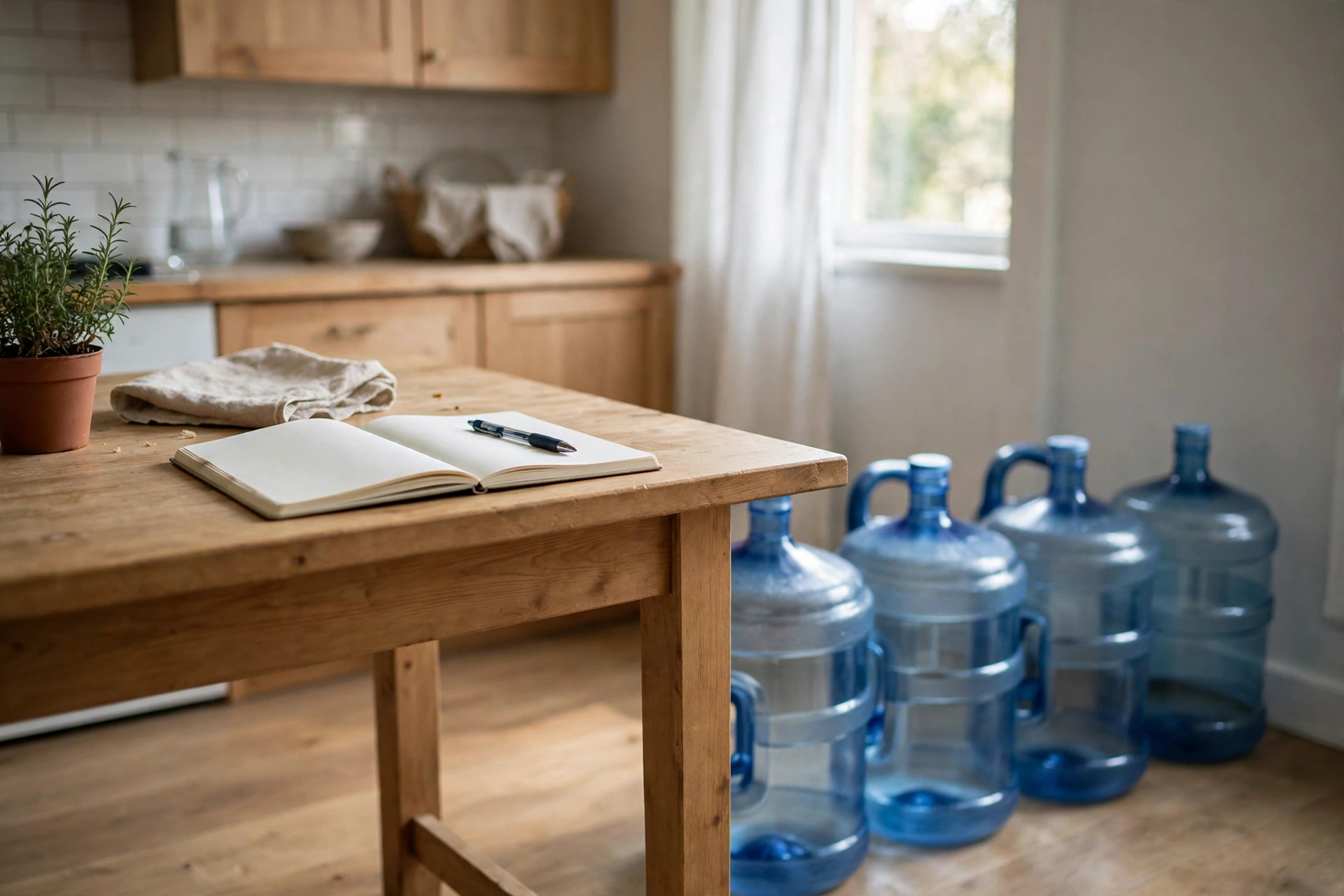
Of every number in emergency preparation, this is the one people actually use — and the one most often half-remembered as a vague “couple of gallons in the garage.” The federal method is not vague. It is a rate, a headcount, and a number of days, and it takes about a minute to run for any household once the rate is fixed.
This guide works the Ready.gov and CDC figures exactly as printed, including where the two pages word the duration differently. This guide is part of our preservation guides; once your total exists, the drum guide and the small-spaces guide cover where the gallons physically go.
What You Need
The inputs are three: the people in the household, the days you are planning for, and the adjustments. Ready.gov says children, nursing mothers, and sick people may need more water, that a medical emergency may require more, and that in very hot temperatures water needs can double. The CDC adds its own list for storing more: pregnant women, people who are sick, pets, and a hot climate. Neither page turns those adjustments into a second formula — they are reasons to round up, stated as plainly as that.

Augason Farms 55-Gallon Water Storage Kit
A 55-gallon drum lands almost exactly on the worked example: a four-person household's 2-week total of 56 gallons.
Check Availability
Reliance Aqua-Tainer, 7 Gallon
A 7-gallon container covers one person for a week at the printed rate, the natural building block for small households.
Check Availability
Saratoga Farms 5-Gallon Water Containers
Stackable 5-gallon containers let the total grow a few days at a time toward the two-week ambition.
$318.79 from AmazonBefore You Start
Run the base calculation before adjusting anything. The base is the floor the sources set — “at least” is their wording, not decoration — and it assumes the water will be stored in the right containers, in the right conditions, on the rotation schedule. A correct total in a cracked jug stored beside gasoline is not the supply the number promises.
How to Work Out Your Total, Step by Step
- Count the people. Every person in the household counts at the full rate: at least 1 gallon per person per day. The CDC’s uses for that water are drinking, cooking, brushing teeth, and other uses; Ready.gov words the same gallon as drinking and sanitation.
- Choose your days. The CDC’s floor is 3 days, and it says to try to store a 2-week supply if possible. Ready.gov words the duration as several days. Pick a number of days inside that framing — the floor is 3, the stated ambition is 14.
- Multiply. People × days × 1 gallon is the whole method. Four people for 3 days is 12 gallons; the same household at the 2-week ambition is 56 gallons.
- Adjust upward where the sources say to. Add margin for children, nursing mothers, pregnant women, and sick people; for pets; for a medical emergency; and for heat — Ready.gov warns needs can double in very hot temperatures.
- Match containers to the total. The CDC’s container rules size the purchase: FDA-approved food-grade containers are best, tight covers are required, and a container that held toxic chemicals is never used. Our drum and small-space guides work the two common fits.
- Write the date and set the rotation. Label each container “drinking water” with its storage date, keep it at 50°F –70°F, and replace home-filled water every six months. A total you cannot rotate is a total you do not really have.
The Numbers: The Gallon, the Days, and Worked Totals
One rate, two published durations, and totals that are pure multiplication of the printed figures.
| Figure | As printed | Source |
|---|---|---|
| Storage rate | At least 1 gallon per person per day, for drinking and sanitation | Ready.gov |
| Duration | Several days | Ready.gov |
| Duration, with days stated | At least 3 days; try to store a 2-week supply if possible | CDC |
| Daily fluid need, normally active person | About three-quarters of a gallon of fluid daily, from water and other beverages | Ready.gov |
| Heat adjustment | Water needs can double in very hot temperatures | Ready.gov |
| Household | 3 days | 2 weeks (14 days) |
|---|---|---|
| 1 person | 3 gallons | 14 gallons |
| 2 people | 6 gallons | 28 gallons |
| 4 people | 12 gallons | 56 gallons |
The worked totals are arithmetic on the printed rate — 1 gallon × people × days — not new guidance. If your household lands between container sizes, the sources’ “at least” is the instruction: round up.
A total on paper needs a treatment plan behind it, for the emergency that outlasts the arithmetic. These are the two filter forms our guide to how to purify water in an emergency builds on, for the emergency that runs past the total you worked so carefully.

Sawyer Squeeze Water Filtration System
A squeeze filter extends the plan past the stored total, treating new water when the arithmetic runs out.
Check Availability
GRAYL GeoPress Water Purifier Bottle
A press purifier is the second line for households whose stored total is limited by space rather than intent.
$99.95 from AmazonWork the method once for your own household and two things usually happen. First, the 3-day floor turns out to be smaller than feared — a shelf or two of containers for most families, which is why the sources set it as a floor everyone should reach rather than an achievement. Second, the 2-week ambition turns out to be a furniture decision: fifty-odd gallons for a family of four is a drum, a stack of containers in a closet, or a honest conversation about which dead spaces in the home are about to get a job. Neither reaction is a reason to stop at the floor. The CDC prints the two numbers together because they do different work — the floor covers the common short outage, the ambition covers the long one that empties shops and queues alike. Build in that order, floor first and ambition second, and let each container you add be labeled, dated, and placed under the storage conditions the moment it is filled. A total built that way is not a pile of water; it is a system with a number on it, and the number is the one the federal method produced for your household, not a stranger’s.
Common Mistakes
Counting only drinking water. The stored gallon covers drinking and sanitation together. A household that stores a drinking-only estimate has quietly planned to be dirty, thirsty, or both by day two.
Planning to ration. Ready.gov’s instruction runs the other way: never ration drinking water unless ordered to do so by authorities. Drink the amount you need today and try to find more for tomorrow — and reduce need by reducing activity and staying cool.
Stopping at three days because it is the floor. The CDC prints 3 days as the minimum and a 2-week supply as the aim in the same breath. Treating the floor as the target is a reading error, not a plan.
Forgetting the adjustment list. Children, nursing mothers, pregnant women, sick people, pets, medical needs, and heat all push the total up on the sources’ own wording. A flat per-person count for a household with a nursing baby in a hot climate is under the guidance, not at it.
Counting water you cannot store properly. Gallons in containers that held chemicals, or stored in sunlight beside fuel, are not the CDC’s supply. The total and the conditions are one instruction.
Storage and Shelf Life
Store the total at 50°F –70°F, away from direct sunlight and away from toxic substances such as gasoline or pesticides, in labeled containers — “drinking water” and the storage date. Replace water you filled yourself every six months, and observe the expiration date on store-bought water. When the plan changes — a new baby, a new pet, a move to a hotter place — rerun the one-minute multiplication rather than trusting the old total.
Frequently Asked Questions
Is the gallon all for drinking?
No. Ready.gov prints the gallon as covering drinking and sanitation, and separately puts a normally active person’s fluid need at about three-quarters of a gallon daily from water and other beverages. The gallon is a storage allowance, not a drinking quota.
How many days should I plan for?
The CDC’s floor is at least 3 days, with a 2-week supply if possible; Ready.gov says several days. Households commonly build to the floor first and then toward the two weeks.
How much for a family of four?
At the printed rate: 12 gallons for 3 days, and 56 gallons for 2 weeks — before any upward adjustment for children, illness, pets, or heat.
Do pets get their own gallon?
The CDC lists pets among the reasons to store more water, but neither federal page prints a per-pet rate. This page therefore prints none; add margin for pets without inventing a figure.
Planning figures: Ready.gov, “Water” (FEMA), with CDC, “How to Create an Emergency Water Supply”, via Centers for Disease Control and Prevention.
Prices shown on this page were last checked November 26, 2026 — prices change; check before you buy.
Talk it over with other readers
The Truly Preserved Community on Facebook is where readers compare notes on food storage, water, and backup power — and where your questions help decide what we research next.