
Truly Preserved is reader-supported. If you buy through a link on this page we may earn a commission at no extra cost to you. Nobody pays for placement or scores.
THE SHORT ANSWER
Smoked sausage, built on Oregon State University Extension’s summer sausage recipe: for 5 pounds of ground meat, mix in 2 tablespoons of Morton Tender Quick salt, 2½ teaspoons of garlic salt, 2½ teaspoons of coarse black pepper, 2½ teaspoons of mustard seed, and 1 teaspoon of hickory smoked salt or liquid smoke. The USDA food safety service sets the finish for all uncooked sausage: sausages containing ground beef, pork, lamb, or veal are cooked to 160°F, and sausages containing ground turkey or chicken to 165°F. Every figure comes from those credited sources.
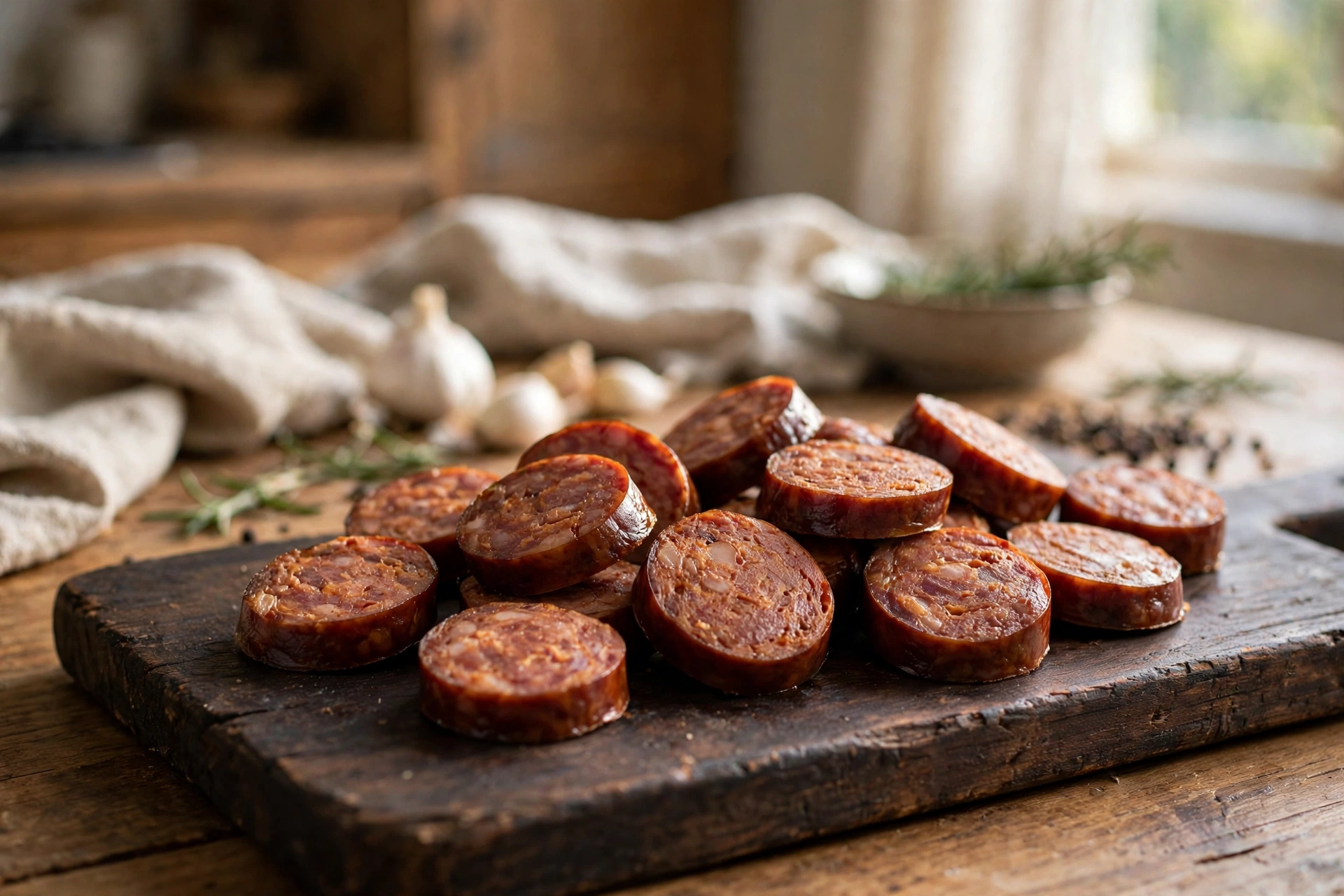
Sausage is ground meat, and grinding changes the safety math: bacteria that sit on the surface of a whole cut get mixed through the whole batch, which is why the food safety service’s sausage temperatures are higher than its whole-muscle ones and why this guide treats the thermometer finish as the recipe’s most important line. The flavor framework here is Oregon State University Extension’s summer sausage — a cooked, cured, sliceable sausage that is the natural home version of smoked sausage.
This guide is part of our preservation guides. It sits beside how to cure bacon at home in this section, and the cure rules behind it are on how to use curing salt safely — including the extension warning that runs through every ground-meat cure: never use more curing mix than an up-to-date recipe recommends.
What You Need
Ground meat — the extension recipe notes that sausages are moister and hold together better with some fat in the meat, and that regular grind beef, lamb, pork, and chicken all work well. For 5 pounds of meat: 2 tablespoons Morton Tender Quick salt, 2½ teaspoons garlic salt, 2½ teaspoons coarse black pepper, 2½ teaspoons mustard seed, and 1 teaspoon hickory smoked salt or liquid smoke. The same recipe per 1 pound of meat: 1½ teaspoons Tender Quick salt, ½ teaspoon garlic salt, ½ teaspoon coarse black pepper, ½ teaspoon mustard seed, and ¼ teaspoon hickory smoked salt or liquid smoke. Casings or a roll form, a smoker or oven, and a thermometer complete the list.

Etekcity Digital Kitchen Scale
The recipe is written per 1 pound and per 5 pounds of meat — the batch gets weighed so the cure column matches the meat.
$9.99 from Amazon
ThermoPro Instant-Read Thermometer
Sausage is done at 160°F or 165°F in the center depending on the meat, and cured sausage's pink color cannot call it — the thermometer does.
$8.99 from Amazon
Ziploc Freezer Quart Bags
Quart freezer bags portion the finished sausage flat for the freezer, one meal per bag.
$26.48 from AmazonBefore You Start
Keep everything cold and clean: ground meat is the most perishable form of meat in the kitchen. Mix the cure and seasonings evenly through the whole batch — the extension method sprinkles them over the meat as you mix, so no pocket of the batch is uncured or over-cured. And hold the recipe’s cure amount exactly: with ground meat, an uneven or heavy hand with curing mix is distributed through every bite.
How to Make Smoked Sausage, Step by Step
- Weigh the meat. The recipe is written per 1 pound and per 5 pounds of ground meat. Weigh the batch and use the matching column.
- Mix the cure and seasonings. For 5 pounds: 2 tablespoons Tender Quick salt, 2½ teaspoons garlic salt, 2½ teaspoons coarse black pepper, 2½ teaspoons mustard seed, 1 teaspoon hickory smoked salt or liquid smoke.
- Work it through the meat. Mix all the spices together and sprinkle them evenly over the meat as you mix, until the cure and seasonings are distributed through the whole batch.
- Form the sausage. Stuff the mixture into casings or form it into rolls, evenly sized so the batch cooks at one rate.
- Smoke and cook to temperature. Cook the sausage in the smoker until the center reaches the food safety service’s finish: 160°F for sausage containing ground beef, pork, lamb, or veal; 165°F for sausage containing ground turkey or chicken.
- Rest and chill. Let the sausage rest briefly, then refrigerate it promptly. Slice when cold for clean rounds.
The Numbers: Cure per Batch, and the Finish Temperatures
| Ingredient | For 1 pound of meat | For 5 pounds of meat |
|---|---|---|
| Morton Tender Quick salt | 1½ teaspoons | 2 tablespoons |
| Garlic salt | ½ teaspoon | 2½ teaspoons |
| Coarse black pepper | ½ teaspoon | 2½ teaspoons |
| Mustard seed | ½ teaspoon | 2½ teaspoons |
| Hickory smoked salt or liquid smoke | ¼ teaspoon | 1 teaspoon |
| Sausage contains | Cook to (USDA FSIS) |
|---|---|
| Ground beef, pork, lamb, or veal | 160°F |
| Ground turkey or chicken | 165°F |
Cooked sausage freezes in link or slice portions, sealed tight. The two sealers that handle sausage day best:

Nesco VS-12 Vacuum Sealer
Vacuum-sealed links and slices keep their smoke and moisture through the freezer's 1-to-2-month quality window.
$108.18 from Amazon
FoodSaver Elite Vacuum Sealer
The step-up sealer with a liquid mode, for sausage portions that weep juice as they seal.
$218.56 from AmazonCommon Mistakes
Judging by color. Cured sausage stays pink at temperature — that is the cure’s pigment, not rawness. The thermometer figures above are the only test.
Adding extra cure “for safety.” The extension warning is direct: never use more than the amounts recommended in up-to-date recipes. More cure is not more safety; it is a dosing error.
Uneven mixing. Cure sprinkled in one spot and barely folded leaves part of the batch uncured and part over-cured. Sprinkle as you mix, through the whole batch.
Leaning on liquid smoke and skipping the cook. Smoke flavor is not cooking. The sausage is done at 160°F or 165°F in the center, however it got its smoke.
Treating poultry sausage like pork sausage. The finishes differ: 165°F for ground turkey or chicken, against 160°F for the red meats.
Storage and Shelf Life
Refrigerate cooked sausage promptly and keep it cold. For the freezer, the food safety service’s sausage storage chart gives cooked sausages — hot dogs and other cooked sausage — 1 to 2 months in the freezer for best quality. Seal portions before freezing so a whole batch does not thaw for one meal.
Viewers also searched for these items.

Morton Canning and Pickling Salt, 4 lb
The plain pickling salt for the curing shelf's salt-only recipes, weighed and additive-free.
$2.68 from Amazon
Mrs. Wages Pickling and Canning Salt
A second additive-free pickling salt in a resealable pouch beside the sausage spices.
$19.32 from Amazon
IRIS USA Airtight Container, 30 lb, with Wheels
Airtight storage for mustard seed, pepper, and the rest of the sausage spice shelf between batches.
$23.99 from AmazonFrequently Asked Questions
Why is my smoked sausage still pink inside?
The cure fixes the meat’s pigment, so cured sausage stays pink even when fully cooked. Judge it by the thermometer: 160°F for red-meat sausage, 165°F for poultry sausage.
Is summer sausage the same as smoked sausage?
Summer sausage is a cooked, cured sausage of exactly the kind this recipe makes — seasoned ground meat, cured, formed, and cooked — and it is the extension-tested framework this guide uses for home smoked sausage.
Can I use Prague Powder #1 instead of Tender Quick?
Not at this recipe’s amounts. The amounts here were tested for Tender Quick; a Cure #1 sausage needs a recipe written for Cure #1. See how to use curing salt safely.
Does the meat need fat?
The extension recipe says sausages will be moister and hold together better if there is some fat in the meat, and that mixing leaner meats with ground pork makes a leaner product.
Recipe: Oregon State University Extension, “Summer Sausage & Deli Style Meats,” SP 50-735 (revised March 2020). Cooking temperatures and storage: USDA Food Safety and Inspection Service, “Sausages and Food Safety,” via via the Oregon State University Extension (SP 50-735, PDF).
Prices shown on this page were last checked November 26, 2026 — prices change; check before you buy.
Talk it over with other readers
The Truly Preserved Community on Facebook is where readers compare notes on food storage, water, and backup power — and where your questions help decide what we research next.