
Affiliate Disclosure: Truly Preserved is reader-supported. When you buy through links on this page, we may earn a commission at no extra cost to you. As an Amazon Associate, Truly Preserved earns from qualifying purchases. Learn more.
How we researched this comparison. We scored 3 products head to head for this page. The work behind the scores: manufacturer specifications and certification records where they apply, prices checked when this review was written, and patterns across verified owner feedback — a praise or complaint point only counts here when it shows up again and again, not once. The products were chosen to cover the main designs and price points a buyer in this category actually cross-shops. We are a research desk: we do not buy or hands-on test the products, and commissions never change a score. How we research and score →
Here is the thing nobody selling emergency ration bars puts on the box: a “3600 calorie, 3-day” pack is built to lifeboat math — 1,200 calories a day, the ration a castaway gets, not the 2,000-plus a person hauling gear actually burns. This comparison is built from manufacturer specs and Coast Guard approval records, prices verified on October 25, 2026, and aggregated owner feedback with the taste reports left in, because taste is the part of this category that decides whether the food gets eaten on day three. We don’t own these bars; we did the homework. One structural fact shapes everything below: Millennium and SOS are the same company, SOS Food Lab — so this is really two makers and three formats. The Preserve the Pantry hub keeps this guide next to the rest of the shelf.

The Short Version
S.O.S. Rations Emergency 3600 Calorie Food Bar
See it on AmazonWe may earn a commission at no extra cost to you.
Datrex Emergency Food Bars 3600 (DX3600F)
See it on AmazonWe may earn a commission at no extra cost to you.
Millennium Energy Bars (SOS Food Lab)
How we chose: Bars are judged on cost per 1,000 calories at verified prices, portion format, what owners say about taste and texture, and whether the paperwork — Coast Guard approvals, manufacture dates, seals — holds up. One of the three had no verifiable price on October 25, 2026; we say so where it happens instead of borrowing a stale one. Read our full methodology.
Head-to-Head Specs
| Product | Price | Per 1,000 cal | Best for |
|---|---|---|---|
| S.O.S. Rations 3600 Read the review ↓ |
$16.99 | $4.60 | Car kits, cheapest calories |
| Datrex 3600 (DX3600F) Read the review ↓ |
$17.29 | $4.80 | Portion control, simple label |
| Millennium Energy Bars Read the review ↓ |
Not verified | — | Taste, single servings, kids |
Two of these three prices are third-party Buy Box prices, and that is normal for this category: ration bars move through resellers, listings churn, and Amazon’s own offers come and go — Amazon itself wanted $19.99 for the SOS pack on October 25, above the $16.99 Buy Box. Millennium is the exception. Amazon’s pages were closed to our browser this run and no standalone Millennium listing could be confirmed on the trackers, so it carries no price rather than a borrowed one.
S.O.S. Rations Emergency 3600 Calorie Food Bar — Our Score: 8/10
The SOS 3600 is the bar we’d stock in quantity, because at the $16.99 Buy Box verified on October 25 (Amazon’s own offer was $19.99) it delivers 3,690 actual calories (nine 410-calorie bars in one vacuum-sealed foil pack) for $4.60 per 1,000 calories, the cheapest verified figure in this comparison.
The pack is a lifeboat ration in the formal sense: U.S. Coast Guard Approval 160.046/36/0, a five-year shelf life, and directions that say the quiet part plainly — three bars a day, about 1,230 calories. Owners rate it 4.3 stars across about 940 Amazon ratings, and the taste reports are the surprise of the category: “shortbread,” “pie crust,” and “sugar cookie” recur across review summaries, with the coconut flavor described as mild to the point some buyers can’t detect it. The complaint that recurs most is not taste — it’s the vacuum seal. Multiple owners report packs arriving with broken seals or already open, which matters more than flavor: a ration’s five-year claim lives and dies with that seal. Check yours the day it lands and return a puffy or open pack without debate.
Pros
- Cheapest verified calories here: $16.99 for 3,690 calories, $4.60 per 1,000.
- Coast Guard-approved ration (160.046/36/0) with a five-year shelf life.
- Cookie-like taste owners consistently rate above the category’s reputation.
Cons
- Broken vacuum seals on arrival are the top recurring complaint — inspect every pack.
- One brick format: open the foil and the clock starts on all nine bars (the bars inside are individually wrapped, which softens this).
- Coconut or cinnamon are the only flavors — no assortment.
Buy it if you want the most verified calories per dollar for car and home kits. Skip it if a pack arrives with a broken seal and no replacement — that’s a return, not a ration.
Check the current price on Amazon →
Datrex Emergency Food Bars 3600 (DX3600F) — Our Score: 7/10
Datrex is the portion-control pick: eighteen individually wrapped 200-calorie bars instead of nine big ones, so an opened pack doesn’t expose your whole supply — and it carries the simplest label in the category, six ingredients: wheat flour, vegetable shortening, cane sugar, water, coconut, salt.
Datrex, made in Kinder, Louisiana, is a genuine SOLAS lifeboat ration, Coast Guard Approval 160.046/19/0 — with a paperwork caveat we detail below: the certificate of approval on file for that number ran to September 24, 2025, and we could not verify a renewal in this run’s research, so we’re reporting the approval as historically certified rather than currently confirmed. Its US Amazon listing holds 4.3 stars across about 480 ratings. Taste panels split hard: several describe a mild coconut shortcake or graham-cookie flavor and praise the smell; others land on dry, crumbly, “cardboard and shortening,” and one panel rated it their least favorite flavor outright — while still calling it the most practical pack to open and portion. The other recurring complaint is short-dated stock: buyers receiving bars made a year or more earlier, with only about 3.5 years of the five left. Keepa showed a live third-party price of $17.29 on October 25 (Amazon itself out of stock; camelcamelcamel’s last figure was $18.29 on October 18) — that’s $4.80 per 1,000 calories.
Pros
- Eighteen 200-calorie wrapped portions — the best format for rationing and for keeping the rest fresh.
- Six-ingredient label, peanut-free, no preservatives per the manufacturer.
- Densest pack here per its certificate weight (3,600 calories in 684 g net).
Cons
- Dry and crumbly for many palates; sub-wrappers are notoriously hard to open.
- Short-dated stock on delivery is a recurring complaint — check the manufacture date first.
- Its Coast Guard certificate on file expired September 2025; renewal unverified.
Buy it if you want strict portions and the cleanest ingredient list. Skip it if the pack that arrives is short-dated — send it back and buy from a seller who states dates.
Check the current price on Amazon →
Millennium Energy Bars — Our Score: 7/10
Millennium is the taste pick, and it isn’t close: across the taste panels we aggregated, it’s the one bar people use the word “delicious” about — a compressed graham-cracker texture with nine flavors (lemon is the panel favorite, apricot the least) strong enough to have favorites at all.
Each bar is a single wrapped 400-calorie serving (84 g, 8 g protein on the label), which is why these end up in school kits, glove boxes, and go-bags where a brick ration is the wrong shape. SOS Food Lab rates them for five years and sells them in packs from 6 to 144. This run we could not verify a standalone listing’s price or rating count — Amazon’s pages were closed to our browser and the trackers had no confirmable Millennium listing — so the taste evidence here comes from published panels, not a rating count. The tradeoffs are nutritional and financial. The label is sugar-led — 33 g of sugar and under a gram of fiber per bar — and a retailer-reproduced label panel lists partially hydrogenated oils and bromated flour among the ingredients, which we flag in the caveats below; formulation may have changed, so read the current pack. Millennium also has no Coast Guard ration approval number of its own that we could find — it’s an energy bar, not a certified lifeboat ration — and no standalone pack had a verifiable live price on October 25, so, again, we print none. Panels note it crumbles and eats slightly oily.
Pros
- Best taste in the category by panel consensus, with nine flavors against flavor fatigue.
- Single wrapped bars — the right unit for kits, kids, and handing out.
- Five-year shelf life and low sodium (15 mg per bar).
Cons
- Sugar-led energy-bar nutrition: 33 g sugar, under 1 g fiber per bar.
- Label history includes partially hydrogenated oils and potassium bromate — check the current pack.
- No Coast Guard approval number found, and historically the priciest per calorie of the three.
Buy it if the bars need to be eaten willingly — by kids, or by you on day three. Skip it if you want certified ration paperwork or the cheapest calories.
Is a 3600-calorie pack really three days of food?
No — and the SOS pack’s own directions admit it: three bars a day is about 1,230 calories. A 3600 pack is three days at lifeboat rationing, or roughly one hard day of evacuation work for an adult burning 3,000-plus calories. Plan a real 72-hour kit at closer to two packs per person, or pair one pack with the kind of food priced in our serving-cost dataset, where a full 2,000-calorie day of kit food runs $8.57 and up. Ration bars are the layer that needs no water, no heat, and no utensils — not the whole plan.
Which bar tastes least like punishment?
Millennium wins taste outright across the panels we aggregated — real flavors, a graham-cracker crumb, and the only “would eat by choice” reports. SOS places second: a plain shortbread-cookie flavor most owners find easy to get down, if a little bland and greasy in the wrapper. Datrex splits the room — coconut shortcake to some, dry shortening-and-cardboard to others — and blandness here is partly by design: lifeboat rations are made unexciting on purpose, so nobody eats three days of food in one sitting. Whatever you buy, eat one bar before you stock twenty. A ration your family refuses is weight, not food.
What does a day of ration bars actually cost?
The verified figures on October 25: SOS at $4.60 per 1,000 calories — $5.66 for a 1,230-calorie ration day, about $9.21 for a full 2,000-calorie day of SOS bars — and Datrex close behind at $4.80. For scale, our bulk staples guide prices rice and wheat near $1.70–$1.87 per 1,000 calories, and the cheapest full kit day we’ve verified is $8.57 — so a full day of ration bars costs about what a full day of kit meals does, and buys zero preparation and a five-year seal instead of a dinner. Millennium’s price could not be verified this run. Whichever bar you buy, check the manufacture date before you judge the deal, because a cheap short-dated pack is the category’s classic trap.
Will they still be good in five years?
All three makers claim five years from manufacture, and the claim rests on the seal, the storage temperature, and the date the pack was actually made — three things you control only partly. SOS’s recurring broken-seal complaints and Datrex’s short-dated deliveries are the same failure wearing two coats: the five years started before the box reached you. Store bars cool (a hot car is the worst shelf in the house, whatever the -22°F to 149°F tolerance claims say), write the manufacture date on the box with a marker, and rotate at four years instead of five. Our water guide makes the matching point for the other half of a ration: these bars are built to be non-thirst-provoking, but no bar replaces stored water.
Honest caveats
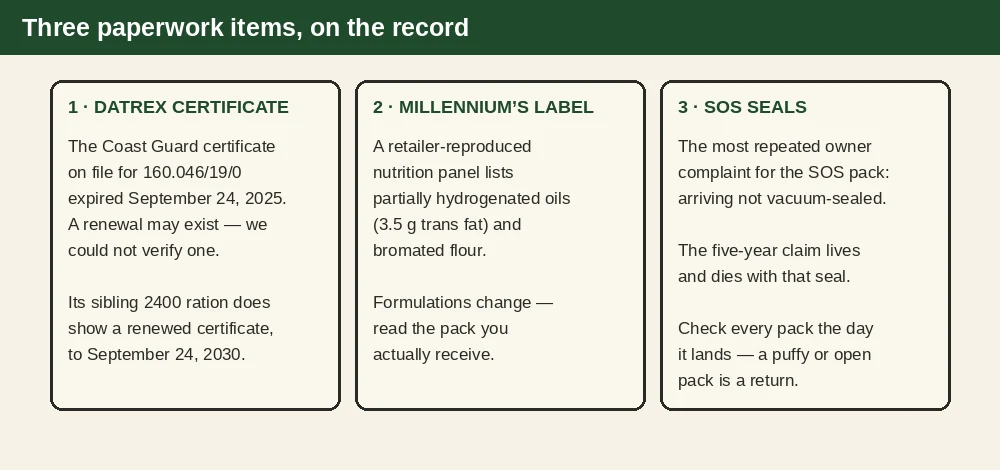
Three paperwork items belong on the record. First, Datrex’s Coast Guard certificate: the Certificate of Approval for 160.046/19/0 that we found on file was issued in 2020 and expired September 24, 2025. Rations don’t stop being food when a certificate lapses, and a renewal may well exist — but we could not verify one, so we won’t print “currently Coast Guard approved” for Datrex the way every other roundup does. For balance: Datrex’s sibling 2400-calorie ration (DX2400F) shows a renewed Coast Guard certificate issued that same week — September 24, 2025, running to September 24, 2030 — so the company’s approvals are plainly active; it is the 3600’s own renewal we could not put eyes on. Second, Millennium’s label: a current retailer-reproduced nutrition panel lists partially hydrogenated soybean and cottonseed oils (3.5 g trans fat per bar) and enriched bromated flour with potassium bromate. Formulations change; read the pack you receive, and know the bar with the best taste carries the roughest label here. Third, SOS’s seals: the single most repeated complaint in its owner record is packs arriving not vacuum-sealed. No recall for any of the three products turned up in this run’s research — that’s what we found, stated as found, not a guarantee none exists.
FAQ
How long do emergency ration bars actually last — are they safe after five years?
Makers date them five years from manufacture for flavor and vitamin potency, and an unopened, cool-stored pack generally keeps longer — but “generally” is doing work in that sentence. Treat five years as the rotation date, check the seal and the manufacture date, and don’t plan a kit around bars you wouldn’t eat today.
Are ration bars thirst-provoking? How much water do I need with them?
All three are formulated to be non-thirst-provoking and low in sodium — that’s core lifeboat design, since water is the scarcer resource at sea. They still need to fit inside a real water plan; dry, dense food on a hot day will make anyone thirsty.
What’s the difference between a ration bar and an energy bar?
A ration bar (Datrex, SOS 3600) is a certified-style survival ration: dense, bland by design, portioned for rationing, and built for a five-year seal. An energy bar (Millennium) is a flavored single serving — better tasting, sugar-led, made to be eaten willingly one at a time. Same company sells both, which tells you they’re tools for different jobs.
Can kids eat emergency ration bars?
Yes — Millennium’s single wrapped bars are a standard school-kit choice, and makers suggest smaller portions for young children. The limits are the wheat and coconut in all three (and soy in the SOS products), and the plain fact that a child who won’t eat the bar gets no benefit from it. Test one at home first.
Why did my bars arrive short-dated or with a broken seal — should I return them?
Yes, return them. Third-party sellers rotate old stock through this category, and a broken vacuum seal voids the shelf-life claim you paid for. Buy from listings that state a manufacture or expiration date, check both the date and the seal the day the box lands, and send back anything that fails either check.
Can I store ration bars in a hot car?
Makers and testers cite wide temperature tolerance, and panels have passed bars through summer car storage still edible — but heat is the fastest way to spend down a five-year claim, and owners are right to be skeptical. A car kit is fine; rotate it yearly instead of trusting the full five.
Sources & freshness: SOS Food Lab’s official product pages and spec sheets, Datrex manufacturer data and its U.S. Coast Guard Certificate of Approval (160.046/19/0), Keepa and camelcamelcamel price records, Amazon owner ratings and review summaries, and published taste panels (TruePrepper, The Survival Mom, The Prepared). Prices last checked: October 25, 2026. Last updated: October 30, 2026.
Talk it over with other readers. The Truly Preserved Community on Facebook is where readers compare notes on food storage, water, and backup power — and where your questions help decide what we research next. Join the group →