
Water questions from prepping forums and Q&A communities are wonderfully specific — a jug, a drum, a water heater, a Berkey element — and most of them have a definite answer. These are the ones our forum-question harvest surfaced, each with its short answer here and a link to the full page where one exists.
How we answer: Truly Preserved is a research desk. Stored-water guidance here follows the CDC and Ready.gov publications; filter claims are stated the way each maker states them and labeled as claims. Where those two disagree, we show both.
Storing It
How long can you store tap water — and do you treat or rotate it?
Six months for water you fill yourself, then rotate it — the CDC and Ready.gov interval, in a clean food-grade container. Treated city tap water needs nothing added for that rotation; bleach is for sanitizing the container (1 teaspoon per quart of water) and for disinfecting water you’re unsure of (8 drops per gallon, wait 30 minutes).
Can I store water in old milk jugs?
No — milk jugs are the one container nearly every guide names to avoid. The thin plastic breaks down and goes brittle, seams split, and milk protein residue is close to impossible to wash fully out of the plastic. A food-grade jug costs little more and lasts for years of rotations.
Where do I store water in an apartment with no garage or basement?
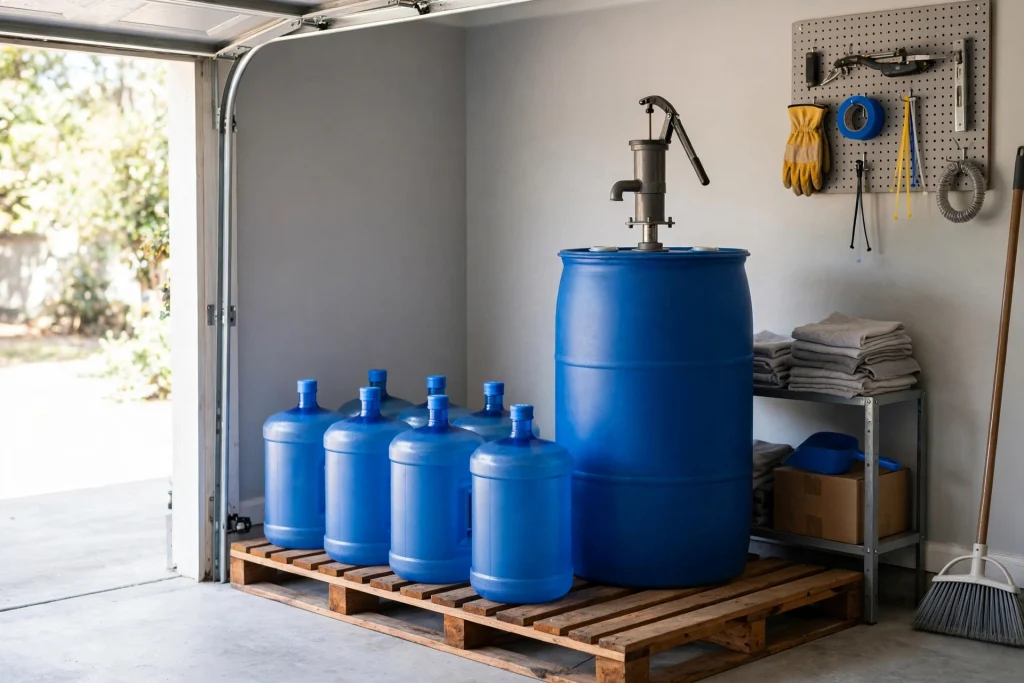
Stackable 5-gallon jugs in a closet beat a drum you have nowhere to put, and a bathtub bladder covers the storm you get warning for. Our water storage containers comparison runs the sizes, the finished cost per gallon, and what actually stacks. Answered in: Water Storage Containers Compared →
Drinking It Safely
Filter vs purifier — what’s the actual difference?
A filter strains out bacteria and protozoa like giardia. A purifier also deals with viruses — that one word is the whole difference, and it’s a regulated claim, not a marketing adjective. Most countertop systems sold for home use are filters, whatever the box implies.
Can I drink the water heater / the pool in an emergency?
The water heater, yes, with conditions: cut its power or gas, let it cool, drain from the bottom valve through a clean cloth, and treat it like stored water of unknown age. The pool stays off the drinking list — its chemical load makes it flushing and washing water.
Is collected rainwater safe to drink if I filter it?
Rainwater is a treatment question, not a collection question: filter it and disinfect it before drinking, and check your local collection rules. Our Rainwater Collection Calculator covers how much your roof can actually catch. Answered in: the Rainwater Collection Calculator →
Does a Berkey remove viruses? Fluoride? PFAS?
Berkey’s own claims and the independent certification record are two different documents, and they don’t say the same thing. Our Berkey vs AquaTru comparison lays out what the maker claims, what is certified, and what neither document supports. Answered in: Berkey vs AquaTru →
Filters and Upkeep
How often do Black Berkey elements really need replacing?
Berkey rates a pair of Black elements at about 6,000 gallons. At two gallons a day that’s years, not months — and the signal owners actually watch is flow rate slowing, not the calendar. The cost-per-gallon math is in our Berkey vs AquaTru comparison. Answered in: Berkey vs AquaTru →
How Much
Does the “1 gallon per person per day” rule include water for cooking freeze-dried food?
The gallon covers drinking and minimal hygiene. Rehydrating freeze-dried food adds roughly 14 gallons for a family of four across two weeks — our two-week water math itemizes that and the other extras the charts leave out. Answered in: How Much Water Does a Family of Four Need for Two Weeks? →
How Much Water Should I Store Per Person Per Day?
One gallon per person per day on the US count — that gallon covers drinking plus basic sanitation. Sweden’s 3 litres and Germany’s 2 litres look smaller only because they count drinking and cooking alone. For a family of four: 12 gallons for 3 days, 56 gallons for two weeks, before heat, pets, and freeze-dried rehydration extras.
This page grows as we work the harvest: questions get their full-page link the day that page publishes. The water reviews, containers, and filters live on the main hub: Preserve the Water.