
Affiliate Disclosure: Truly Preserved is reader-supported. When you buy through links on this page, we may earn a commission at no extra cost to you. As an Amazon Associate, Truly Preserved earns from qualifying purchases. Learn more.
How we researched this comparison. We scored 3 products head to head for this page. The work behind the scores: manufacturer specifications and certification records where they apply, prices checked when this review was written, and patterns across verified owner feedback — a praise or complaint point only counts here when it shows up again and again, not once. The products were chosen to cover the main designs and price points a buyer in this category actually cross-shops. We are a research desk: we do not buy or hands-on test the products, and commissions never change a score. How we research and score →
The best gravity water filters for emergency storage all look alike in photos: a stainless can, a spigot, no plug, no pump. What separates them is paperwork and filter life, and this year both moved. One of the three systems below has been discontinued by its new owner. Another quietly changed its filter from a 5,000-gallon claim to a 200-gallon rating. The third changed its standard filter element and left its old one unavailable. This comparison is built from published specs, current prices, and aggregated owner feedback. We don’t own these systems; we did the homework, and the homework this time is reading what each maker actually claims today — not what it claimed when the reviews you have already read were written.
All three filter by gravity alone, so all three keep working in an outage. The questions that decide between them are what each one is certified to remove, what a gallon of its water costs over the life of the filters, and whether the company behind it will still sell you elements in five years.

The Short Version
Best for proof you can look up: ProOne Big+ — $229.95 list, seen at $183.96 on closeout. The only system here whose elements carry IAPMO certification to NSF/ANSI 42, 53, 372, and 401 — lead, total PFAS, and microplastics included. It is also being discontinued, which is why the price is falling; its filter line continues under Culligan’s MaxClear name.
Best for cheap gallons over years: Big Berkey — $367. A pair of elements rated for 6,000 gallons puts filter cost near 2 cents a gallon on the current Phoenix replacement pair. The tradeoff is certification: the classic Black Berkey elements are lab-tested to standards, not NSF-certified, and Black replacements are currently unavailable.
Simplest to buy, priciest to run: Alexapure Pro — $279.99. One filter, fast flow, sold by My Patriot Supply. Its current filter is rated for up to 200 gallons and costs $129.99 to replace — about 65 cents a gallon, the highest running cost here by a wide margin.
How we chose: we compared each maker’s stated capacity, flow, and filter life, checked certification claims against what the makers and certifier listings actually say, and priced filter replacements per gallon. How we rate explains the scoring.
Head-to-Head Specs
| System | Price | Filter life | Best for |
|---|---|---|---|
| ProOne Big+ Read the review ↓ | $229.95 | ~1,000 gal per element | Certified lead & PFAS reduction |
| Big Berkey Read the review ↓ | $367 | 6,000 gal per pair | Lowest cost per gallon |
| Alexapure Pro Read the review ↓ | $279.99 | 200 gal per filter | Simple one-filter setup |
The rest of the sheet, plainly: the ProOne Big+ holds about 3 gallons and filters about a gallon an hour with two elements fitted. The Big Berkey holds 2.25 gallons and, per the maker’s figures, filters about 3.5 gallons an hour with two elements — the fastest here. The current Alexapure Pro holds 2.5 gallons in each chamber — the older model held 2.25 — and its maker rates one filter at an average of 1.67 gallons an hour. All three are polished stainless, all three stand roughly 18 to 23 inches tall, and none needs power, plumbing, or water pressure. Prices last checked: October 29, 2026.
ProOne Big+
Our score: 8/10. The ProOne Big+ has the strongest certification paperwork in this comparison — and a discontinuation notice hanging over it, so buy it with your eyes open.
ProOne’s G3.0 elements are IAPMO-certified to NSF/ANSI 42 for chlorine and chloramine, 53 for lead and total PFAS, 372 for lead content, and 401 for microplastics. No other gravity system in this comparison can point to a certifier’s listing covering lead, PFAS, and microplastics together, and the element handles fluoride reduction without a separate add-on filter, which Berkey charges extra for. The rated life is about 1,000 gallons per 7-inch element, or roughly six months, and replacements list at $78.95 each — about 8 cents a gallon. One honest caution: a rating and a certified capacity are not the same number, and the certified gallonage on a listing can be far smaller than the element’s rated life. Check the IAPMO listing’s certified capacity before you treat 1,000 gallons as a certified figure.
The bigger caveat is corporate. Culligan acquired ProOne, and the Big+ is listed as discontinued, sold while supplies last — list price $229.95, seen at $183.96 on closeout. That is not the dead end it sounds like: Culligan states that its MaxClear replacement filters fit the Big+, the Traveler+, and the older Propur systems, so elements stay buyable under the new name. Owner feedback on the Big+ runs positive on taste and build, with slow flow — about a gallon an hour with two elements — as the standing complaint, along with the scrub-and-rinse break-in the elements need before first use.
- Pros: real third-party certification for lead, total PFAS, and microplastics; fluoride reduction built into the element; stainless spigot included; closeout pricing while stock lasts.
- Cons: discontinued — the system is a closeout purchase; slowest flow here; elements cost more per gallon than Berkey’s; rated life and certified capacity are different numbers.
Buy it if certified PFAS and lead reduction is your deciding issue and you are comfortable stocking a few spare elements now. Skip it if a discontinuation notice makes you nervous — the same certification story is continuing under the Culligan MaxClear name.
Check the current price on Amazon →
Big Berkey
Our score: 7/10. The Big Berkey remains the cheapest way we know to filter a lot of water for a lot of years — bought with a clear head about what its testing is and is not.
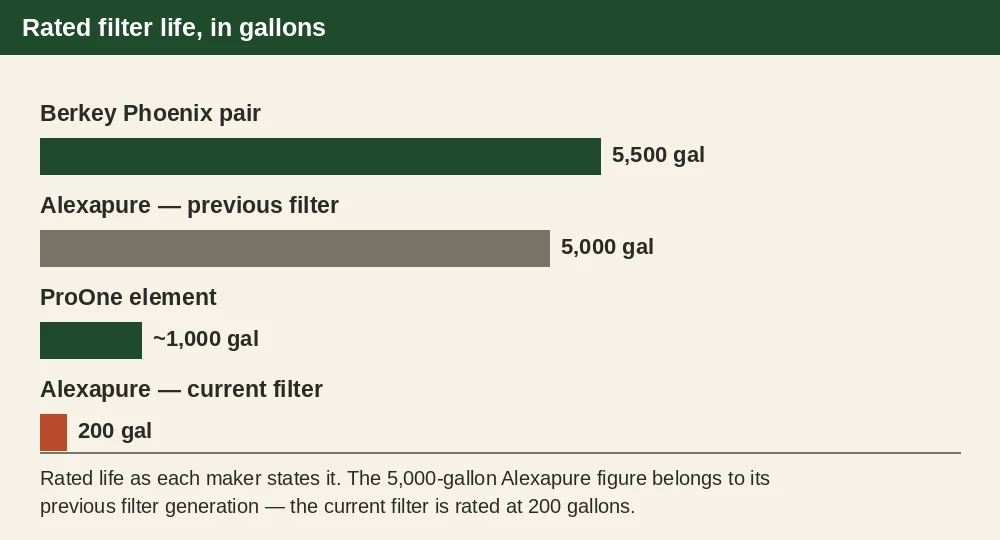
The system holds 2.25 gallons, stands 19.25 inches tall, and ships with two elements. With the classic Black Berkey elements, a pair is rated for 6,000 gallons; at a household’s two gallons a day, that is years between replacements. The current replacement element is the Berkey Phoenix pair — $120, rated for 5,500 gallons, which works out to about 2 cents a gallon — because Black Berkey replacement elements are currently unavailable. Fluoride and arsenic reduction needs the optional PF-2 add-on filters, $103 a pair, rated for 1,000 gallons or a year. Flow is the best here at about 3.5 gallons an hour with two elements.
The certification point needs stating plainly, because our earlier Berkey coverage said the same and it still holds: Black Berkey elements are tested by independent labs against NSF/ANSI standards, with reports the maker publishes, but they are not themselves NSF-certified. The newer Phoenix elements are the certified ones — listed to NSF/ANSI 42 and 372 — and a Big Berkey with two Phoenix elements sells from $267, less than the $367 Black Berkey edition. Owners across about 6,272 Amazon ratings in our earlier count rate the system 4.6 stars; the recurring complaints are slow priming, occasional leaks at the spigot, and the price of the PF-2 add-ons. One dealer also notes Berkey systems do not ship to California or Iowa.
- Pros: lowest cost per gallon here by a wide margin; fastest flow; huge installed base and published lab reports; works for years on one element pair.
- Cons: Black elements are tested-to-standard, not certified — and currently unavailable as replacements; fluoride needs a $103 add-on pair; $367 is the highest sticker here.
Buy it if cost per gallon over a decade is your deciding number and published lab reports satisfy you. Skip it if you want a certifier’s name on the element itself — buy the Phoenix edition, or the ProOne above.
Check the current price on Amazon →
Alexapure Pro
Our score: 6/10. The Alexapure Pro is a well-built, simple system whose new filter changed its running costs completely — and most of the reviews you will find describe the old one.
The current Alexapure Pro has 2.5-gallon upper and lower chambers in 304 stainless, one filter included, at $279.99 from My Patriot Supply. The maker’s current filter is rated for up to 200 gallons at an average flow of 1.67 gallons an hour, and a replacement costs $129.99. That is about 65 cents a gallon — roughly eight times the ProOne’s running cost and thirty times the Berkey’s. Older listings and reviews credit this system with up to 5,000 gallons per filter; that figure belongs to the previous filter generation, and the maker’s own replacement-filter page now states 200 gallons. Do not buy this system on the old number.
My Patriot Supply rates the system 4.8 stars across 2,799 reviews on its own site, and to its credit the maker flags that reviews from before late September 2026 describe the original system and filters. The maker says the current filter has been tested across 220-plus contaminants, including PFAS, metals, and VOCs; the pages we read claim testing, not NSF certification. The setup itself gets consistent owner praise — one filter, no priming ritual worth the name, fast flow for a gravity system — and the same pages note the system is not currently sold to customers in California.
- Pros: simplest setup here; good flow from a single filter; tall owner rating on the maker’s site; stainless build with a low-profile lid that fits under cabinets.
- Cons: 200-gallon filter life at $129.99 a replacement is the most expensive water here; claims rest on maker testing, not certification; most existing reviews describe the previous filter.
Buy it if you value a dead-simple one-filter system and you have done the per-gallon math with your eyes open. Skip it as a high-volume family filter — at four gallons a day, a filter lasts about seven weeks.
Check the current price at My Patriot Supply →
Which system has certification you can look up?
The ProOne Big+ has the certification a buyer can verify independently: its G3.0 elements carry IAPMO certification to NSF/ANSI 42, 53, 372, and 401, covering lead, total PFAS, and microplastics. The Big Berkey splits in two — its Phoenix elements are listed to NSF/ANSI 42 and 372, while the classic Black Berkey elements rest on independent lab testing to those standards, with published reports but no certification. The Alexapure Pro’s maker reports testing across 220-plus contaminants without claiming NSF certification on the pages we read. None of that makes an uncertified system unsafe; it changes what you are trusting — a certifier’s ongoing listing, or a maker’s lab reports. Our Berkey vs AquaTru comparison works through the same question against an electric system.
What does a gallon of filtered water cost from each system?
The Big Berkey is the cheapest water here by a distance: about 2 cents a gallon on a $120 Phoenix pair rated for 5,500 gallons. The ProOne Big+ runs about 8 cents a gallon on $78.95 elements rated near 1,000 gallons each. The Alexapure Pro runs about 65 cents a gallon, because its current $129.99 filter is rated for 200 gallons. For a family drinking and cooking with four gallons a day, a year of filters costs roughly $80 with the Berkey, about $115 to $230 with the ProOne depending on element count, and close to $950 with the Alexapure. Filter life — not the sticker on the can — is the price of a gravity system. The full six-system picture, including pitcher and countertop options, is in our water filters comparison.
Which filter keeps up when four people are thirsty?
The Big Berkey keeps up best, at about 3.5 gallons an hour with two elements — and it can take two more. The Alexapure Pro’s single current filter averages 1.67 gallons an hour, respectable for one element, and adding filters speeds it up at $129.99 each. The ProOne Big+ is the slowest, at about a gallon an hour with two elements. Every gravity system rewards the same habit: fill the top chamber at night and after meals, so the lower chamber is a standing reserve instead of a wait. A 2.25- to 3-gallon reserve covers a family’s drinking water for most of a day; cooking for four is what empties it.
Can a gravity filter handle stored or surface water in an emergency?
Each maker positions its system for emergency use on freshwater sources, and each states its own tested reductions for bacteria and cysts — read the exact performance sheet for the element you own, because the claims differ by element and by generation. What no gravity filter on this page does is make questionable water a settled question: for pond, rain-barrel, or flood water, the standing advice from health agencies is to filter and then disinfect — boil it, or treat it — rather than trusting any single device. Storage comes first anyway: our water storage containers comparison and our family water-needs guide cover the 56 gallons a family of four should already have on hand, before any filter enters the plan.
Honest caveats
This category is changing under its own listings, and a buyer deserves the whole list. ProOne has been acquired by Culligan and the Big+ is a closeout item; its filters continue as Culligan MaxClear, and Culligan says those filters fit ProOne systems. Berkey’s Black elements — the ones most owners know — are currently unavailable as replacements, with the certified Phoenix pair as the standing option. Alexapure’s filter life dropped from a widely quoted 5,000 gallons to a stated 200 gallons with its current filter, and its review record mostly predates that change. None of these are reasons to avoid gravity filtration. All of them are reasons to buy the current product on its current paperwork, not on a review written about a previous one.
FAQ
Do gravity water filters work during a power outage?
Yes — that is the point of the format. All three systems here filter by gravity alone, with no electricity, plumbing, or water pressure. Fill the upper chamber and the lower chamber collects filtered water at the rates listed above.
How long do gravity filter elements last?
It depends entirely on the element. A pair of Berkey elements is rated for 5,500 to 6,000 gallons. A ProOne G3.0 element is rated near 1,000 gallons, or about six months. The current Alexapure Pro filter is rated for up to 200 gallons. At four gallons a day, those are roughly four years, eight months, and seven weeks.
Do these systems remove fluoride?
The ProOne G3.0 element handles fluoride reduction in the element itself, per its maker. The Big Berkey needs the optional PF-2 add-on filters, $103 a pair, rated for 1,000 gallons or a year. Alexapure’s maker lists fluoride among the reductions its current filter was tested on.
Are Berkey filters NSF certified?
The classic Black Berkey elements are not NSF-certified; they are independently lab-tested against NSF/ANSI standards, with the reports published. Berkey’s newer Phoenix elements are listed to NSF/ANSI 42 and 372. If certification is your deciding issue, the ProOne Big+ carries the broadest certification in this comparison.
Why is my gravity filter so slow?
Usually one of three things: the elements were not primed or scrubbed in properly, an airlock is sitting in an element, or the system is running fewer elements than it can hold. Flow also falls as elements load up with sediment — a gentle scrub of a ceramic-style element, following the maker’s instructions, is standard maintenance on these systems.
Can I filter rainwater or pond water with one of these?
The makers position these systems for emergency use on freshwater sources and publish their own reduction claims for bacteria and cysts. Health-agency guidance for questionable water is still filter, then disinfect — boil or treat the water after filtering rather than relying on the filter alone.
Sources & freshness: makers’ and authorized dealers’ product pages for Berkey, ProOne/Culligan, and My Patriot Supply (Alexapure Pro); IAPMO certification summaries as reported by the makers. Prices last checked: October 29, 2026. Last updated: October 30, 2026.
Talk it over with other readers. The Truly Preserved Community on Facebook is where readers compare notes on food storage, water, and backup power — and where your questions help decide what we research next. Join the group →