Canning questions do not arrive one at a time. They arrive at midnight, over a sink full of hot jars, in groups with half a million members — and the answers in those threads are a stew of grandmothers, guesswork, and the occasional person quoting the actual tested guidance. These are the canning questions our harvest of those groups surfaced, answered the only way this site answers safety questions: from the USDA Complete Guide to Home Canning and the National Center for Home Food Preservation (NCHFP), with the source named on every page. Where the USDA has no tested process, the answer below says so, in plain words. A sealed jar is not the goal. A safely processed jar is.
How we answer: Truly Preserved is a research desk. On this cluster, every method, time, pressure, headspace, yield, and keep-or-discard call comes from the USDA Complete Guide to Home Canning (2015 revision) or NCHFP — never from memory, never from a comment thread. Methods those sources reject are covered only as rejected, with the reason why.
Jars, Lids, and Secondhand Finds
Why do old canning jars still look cloudy after washing?
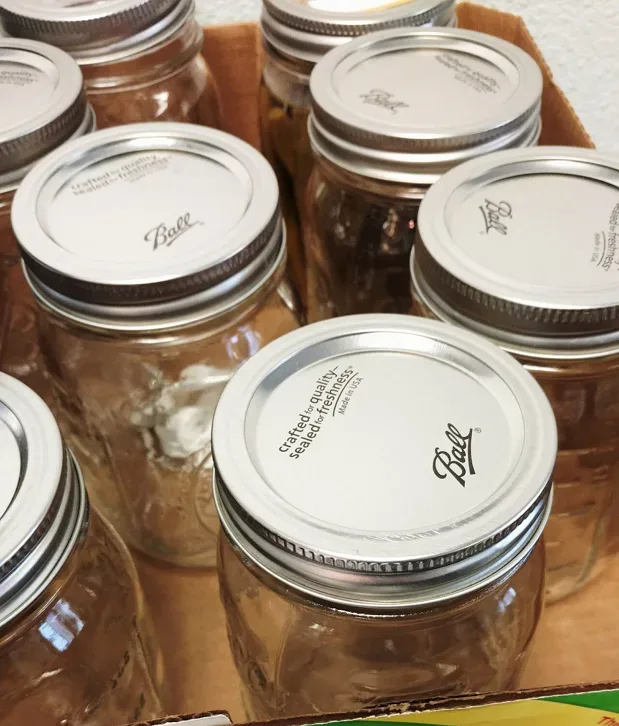
That white film is usually mineral scale from hard water, and the USDA fix is a soak, not a boil: several hours in 1 cup of vinegar (5 percent acidity) per gallon of water, then a hot detergent wash. What retires a jar is not the cloudiness — it is a chip, nick, or crack on the sealing surface, which you find with a fingertip, not an eyeball.
Can I reuse lids — including the lug lids off store-bought jars?
Flat two-piece canning lids: no. The USDA system is a new flat lid on every jar, every run — the gasket flows to seal during processing, once. Jars and screw bands are the reusable parts. Commercial lug lids from store jars are not part of the tested system at all: jars that cannot be sealed with two-piece canning lids are “not recommended for use in canning any food at home,” and even commercial jars that can take a two-piece lid are acid-food-only, with more seal failures expected, and never for pressure canning. A lid that sealed pasta sauce at a factory was not tested to seal your beans in your kitchen.
After the Canner: Did It Work?
Did I ruin it — is my canning still safe?
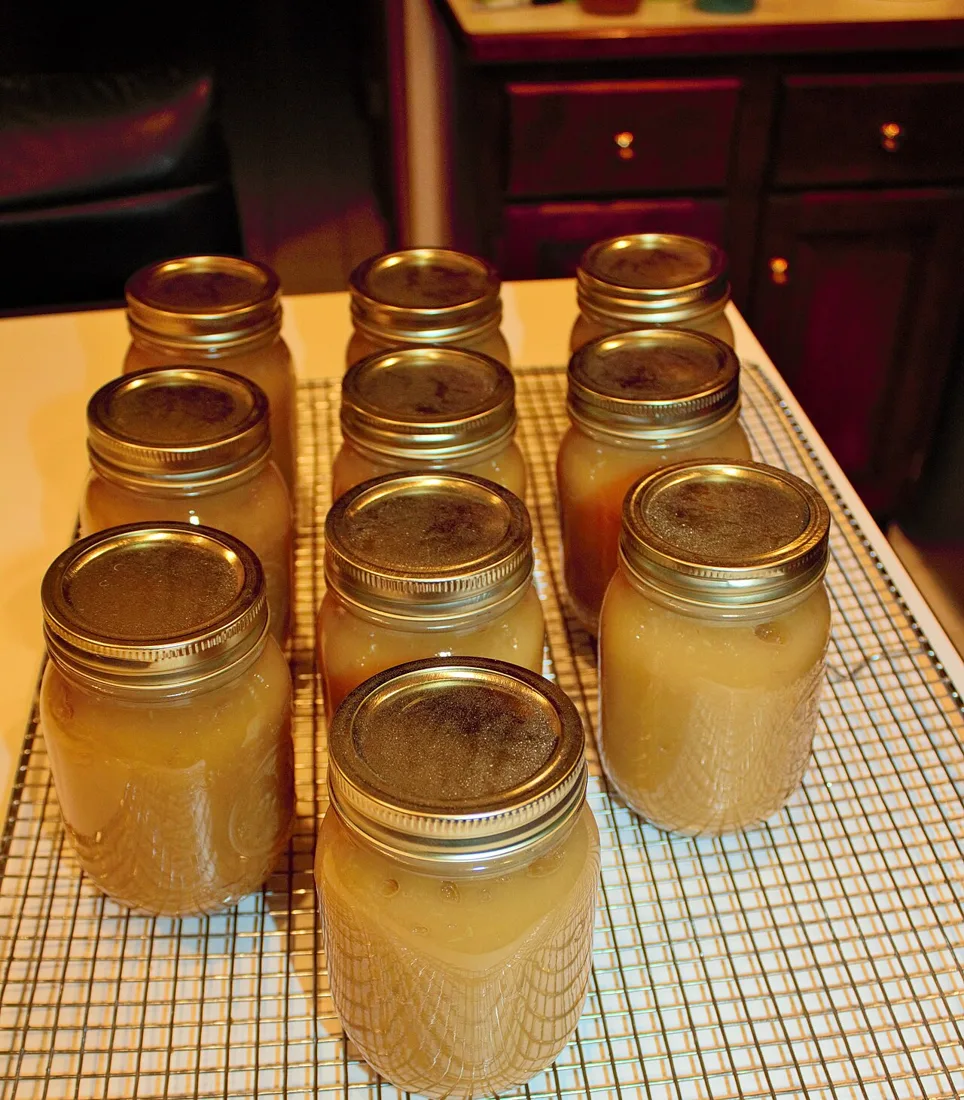
Usually not ruined, and the calls are specific. Siphoning — liquid lost during processing — is “not a sign of spoilage” per NCHFP: keep a sealed jar, never open it to top it up. A jar that failed to seal gets reprocessed within 24 hours with a new lid and the full process time, or refrigerated and eaten within several days. Bulging, spurting, mold, or off odors end the discussion: discard, without tasting.
When do I start timing — when the jars go in, or when it boils again?
When the process actually reaches temperature, per USDA Guide 1. Water bath: the timer starts when the water boils vigorously over the loaded jars, and if the boil stops mid-process, you bring it back to a vigorous boil and start the timing over from the beginning. Pressure canner: vent 10 minutes first, then time from when the gauge reaches the recommended pressure (or the weighted gauge jiggles as the maker describes) — and if pressure drops below the recommendation at any point, the full timing restarts. Timing from “jars in” under-processes everything in the load.
I flipped my hot jars upside down and the lids popped. Am I done?
No. A popping lid is a vacuum forming as hot food cools — it is not processing, and it kills nothing. NCHFP lists inverting jars as a cause of imperfect seals, and the USDA’s tested methods are the boiling-water canner for acid foods and the pressure canner for low-acid foods. “Sealed” was never the test. “Processed by a tested method, for the tested time” is the test, and a flipped jar has not taken it.
Choosing a Canner
Water bath or pressure canner — which should a beginner buy?
Buy for the food. Acid foods — pH 4.6 or lower: fruits, pickles, jams, acidified tomatoes — go in a boiling-water canner. Every low-acid food — vegetables, meats, soups, chili — must go in a pressure canner, the only home equipment that reaches the 240° to 250°F needed to destroy botulism spores. A pressure canner also runs as a water-bath canner; the reverse is never true, so vegetable plans make the decision for you.
How Much Will It Make?
How many jars and lids do I need for 50 pounds of produce?
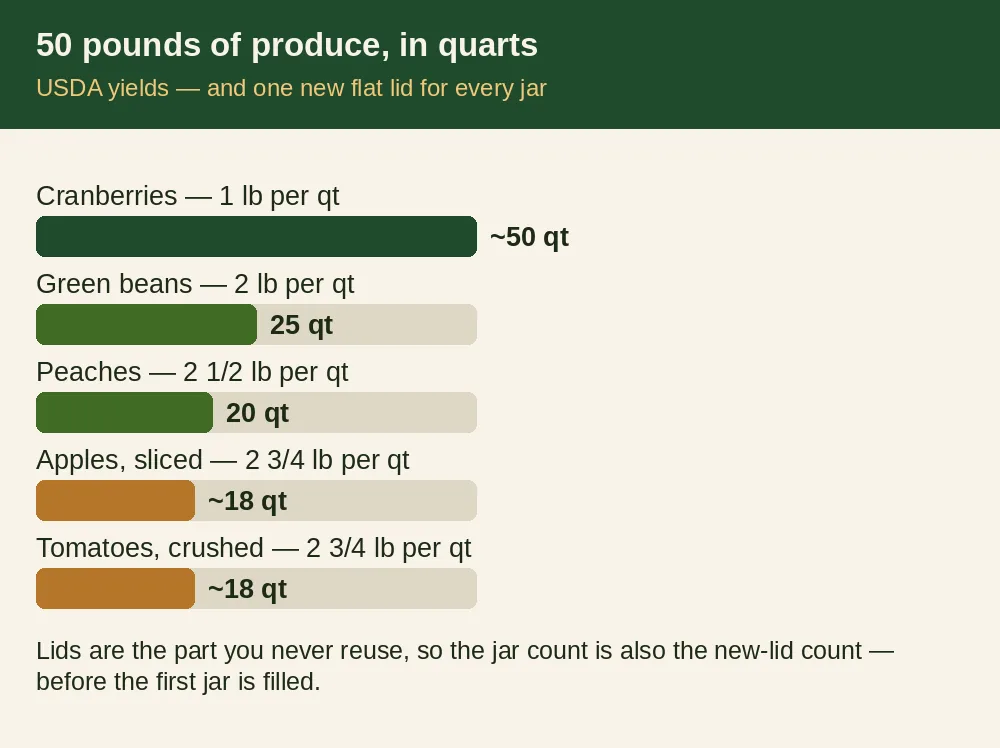
The USDA publishes the yields: about 1 pound of cranberries fills a quart, green beans take 2 pounds per quart, peaches 2½, sliced apples and crushed tomatoes about 2¾. Fifty pounds is therefore roughly 50 quarts of cranberries, 25 of beans, 20 of peaches, 18 of apples or tomatoes — and one new flat lid per jar, because lids are the part you never reuse.
Methods We Will Not Give You — and Why
Can I water-bath green beans if I just do them longer?
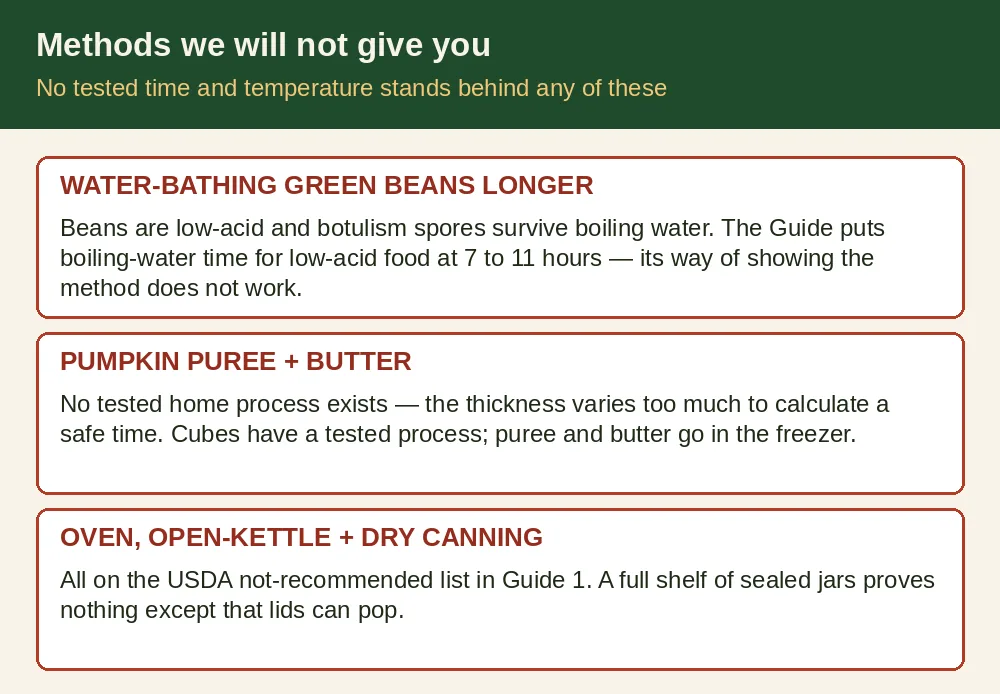
No, and this is the most dangerous question in the canning groups — one thread asking exactly this drew 216 comments, most of them anecdotes. Green beans are low-acid. Botulism spores survive boiling-water temperatures; the USDA Guide puts the boiling-water time for low-acid food at 7 to 11 hours, which is the Guide’s way of showing the method does not work. Pressure canner at 240° to 250°F, or freeze the beans. “My grandmother did it” is a story about luck, not a process.
Can I can pumpkin purée, or pumpkin butter?
There is no tested home process, and NCHFP says so directly: the research needed to establish safe processing times for puréed pumpkin products has not been done — the thickness varies too much from batch to batch for anyone to calculate a time that covers yours. Pumpkin is a low-acid food that can support botulism growth. What does have a tested process is pumpkin in cubes, pressure canned. Purée and butter go in the freezer, which is NCHFP’s own recommendation: make them fresh, refrigerate for short storage, or freeze them.
What about oven canning, open-kettle canning, and dry canning?
All three are on the USDA’s not-recommended list, in Guide 1’s “Equipment and methods not recommended”: open-kettle canning and processing jars in conventional ovens (microwaves and dishwashers are named in the same breath) “do not prevent all risks of spoilage.” Dry canning — jars of dry goods or vegetables baked in an oven with no liquid and no tested process — is oven canning wearing a newer name, and it inherits the same verdict. If a method has no tested time and temperature behind it, a full shelf of sealed jars proves nothing except that lids can pop.
Keep Reading
Canning sits inside the bigger food-storage picture this site covers: what to do when stored food goes wrong is on how to tell if stored food has gone bad, the rest of the pantry questions live in What People Are Asking About Food Storage, and the other way to put a garden glut by — mylar, buckets, and oxygen absorbers — is in our mylar bag guide. If a canning question you have is not on this page, the two sources behind every answer here are the USDA Complete Guide to Home Canning, Guide 1 (PDF) and the National Center for Home Food Preservation — check them before you check a comment thread.