
Affiliate Disclosure: Truly Preserved is reader-supported. When you buy through links on this page, we may earn a commission at no extra cost to you. As an Amazon Associate, Truly Preserved earns from qualifying purchases. Read our full affiliate disclosure.
Last updated: November 1, 2026
THE SHORT ANSWER
That white, filmy cloudiness on used jars is usually mineral scale from hard water, and the USDA’s fix is a soak, not a scrub: several hours in 1 cup of vinegar (5 percent acidity) per gallon of water, before you wash the jars. Boiling the jars in vinegar water often isn’t enough contact time, which is why yours still look dirty. If the film survives the soak, the jar isn’t automatically done — what retires a jar from canning is damage to the sealing surface: chips, nicks, and cracks you can feel with a fingertip around the rim.
The question that started this page drew 870 comments in a canning group: “I was given old jars that were dirty… boiled them in vinegar water and they still look dirty/cloudy. What should I use or do to clean them?” It is the single most-answered jar question on the internet, and most of the answers are folklore. This page sticks to what the USDA Complete Guide to Home Canning and the National Center for Home Food Preservation (NCHFP) actually say — because with canning, the difference between “looks clean” and “seals safely” is the whole game.
What the cloudiness actually is
The USDA Guide names it directly, in Guide 1 (Principles of Home Canning), under “Jar cleaning and preparation”: some used jars carry “a white film on the exterior surface caused by mineral deposits.” The same passage calls it “scale or hard-water film.” If your water is hard — well water especially — every boil, wash, and canner load lays down a little more of it, and a gifted box of jars from somebody else’s pantry can arrive wearing years of it.
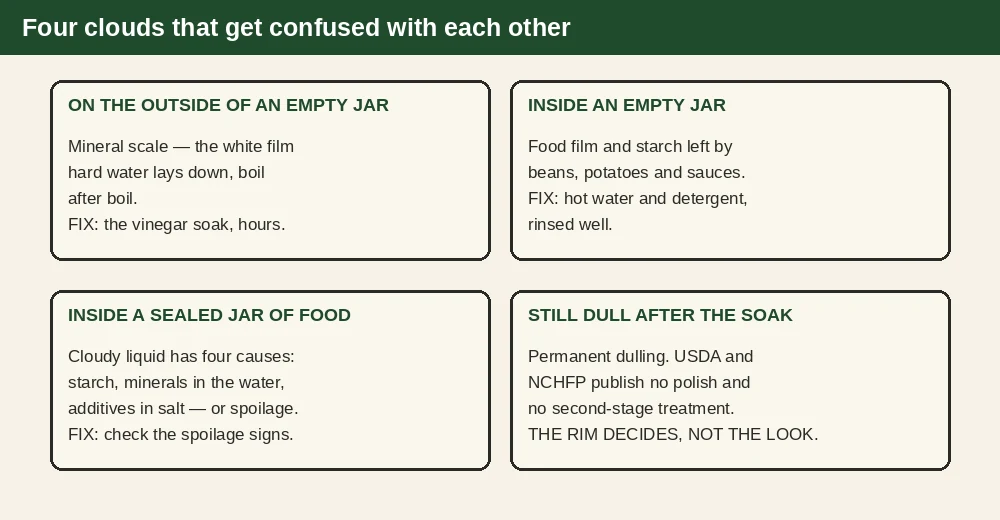
Three other things get confused with that film, and they matter because the fixes differ:
- Food film and starch. Jars that held beans, potatoes, or sauces can carry a dull residue inside that is just dried food. Hot water and detergent take it off — the USDA’s standard jar wash is hot water with detergent, rinsed well, by hand or in a dishwasher. Unrinsed detergent, the Guide warns, can cause unnatural flavors and colors in the next batch, so rinse like you mean it.
- Cloudiness inside a jar of finished food. That is a different problem from film on an empty jar. NCHFP’s “Causes and Possible Solutions for Problems with Canned Food” lists four causes of cloudy liquid: starch in the vegetables (use produce at the right stage of maturity, not overmature), minerals in the water (use soft water), additives in salt (use plain pickling or canning salt), and spoilage. Three of the four are harmless. The fourth is why cloudy liquid gets checked against the spoilage signs on our did-I-ruin-it page before anyone eats it.
- Permanent dulling that no soak touches. Here is the honest limit of the guidance: USDA and NCHFP publish exactly one remedy for film on jars — the vinegar soak below. They offer no second-stage treatment, no abrasive routine, no product. If a jar stays dull after the soak and a proper wash, the guidance gives you no way to polish it back, and we are not going to invent one. What decides that jar’s future is not how it looks. It is the inspection in the next section but one.
The USDA vinegar soak, exactly as published
From Guide 1, “Jar cleaning and preparation,” and repeated on NCHFP’s “Recommended Jars and Lids” page: scale or hard-water films “are easily removed by soaking jars several hours in a solution containing 1 cup of vinegar (5 percent acidity) per gallon of water.” Note the two details the group thread kept missing:
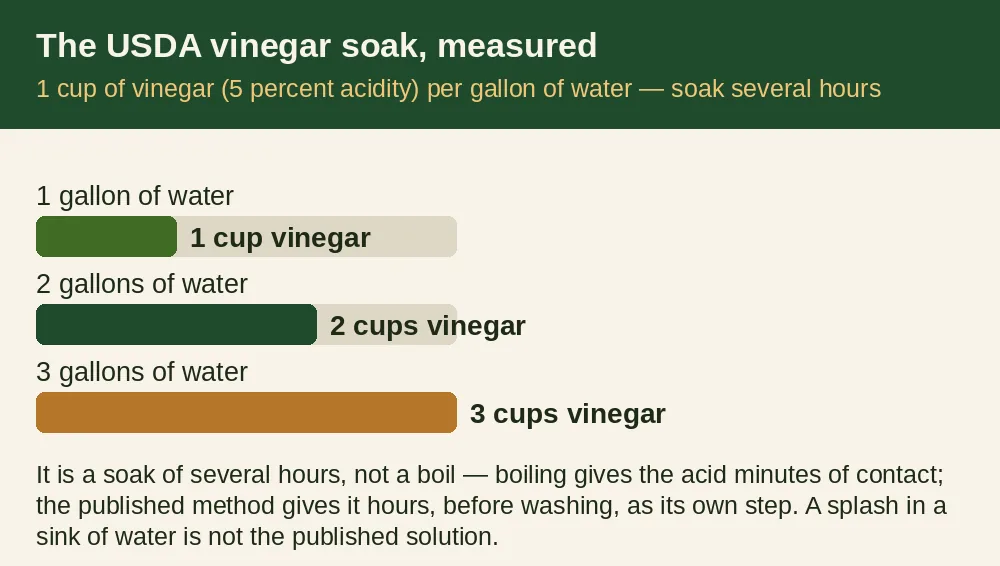
- It is a soak of several hours, not a boil. Boiling jars in vinegar water — the method in the original question — gives the acid minutes of contact. The published method gives it hours, and it happens before washing, as its own step.
- The ratio is 1 cup per gallon. A splash in a sink of water is not the published solution. Measure it: a stockpot with two gallons of water takes two cups of standard 5 percent vinegar.
After the soak, wash the jars in hot water with detergent and rinse well, exactly like any canning jar before use. Keep them hot until filling — the Guide’s method is to hold clean jars in simmering water (180°F) or in a closed dishwasher after a full cycle. One more thing the soak is not: it does not sterilize anything. The Guide says plainly that washing methods do not sterilize jars. Sterilizing is a separate step, and it is only needed for jams, jellies, and pickled products processed less than 10 minutes; jars for pressure-canned foods and for anything processed 10 minutes or longer in a water bath do not need pre-sterilizing at all.
The inspection that actually decides whether a jar cans again
A cloudy jar with a perfect rim is a canning jar. A sparkling jar with a nicked rim is not. The USDA’s test is a fingertip, not an eyeball. From Guide 1, “Reprocessing unsealed jars” — the same check applies before any reuse: check the jar-sealing surface for tiny nicks, and NCHFP’s seal-failure table says to examine the sealing surface “carefully by observing and carefully rubbing finger around the mouth of the jar.” Chips or cracks in the sealing surface are the first-listed cause of an imperfect seal.
Run the full pass on every gifted or stored jar before it goes in the canner:
- Rim: fingertip around the whole sealing surface. Any chip, nick, or crack you can feel — that jar is done canning. It can hold dry goods on a shelf; it does not go back in a canner.
- Body: cracks anywhere retire the jar, and remember the Guide’s warning about commercial jars: seemingly insignificant scratches can cause cracking and breakage during processing. Mason-type canning jars are the recommended choice; most commercial mayonnaise or salad-dressing jars can be used with new two-piece lids for acid foods only, with more seal failures expected — and they are not recommended for pressure canning at all, because of breakage.
- Bands: rusted, dented, or bent bands cause seal failures. Bands that wash clean and stay true can be reused many times; bands that don’t, get replaced.
- Flat lids: never a reuse question. Mason jars “may be reused many times, requiring only new lids each time.” A flat lid that has already sealed once has done its job; it does not do it twice. The gasket compound in even unused lids works well for at least 5 years from manufacture — buy about a year’s worth at a time, per the Guide, and check every lid for dents, deformities, or gasket gaps before use.
If a batch of gifted jars needs fresh lids to be usable again — and every batch does — the standard is a new flat lid on every jar, every run. Ball regular-mouth lids are the ones most pantries here run; what matters is that they are new, undented, and made for two-piece canning lids, not the brand name on the box.
Keeping the film from coming back
The Guide’s prevention advice is aimed at your water, not your jars. For the liquid inside jars, NCHFP’s fix for mineral cloudiness is soft water. For jars themselves, the soak above is the standing remedy whenever scale builds up — cheap, published, and repeatable every season. NCHFP’s storage guidance adds the end-of-season habit that keeps a jar collection honest: when you put equipment away, inventory your jars, checking for chips and breaks, wash and dry them, and take the ring bands off for storage. Bands left on stored jars rust, and rusted bands are tomorrow’s seal failures.
Where this comes from
Every method and figure on this page comes from the USDA Complete Guide to Home Canning (2015 revision), Guide 1 — Principles of Home Canning, sections “Jar cleaning and preparation,” “Jars and lids,” and “Reprocessing unsealed jars” — and from the National Center for Home Food Preservation pages Recommended Jars and Lids and Causes and Possible Solutions for Problems with Canned Food. We are a research desk: we publish what the tested guidance says, and where the guidance stops — as it does after the vinegar soak — we say so instead of filling the gap with folklore.
Questions people also ask
Can I scrub the film off with a scouring pad or steel wool?
The USDA guidance does not list any abrasive method, and its jar guidance points the other way: scratches weaken glass, and seemingly insignificant scratches may cause cracking and breakage while processing. The published remedy is the vinegar soak — several hours in 1 cup of vinegar (5 percent) per gallon of water — followed by a hot detergent wash.
Does a cloudy jar mean the food inside went bad?
Not by itself, and the two kinds of cloudiness are different problems. Film on the outside of an empty jar is mineral scale — cosmetic. Cloudy liquid inside a sealed jar of food has four causes on NCHFP’s list: starch, minerals in the water, additives in salt, or spoilage. The first three are quality issues. If cloudiness comes with a loose or bulging lid, bubbles, or an off smell, treat it as spoilage and follow the discard rules on our diagnosis page.
Are old jars safe to can in at all?
Yes, if they are Mason-type canning jars and they pass inspection. The USDA Guide says that with careful use and handling, Mason jars may be reused many times, requiring only new lids each time. What ends a jar’s canning life is damage — chips, nicks, or cracks, especially on the sealing surface — not age.
Can I reuse the flat lids if they look fine?
No. The Guide’s system is built on a new flat lid for every jar, every run: the gasket softens and flows to cover the sealing surface during processing, which is a one-time event. Jars and screw bands are the reusable parts. Flat lids are not.
Related questions
- Did I ruin it — is my canning still safe?
- How many jars and lids do I need for 50 pounds of produce?
- How do I tell if stored food has gone bad?
This question sits in What People Are Asking About Canning — the full list of canning questions from real groups and forums, each answered from USDA and NCHFP guidance.
Talk it over with other readers
The Truly Preserved Community on Facebook is where readers compare notes on food storage, water, and backup power — and where your questions help decide what we research next.