
Truly Preserved is reader-supported. If you buy through a link on this page we may earn a commission at no extra cost to you. Nobody pays for placement or scores.
THE SHORT ANSWER
Most batches take 4 to 8 hours of drying — but the clock is the wrong thing to watch. The USDA’s order of work comes first: heat the meat to 160°F (165°F for poultry) before drying, then hold the dehydrator at a steady 130–140°F. Jerky is done when a cooled piece bends and cracks but does not break in two. Thickness, marinade, and humidity move the time by hours in either direction, which is why the bend test — not a timer — decides when it comes out.
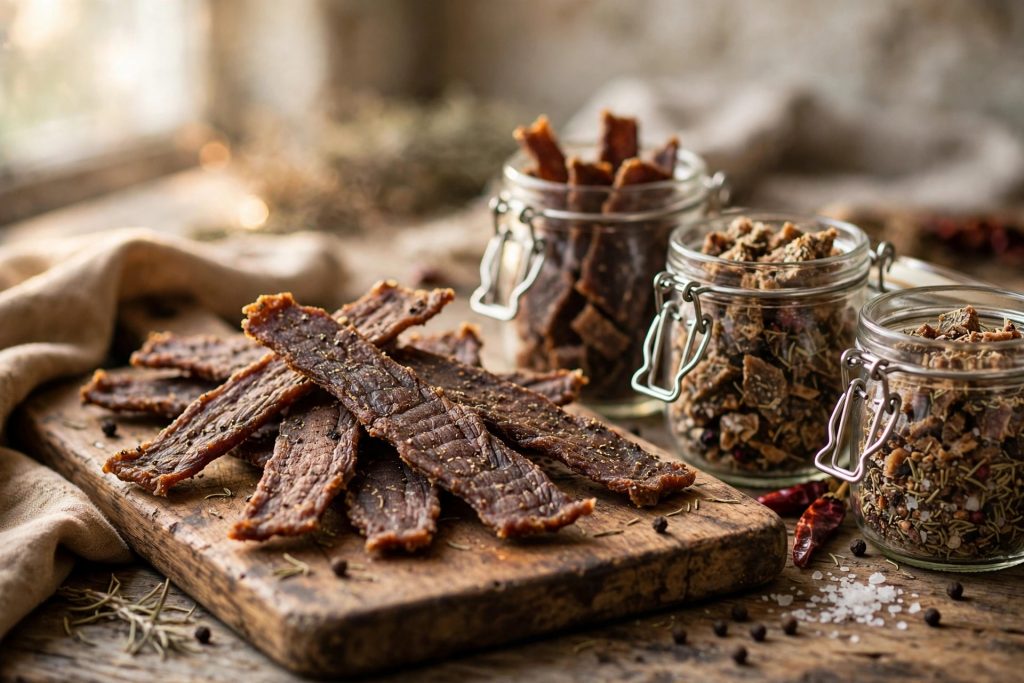
Ask ten jerky makers how long it takes and you get ten answers, because the honest answer is “it depends” — on how thick you sliced, how wet the marinade was, and how much moisture your kitchen air already holds. What does not depend on anything is the safety sequence. The USDA Food Safety and Inspection Service’s fact sheet Jerky and Food Safety is blunt about it: bacteria are likely to survive the dry heat of a dehydrator, so the meat gets heated first, and drying comes second.
We cover the reasoning behind that order in do you have to heat meat before dehydrating jerky? — this page is about the drying itself: how long it runs and how you know it is finished. It sits in our preservation guides next to the rest of the dehydrating shelf, including how to dehydrate peppers and how to dehydrate tomatoes.
What You Need
Three things decide whether this method works: a dehydrator whose thermostat actually holds the drying range, a thermometer that proves the heat step, and even airflow so the batch finishes together.

Excalibur 9-Tray Dehydrator
The 9-tray Excalibur holds a whole batch at once, and its thermostat holds the steady 130–140°F the FSIS method calls for.
Check Availability
ThermoPro Instant-Read Thermometer
The heat step is measured, not guessed — an instant-read thermometer is how you know the strips actually reached 160°F.
$8.99 from Amazon
Cosori Food Dehydrator, 6 Stainless Trays
The Cosori's stainless trays and even airflow keep one tray from finishing hours ahead of another.
$135.99 from AmazonBefore You Start: Step One Is Not Drying — It Is Heating
Before the dehydrator does anything, the meat reaches 160°F for beef and other red meats, 165°F for poultry, measured with a food thermometer. The practical ways to do it: steam the strips, roast them, or heat them in the marinade itself. The reason drying alone cannot be trusted is physics — as moisture evaporates off the meat’s surface, it cools the surface, so the inside of a strip in a 145°F dehydrator may never actually reach 145°F. In the research FSIS cites, E. coli survived 10 hours of drying at temperatures up to 145°F. The heat step is a few minutes of work that removes the entire question.
There is an approved alternative if you skipped the pre-heat: put the finished jerky on a baking sheet in a preheated 275°F oven for 10 minutes. Either way, one of the two heat steps happens. Then drying begins.
Step by Step
- Slice evenly, about 1/4 inch, and trim the fat. A batch of mixed thicknesses finishes in waves; fat does not dry and is what goes rancid first.
- Heat the strips to temperature — 160°F for beef, 165°F for poultry — in the marinade, by steaming, or by roasting.
- Blot the strips and load the trays. Surface marinade is surface moisture, and every drop of it is drying time.
- Dry at a steady 130–140°F. FSIS is specific that the temperature should not sag below that range during drying.
- Start bend checks an hour before you expect to finish — the test is below.
- Cool completely, then pack airtight. Warm jerky sweats inside a sealed bag, and that moisture undoes the drying.
The Numbers
| Step | The figure |
|---|---|
| Pre-heat, beef and red meats | 160°F internal |
| Pre-heat, poultry | 165°F internal |
| Drying temperature | A steady 130–140°F |
| Drying time at 1/4 inch | 4 to 8 hours for most batches |
| Post-heat alternative | 275°F oven for 10 minutes |
| Home-dried storage (FSIS) | 1 to 2 months, airtight |
Sliced at the standard 1/4 inch, most beef jerky lands in the 4-to-8-hour window. Thinner slices finish sooner; thick-cut strips, sugary marinades, and humid days push toward the long end. Traditional recipes that skip the marinade heat step entirely can run 10 hours and beyond, which is one more reason the modern sequence is better: it is faster and safer. The dehydrators in our best dehydrator for jerky roundup were chosen on exactly the criteria this page uses: a real adjustable thermostat that holds the 130–140°F range, and even airflow so one tray does not finish hours ahead of another. For the cure side of jerky — when curing salt enters the recipe and how it is dosed — see the companion guide, how to cure jerky safely.

Nesco Snackmaster Pro Dehydrator
The round-tray Nesco is the budget way into jerky — its thermostat range covers the 130–140°F drying window this method runs on.
$64.39 from Amazon
ThermoPro TP49 Hygrometer
A hygrometer on the counter explains the slow days — humid kitchen air stretches every drying window on this page.
$8.54 from AmazonThe Bend Test Decides
Start checking an hour before you expect the batch to finish. Take one piece out and let it cool for a few minutes — warm jerky bends like leather no matter how dry it is, and judging it hot is how batches get over-dried. Then bend the cooled piece. Done jerky cracks but does not break: the surface splits and fibers show, but the piece holds together. If it bends without cracking, it is still wet inside — back it goes. If it snaps cleanly in two, it went too far; it is still edible and keeps fine, it is just tougher to chew.
There should be no visible moisture when you squeeze a cut edge between paper towels, and no soft, undercooked-looking spots anywhere. When the test piece passes, the batch comes out — pieces a little thicker than the test piece get sorted and checked individually.
Common Mistakes
- Judging jerky while it is warm. Warm jerky bends like leather at any dryness. Cool the test piece first, every time.
- Skipping the heat step because the dehydrator “gets hot enough.” Evaporation cools the meat’s surface below the air temperature — that gap is the whole reason FSIS puts heating first.
- Mixed slice thicknesses. The thin pieces over-dry while the thick ones are still wet inside. Even cuts are the whole secret.
- Drying too long. Past the bend test, jerky turns brittle, then woody, and the flavor flattens. It stays safe and keeps just as long — chop it for soups and stews and call it a save.
Cooling, and How Long Home-Dried Jerky Keeps
Let the jerky cool completely, then pack it airtight. FSIS gives home-dried jerky 1 to 2 months of storage — far shorter than the 12 months for commercially packaged jerky, because home drying leaves more moisture behind. Refrigerating or freezing stretches that window, and vacuum sealing helps too, but home jerky is a make-it-and-eat-it food, not a years-long storage food. If long keeping is the goal, that is freeze-drying’s territory. Within its two months, keep it in a sealed container somewhere cool, and discard any piece that shows mold or smells off.
Viewers also searched for these items.

Nesco VS-12 Vacuum Sealer
Vacuum sealing is how a 1-to-2-month food becomes a freezer staple — portion the batch the day it cools.
$108.18 from Amazon
Etekcity Digital Kitchen Scale
Weighing portions keeps bags honest — and a scale is how a marinade recipe repeats exactly next batch.
$9.99 from Amazon
Metronic 8-Inch Impulse Sealer
The impulse sealer closes mylar bags of jerky for the pantry shelf — a heat seal that holds.
$39.99 from AmazonQuestions People Ask
How long does beef jerky take to dehydrate?
Typically 4 to 8 hours at a steady 130–140°F after the meat has been heated to 160°F, for slices about 1/4 inch thick. Judge by the bend test — a cooled piece should crack without breaking — rather than by the clock alone.
What temperature should a dehydrator be set to for jerky?
FSIS calls for a constant 130–140°F during drying, after the pre-heat to 160°F (165°F for poultry). Many home dehydrators are run at their jerky setting around 145–160°F, which also works — what matters is the pre-heat and a temperature that does not sag.
My dehydrator only goes to 158°F or has no thermostat. Can I still make jerky?
A fixed high temperature dries jerky, but you lose control of the process and the texture suffers. The bigger problem is a dehydrator with no thermostat at all that cannot prove it holds 130–140°F. The pre-heat step matters even more with basic machines — do the 160°F heat step in the oven or marinade, and treat the dehydrator as drying-only.
Does jerky need to cure with nitrites?
Home jerky made with the heat step does not require curing salts for safety. Cures are used commercially for color, flavor, and an extra margin in long storage. If a recipe calls for cure, follow its amounts exactly — it is measured in fractions of a teaspoon for a reason. How to use curing salt safely works through the dosing discipline.
Why is my jerky greasy?
Fat. Fat does not dry, and it is also what goes rancid first. Start with lean cuts, trim every visible piece of fat before slicing, and blot finished jerky with paper towels. Fatty jerky should be eaten first and stored in the fridge.
How long does homemade jerky keep?
One to two months stored airtight, per FSIS — much shorter than commercial jerky’s 12 months. Refrigeration and freezing extend it. Mold or an off smell at any point means it goes.
Temperatures and times on this page follow USDA Food Safety and Inspection Service jerky guidance — the Jerky and Food Safety fact sheet, linked above.
Prices shown on this page were last checked November 26, 2026 — prices change; check before you buy.
Talk it over with other readers
The Truly Preserved Community on Facebook is where readers compare notes on food storage, water, and backup power — and where your questions help decide what we research next.