
Truly Preserved is reader-supported. If you buy through a link on this page we may earn a commission at no extra cost to you. Nobody pays for placement or scores.
THE SHORT ANSWER
Kimchi is salted Napa cabbage rubbed with a seasoned paste and left to ferment: this tested recipe starts with 2 medium heads of Napa cabbage (about 6 to 8 pounds total) and 1 1/2 cups of coarse non-iodized salt, divided. The salted cabbage rests 3 to 6 hours, gets rinsed 3 to 4 times, and is mixed with the paste. Ferment it 1 to 2 days at room temperature — around 68 degrees F is ideal — or 3 to 4 days in the refrigerator, and eat it only once it reaches a pH of 4.6 or below. Keep it refrigerated and eat it within 2 weeks for best quality. Every figure on this page comes from the tested source credited at the bottom.
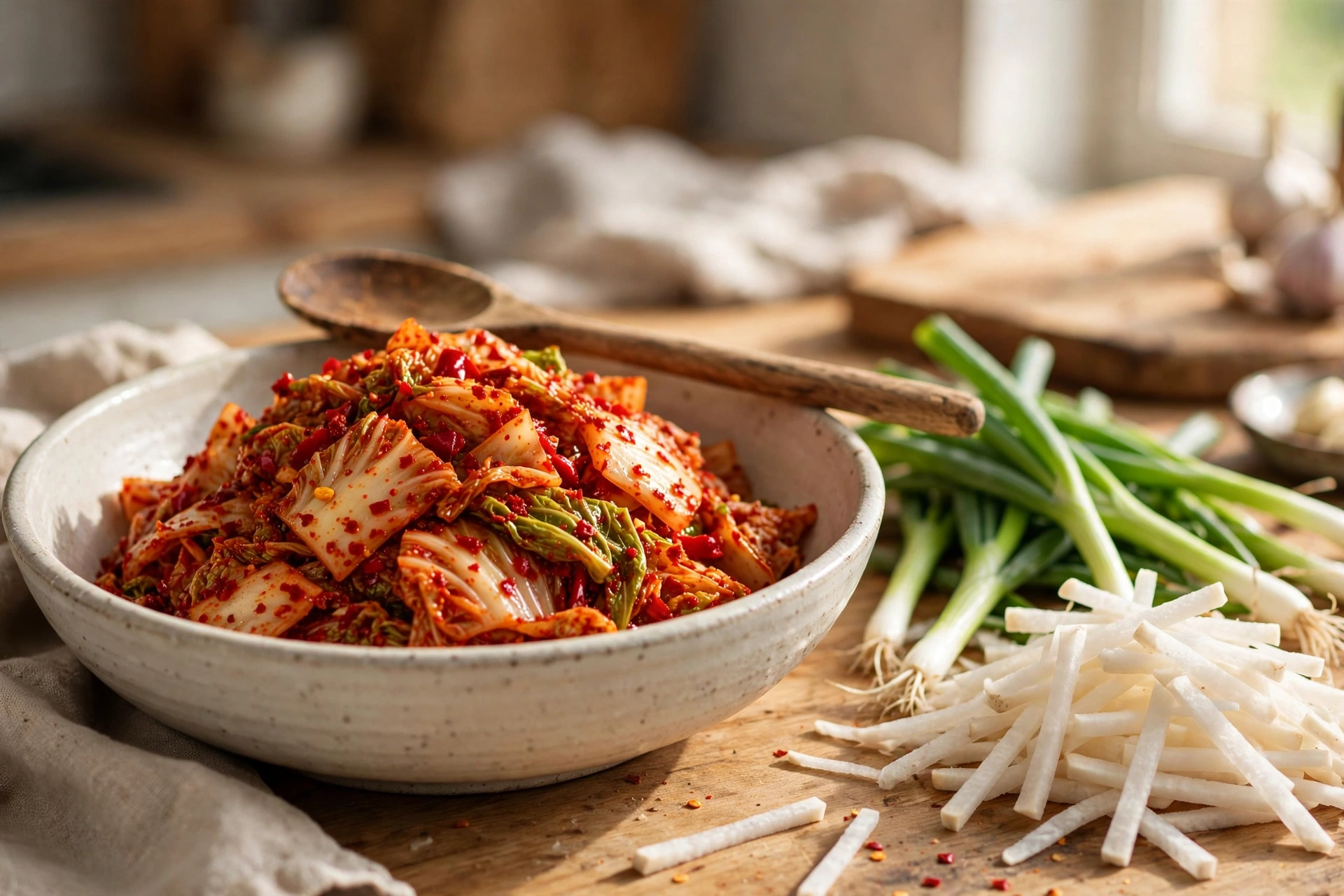
Kimchi is the fast ferment. Where our flagship sauerkraut takes weeks, Colorado State University Extension describes kimchi fermenting at room temperature in only 1 to 2 days. It is also the most varied: more than 200 variations exist, built classically on Napa cabbage, radishes, green onions, garlic, and ginger with a specific red pepper. The recipe below is the Extension’s chopped-cabbage baechu style, printed with its own quantities and its own safety check — a pH reading, not a guess.
This guide is part of our preservation guides, where every procedure comes from a tested source and the numbers are that source’s numbers. Season matters here more than in most ferments: the source notes that in summer Napa cabbage may be softer and ferment faster, while in winter it may be firmer and need more time.
What You Need
2 medium heads of Napa cabbage (about 6 to 8 pounds total); 1 1/2 cups of coarse salt, non-iodized, divided (sea salt recommended); 1 gallon plus 1/2 cup of cold water, divided; 2 tablespoons of sweet rice flour; 1 to 10 cloves of garlic, depending on taste preference; about 3 slices of fresh ginger root (about 0.2 to 0.4 ounces); 1 cup of Korean red pepper powder specific for kimchi; 1/2 Korean radish (about 1 to 1.5 pounds), or daikon radish; 1 Asian pear (optional); 10 green onions; 1 teaspoon of fish sauce (optional); and 2 teaspoons of finely ground salt (optional, as needed). For containers, the source calls for a food-safe glass or plastic container with a tight-fitting lid, big enough to hold 2 cabbages — and no metal containers, and no earthenware with cracks or chips.

Morton Canning and Pickling Salt, 4 lb
The recipe salts with coarse non-iodized salt in two measured steps totaling 1 1/2 cups, and a canning and pickling salt is the non-iodized salt this shelf stocks for exactly that job.
$2.68 from Amazon
Ball Half-Pint Mason Jars, 12-Pack
The procedure packs kimchi into glass mason jars with bands and lids and fills them about 2/3 full; this half-pint case covers a full 6 to 8 pound cabbage batch in small jars.
Check Availability
Etekcity Digital Kitchen Scale
The recipe is written for about 6 to 8 pounds of cabbage, and a kitchen scale is how you know the heads you bought actually land in that range before salting.
$9.99 from AmazonBefore You Start
Sanitation carries this recipe. The source directs proper hand washing and clean equipment, utensils, and surfaces throughout all preparation steps, because contamination by spoilage or harmful microorganisms is the risk the whole method works against. Two more source rules: the cultures needed are already present on the raw ingredients, so a starter culture is unnecessary — do not add one and expect it to fix anything — and the finished kimchi is judged by pH. For safety, kimchi should reach a pH of 4.6 or below before consuming, verified with a pH test strip; the source recommends a strip with a test range of 0 to 6, with increments of 0.5. The optimum kimchi pH, once the organic acids form, is 4.2.
How to Make Kimchi, Step by Step
- Prepare the cabbage. Rinse the heads under cold water and drain. Cut away and discard any spoiled or damaged spots. Cut the cabbage into four quarters, remove the core from each, and chop the quarters into 2-inch pieces.
- Dip in salt water. Prepare a saltwater solution of 1/2 cup of coarse, non-iodized salt and 1 gallon of cold water in a large mixing bowl. Dip the cabbage pieces briefly in the solution, then discard the saltwater solution.
- Salt and rest. Drain the cabbage and place it in a bowl. Sprinkle 1 cup of coarse, non-iodized salt over the cut cabbage and massage it in well. Allow the cabbage to sit covered at room temperature for 3 to 6 hours — a longer time will make it more salty.
- Rinse and drain. Rinse the cabbage pieces 3 to 4 times with cold water to rinse away the salt, then place them in a colander to drain out excess water for at least 30 minutes.
- Make the paste. Add the sweet rice flour to 1/2 cup of water in a small saucepan, bring to a boil, and set aside to cool. Finely mince the garlic and ginger, mix them with the cooled paste, and add the Korean red pepper powder.
- Cut the vegetables. Clean and peel the radish, clean and trim the green onions, and peel the Asian pear if using. Slice all julienne style, or into matchsticks about 1 inch in length.
- Combine. Wearing disposable food handler gloves, mix the seasoning paste and the julienned vegetables together, then mix in the fish sauce to create a spicy veggie paste, adding salt only as needed. Combine the cabbage with the paste, rub together, and mix thoroughly.
- Pack. Pack the kimchi tightly into the container, minimizing air exposure. Fill the container about 2/3 of the way full, because the fermenting microorganisms release carbon dioxide and create bubbling and fizzing. Cover tightly; if using jars, do not over-tighten the lid, so the gases can escape.
- Ferment. Either refrigerate it to ferment slowly over 3 to 4 days, or hold it at a relatively constant room temperature — around 68 degrees F is ideal — for 1 to 2 days, testing daily until a pH of 4.6 or below is reached. Use a pH test strip that can test a range of 3.0 to 5.5 pH.
The Numbers: Salt, Temperature, and Time
| Figure | Tested value |
|---|---|
| Final salt concentration | 2 to 5 percent |
| Salt in the recipe | 1 1/2 cups coarse non-iodized salt, divided (1/2 cup in the dip, 1 cup on the cabbage) |
| Salted cabbage rest | 3 to 6 hours at room temperature |
| Fermentation temperature, room option | Around 68 degrees F |
| Fermentation time, room temperature | 1 to 2 days |
| Fermentation time, refrigerated | 3 to 4 days (around 3 to 4 days while in refrigeration) |
| Safety pH before eating | 4.6 or below |
| Optimum kimchi pH | 4.2 |
| Best-quality refrigerated life | Eat within 2 weeks |
Kimchi that outruns the household’s appetite freezes for cooked dishes later, and these are the two tools that side of the job runs on.

Ball Regular Mouth Lids (96)
Canning fully fermented pickles assumes fresh lids when the procedure says to adjust lids and process; a new flat on every jar is how the seal forms.
$36.99 from Amazon
Ziploc Freezer Quart Bags
Quart freezer bags are the simple backup for portioning leftover kimchi and salted vegetables that need to move to the freezer quickly.
$26.48 from AmazonCommon Mistakes
Eating it before the pH check. The source’s safety line is a number, not a day count: kimchi should reach a pH of 4.6 or below before consuming. A batch that tastes sour but has not been tested has not finished its safety step.
Filling the container to the top. The procedure fills it about 2/3 of the way full because the ferment releases carbon dioxide. A brim-full jar overflows or blows its lid loose.
Using a metal or damaged container. The equipment list excludes metal containers and earthenware with cracks or chips. Glass or food-safe plastic with a tight-fitting lid is what the recipe assumes.
Skipping the rinses. Three to four rinses after the salt rest are what bring the cabbage back from the salting step to the recipe’s final salt concentration of 2 to 5 percent. Unrinsed cabbage stays harsh and can stall the ferment.
Letting it age past its quality window. For best quality the source says to eat kimchi within 2 weeks, and notes that kimchi may become more sour over time. If surface mold appears in storage, discard it — that instruction is in the source’s storage step, and our troubleshooting ferments guide covers the same ground.
Storage and Shelf Life
Store fermented kimchi covered tightly in the refrigerator, kept pressed down to minimize air exposure. It will keep souring slowly in the cold, so the flavor moves even after fermentation ends. For best quality, eat it within 2 weeks. Discard the batch if you observe indications of surface mold.
Viewers also searched for these items.

SOLIGT Glass Fermentation Weights, 4-Pack
A glass weight keeps the packed kimchi pressed down in its container, which is the storage position the source specifies to minimize air exposure.
$11.99 from Amazon
ThermoPro TP49 Hygrometer
The room-temperature option ferments around 68 degrees F, and a room hygrometer with a temperature readout is how you know the corner you picked actually holds there.
$8.54 from Amazon
Mrs. Wages Pickling and Canning Salt
A second bag of pickling salt keeps the non-iodized salt this recipe divides across two steps on hand, so the next batch is not improvised with iodized table salt.
$19.32 from AmazonFrequently Asked Questions
Do I need a starter culture for kimchi?
No. The source states that the bacterial cultures needed for fermentation are present on the raw ingredients, so a starter culture is unnecessary.
How do I know kimchi is safe to eat?
Test it. Kimchi should reach a pH of 4.6 or below before consuming, verified with a pH test strip — the source recommends a range of 0 to 6 with increments of 0.5 for the check, and a 3.0 to 5.5 range strip for the fermentation test.
Room temperature or refrigerator — which ferment is better?
Both are in the procedure: 1 to 2 days at room temperature, around 68 degrees F, or 3 to 4 days refrigerated, which the source says may be preferred especially during hot weather.
How long does kimchi keep?
For best quality, keep it refrigerated and eat it within 2 weeks. It grows more sour over time, and any sign of surface mold means discard it.
Procedure, quantities, salt concentration, fermentation temperatures and times, and pH guidance: Colorado State University Extension, “Understanding and Making Kimchi,” via Colorado State University Extension.
Prices shown on this page were last checked November 26, 2026 — prices change; check before you buy.
Talk it over with other readers
The Truly Preserved Community on Facebook is where readers compare notes on food storage, water, and backup power — and where your questions help decide what we research next.