
Truly Preserved is reader-supported. If you buy through a link on this page we may earn a commission at no extra cost to you. Nobody pays for placement or scores.
THE SHORT ANSWER
Fermented hot sauce is peppers held under a salt brine until the brine turns safely acidic: University of Minnesota Extension lists peppers for sauce among the produce that takes a wet brine, at 1 to 3 tablespoons of salt per quart of water for most vegetables, and Extension brine tables put chopped peppers at a 3 percent brine (2 tablespoons of salt, about 27 grams, per quart of water) and whole or large pieces at 5 percent (3 tablespoons, about 45 grams, per quart). Ferment at 68 to 72 degrees F, keep 1 to 2 inches of brine over the peppers, and blend the sauce only when the pH reads 4.60 or lower and the bubbling has stopped. Every figure on this page comes from the tested sources credited at the bottom.
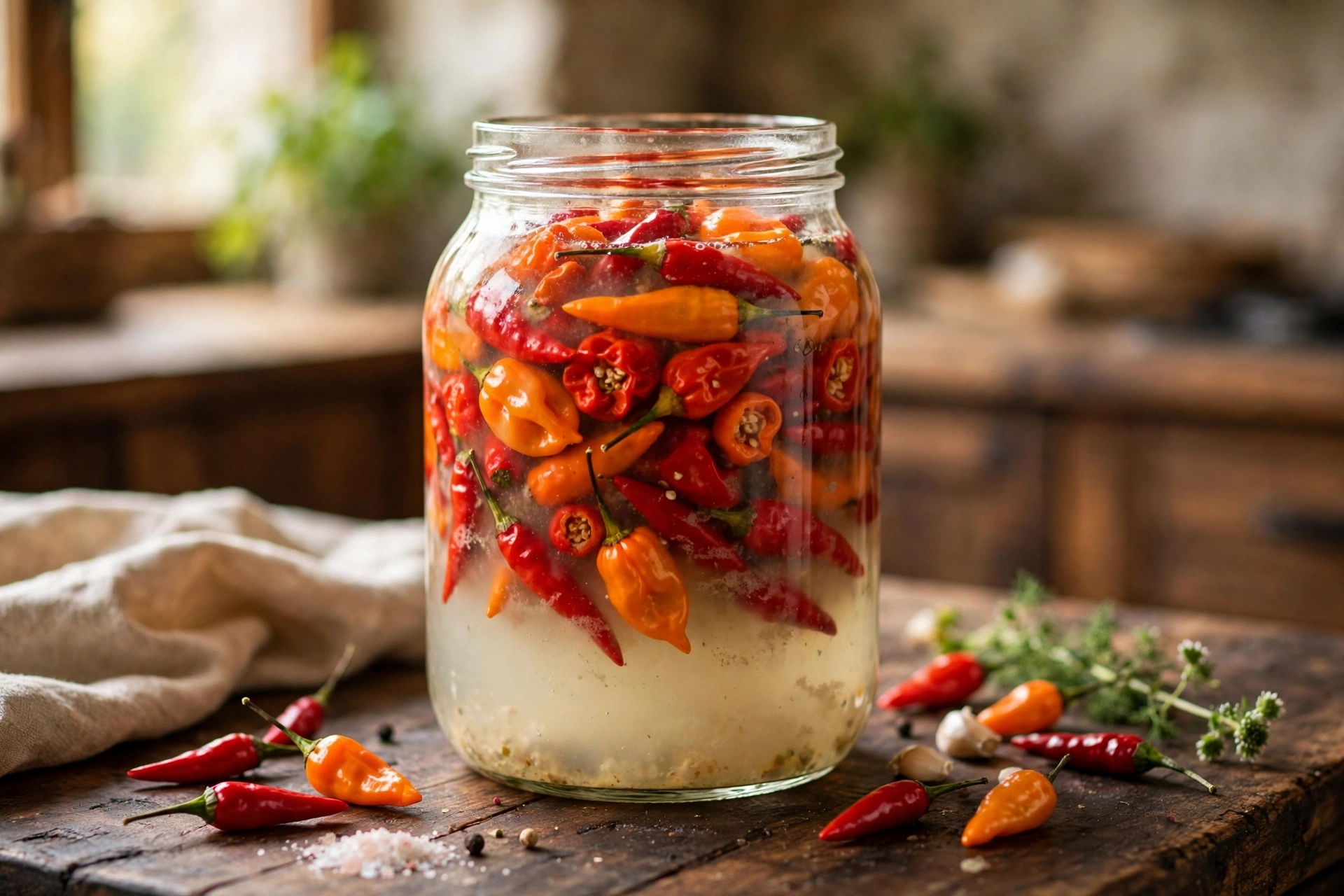
A vinegar hot sauce is finished the day you bottle it. A fermented one is alive for weeks first: the peppers sit under brine while lactic acid bacteria turn their sugars into acid, and the heat that comes out the other side is rounder and deeper than raw peppers ever taste. University of Minnesota Extension names this exact use — its fermentation guide lists peppers for sauce among the produce suited to a wet brine. The method below is that Extension framework, with the brine strengths Extension publishes for chopped versus whole peppers.
This guide is part of our preservation guides. It sits beside the category flagship, how to make sauerkraut, and it follows the same discipline: tested figures, copied exactly, and a pH reading — not a calendar — decides when the ferment is done.
What You Need
Fresh peppers, lightly washed — Minnesota Extension directs you to select fresh produce and wash it lightly to remove visible dirt, without vigorous scrubbing, which can remove the good bacteria the fermentation needs. For the brine: canning or pickling salt, iodine-free, because the source says iodine can interfere with fermentation, and soft or distilled water for the wet brine, because minerals in hard water can discolor produce or cause texture changes. For the container: a fermentation crock, or food-grade plastic, ceramic, or glass — the source says you will need 1 gallon of container volume in its equipment list and to avoid metal containers, because metal will react with the lactic acid the bacteria produce. Mason-style jars need an airlock system to control oxygen and carbon dioxide.

Morton Canning and Pickling Salt, 4 lb
The brine is specified in iodine-free canning or pickling salt, measured by the tablespoon and gram per quart of water, and this is that salt for both the 3 percent and 5 percent brines.
$2.68 from Amazon
SOLIGT Glass Fermentation Weights, 4-Pack
Glass weights hold chopped and halved peppers under the brine's surface for the whole ferment, keeping the 1 to 2 inches of cover the method requires.
$11.99 from Amazon
Ball Half-Pint Mason Jars, 12-Pack
Peppers ferment and the finished sauce stores in glass jars, and this half-pint case covers both the small test batches and the bottled sauce from a full crock.
Check AvailabilityBefore You Start
Minnesota Extension frames fermentation safety as five controls, and all five apply to peppers. Food: fresh produce, lightly washed. Acidity: monitor the acidity throughout the process to ensure a safe pH is reached — no acidifying component such as vinegar or lemon juice is added. Oxygen: an anaerobic, low-oxygen environment is needed for the good bacteria to work. Temperature: between 68 and 72 degrees Fahrenheit is ideal; temperatures over 78 degrees Fahrenheit can cause over-fermentation and spoilage, and temperatures below 60 degrees Fahrenheit will inhibit fermentation. Time: allow enough time for the bacteria to produce enough acid to lower the pH of the food.
How to Make Fermented Hot Sauce, Step by Step
- Prepare the peppers. Wash the produce under cool running water. Do not scrub it, and avoid peeling — the bacteria you need live on the surface. Chop the peppers for a chopped-pepper brine, or halve them for a large-piece brine.
- Make the brine. For chopped peppers, mix a 3 percent brine: 2 tablespoons of salt (about 27 grams) per quart of water. For whole or large pieces, mix a 5 percent brine: 3 tablespoons of salt (about 45 grams) per quart of water. Both sit inside Minnesota Extension’s general wet-brine range of 1 to 3 tablespoons of salt per quart of water for most vegetables, at the strengths its brine tables assign by cut size.
- Pack the container. Place the peppers and brine in the container. Ensure the brine covers the produce, with 1 to 2 inches of brine above the peppers. In a large container or crock, leave 4 to 5 inches of headspace; it should be about 75 percent full. Weigh the peppers down if needed.
- Make the container airtight. Wipe the rim and fit the lid or airlock. If the container has no lid, cover the peppers with a plate or tray weighed down with a bag of brine, so a leak adds brine rather than air.
- Store it dark and steady. Containers of fermenting produce are stored in a dark place, because the bacteria are sensitive to light; cover the container with a dark towel if needed. Hold it at 68 to 72 degrees Fahrenheit and measure the air temperature with a thermometer.
- Monitor. Minnesota Extension’s general produce ferment runs 3 to 4 weeks, or 5 to 6 weeks if temperatures are below 68 degrees Fahrenheit. Burp the container if needed — crack the lid briefly to let built-up carbon dioxide escape, keeping the opening brief to limit oxygen entering. Test the pH of the brine throughout fermentation.
- Finish on the pH reading. When a pH of 4.60 or lower is reached and bubbling has stopped, the ferment is ready. If bubbling has stopped but the pH is still above 4.60, continue to ferment and check the pH every 1 to 2 days.
- Blend the sauce. Blend the finished peppers with their brine to the texture you want, and refrigerate the sauce. Refrigeration stops the fermentation process.
The Numbers: Brine, Temperature, and Time
| Figure | Tested value |
|---|---|
| Wet brine, general range | 1 to 3 tablespoons of salt per 1 quart (4 cups) of water |
| Brine for chopped peppers | 3 percent — 2 tablespoons of salt (about 27 grams) per quart of water |
| Brine for whole or large pieces | 5 percent — 3 tablespoons of salt (about 45 grams) per quart of water |
| Brine cover over produce | 1 to 2 inches of brine above the produce |
| Fermentation temperature | 68 to 72 degrees Fahrenheit ideal; over 78 degrees risks spoilage; below 60 degrees inhibits fermentation |
| Fermentation time, general produce method | 3 to 4 weeks; 5 to 6 weeks below 68 degrees Fahrenheit |
| Finish test | pH of 4.60 or lower, and bubbling stopped |
| Refrigerated storage, finished ferment | Up to 9 months |
One honest limit, stated plainly: no Extension source we found publishes a tested recipe for pepper mash by name, with its own day count. This guide therefore uses the brined-pepper method Extension does publish, and the pH test — not a mash tradition — decides when it is done. If your peppers never reach a pH of 4.60 or lower, the troubleshooting criteria in troubleshooting ferments apply.
Finished sauce keeps in the refrigerator, and the pepper overflow from a big harvest freezes for the next batch — these are the two tools that side of the job runs on.

Ball Regular Mouth Lids (96)
Canning fully fermented pickles assumes fresh lids when the procedure says to adjust lids and process; a new flat on every jar is how the seal forms.
$36.99 from Amazon
Ziploc Freezer Quart Bags
Quart freezer bags are the simple backup for portioning finished sauce and frozen peppers that need to move to cold storage quickly.
$26.48 from AmazonCommon Mistakes
Scrubbing the peppers clean. The source says not to scrub, because scrubbing can remove the good bacteria needed for fermentation. A light wash to remove visible dirt is the instruction.
Guessing the salt by the spoonful for a different salt. The brine is specified in canning or pickling salt, iodine-free. If there is too much salt in the brine, Minnesota Extension notes, fermentation will not occur and the pH will not drop — the brine strengths above are the recipe, not a starting point for improvisation.
Letting peppers float. The brine must cover the produce by 1 to 2 inches for the whole ferment. Peppers at the surface meet oxygen, and the good bacteria need a low-oxygen environment.
Fermenting hot. Over 78 degrees Fahrenheit can cause over-fermentation and spoilage. A sunny windowsill is the opposite of the dark, steady 68 to 72 degrees the method calls for.
Blending on a schedule instead of a reading. The finish line is a pH of 4.60 or lower with bubbling stopped. Sauce blended before that test passes is sauce finished early, whatever the calendar says.
Storage and Shelf Life
Refrigeration stops the fermentation process, and Minnesota Extension puts refrigerated fermented produce at up to 9 months. Freezing also stops fermentation, and fermented produce can be stored in the freezer indefinitely, though produce may lose crisp texture on thawing — for a blended sauce, that trade costs nothing. Keep the sauce cold, covered, and dated.
Viewers also searched for these items.

Etekcity Digital Kitchen Scale
The brine tables give salt in grams as well as spoonfuls — about 27 grams and about 45 grams per quart — and a kitchen scale is how those weights get measured exactly.
$9.99 from Amazon
ThermoPro TP49 Hygrometer
The ferment holds at 68 to 72 degrees Fahrenheit, and a room unit with a temperature readout is how you know the dark corner you picked actually stays in that band.
$8.54 from Amazon
ThermoPro Instant-Read Thermometer
A thermometer measures the air temperature around the ferment, which is the check the method itself names for holding the ideal range.
$8.99 from AmazonFrequently Asked Questions
How much salt goes in fermented hot sauce?
By the Extension brine tables: a 3 percent brine for chopped peppers (2 tablespoons of salt, about 27 grams, per quart of water) and 5 percent for whole or large pieces (3 tablespoons, about 45 grams, per quart). Minnesota Extension’s general wet-brine range for most vegetables is 1 to 3 tablespoons of salt per quart of water.
What temperature should peppers ferment at?
Between 68 and 72 degrees Fahrenheit is ideal. Over 78 degrees can cause over-fermentation and spoilage; below 60 degrees will inhibit fermentation.
How do I know the sauce is done?
When a pH of 4.60 or lower is reached and bubbling has stopped. If bubbling stops while the pH is still above 4.60, keep fermenting and check the pH every 1 to 2 days.
Can I add vinegar to help it along?
The method adds none. Minnesota Extension states that an acidifying component such as vinegar or lemon juice is not added; the acid is produced by the bacteria as they use the carbohydrates in the peppers.
Procedure, brine range, temperatures, and pH finish test: University of Minnesota Extension, “Preserving food at home: Fermentation,” via UMN Extension; brine strengths by cut size: University of Illinois Extension / UC Master Food Preserver brine tables (3 percent and 5 percent per quart).
Prices shown on this page were last checked November 26, 2026 — prices change; check before you buy.
Talk it over with other readers
The Truly Preserved Community on Facebook is where readers compare notes on food storage, water, and backup power — and where your questions help decide what we research next.